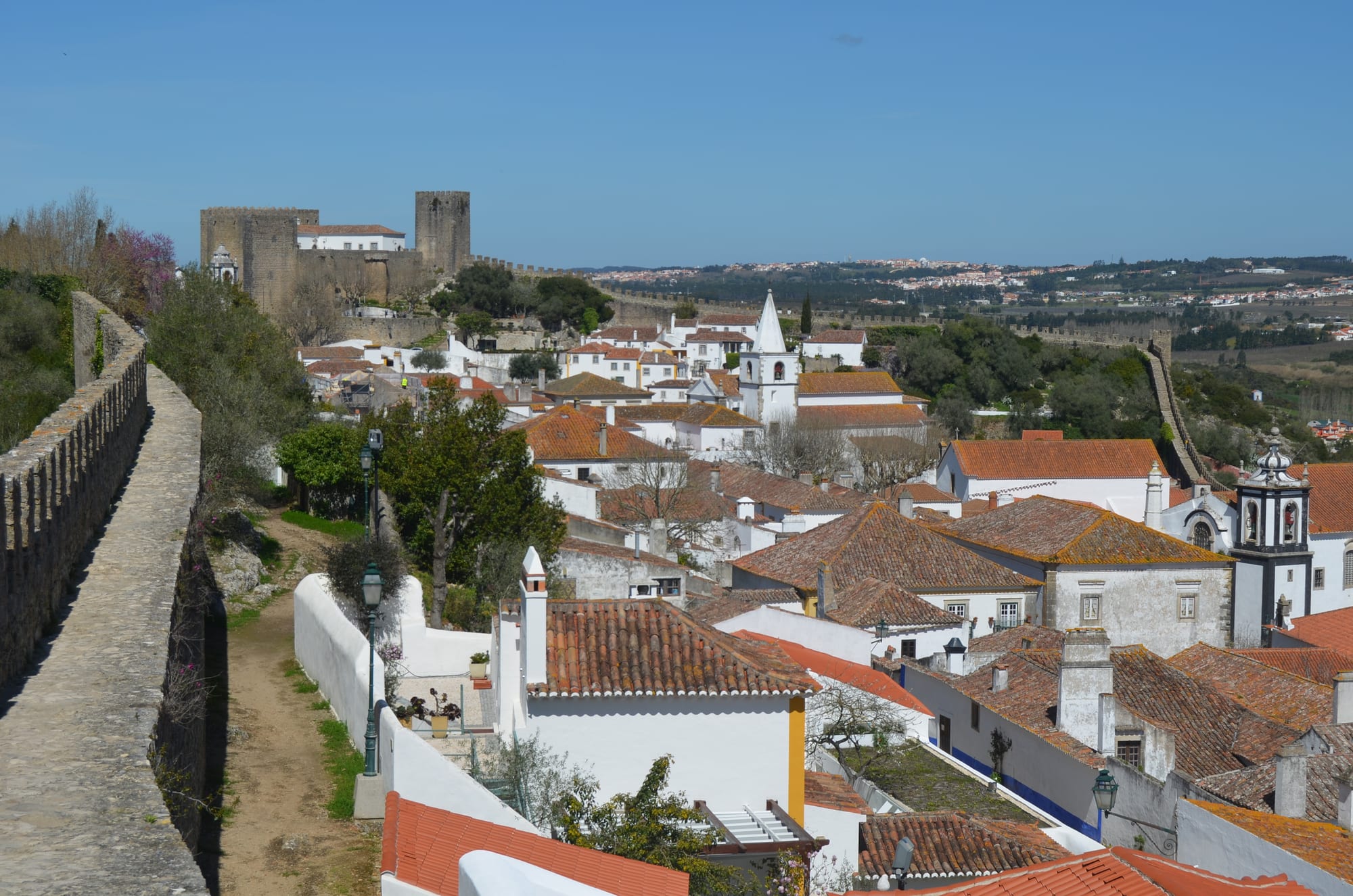
A stone wall walk leading past whitewashed houses with orange roofs towards a castle keep under a clear blue sky

Central Portugal, Portugal

Óbidos

The wall walk above the whitewashed houses of Óbidos, with the castle on the left. (Pedro from Maia (Porto), Portugal / Wikimedia Commons · CC BY 2.0)

A small hilltop town in Portugal's Oeste region, about 88 km north of Lisbon, enclosed by a complete ring of medieval walls around its castle. Long given to the queens of Portugal, it is now a whitewashed town of narrow streets, bookshops and festivals, known for the cherry liqueur ginja served in chocolate cups.

Neighbourhoods

  • Inside the walls
    • First-time visitors
    • Historic district
    • Best for food

    The town within the walls, entered through the tiled Porta da Vila and threaded by the Rua Direita, the main street, from the gate up to the castle. Whitewashed houses, churches, bookshops and ginja sellers fill the lanes, which are crowded by day in summer and quiet in the evening.

    Open in Maps
  • Below the walls
    • Quiet and residential
    • Close to public transport

    The newer town outside the gate, where the coaches stop and the 16th-century aqueduct runs in. The pilgrimage church of Senhor Jesus da Pedra stands just to the north-east, and the streets here are calmer and more residential.

    Open in Maps
  • The lagoon and the coast
    • Beaches
    • Nature
    • Watersports

    West of the town the municipality reaches the Atlantic around the Lagoa de Óbidos, a shallow coastal lagoon shared with Caldas da Rainha, with Foz do Arelho at its mouth and golf resorts along the shore.

    Open in Maps

Things to do

The walled town

  • Castle of Óbidoslandmark

    The medieval castle at the northern end of the town, taken from the Moors in 1148 and remodelled by later kings, chosen in 2007 as one of the Seven Wonders of Portugal.

    Open in Maps
  • Wall walktrail

    The crenellated walls run for about 1,565 metres around the whole town, up to 13 metres high in places, and can be walked along the top for views over the roofs and the countryside.

    Open in Maps
  • Porta da Vilalandmark

    The main gate into the walled town, entered through a tiled portico.

    Open in Maps
  • Igreja de Santa Marialandmark

    The main church of the town, dedicated as a Catholic church after the conquest of 1148, where the boy-king Afonso V married his cousin Isabella of Coimbra in 1441.

    Open in Maps
  • Pelourinho de Óbidoslandmark

    The town's pillory, a national monument since 1910, carrying the fishing-net emblem of Queen Leonor.

    Open in Maps
  • Museu Municipal de Óbidosmuseum

    The town museum in the old council house on the Rua Direita, with paintings of the 16th and 17th centuries, notably by André Reinoso and Josefa de Óbidos.

    Open in Maps

Outside the walls

  • Óbidos Aqueductlandmark

    A 16th-century aqueduct about 3 km long, built by Queen Catherine of Austria to carry water from the hills of Usseira to the town's fountains.

    Open in Maps
  • Santuário do Senhor Jesus da Pedralandmark

    A pilgrimage church just north-east of the town, classified as a monument of public interest.

    Open in Maps
  • Eburobrittiumattraction

    The excavated remains of a Roman town, occupied from the 1st century BC to the 5th century AD and then abandoned for the defensible hilltop of Óbidos.

    Open in Maps

Lagoon, coast and nearby towns

  • Lagoa de Óbidospark

    The largest coastal lagoon system on the Portuguese coast, shallow and about 6 km long, designated a protected Ramsar site in 2025.

    Open in Maps
  • Foz do Arelhobeach

    The village at the mouth of the lagoon, where the calm water of the lagoon meets an Atlantic beach.

    Open in Maps
  • Caldas da Rainhaattraction

    The neighbouring city founded around the thermal hospital that Queen Leonor established at its hot springs in the 15th century, with several museums.

    Open in Maps

Seasonal events

  • International Chocolate FestivalMarch

    A festival of chocolate in early spring, with life-size chocolate sculptures and workshops where children make their own chocolates.

  • Medieval FairJuly

    For about two weeks the castle and the town recreate the Middle Ages, with a medieval market inside the walls.

  • FOLIOOctober

    The international literary festival held every year since 2015, created under the town's literature programme; Óbidos was named a UNESCO City of Literature the same year.

  • Vila NatalDecember

    At Christmas the town turns into the 'Vila Natal', a Christmas village of attractions for children and families.

Eat and drink

Long-standing places and food districts in Óbidos. Hours, ratings and directions come from your maps app, always current.

Óbidos classics

  • Ginja de Óbidoscafe

    Sour-cherry liqueur sold along the Rua Direita, commonly served in Óbidos in a small edible chocolate cup.

    Open in Maps

Food streets

  • Restaurants inside the wallsneighborhood

    Taverns, cafés and restaurants line the Rua Direita and the lanes around the main church, from snack bars to sit-down dining rooms.

    Open in Maps
  • Foz do Arelho seafoodneighborhood

    Restaurants at the mouth of the lagoon, a short drive west of the town, beside the beach.

    Open in Maps

Experience Óbidos

History

The name comes from the Latin oppidum, a citadel, by way of the older Celtic Eburobricio. The Roman town of Eburobrittium, mentioned by Pliny the Elder, stood nearby at the edge of a lagoon that then gave access to the ocean; it was occupied from the 1st century BC to the 5th century AD and then abandoned for the more defensible hill where the castle stands. The Moors fortified the hilltop some time after 713, while a Christian Mozarab community lived in the Moncharro neighbourhood, and Afonso Henriques, the first king of Portugal, took the town in 1148, the last stage in the conquest of Estremadura.

Sancho I granted a charter in 1195, and in 1210 Afonso II gave the town to Queen Urraca. From then on Óbidos was often held by the queens of Portugal, who enriched it with donations until the 16th century, earning it the name Vila das Rainhas, the town of the queens. King Dinis remodelled the castle and walls, and the keep was added in the 14th century. In 1441 the Church of Santa Maria saw the wedding of Afonso V and Isabella of Coimbra, aged nine and ten. Manuel I granted a new charter and reorganised the town in 1513, and Queen Catherine of Austria had an aqueduct built to bring water to its fountains.

The earthquake of 1755 damaged the walls, several churches and many buildings, and the Peninsular War brought fighting nearby at Roliça. Restoration of the castle and walls began in 1932, and in 1948 the castle was converted into a pousada. In 1974 the town served as a meeting place for those involved in the Carnation Revolution.

Culture & Customs

Óbidos is above all a preserved medieval town, and its streets, squares, walls and castle are its attraction; in 2007 the castle was voted second among the Seven Wonders of Portugal. The town has turned its past into a calendar of events: a medieval fair in July, when the castle and the streets return to the Middle Ages for two weeks, a chocolate festival in March, and a Christmas village in December.

Books are the newer identity. The town has around 14 bookshops, one of them inside a church and another that sells fish as well as books, and in 2013 the council launched a literature programme that created the FOLIO international literary festival, held each October since 2015. The same year UNESCO named Óbidos a City of Literature in its Creative Cities Network.

Art has older roots. The painter Josefa de Óbidos is among its best-known figures, and her work hangs in the municipal museum alongside paintings by André Reinoso. The town's motto, mui nobre e sempre leal, "very noble and ever loyal", recalls its resistance in a 13th-century succession crisis. Ginja, the sour-cherry liqueur, is part of the town's image, sold from stalls and shops along the main street.

Daily Life

The walled town itself is small — around 3,100 people live in the town proper — and the municipality had about 12,000 inhabitants at the 2021 census, spread across seven parishes of farmland, villages and coast. Caldas da Rainha, the neighbouring city, is the larger centre for shopping, services and work.

Tourism is the town's economy. Visitors come in large numbers in summer and during the festivals, and the shops, cafés, galleries and bookshops inside the walls depend on them. Around the town, the Oeste countryside is farmed, and the municipality's coast near the lagoon has some of Portugal's best-known golf resorts.

The rhythm of the walled town follows the visitors: lanes fill from mid-morning when the coaches arrive and empty again by evening, when the few residents inside the walls have the streets to themselves. Many people live in the newer houses outside the gate and in the villages around, and the lagoon and the beaches at Foz do Arelho draw local families on summer weekends.

Food

The drink of Óbidos is ginja, or ginjinha, a liqueur made by infusing sour Morello cherries in aguardente and adding sugar, most often with cloves and cinnamon. It is typical of several towns in Portugal's Oeste and Lisbon regions, but Óbidos has made it its own by serving it in a small edible chocolate cup. The sour cherries used for the ginja of Óbidos and nearby Alcobaça were put forward for Protected Geographical Indication status in 2013.

Chocolate itself has become a local theme through the International Chocolate Festival each spring, with life-size chocolate sculptures and workshops for children.

Eating out is concentrated in the restaurants and taverns along the Rua Direita and the lanes inside the walls, with more seafood-minded places at Foz do Arelho by the lagoon. The wider region shapes the menu, with Portugal's convent sweets, built on egg yolks and sugar, and fish from the nearby Atlantic coast. In neighbouring Caldas da Rainha, a summer festival each August serves food from each of its parishes.

Planning tools

Budget

Óbidos is expensive for its size in summer, when day-trippers fill the walled town and rooms inside the walls are in short supply. Staying outside the walls or in nearby Caldas da Rainha costs less, and prices rise during the medieval fair and the Christmas village.

Daily Budget Midrange
USD 110–210 (guesthouse or hotel, restaurant dinners, festival tickets, a hire car for the coast)
Daily Budget Shoestring
USD 50–85 (guesthouse, set lunches, coaches and local buses)

Walk the walls and the lanes early or late in the day, when the coach parties have gone; the wall walk and the churches are free to see.

Best Time to Visit

Spring and early autumn are the most comfortable for walking the walls. The chocolate festival brings visitors in March, the medieval fair fills the town in July, the literary festival comes in October and the Christmas village in December. Summer is the busiest season of all.

Suggested Number of Days

Many visitors come for a single day from Lisbon. One night allows the quiet evening hours inside the walls; two or three days take in the lagoon, the coast and neighbouring towns, longer during a festival.

First Visit
1 day
With Surroundings
2–3 days

Transportation

The walled town is entirely on foot, and cars stay outside. A bus service links Óbidos with the surrounding villages, and coaches stop outside the walls. A car is the easiest way to reach the lagoon, Foz do Arelho and the coast.

Wear shoes with grip: the lanes are steep and cobbled, and the wall walk is narrow.

Airport & Station Connections

Óbidos lies 88 km north of Lisbon by the A8 motorway. The frequent express coach from Lisbon's Campo Grande takes about an hour and is the fastest public link; the train on the Linha do Oeste is slower and less frequent, taking two to three hours. Lisbon's Humberto Delgado Airport is the usual gateway.

Walkability

Excellent inside the walls, which can be crossed in a few minutes, though the cobbled lanes climb steeply towards the castle. The wall walk is narrow and high, up to 13 metres above the ground in places, so small children need close watching and anyone unsteady on heights may prefer the streets.

Safety

Portugal is one of the safest countries in Europe, with low violent crime. Óbidos is a small and quiet town. The main risks are falls from the high wall walk and on the steep cobbles, and pickpocketing in the summer crowds on the Rua Direita.

Keep children close on the walls and watch bags in the busiest lanes. Check current official travel advice before travelling.

Climate

A Mediterranean climate, as at neighbouring Caldas da Rainha, with warm, dry summers and mild, rainy winters.

Summer
warm and dry; in Lisbon, to the south, August daytime highs typically range from 25 to 32°C
Winter
mild and wet; in Lisbon, to the south, January daytime highs typically range from 14 to 19°C

Local Customs

Shops and cafés open to the daily rhythm of the coach parties, and the town is much quieter after dark. Tipping is modest and not obligatory; leaving a little in a restaurant is appreciated. Churches expect modest dress and quiet. A greeting on entering a shop is normal courtesy.

Say 'bom dia' or 'boa tarde' on entering, cover shoulders in the churches, and drink ginja in moderation — it is stronger than it tastes.

Common Payment Methods

The currency is the euro. Cards and contactless payment are accepted almost everywhere, and Multibanco ATMs are common. Carry a little cash for ginja stalls and small cafés.