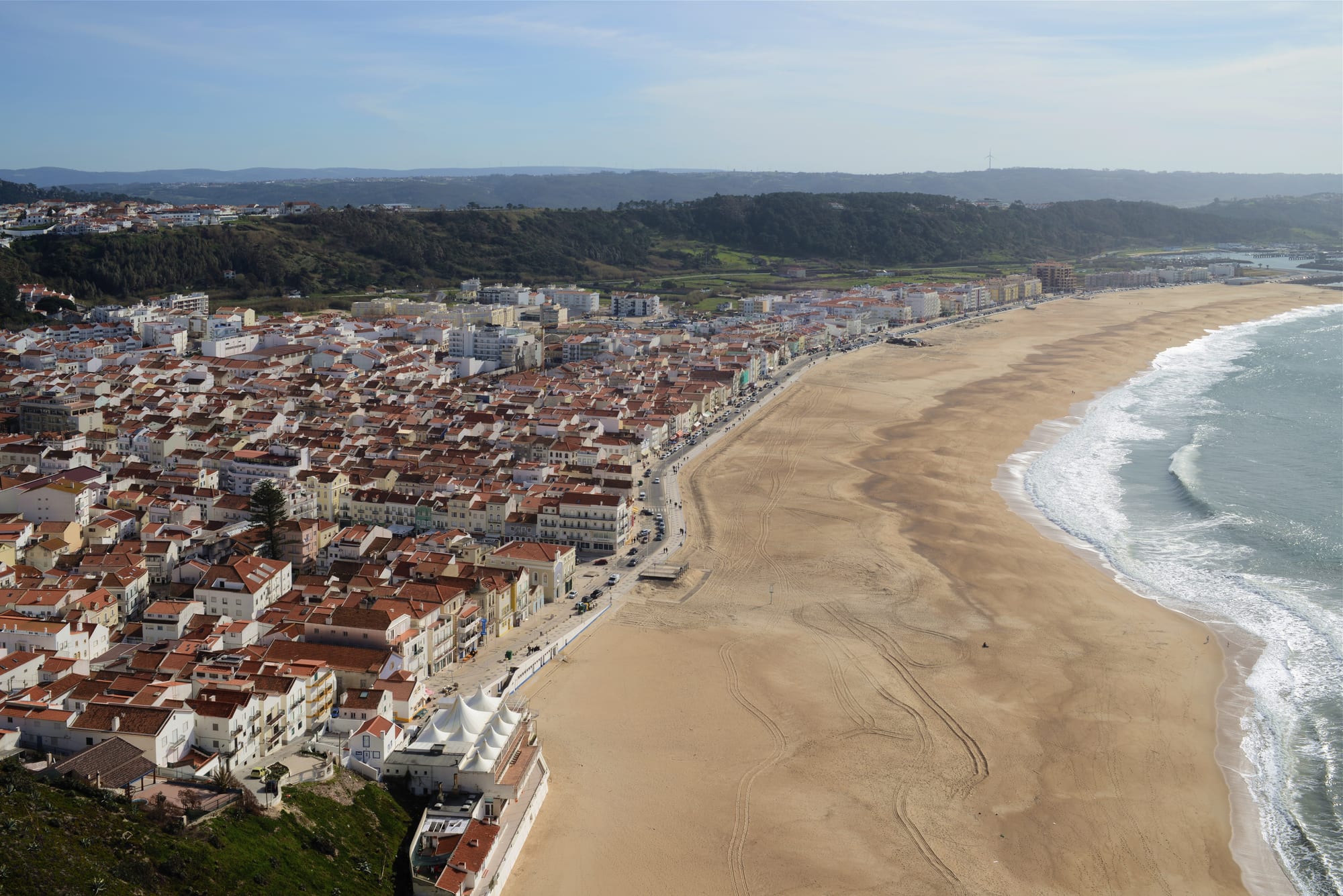
A town of white houses with red roofs beside a long curving sandy beach and breaking Atlantic waves, seen from a high cliff

Central Portugal, Portugal

Nazaré

The town and beach of Nazaré seen from the clifftop village of Sítio. (Alvesgaspar / Wikimedia Commons · CC BY-SA 3.0)

A fishing town and seaside resort on Portugal's Silver Coast, spread between a long beach and two old hilltop villages, one of them home to a medieval Marian shrine. Since 2011 the giant winter waves of Praia do Norte, raised by an undersea canyon, have made Nazaré world-famous for big-wave surfing.

Neighbourhoods

  • Praia
    • First-time visitors
    • Beaches
    • Best for food

    The lower town along the beach, settled only in the 19th century once pirate raids had ended and today the centre of Nazaré. Narrow streets of fish restaurants are here, with the beach of Praia da Nazaré in front.

    Open in Maps
  • Sítio
    • Viewpoints
    • Historic district
    • Pilgrimage

    The old village on the clifftop, reached by the funicular, with the Sanctuary of Our Lady of Nazaré on its broad square, the tiled Memory Hermitage at the cliff edge and the views over the beach. The road to the fort and Praia do Norte starts here.

    Open in Maps
  • Pederneira
    • Quiet and residential
    • Historic district

    The other old hilltop village, once the seat of the municipality, which was called Pederneira until 1912. It keeps its old town hall, pillory, the parish church of Nossa Senhora das Areias and a Misericórdia church, and is quieter than the beach.

    Open in Maps

Things to do

Sítio and the shrine

  • Sanctuary of Our Lady of Nazarélandmark

    The Marian shrine on the Sítio, founded in the 14th century and transformed over the following centuries, with Dutch tile panels of 1709 in the transept and a gilded high altar.

    Open in Maps
  • Memory Hermitagelandmark

    A small four-sided chapel with blue-and-white tiles and a pyramid roof at the edge of the promontory, built over the grotto linked to the legend of Dom Fuas Roupinho.

    Open in Maps
  • Nazaré Funiculartransit hub

    The funicular railway that climbs the cliff between the beach and the Sítio.

    Open in Maps
  • Museu Dr. Joaquim Mansomuseum

    The Doctor Joaquim Manso Folk and Archaeological Museum, the town museum of Nazaré.

    Open in Maps

Beaches and the big waves

  • Praia da Nazarébeach

    The town beach, a long curve of sand in front of the Praia district.

    Open in Maps
  • Praia do Nortebeach

    The wild beach north of the headland where giant winter waves have set world records for the biggest waves ever surfed.

    Open in Maps
  • Fort of São Miguel Arcanjoviewpoint

    A fort first built in 1577 on the headland, with a lighthouse added in 1903; it is now a museum partly devoted to surfing and a popular viewing point for the big waves.

    Open in Maps

Short trips from the town

  • Alcobaça Monasterylandmark

    A Cistercian monastery founded in 1153, among the first Gothic buildings in Portugal and a UNESCO World Heritage Site, in the inland town of Alcobaça.

    Open in Maps
  • São Martinho do Portobeach

    A seaside village on a bay to the south, in the neighbouring municipality of Alcobaça.

    Open in Maps
  • Monastery of Batalhalandmark

    The great Gothic monastery built in thanks for the victory at Aljubarrota in 1385, also a UNESCO World Heritage Site.

    Open in Maps

Seasonal events

  • Our Lady of Nazaré FestivalSeptember

    A ten-day religious and secular celebration around the municipal holiday on 8 September, with processions, bullfights, fireworks, folk dancing and a fair.

  • Big-wave surfing seasonWinter

    The months when the largest swells arrive at Praia do Norte, when a tow-surfing competition is held each year and crowds gather at the fort on the headland to watch.

Eat and drink

Long-standing places and food districts in Nazaré. Hours, ratings and directions come from your maps app, always current.

Nazaré classics

  • Grilled fish in the Praianeighborhood

    Many small restaurants in the streets behind the seafront grill sardines and other fish, often over charcoal outside the door.

    Open in Maps
  • Sítio squareneighborhood

    Restaurants and cafés around the sanctuary square on the clifftop, where grilled fish and seafood come with the view over the beach.

    Open in Maps

Experience Nazaré

History

The earliest settlements were at Pederneira and the Sítio, on high ground above the beach, which gave refuge from raids by Vikings and later by French, English and Dutch pirates that continued into the early 19th century. According to the Legend of Nazaré, a small wooden statue of the Virgin Mary brought from Nazareth was carried here in 711 by a monk, Romano, with Roderic, the last Visigothic king, and left in a grotto on the cliff. In 1182, tradition says, the Virgin saved the knight Dom Fuas Roupinho when his horse stopped at the edge of the cliff in thick fog, and he built a chapel over the grotto in thanks; a mark said to be a hoofprint is still shown in the rock.

King Fernando I founded a larger church on the Sítio in 1377, transformed over the following centuries into the sanctuary of today, and the shrine became a landmark for sailors. Pederneira, a port with shipbuilding, received a charter in 1514, and in 1577 King Sebastian ordered a fort on the headland to protect the fishing, shipbuilding and timber trade from raiders. During the French invasion, the fort's garrison was persuaded to surrender by local students; the French later returned and burned houses and boats in reprisal.

Only in the 19th century, with the end of piracy, did people settle the beach itself, which became the town centre. The municipality took the name Nazaré in 1912. Over the 20th century the fishing village grew into a seaside resort, and from 2011, when Garrett McNamara surfed a record-breaking wave at Praia do Norte, it became a world centre of big-wave surfing.

Culture & Customs

The town is best known for its fishing traditions. Women traditionally wore a headscarf and flannel skirts embroidered in seven colours — the famous seven skirts, worn in layers to cover the head, shoulders and legs against the sea air — and men a flannel shirt and black stocking cap. In the 1950s and 1960s the costume and daily life of the town drew painters and photographers, among them Stanley Kubrick and Henri Cartier-Bresson. The costumes are still worn occasionally, and the Fisherman House-Museum keeps the memory of that life.

Faith is the other pillar. The Sanctuary of Our Lady of Nazaré draws pilgrims all year, many of them visiting on the way to or from Fátima, and the festival of Our Lady of Nazaré around 8 September, the municipal holiday, combines processions with bullfights at the town's bullring, fireworks, folk dancing and a fair.

The waves have added a new identity. Records were set at Praia do Norte by Garrett McNamara in 2011, Rodrigo Koxa in 2017 and Sebastian Steudtner in 2020, whose wave of 26.2 metres remains the tallest ever surfed, while Maya Gabeira set the women's record here in 2020. The HBO series 100 Foot Wave was filmed largely in Nazaré, and visitors to the fort's viewpoint more than doubled between 2015 and 2017.

Daily Life

The municipality had about 15,000 people at the 2021 census, around 10,000 of them in the town itself, which brings together the three old settlements of Praia, Sítio and Pederneira and newer districts built since the second half of the 20th century. The municipality is surrounded on its landward side by Alcobaça.

Tourism dominates the economy, with a summer beach season and, increasingly, a winter season built around the big waves and the surfing championships. Fishing traditions remain part of the town's identity, and many residents let rooms to visitors. Pilgrims add a steady flow to the Sítio all year.

Summer brings crowds to the beach and long evenings in the restaurants of the Praia; winter is quieter, punctuated by swell days when the headland fills with spectators. The sea is a constant presence and danger: in 2012 a rogue wave killed a child and her grandfather walking on a beach nearby, and in 2023 a Brazilian professional surfer died while tow-in surfing. In late January 2026 Storm Kristin struck the district, causing about €15 million of damage to the municipality's infrastructure and revealing large amounts of debris and rubbish on the coast.

Food

Fish is the heart of the table in Nazaré. The town's small restaurants grill sardines and other fish, often outside the door, and the fishing traditions of the Praia mean seafood dominates menus along the seafront and around the Sítio square. The fort on the headland was built in 1577 partly to protect the town's fishing, and the Fisherman House-Museum records the lives of the families who depended on the catch.

In the wider Oeste region the sour-cherry liqueur ginja, made by infusing sour cherries in aguardente with sugar and spices, is a typical drink, and nearby Alcobaça is one of the towns known for it.

Eating out ranges from simple grill houses in the back streets of the Praia to restaurants with views over the bay from the clifftop. Summer is the busiest season, when the beach crowds fill the restaurants; in winter the swell-watchers and the townspeople keep them going.

Planning tools

Budget

Nazaré is a busy summer resort, and rooms are dearest in July and August and during the September festival. Out of season prices fall, though the big-wave days of winter can fill the town at short notice. Simple fish restaurants keep eating costs moderate, and private rooms are widely offered.

Daily Budget Midrange
USD 100–200 (seafront hotel, restaurant dinners, museum tickets, a hire car for the monasteries)
Daily Budget Shoestring
USD 45–80 (private room or guesthouse, grilled-fish lunches, coaches and the funicular)

Watching the waves from the headland costs nothing; book rooms early for August and for the September festival.

Best Time to Visit

June to September for the beach, with September often warmer than June. The festival of Our Lady of Nazaré fills the town in early September. The big waves at Praia do Norte come in the winter months, when the town is quieter but the weather is more unsettled.

Suggested Number of Days

One or two days cover the town, the clifftop and the waves. Three or four allow the monasteries and neighbouring beaches as well. In winter the length of a visit depends on the swell forecast.

First Visit
1–2 days
With Surroundings
3–4 days

Transportation

The Praia is compact and flat, and the funicular links it with the Sítio. Regional buses connect Nazaré with the other towns of the Oeste, and a car is the easiest way to reach the monasteries of Alcobaça and Batalha.

Parking near the headland is scarce on big-wave days; walk up from the Sítio instead.

Airport & Station Connections

Express coaches run from Lisbon's Sete Rios terminal and other cities to the bus station in the town. Trains on the Linha do Oeste link the area with Lisbon, Caldas da Rainha, Leiria and Coimbra, but are often slower than the coach, and the nearest station is at Valado dos Frades, outside the town. By road the town is reached by the A8 motorway from Lisbon. Lisbon's Humberto Delgado Airport is the usual gateway.

Walkability

The Praia is easy to cover on foot along the seafront. The Sítio sits on a cliff high above, and the funicular makes the link. The fort is a short walk from the Sítio square, and Pederneira is a climb inland from the beach.

Safety

Portugal is one of the safest countries in Europe, with low violent crime. The winter sea at Nazaré is extremely dangerous: waves can sweep beaches without warning, and a rogue wave killed two people walking on a local beach in 2012. Crime is low, but bags and cars should be watched on crowded summer and big-wave days.

Watch the big waves from the Nazaré headland, never from the shoreline rocks or the water's edge, and swim only where lifeguards are on duty. Check current official travel advice before travelling.

Climate

A Mediterranean climate heavily moderated by the Atlantic, with cool to warm, dry and generally sunny summers and mild, wet winters. Morning and evening fog is common in summer, and winter brings rainy, stormy spells between clear days.

Summer
cool to warm and dry — on average only about two days a year pass 30°C, and September is generally warmer than June
Winter
mild, wet and stormy at times; on average only about three nights a year fall below 0°C

Local Customs

Nazaré keeps its fishing traditions, and some older women still wear the traditional costume of headscarf and layered flannel skirts. The shrine is an active place of pilgrimage, so dress and behaviour should be respectful there. Tipping is modest; leaving a little in restaurants is appreciated.

Ask before photographing people in traditional dress, and keep quiet and covered inside the sanctuary.

Common Payment Methods

The currency is the euro. Cards and contactless payment are accepted almost everywhere, and Multibanco ATMs are common. Carry a little cash for small restaurants, market stalls and the funicular.