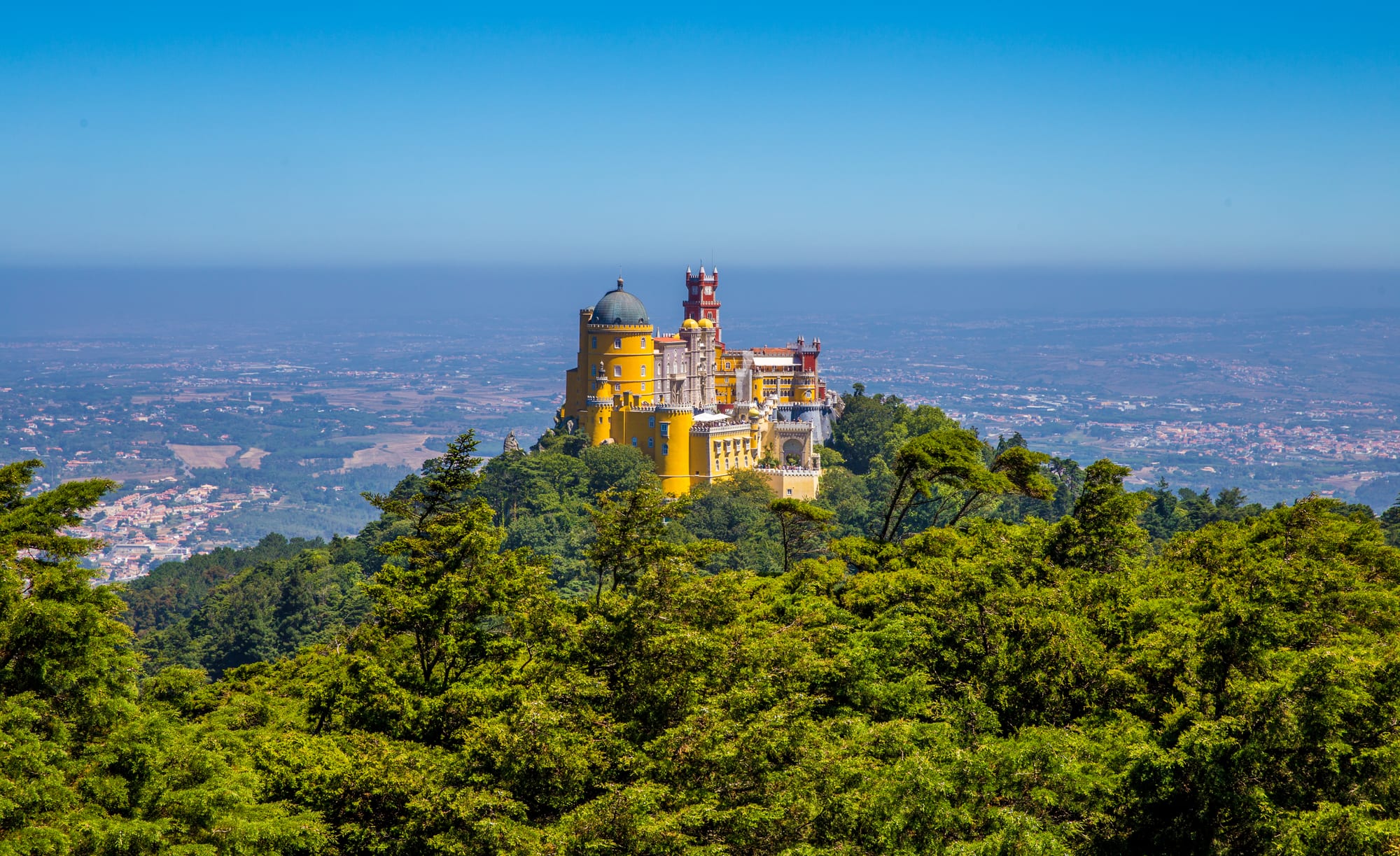
A yellow and red palace with turrets and a dome rising above green forest, with a wide plain stretching to the horizon

Portugal

Lisbon & the Coast

The Pena Palace above the forests of the Sintra hills. (Alina Chan / Wikimedia Commons · CC BY-SA 4.0)

The capital and its two coastal districts — Lisbon on its hills above the Tagus, the Romantic palaces of Sintra, the resort coast of Cascais and Estoril, the surf town of Ericeira, and south across the river the working port of Setúbal and the limestone cliffs of the Arrábida.

Explore Lisbon & the Coast

History

Phoenicians traded at the mouth of the Tagus, the Romans called the town Olisipo, and after the Moorish conquest in the 8th century it was a prosperous Muslim city. Afonso Henriques took it in 1147 with the help of crusaders sailing for the Holy Land, and by the 13th century Lisbon was the kingdom's capital. Sintra, with its Moorish castle and cool hills, became the royal summer retreat.

The city's golden age came with the voyages of discovery. Vasco da Gama sailed from Belém in 1497, and spice and gold paid for the Jerónimos Monastery and the Belém Tower in the ornate Manueline style. On 1 November 1755 an earthquake, tsunami and fire destroyed much of the city; the Marquis of Pombal rebuilt the Baixa on a grid with some of the first earthquake-resistant frames in Europe. Setúbal, across the river, grew on salt, fishing and later sardine canning.

In 1807 the royal family sailed from Lisbon to Brazil ahead of Napoleon's army, and the Lines of Torres Vedras north of the city stopped the French in 1810. King Carlos was assassinated in the Terreiro do Paço in 1908 and the republic proclaimed in Lisbon two years later. Neutral in the Second World War, the city was a gateway for refugees and a haunt of spies, and exiled royals settled in Estoril. On 25 April 1974 the song "Grândola, Vila Morena" on the radio signalled the start of the revolution. Expo 98 regenerated the eastern riverside and gave the city the Vasco da Gama bridge.

Culture & Customs

Lisbon's people are nicknamed alfacinhas, "little lettuces", and its culture is most distinctively expressed in fado, born in the working-class quarters of Alfama and Mouraria and added to UNESCO's intangible heritage list in 2011. Amália Rodrigues remains its icon, and fado houses from Alfama to Bairro Alto still host both professional and amateur singers.

June belongs to Santo António, the city's popular patron. On the night of 12 June the neighbourhoods parade down the Avenida da Liberdade in the marchas populares, and the old quarters fill with grilled sardines, beer and pots of basil given with paper carnations and short verses. Football splits the city between Benfica and Sporting, whose derbies are among the most intense in the country.

The capital is the most diverse place in Portugal. Communities from Cape Verde, Angola, Guinea-Bissau, Brazil and South Asia shaped the music of the suburbs, from Cape Verdean morna to kizomba and the Afro-Portuguese electronic sounds of the 2010s, and Mouraria is now one of Lisbon's most multicultural neighbourhoods. South of the Tagus, Setúbal and the industrial towns of the peninsula carry a proud left-wing tradition, and the Arrábida coast is where Lisbon families have long spent their Sundays. Ericeira keeps its fishing-village character alongside a large international surf community.

Daily Life

About 3.35 million people live in the Lisbon metropolitan area, which almost matches these two districts. The city proper has around 660,000 inhabitants, while Sintra, Amadora, Loures, Cascais, Oeiras and, across the river, Almada and Seixal are large municipalities in their own right. Setúbal has about 120,000 people.

The region produces a large share of Portugal's economic output. Government, finance and services are concentrated in Lisbon, the tech sector has grown around the Web Summit and new offices along the river, and tourism has transformed the old quarters. South of the Tagus, the Volkswagen Autoeuropa plant at Palmela is a major car factory, and Sines, at the district's southern end, has a deep-water port and refinery.

The defining issue is housing. Rents and prices in central Lisbon have risen far faster than wages, short-term lets have hollowed out parts of Alfama and Mouraria, and many residents commute long distances over the 25 de Abril bridge or by ferry. Days start with a bica and a pastry at the counter, lunch is a set menu near the office, and dinner rarely begins before eight; on summer weekends, the city empties to the beaches of Caparica, Cascais and the Arrábida.

Food

Lisbon's street food is simple: the bifana, a pork steak in a bread roll marinated in garlic and wine, the prego, a beef version. Its seafood classics are amêijoas à Bulhão Pato, clams in garlic, olive oil and coriander, and charcoal-grilled sardines during the June festivals. Bacalhau à Brás, shredded salt cod with straw potatoes and egg, is said to come from the Bairro Alto. The pastéis de Belém, the original custard tarts, have been baked near the Jerónimos Monastery since 1837, and ginjinha, a sour-cherry liqueur, is drunk by the glass.

Sintra has its own pastries: travesseiros, pastry "pillows", and queijadas, small cheese tarts. Ericeira is known for its fish and seafood restaurants.

Setúbal's signature is choco frito, strips of fried cuttlefish. Nearby Azeitão makes a soft, thistle-curdled sheep's cheese with protected designation and tortas de Azeitão, rolled sponge filled with egg cream. The peninsula's wine is Moscatel de Setúbal, a sweet fortified Muscat. North of Lisbon, the old appellations of Colares, from ungrafted vines grown in sand by the sea, and Bucelas, a crisp white from the Arinto grape, survive in small quantities.

Attractions & Natural Wonders

Lisbon rewards walking. Alfama's lanes climb from the cathedral to the Castelo de São Jorge, with views from the Santa Luzia and Graça terraces; the Baixa's grid runs to the arcaded Praça do Comércio on the river; and Chiado and Bairro Alto sit above. Belém has the Jerónimos Monastery, the Belém Tower and the Monument to the Discoveries, and the city's museums include the Gulbenkian, the National Tile Museum and the Oceanário at Parque das Nações.

Sintra's hills, a UNESCO cultural landscape, hold the painted Pena Palace, the walls of the Moorish Castle, the National Palace with its conical chimneys, the gardens of Monserrate and the initiation well of Quinta da Regaleira. Cabo da Roca, mainland Europe's westernmost point, lies on the coast below. Cascais has its bay, marina and the sea-carved Boca do Inferno, with the dunes and surf of Guincho to the north and the casino town of Estoril to the east. Further north, the vast palace-convent of Mafra, a UNESCO site, stands inland from Ericeira, whose reefs and point breaks draw surfers year-round.

South of the Tagus, the Cristo Rei statue looks over Lisbon from Almada, and the beaches of Costa da Caparica run south for kilometres. Setúbal has a market hall and boat trips to see the dolphins of the Sado estuary. The Arrábida coast, a natural park, has cove beaches such as Portinho da Arrábida and Galapinhos, and continues to the fishing town of Sesimbra and the cliffs of Cabo Espichel. Across the Sado lie the Tróia peninsula and the long beaches of Comporta.

Cities in Lisbon & the Coast

Planning basics

Budget

This is the most expensive part of Portugal. Central Lisbon hotels, Cascais and Sintra have risen sharply in price, and restaurants in the tourist quarters charge accordingly. Costs fall south of the Tagus in Almada, Setúbal and Sesimbra, and a set lunch in a neighbourhood tasca remains cheap everywhere.

Daily Budget Midrange
USD 160–320 (central hotel, restaurant dinners, palace tickets in Sintra, a boat trip on the Sado)
Daily Budget Shoestring
USD 70–110 (hostel, tasca lunches, metro, trams and suburban trains)

Buy a rechargeable transport card for the metro, trams, ferries and suburban trains, and visit Sintra's palaces on a weekday morning.

Safety

The region is safe, but pickpocketing is common on tram 28, the metro, at the Santa Justa lift, in Alfama and Bairro Alto, and at Sintra's crowded palaces. Cars parked at Sintra, Cabo da Roca and beach car parks are targets for break-ins. The Atlantic beaches of Guincho, Ericeira and Caparica have strong currents, and cliff edges are unstable.

Keep bags closed and in front on crowded trams, leave nothing in parked cars, and swim only where lifeguards are on duty. Check current official travel advice before travelling.

Climate

Lisbon has a warm Mediterranean climate with dry, sunny summers and mild, wet winters. The coast is cooler and windier: the Guincho and Ericeira shores take the full force of the Atlantic, and the Sintra hills catch mist and rain, staying several degrees cooler than the city. The Arrábida, sheltered from the north wind, is the calmest shore for swimming.

Summer
25–32°C in Lisbon, occasionally hotter; cooler and often misty in Sintra and breezy on the coast
Winter
mild and wet, 8–15°C, with Atlantic storms bringing big surf

Transportation

Lisbon's airport is on the metro. Suburban trains run from Rossio to Sintra in roughly 40 minutes and from Cais do Sodré along the coast to Estoril and Cascais, and ferries cross the Tagus to Cacilhas and Seixal. Trains cross the 25 de Abril bridge towards Setúbal, while Ericeira and Mafra are reached by coach. Driving in central Lisbon and in Sintra's historic core is slow, and parking is scarce.

Use the train for Sintra and Cascais rather than a car, and hire one only for the Arrábida and the coast south of Setúbal.

Best Time to Visit

Spring and autumn are best, with warm days and fewer queues at Sintra and Belém. June brings the Santo António festivities, peaking on the night of 12–13 June. July and August suit the beaches but fill Lisbon and Sintra. Ericeira's surf is best from autumn to spring, and winter is a mild, quiet season for the city.