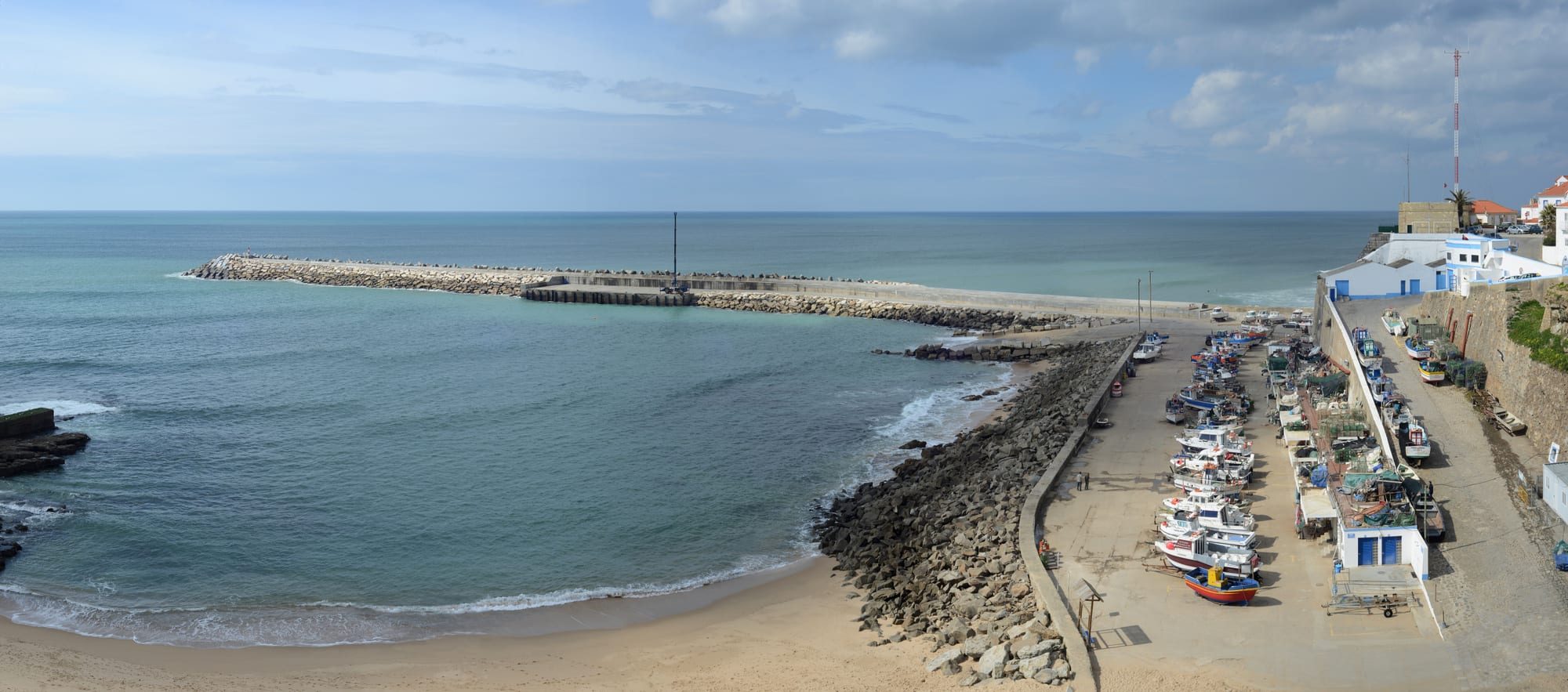
A small sandy beach and harbour wall with fishing boats drawn up on a ramp below white houses on the cliff

Lisbon & the Coast, Portugal

Ericeira

Praia dos Pescadores, the fishermen's beach and harbour of Ericeira. (Alvesgaspar / Wikimedia Commons · CC BY-SA 3.0)

A fishing town on the cliffs of the Atlantic coast in the Mafra municipality, about 35 kilometres north-west of Lisbon. Once a busy port and a seaside retreat for Lisbon families, it is famous as the beach from which Portugal's last king sailed into exile in 1910, and today as a World Surfing Reserve with a whitewashed old town.

Neighbourhoods

  • Old town and Praça da República
    • First-time visitors
    • Historic district
    • Cafés

    The compact centre of white houses on the clifftop, around the main square with its cafés and the parish church of São Pedro. Narrow lanes lead down to the fishermen's beach and the small harbour, and most restaurants are a few minutes' walk away.

    Open in Maps
  • Praia do Sul and Praia do Norte
    • Beaches
    • Close to the centre

    Two of the town beaches, used by swimmers in summer and within walking distance of the old town.

    Open in Maps
  • Ribeira d'Ilhas and the northern coast
    • Surfing
    • Wild coast

    North of the town the coast becomes a string of reef and point breaks: Ribeira d'Ilhas about two kilometres away, a regular venue for international surf competitions, and further on the powerful Coxos break near the village of Ribamar, not a place for beginners.

    Open in Maps
  • Foz do Lizandro
    • Beaches

    The Blue Flag beach at the mouth of the Lizandro river, in the neighbouring parish of Carvoeira.

    Open in Maps

Things to do

Beaches and surf

  • Praia dos Pescadoresbeach

    The fishermen's beach in the centre of the town, from which King Manuel II left for exile on 5 October 1910.

    Open in Maps
  • Ribeira d'Ilhasbeach

    A beach about two kilometres north of the town that is one of the best-known surf spots in Europe and a regular stop on the professional surfing tour.

    Open in Maps
  • Coxosbeach

    A point break on the northern edge of the parish, regarded as one of the best professional surf spots in Europe and not suited to beginners.

    Open in Maps

Town landmarks

  • Chapel of Santo Antóniolandmark

    A chapel also dedicated to Our Lady of Good Voyage of the Men of the Sea — a devotion that began in Ericeira.

    Open in Maps
  • Fort of Nossa Senhora da Piedadelandmark

    A coastal fort in the town, later used as a post of the Guarda Fiscal, the customs guard.

    Open in Maps

Short trips from the town

  • Palace of Mafralandmark

    A vast Baroque and Neoclassical palace, basilica and convent begun in 1717, inscribed as a UNESCO World Heritage Site in 2019 together with its garden and hunting park.

    Open in Maps
  • Tapada Nacional de Mafrapark

    The walled royal hunting park beside the palace, with deer, wild boar and birds of prey, open for walking, mountain biking and riding.

    Open in Maps
  • Sintraattraction

    The hill town of Romantic palaces and royal gardens to the south, reached by road or by coach.

    Open in Maps

Seasonal events

  • Festa de São Pedrolate June

    The feast of the town's patron saint, St Peter, celebrated on 28 June.

  • Festa de Nossa Senhora da Boa ViagemAugust (third Sunday)

    The town's festival for Our Lady of Good Voyage, protector of fishermen, whose devotion began in Ericeira.

Eat and drink

Long-standing places and food districts in Ericeira. Hours, ratings and directions come from your maps app, always current.

Ericeira classics

  • Seafood restaurants of the old townneighborhood

    Fish and shellfish are the town's speciality, served in restaurants across the old centre and along the cliffs above the harbour.

    Open in Maps
  • Cafés of Praça da Repúblicacafe

    The main square, with its historic café building, is the town's meeting place for coffee and pastries.

    Open in Maps

Experience Ericeira

History

Ericeira's name is traditionally said to come from ouriço, the sea urchin, and the town took one for its coat of arms; research using an old coat of arms kept in the Misericórdia's archive museum shows that the animal was in fact a hedgehog. The settlement may date back to the Phoenicians, and its first charter was granted in 1229 by the master of the Order of Avis, later reformed by King Manuel I in 1513. After King Sebastian vanished at the Battle of Alcácer Quibir, a hermit from a chapel south of the village passed himself off as the lost king; he and his followers were later executed.

The port made the town. In the 19th century it was the busiest in Estremadura and the fourth most important in Portugal, after Lisbon, Porto and Setúbal, with a customs house covering the coast from Cascais to Figueira da Foz; 175 boats were recorded anchoring there in 1834, landing cereals and taking wine and spirits away. The railway and better roads took the trade, but sea bathing brought new visitors — the royal family, including Queen Maria Pia in 1864, and Lisbon aristocrats who built houses here around 1900.

On the afternoon of 5 October 1910 the 20-year-old King Manuel II, with his mother and grandmother, arrived from Mafra and was rowed out from the Praia dos Pescadores to the royal yacht, leaving Portugal for exile as the republic was proclaimed. From the 1940s it was a favourite summer retreat for Lisbon families. In 2011 its coast was named a World Surfing Reserve.

Culture & Customs

For centuries the town was inhabited almost entirely by people of the sea, a distinct community known as the Jagoz, and the fishing tradition still shapes its identity. The devotion to Our Lady of Good Voyage, protector of seafarers, began in Ericeira, and the town's religious festas — for its patron St Peter at the end of June and for Our Lady of Good Voyage in August — remain high points of the year. The local philharmonic band, now the Filarmónica Cultural Ericeira, has played since 1849.

Surfing has become the second culture of the town. Ericeira is often called the surfing capital of Europe: its coast has around forty beaches with good conditions, Ribeira d'Ilhas has regularly hosted a round of the professional world tour, and the town is one of only two World Surfing Reserves in Europe. The Ericeira Surf Clube, founded in 1993 from the surfing section of the Ericeira Naval Club, runs competitions and a school.

Since the 2020s, and especially after the pandemic, the town has also drawn many internationally mobile freelancers, with co-working spaces and community meet-ups. Football is played by Grupo Desportivo União Ericeirense, founded in 1921.

Daily Life

The parish of Ericeira had about 12,400 inhabitants at the 2021 census, in an area of about 12 square kilometres that includes outlying settlements such as Fonte Boa dos Nabos and Pinhal de Frades. It belongs to the municipality of Mafra, whose seat lies inland.

Once a commercial fishing port, Ericeira has become a town dependent on tourism, with businesses ranging from restaurants and accommodation to shops, alongside the fishing that continues from the small harbour. The arrival of remote workers has added a new international population to the year-round community.

The rhythm of life follows the sea and the seasons. In summer the population swells with holidaymakers and day visitors from Lisbon escaping the crowded beaches of Caparica and the Cascais line, and the old town is busy late into the evening. In winter the town belongs to the residents and the surfers who come for the big Atlantic swells.

Food

Ericeira's cooking rests on the sea. For centuries the town lived from its port and its fishing grounds, and today its beaches and fishing spots, together with a cuisine built on a wide variety of fish and shellfish, are counted among its greatest attractions. Seafood restaurants are spread through the old town and above the harbour, where the fishing harbour still keeps its traditional boats.

The food is a large part of why Lisbon people come for the weekend: many drive out to enjoy the local cooking and the calm of the town, away from the crowded beaches of Costa da Caparica and the Cascais line.

Coffee culture centres on Praça da República, the main square, whose historic café building is one of the town's listed civic landmarks. Since the 2020s the arrival of surfers and remote workers from abroad has added co-working cafés and casual places to eat, so that the older seafood houses now share the streets with newer, more international menus.

Planning tools

Budget

Ericeira is in the costly Lisbon region, and prices rise in summer and during major surf events, when visitors and surfers fill the town. Surfers' hostels, simple seafood lunches and the coach from Lisbon keep costs moderate, while surf lessons and board hire are the usual extras.

Daily Budget Midrange
USD 150–280 (guesthouse or hotel, seafood dinners, a surf lesson or board hire)
Daily Budget Shoestring
USD 65–100 (surf hostel bed, simple meals, the coach from Lisbon)

Surf schools in the town cater for beginners; the reef and point breaks north of the town are for experienced surfers only.

Best Time to Visit

Summer suits swimmers and beginner surfers, and the town is at its liveliest for the festas of June and August. From autumn to spring the Atlantic swells are bigger and the surf is at its best, and the town is quieter. Winters are mild but wet and windy.

Suggested Number of Days

The town itself can be seen in a day. Surfers often stay a week or more; for others, two or three extra days allow for the beaches along the coast and the palace country inland.

First Visit
1–2 days
With Surroundings
3–5 days

Transportation

The town is small enough to walk, and the beaches nearest the centre are within reach on foot. The surf beaches further north and south are easiest by car, bicycle or local bus. Parking in the old town is limited in summer.

Respect the local order of priority in the water at the reef breaks.

Airport & Station Connections

Ericeira is about 45 kilometres from central Lisbon by road. Buses run to the town from Lisbon, Mafra and Sintra. Most visitors arriving by air land at Lisbon's airport and continue by coach, hire car or taxi.

Walkability

The old town is compact and pleasant on foot, with lanes of white houses leading to viewpoints over the sea, though steps and steep slopes lead down to the beaches.

Safety

Portugal is one of the safest countries in Europe, with low violent crime. In Ericeira the main hazards are natural: strong Atlantic currents, powerful surf over rock reefs and unstable cliff edges. Cars at beach car parks are targets for break-ins.

Swim only on lifeguarded beaches, leave the reef breaks to experienced surfers, stay back from cliff edges and leave nothing in parked cars. Check current official travel advice before travelling.

Climate

A mild Atlantic climate, cooler and windier on this exposed coast than in Lisbon. Summers are dry and sunny; winters bring rain, wind and big swells from Atlantic storms.

Summer
dry and sunny — in the Lisbon area, July and August maxima average about 23–25°C on the coast west of the city and around 30°C across the Tagus estuary
Winter
mild and wet — in Lisbon, winter days average 15–16°C and nights 8–10°C

Local Customs

Tipping is not generally expected in Portugal, though a euro or two after a full meal is appreciated when service has been good. Bread, olives and other starters put on the table are charged if eaten, and can be refused. The town mixes a long-established fishing community with a large international surf scene, and a greeting in Portuguese is appreciated.

The legal drinking age is 18. Keep beachwear for the beach and dress modestly in churches and chapels.

Common Payment Methods

Portugal uses the euro. Cards and contactless payment are widely accepted, though some small cafés and stalls prefer cash. Multibanco ATMs are found in the town centre.