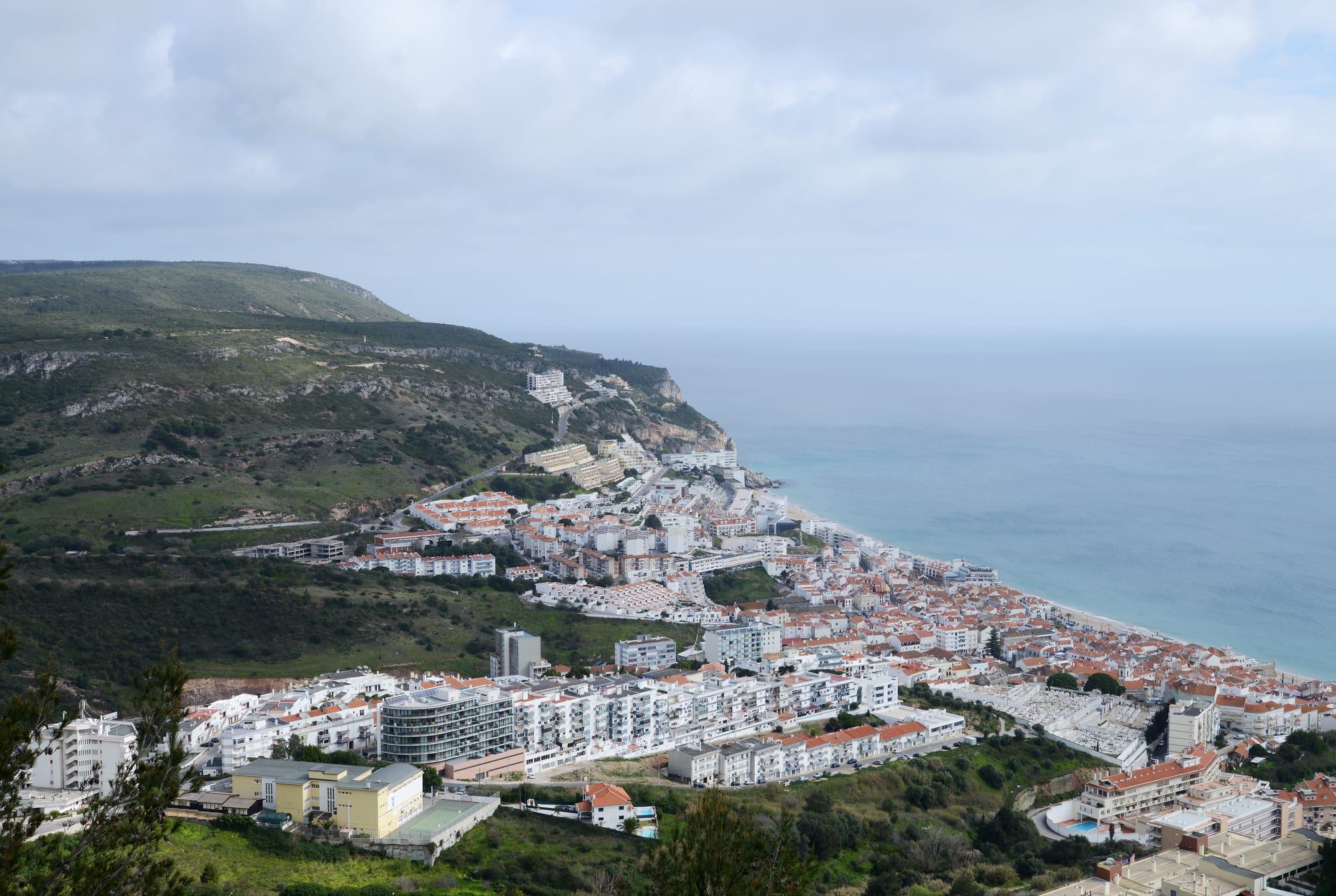
White houses with red roofs spreading along a curving bay below green hills, seen from high above under a cloudy sky

Lisbon & the Coast, Portugal

Sesimbra

Sesimbra and its bay seen from the castle hill. (Alvesgaspar / Wikimedia Commons · CC BY-SA 4.0)

A fishing town on a sheltered bay at the western end of the Arrábida hills, south of Lisbon on the Setúbal Peninsula, below a castle taken from the Moors in 1165. A seaport in the Age of Discovery and later a royal seaside retreat, it still lands fish in its natural harbour and draws visitors to its beaches, fish restaurants, dive sites and Cape Espichel.

Neighbourhoods

  • Town centre and the bay
    • First-time visitors
    • Beaches
    • Best for food

    The old fishing town of white houses and narrow streets on the bay, with the town beach beside the Fortress of Santiago, the parish church of Santiago and most of the fish restaurants. In summer the seafront is the centre of life day and night.

    Open in Maps
  • Castle hill
    • Views
    • Historic district

    The hilltop about 240 metres above the sea, crowned by the walls of the Moorish castle and the church of Nossa Senhora do Castelo, with views over the town, the harbour and the countryside.

    Open in Maps
  • The harbour
    • Local life
    • Boat trips

    The fishing port on the bay, where the boats land their catch and from which sport-fishing, diving and boat trips set out.

    Open in Maps
  • Meco and the Lagoa de Albufeira
    • Beaches
    • Wildlife

    The Atlantic side of the municipality, with the long beach at Meco and the Albufeira lagoon, a protected wetland whose calm waters suit windsurfing, kitesurfing and sailing.

    Open in Maps

Things to do

Castles and forts

  • Castle of Sesimbralandmark

    The Moorish castle on its hilltop, taken by Afonso Henriques with the help of crusaders in 1165 and a national monument since 1910; its battlements look out over the town and the harbour.

    Open in Maps
  • Igreja de Nossa Senhora do Castelolandmark

    The church inside the castle, built in 1721 where Sancho I had founded a Romanesque chapel, with azulejo-lined walls, a pulpit of local pink marble and a gilded statue of the Madonna on a giant shell.

    Open in Maps
  • Fortress of Saint Jamesmuseum

    The fortress on the beach in the town centre, built in 1642–48 on the site of an earlier Manueline fort, later used as a royal seaside retreat and now home to a museum of the town's fishing history.

    Open in Maps
  • Fort of São Teodósio da Ponta do Cavalolandmark

    A coastal fort of 1648–52 on the headland at the western edge of the bay.

    Open in Maps

Coast and nature

  • Cape Espichelviewpoint

    The sharp headland at the south-western corner of the Setúbal Peninsula, with a pilgrimage sanctuary and wide views north to Cascais and the Sintra hills and south-east towards Tróia.

    Open in Maps
  • Arrábida Natural Parkpark

    The protected limestone range running east from the town towards Setúbal, where the mountains meet the sea in sheltered coves.

    Open in Maps
  • Lagoa de Albufeirapark

    A coastal lagoon in the west of the municipality, a Ramsar site and bird protection area, popular with families and with windsurfers, kitesurfers and canoeists.

    Open in Maps
  • Praia do Mecobeach

    A long Atlantic beach beside the village of Meco on the western coast of the municipality.

    Open in Maps

Seasonal events

  • Festas do Senhor Jesus das Chagasearly May

    The town's main religious festival, held on 4 May, the municipal holiday, in honour of the Lord Jesus of the Wounds.

Eat and drink

Long-standing places and food districts in Sesimbra. Hours, ratings and directions come from your maps app, always current.

Sesimbra classics

  • Fish restaurants of the seafrontneighborhood

    Sesimbra is known for its traditional fish restaurants, many grilling the local catch near the beach and the harbour.

    Open in Maps
  • The harbourneighborhood

    The working fishing port, where the boats land the fish that supply the town's restaurants.

    Open in Maps

Experience Sesimbra

History

The oldest recorded name of the place, Cempsibriga, joins the Celtic word briga, a fortified high place, to the name of a tribe, the Cempsi. Under Moorish rule a castle stood on the hilltop 240 metres above the bay, and in 1165 Afonso Henriques took it with the help of Frankish crusaders. A royal charter followed on 15 August 1201, and early in the 13th century Sancho I built a Romanesque chapel inside the walls, which became the seat of a parish in 1388.

During the Age of Discovery Sesimbra became an important seaport, and King Manuel I lived here for a time. On 3 June 1602 an English fleet defeated a squadron of Spanish galleys in the bay, capturing a large Portuguese carrack and badly damaging the fort. After the restoration of independence the Fortress of Santiago was built on the beach between 1642 and 1648, on the site of a Manueline fort, and the Fort of São Teodósio followed on the western headland; in the 18th century Portuguese kings used the fortress as a seaside retreat.

The castle church, rebuilt in 1721, was restored between 1965 and 2001. In 1989 the Nigerian cargo ship River Gurara sank off the coast with the loss of 45 sailors; its wreck is now the area's best-known dive site.

Culture & Customs

Sesimbra's culture is that of a fishing community. Its year turns on the sea and on the church: the main festival, on 4 May, the municipal holiday, honours the Lord Jesus of the Wounds, and the town's devotion to its patron saints and to the Virgin of the castle runs through its history. Cape Espichel, at the end of the municipality, is home to the sanctuary of Our Lady of the Cape, with its church and pilgrims' lodgings.

The town's monuments show its layered past: the castle walls, the church of Nossa Senhora do Castelo with its azulejos, a pulpit of local pink marble and an 18th-century choir arch carved with Manueline motifs, and the forts of the bay, one of which now tells the story of Sesimbra as a fishing village. The municipal museum and the archaeological cave of Lapa do Fumo add older layers.

Today Sesimbra is known well beyond the peninsula for its beaches, its fish restaurants and its nightlife, and it is one of the most popular diving areas close to Lisbon. Sport fishing, mainly for swordfish, has a following of its own, and the local radio station, Sesimbra FM, serves the municipality.

Daily Life

The town itself had about 5,600 inhabitants in 2011, while the municipality, which also includes the parishes of Castelo and Quinta do Conde, had about 52,400 at the 2021 census, spread over about 195 square kilometres. It belongs to the Setúbal District and the Lisbon metropolitan area, and many residents work elsewhere in the region.

Fishing remains central. The natural harbour on Setúbal Bay, near the mouth of the Sado, makes Sesimbra an important fishing town, and professional and sport fishing are, with tourism, its most significant sources of income. The town is also an unusual piece of global infrastructure: international submarine communication cables, among them SAT-3/WASC and Atlantis-2, come ashore here.

Life changes sharply with the seasons. In summer the population swells with holidaymakers and day visitors from Lisbon, the beaches fill, and traffic around the Albufeira lagoon can be chaotic at weekends. Out of season Sesimbra returns to its residents, its fishermen and the visitors who come for a long lunch by the sea.

Food

Fish is what people come to Sesimbra to eat. The town is known for its traditional fish restaurants, supplied by the boats that work from its natural harbour, and a meal of fresh fish by the bay is, for many visitors from Lisbon, the whole point of the trip. Across the Setúbal Peninsula, fish is roasted, boiled or grilled, and the coast's restaurants follow the same tradition.

The neighbouring city of Setúbal, with which Sesimbra shares the peninsula's fishing culture, is known for choco frito, cuttlefish marinated and fried without flour or breadcrumbs, and the inland parishes of the Arrábida produce Azeitão sheep's cheese, which has protected designation of origin, and tortas de Azeitão, a sweet made with egg yolks, sugar and ovos moles. The peninsula's wine is Moscatel de Setúbal, a sweet fortified Muscat.

Sesimbra's working harbour remains the source of what reaches the table. Sport fishing in its waters is mainly for swordfish, and the town's fishermen still land their catch at the town's port.

Planning tools

Budget

Sesimbra is cheaper than Lisbon, Cascais or Sintra, and its fish restaurants are the main draw for many day visitors. Costs rise in July and August, when the town fills with holidaymakers. Boat trips, diving and sport fishing are the main extra expenses.

Daily Budget Midrange
USD 140–260 (hotel or apartment, fish dinners, a boat trip or a dive)
Daily Budget Shoestring
USD 60–100 (simple guesthouse or campsite, grilled fish lunches, the bus from Lisbon)

Visit outside the summer peak, or on a weekday, when the beach and the roads into town are far quieter.

Best Time to Visit

June to September is beach season, when the sheltered bay is at its busiest and liveliest. Spring and autumn are quieter, warm enough for walking the hills and the coast, and May brings the town's main festival. Winter is mild and wet, and the town is calm.

Suggested Number of Days

The town and its castle can be seen in a day, and many people come only for lunch. A longer stay allows time for the beaches, the hills and the cliffs of the surrounding coast, which are easiest to reach by car.

First Visit
1–2 days
With Surroundings
3–4 days

Transportation

The centre and the seafront are compact and walkable. Carris Metropolitana buses link the town with the rest of the peninsula. The castle, Cape Espichel, Meco and the Albufeira lagoon are spread out and easiest by car; traffic around the lagoon can be heavy at weekends.

The castle stands about 240 metres above sea level, so the way up from the seafront on foot is long and steep.

Airport & Station Connections

Carris Metropolitana buses run to Sesimbra from Lisbon and from the ferry terminal at Cacilhas in Almada. By car the town is reached from Lisbon by the A2 motorway and the N378, and from Setúbal by the N10 and N379. Visitors flying in use Lisbon's airport.

Walkability

The town centre is small and easy on foot, with a promenade along the bay, though streets rise steeply behind the seafront. The castle and the outlying beaches are a long uphill walk or a drive away.

Safety

Portugal is one of the safest countries in Europe, with low violent crime. Sesimbra is a quiet fishing town; the main risks are bag theft on crowded summer beaches, break-ins at beach car parks, and strong currents and unstable cliff edges on the open Atlantic coast towards Meco and Cape Espichel.

Swim where lifeguards are on duty, stay back from the cliff edges at Cape Espichel, and leave nothing in parked cars. Check current official travel advice before travelling.

Climate

A Mediterranean climate with mild, rainy winters and hot, dry summers. The town's bay is sheltered by the Arrábida hills, while the open coast to the west takes the Atlantic wind.

Summer
hot and dry — in nearby Setúbal, days typically reach 28–31°C with nights of 15–17°C
Winter
mild and wet — in nearby Setúbal, days typically reach 15–17°C with nights of 5–8°C, and most rain falls from November

Local Customs

Tipping is not generally expected in Portugal, though a euro or two after a full meal is appreciated when service has been good. Bread, olives and other starters put on the table are charged if eaten, and can be refused. A greeting in Portuguese is appreciated.

The legal drinking age is 18. Keep beachwear for the beach and dress modestly in churches and at the Cape Espichel sanctuary.

Common Payment Methods

Portugal uses the euro. Cards and contactless payment are widely accepted, but carry some cash for small cafés and beach bars. Multibanco ATMs are found in the town centre.