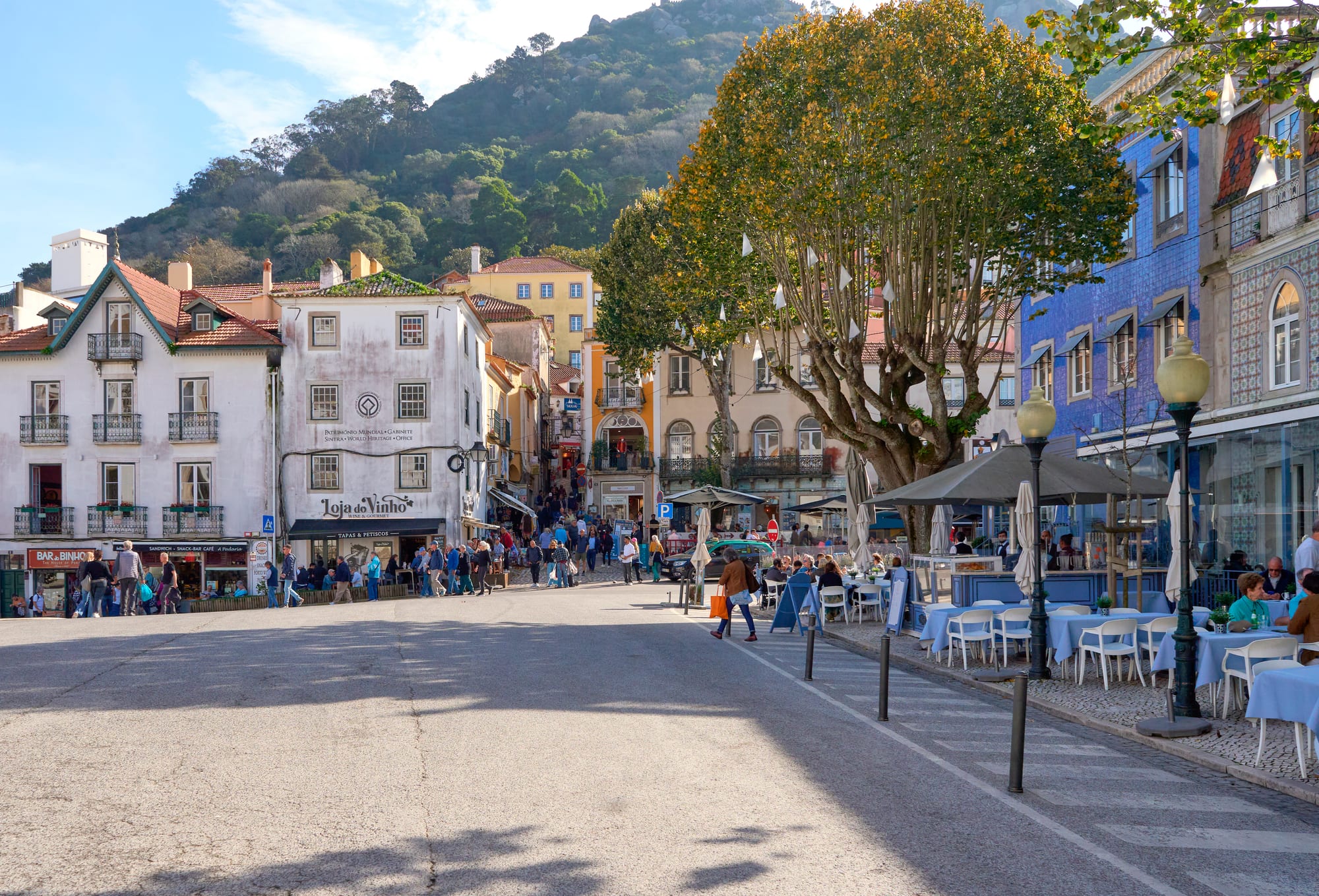
A sunny square in Sintra lined with pastel and tiled houses and café tables, below a steep wooded hill

Lisbon & the Coast, Portugal

Sintra

A square in the historic centre of Sintra. (londonexpat / Wikimedia Commons · CC BY-SA 4.0)

A hill town on the wooded northern slopes of the Sintra Mountains, west of Lisbon, that was a summer seat of Portuguese kings for centuries and then a retreat of Romantic writers, aristocrats and millionaires. Its palaces, castle walls and gardens form a UNESCO World Heritage cultural landscape, and today the small old town draws millions of visitors a year.

Neighbourhoods

  • Historic centre (Vila Velha)
    • First-time visitors
    • Historic district
    • Cafés and pastries

    The old town around the National Palace and its two tall kitchen chimneys, with steep lanes of pastel houses, pastry shops and souvenir shops. Quinta da Regaleira and the road to Seteais and Monserrate lead west from here, and the tourist buses up to the castle and Pena start nearby.

    Open in Maps
  • São Pedro de Penaferrim
    • Quiet and residential
    • Local life

    A former parish, merged in 2013 into the parish of Sintra, that takes in many of the town's monuments, including the Pena Palace and the Castle of the Moors. Away from the monuments its streets are quieter and more residential than the old town.

    Open in Maps
  • Colares
    • Wine
    • Countryside

    A village of quintas and vineyards on the western side of the mountains towards the sea, home of the Colares wine grown in sand. The seasonal tram from Sintra passes through on its way to the coast at Praia das Maçãs.

    Open in Maps
  • Azenhas do Mar
    • Beaches
    • Sea views

    A small village of white houses stacked on a cliff above the Atlantic, at the coastal end of the municipality. It has a beach and a man-made pool at the foot of the cliff, and lies less than 2 kilometres from Praia das Maçãs.

    Open in Maps

Things to do

Palaces and castles

  • Pena Palacelandmark

    The brightly painted Romantic palace on a peak above the town, built for King-Consort Ferdinand II over a 16th-century monastery of the Order of Saint Jerome, in a mixture of Neo-Gothic, Neo-Manueline and Neo-Islamic styles.

    Open in Maps
  • Sintra National Palacelandmark

    The town-centre royal palace, a principal summer residence of the court until the end of the 17th century, recognised from afar by its two conical kitchen chimneys.

    Open in Maps
  • Castle of the Moorslandmark

    Walls and towers from the Moorish period running along a ridge of the mountains; the castle surrendered to the Christians in 1147, after the conquest of Lisbon.

    Open in Maps
  • Quinta da Regaleiraattraction

    A Neo-Manueline palace and chapel built in 1904–10 for the millionaire António Augusto Carvalho Monteiro, designed by Luigi Manini, with gardens of grottoes, lakes and wells.

    Open in Maps
  • Monserrate Palacelandmark

    A palatial villa in the foothills west of the town, once rented by William Beckford and later the estate of Sir Francis Cook, who added an oriental pavilion.

    Open in Maps
  • Seteais Palacelandmark

    A neoclassical palace, part of the UNESCO-listed cultural landscape, on the road west of the old town, with a triumphal arch commemorating a royal visit of 1802.

    Open in Maps

Gardens, convents and the mountains

  • Convent of the Capuchoslandmark

    A convent of small quarters in the forest of the mountains, associated with the Viceroy of India, João de Castro, and his family.

    Open in Maps
  • Sintra Mountainstrail

    The granite range above the town, about ten kilometres long, whose damp, misty slopes carry mixed forest and footpaths between the palaces.

    Open in Maps
  • Sintra tramwaytransit hub

    A seasonal narrow-gauge tram line of about 11.7 kilometres that runs from the town through Colares to the sea at Praia das Maçãs.

    Open in Maps

Short trips from the town

  • Cabo da Rocaviewpoint

    The windswept cape at the end of the Sintra Mountains, the westernmost point of mainland Europe.

    Open in Maps
  • National Palace of Queluzlandmark

    A royal palace begun in 1747 in Queluz, in the east of the municipality, nearer Lisbon.

    Open in Maps

Eat and drink

Long-standing places and food districts in Sintra. Hours, ratings and directions come from your maps app, always current.

Sintra classics

  • Piriquitacafe

    The best-known pastry shop in the old town, famous for its travesseiros, puff-pastry pillows filled with almond and egg-yolk cream.

    Open in Maps
  • Casa do Pretocafe

    A pastry shop known for queijadas de Sintra, small crisp tarts filled with fresh cheese, sugar, eggs and cinnamon.

    Open in Maps

Wine

  • Adega Regional de Colaresrestaurant

    The regional winery in Colares, where the rare wines of the sand-rooted Colares vineyards can be tasted.

    Open in Maps
  • Restaurants of the historic centreneighborhood

    The lanes around the National Palace hold traditional restaurants serving fish, grilled meat and daily specials alongside the pastry shops.

    Open in Maps

Experience Sintra

History

People have lived in the Sintra hills since the Palaeolithic, and a late Bronze Age settlement stood where the Castle of the Moors is today. The Romans counted the area within the territory of Olisipo, the later Lisbon, and under Moorish rule the geographer al-Bakri described Sintra as a town dependent on Lisbon, "permanently submerged in a fog that never dissipates". The castle surrendered for good in November 1147, a month after Afonso Henriques took Lisbon with the help of crusaders, and in 1154 he granted the town its charter. Medieval Sintra had a Sephardic community with its own synagogue and quarter.

For the next five centuries the town was a royal retreat. The palace in its centre was one of the court's principal summer residences until the end of the 17th century: John I decided there to conquer Ceuta in 1415, Afonso V was born and died there, and the deposed Afonso VI was held prisoner there until his death in 1683. Manuel I rebuilt the parish church and in 1511 founded a monastery on the highest peak. The 1755 earthquake destroyed much of the town centre.

From the late 18th century Sintra became a place of Romantic pilgrimage — Lord Byron's "glorious Eden" — and wealthy foreigners and Portuguese aristocrats built estates such as Monserrate. In 1838 King-Consort Ferdinand II bought the ruined monastery and began the Pena Palace, the railway from Lisbon opened in 1887, and the millionaire Carvalho Monteiro built Quinta da Regaleira early in the 20th century. A municipal plan of 1949 protected the old town, while the land towards Lisbon filled with dense suburbs. The town's cultural landscape is now a UNESCO World Heritage Site.

Culture & Customs

Sintra's identity rests on its landscape and its literary fame. Camões wrote of its mountains in The Lusiads as a land of water nymphs, Byron praised it, and the novelist Eça de Queirós set scenes of Os Maias and The Mystery of the Sintra Road here. From the later 19th century musicians, painters and architects settled in the town, among them the composer Alfredo Keil and the architect Raul Lino, and the painter Vieira da Silva and the writer Ferreira de Castro, whose museum is in the town, later lived in the area.

The palaces and parks are looked after by Parques de Sintra, and tourism dominates the old centre: its sites received about 3.2 million visitors in 2017. The town has also long been a film set — scenes of The Ninth Gate, The Count of Monte Cristo and the 1996 Gulliver's Travels were shot among its palaces. Each year the European Central Bank holds its Forum on Central Banking here.

Local life carries on beneath the crowds. Sport União Sintrense, founded in 1911, plays football, the Hockey Club de Sintra is known for roller hockey and artistic roller skating, and the villages of the western slopes keep their wine and farming traditions.

Daily Life

The municipality of Sintra had 395,528 people in 2023, making it one of the most populous in Portugal, but very few of them live in the historic town. Most are concentrated in the south-east, in the Queluz–Agualva-Cacém–Mem Martins corridor along the railway line and the IC19 motorway, where blocks of seven storeys or more house commuters to Lisbon. Sintra has the youngest population structure in the Lisbon metropolitan area, and around a fifth of those born outside the town are from abroad.

The economy is mostly services, retail and construction, with some industry, and tourism is central to the old town and the mountains. The municipality is also among the wealthiest in Portugal and has a large foreign community, much of it living in villas and estates on the hills and along the coast.

For residents of the old centre, daily life means sharing narrow streets with tour groups, buses and tuk-tuks, especially in summer. Many people commute to Lisbon on the frequent trains, while the coastal villages of Colares, Azenhas do Mar and Praia das Maçãs fill with summer residents and day trippers in the warm months. In the 2025 local elections Marco Almeida of the PSD became mayor.

Food

Sintra is best known for its pastries. The travesseiro de Sintra, a "pillow", is a puff pastry filled with a cream of almonds, sugar and egg yolks with cinnamon, often dusted with sugar; the old Piriquita pastry shop is the most famous place to buy them. The queijada de Sintra is a small tart with a crisp case and a filling of fresh cheese, sugar, eggs and cinnamon, sometimes with lemon zest — Sintra's version is among the best known of Portugal's queijadas, and shops in the old town sell them.

Restaurants in the town and the surrounding villages serve the Portuguese repertoire of grilled fish, meat and daily specials, and seafood is the speciality on the coast at Azenhas do Mar and Praia das Maçãs. Across the Lisbon region, set lunches in small restaurants remain the cheapest way to eat.

Colares produces a rare wine. Its vines grow in sand dunes near the sea that protect them from the Atlantic wind, and the appellation holds the country's highest classification of origin. Suburban growth has shrunk the vineyards from about 2,500 acres in the 1940s to around 50 acres, and the regional winery in Colares is a place to taste it.

Planning tools

Budget

Sintra is in the most expensive part of Portugal. Palace admissions are the main extra cost, since most visitors see several in one trip, and rooms in and around the old town are priced for a busy tourist market. The train from Lisbon is cheap, and pastries and set lunches keep food costs down.

Daily Budget Midrange
USD 160–300 (guesthouse or hotel, restaurant dinners, several palace tickets, a day bus ticket)
Daily Budget Shoestring
USD 70–110 (hostel bed, pastries and a set lunch, one palace ticket, the train and buses)

Buy palace tickets online, as entry is timed, and go early in the day or late in the afternoon to avoid the worst of the queues.

Best Time to Visit

Spring and autumn are the best seasons, when the gardens are green and the queues shorter. Summer brings the largest crowds and the seasonal tram to the coast, and the hills are often cooler and mistier than Lisbon. Winter is quiet and damp, with fog on the heights.

Suggested Number of Days

Many people come for a single day from Lisbon, but the palaces are spread over steep hills and the queues are long, so a night or two makes the visit far more comfortable. Allowing longer brings the coast and the villages on the western side of the mountains within reach.

First Visit
1–2 days
With Surroundings
3 days

Transportation

The town is compact, but the palaces sit high above it on narrow, winding roads. Circular tourist buses run from the railway station through the old town to the castle and Pena, and another route runs west past Quinta da Regaleira, Seteais and Monserrate; they often get stuck in traffic at busy times. Tuk-tuks and taxis also work the hill roads. Driving and parking in the historic core are difficult.

Fit walkers can take the signed footpath from the old town up to the castle and Pena, which climbs about 200 metres and avoids the crowded buses.

Airport & Station Connections

Frequent commuter trains run from Lisbon to Sintra station, leaving Rossio station about every twenty minutes; Lisbon's rechargeable transport card is valid for the trip. The station is about ten minutes' walk from the old town. Visitors flying in arrive at Lisbon's airport and continue by train or road.

Walkability

The historic centre is small and walkable, though steep and cobbled. The palaces on the heights involve long climbs, and the paths through the forest can be muddy after rain, so good shoes matter. The road between the town and the western palaces has narrow pavements in places.

Safety

Portugal is one of the safest countries in Europe, with low violent crime. In Sintra the risks are pickpocketing in the crowds at the palaces, on the buses and in the old town's lanes, and break-ins at car parks. The coast below the mountains has strong currents and high cliffs.

Keep bags closed in crowds and on the buses, leave nothing in a parked car, and keep away from cliff edges on the coast. Check current official travel advice before travelling.

Climate

Sintra has a temperate Mediterranean climate that tends towards an oceanic one in places. The mountains force moist Atlantic air to rise, so they catch more rain and fog than the surrounding land; the mean annual temperature is around 15°C, and January is the coldest month, above all on the heights.

Summer
dry and warm — in July and August, days in Sintra usually average around 23–25°C, cooler than across the Tagus estuary, and the hills are often misty
Winter
mild and wet — in Lisbon, winter days average 15–16°C and nights 8–10°C; fog is common on the mountains

Local Customs

Tipping is not generally expected in Portugal, though a euro or two after a full meal is appreciated when service has been good. Bread, olives and other starters put on the table are charged if eaten, and can be refused. A few words of Portuguese as a greeting are well received.

The legal drinking age is 18. Churches and the convent are religious spaces: dress modestly and keep quiet inside.

Common Payment Methods

Portugal uses the euro. Cards and contactless payment are accepted almost everywhere; carry a little cash for small cafés, pastry counters and buses. ATMs of the Multibanco network are easy to find in the town.