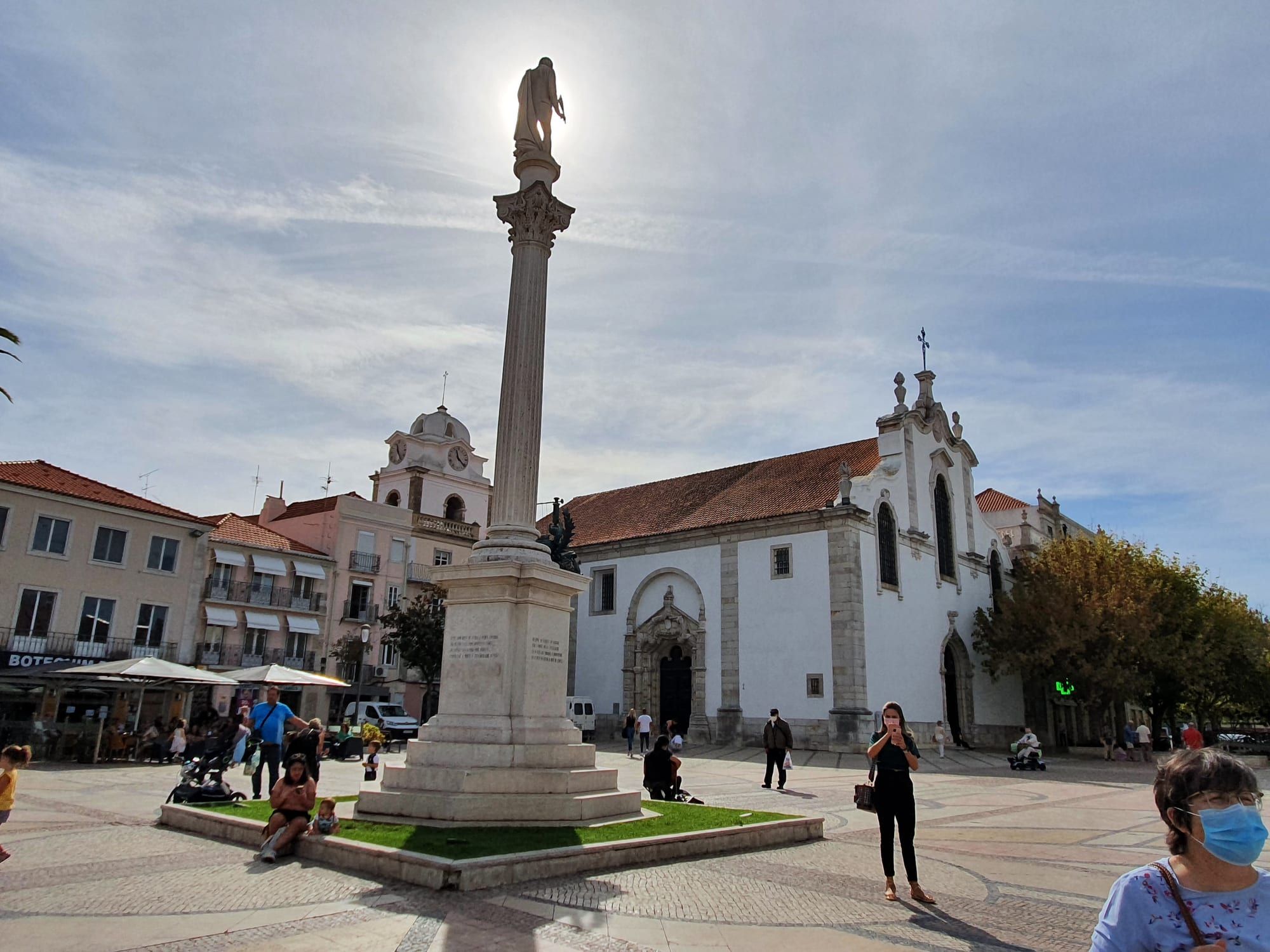
A paved square with a tall stone column topped by a statue, a white church with a carved portal and café umbrellas

Lisbon & the Coast, Portugal

Setúbal

Praça do Bocage, the main square of Setúbal, with the monument to the poet Bocage. (GualdimG / Wikimedia Commons · CC BY-SA 4.0)

A port city on the northern shore of the Sado estuary, about 50 kilometres south of Lisbon by road, built on fish-salting, sea salt and later sardine canning. The canneries have gone, but the port, industry and fishing boats remain, and the city is known for fried cuttlefish, a resident dolphin colony and the limestone coast of the Arrábida on its doorstep.

Neighbourhoods

  • Historic centre and Avenida Luísa Todi
    • First-time visitors
    • Historic district
    • Best for food

    The flat old town around Praça do Bocage and the church of São Julião, and the long avenue along the old waterfront. The Livramento market, the Monastery of Jesus, the city museum and many of the seafood restaurants are all within walking distance.

    Open in Maps
  • Troino and Fontainhas
    • Local life
    • Seafood

    Among the most traditional quarters of the city, where much of the fishing community lived. The ferry to Tróia leaves from the Fontainhas dock.

    Open in Maps
  • Albarquel and the Arrábida road
    • Parks
    • Beaches

    West of the end of Avenida Luísa Todi, the Albarquel urban park and beach lead on to the road along the estuary into the Arrábida hills, with beaches such as Figueirinha, Galápos, Galapinhos and Portinho da Arrábida.

    Open in Maps
  • Azeitão
    • Wine
    • Countryside

    A cluster of small villages on the inland side of the Arrábida, part of the Setúbal municipality, famous for its sheep's cheese, its tortas and its wine cellars, including the José Maria da Fonseca family winery founded in 1834.

    Open in Maps

Things to do

Historic Setúbal

  • Monastery of Jesusmuseum

    A former convent of Poor Clare nuns and one of the first buildings in the Manueline style, the Portuguese late Gothic; its cloisters house a museum.

    Open in Maps
  • Igreja de São Juliãolandmark

    The main church of the city on Praça do Bocage, an 18th-century building with Manueline portals.

    Open in Maps
  • Our Lady of Grace Cathedrallandmark

    The seat of the Diocese of Setúbal, known for its Mannerist façade.

    Open in Maps
  • Fort of São Filipeviewpoint

    A fortress built between 1582 and 1600 on a hill beside the city, overlooking the city and the estuary.

    Open in Maps
  • Livramento Marketmarket

    The city's covered market on Avenida Luísa Todi, where the morning fish stalls show off the catch from the Sado and the Atlantic.

    Open in Maps

The estuary and the Arrábida

  • Sado Estuary Natural Reservepark

    The protected estuary between Setúbal and Alcácer do Sal, home to a colony of bottlenose dolphins that boat trips from the city go out to see.

    Open in Maps
  • Arrábida Natural Parkpark

    A limestone range rising to about 500 metres straight from the sea, with sheltered beaches such as Galapinhos, Portinho da Arrábida and Figueirinha below a 16th-century convent.

    Open in Maps

Short trips from the city

  • Tróia Peninsulabeach

    The long sandy peninsula across the estuary, reached by ferry from the city, with Atlantic beaches facing the open sea.

    Open in Maps
  • Roman ruins of Tróialandmark

    Remains of fish-salting works, baths and burial grounds used from the 1st to the 6th centuries, on the estuary shore of the Tróia peninsula.

    Open in Maps
  • Castle of Palmelalandmark

    A hilltop castle, a national monument, on the eastern end of the Arrábida range between the Tagus and Sado estuaries.

    Open in Maps

Eat and drink

Long-standing places and food districts in Setúbal. Hours, ratings and directions come from your maps app, always current.

Setúbal classics

  • Choco frito restaurantsneighborhood

    Small restaurants and tascas around the centre and the docks serve the city's signature, fried cuttlefish in slabs, with chips and salad.

    Open in Maps
  • Livramento Marketmarket

    The covered market on Avenida Luísa Todi, best in the morning, with fish from the local boats, fruit and vegetables.

    Open in Maps

Wine and the countryside

  • José Maria da Fonsecarestaurant

    A family winery in Azeitão since 1834, whose founder is credited with creating the fortified Moscatel de Setúbal; it offers tastings.

    Open in Maps
  • Azeitãoneighborhood

    The villages behind the Arrábida known for Azeitão sheep's cheese, tortas de Azeitão and Moscatel.

    Open in Maps

Experience Setúbal

History

In antiquity Setúbal was Cetobriga, a settlement visited by Phoenicians, Greeks and Carthaginians in search of salt and tin and later a Roman town of fish-salting works and pottery kilns; more salting tanks survive across the estuary at Tróia. After the fall of Rome, invasions and piracy left the place stagnant or abandoned for centuries, and in Arabic it was known as Shaṭūbar. After the Christian reconquest it came under the protection of the Order of Santiago, which granted it a charter in March 1249. John II began the square now called Praça do Bocage and an aqueduct in 1487, and the Monastery of Jesus, one of the first Manueline buildings, was founded in the same period.

Salt made the town rich. In the 17th century it reached the height of its prosperity, when the salt of "Saint Ubes", as the English called it, served as currency and payment to the European states that had backed Portugal's wars of restoration; it was still being exported as far as Australia in the 1830s. The 1755 earthquake, with the sea and fire that followed, interrupted that prosperity.

The railway arrived in 1860, the year King Pedro V raised Setúbal to a city, and the river was filled in to build the Avenida Luísa Todi. The first canneries of sardines in olive oil opened in the 19th century, and by the early 20th century Setúbal was Portugal's most important centre of the fishing industry. The canneries declined from the mid-1970s until none remained, and the city turned to heavy industry, its port and, increasingly, tourism.

Culture & Customs

Setúbal honours its poets and musicians. The city holiday, 15 September, marks the birth in 1765 of Manuel Maria Barbosa du Bocage, the satirical and classical poet, whose statue stands on a column in the main square and whose house is now a museum. The opera singer Luísa Todi gave her name to the main avenue and the municipal theatre, and the singer-songwriter Zeca Afonso lived, worked and died in the city. Teatro Animação de Setúbal is based here.

The city's identity is that of a working port. The old fishing quarters of Troino and Fontainhas, the cannery history told at the Michel Giacometti Museum of Work and the boats still landing fish at the docks keep that past visible. The Diocese of Setúbal has its seat at the Cathedral of Our Lady of Grace, and its current bishop, Américo Aguiar, is a cardinal.

Football means Vitória de Setúbal, founded on 20 November 1910. The Sado's dolphins are a source of local pride: the colony is the only one living in a Portuguese estuary. On summer Sundays, people from Setúbal and Lisbon head for the Arrábida beaches below the hills.

Daily Life

The city had about 90,000 inhabitants in 2021, and the wider municipality, which includes the villages of Azeitão, about 124,000. It is the capital of the Setúbal District and part of the Lisbon metropolitan area, and many residents commute to the capital by train or across the Tagus bridges.

Industry still matters more here than in most Portuguese cities: pulp and paper, cement, fertilisers and other chemicals, power generation, shipbuilding and ship repair, and car assembly, which has been part of the local economy since the 1950s. The port was the fourth busiest in Portugal by cargo in 2012. Unemployment has been a persistent problem — 15.6 per cent of the labour force was out of work at the 2011 census — and services now employ most people, with tourism growing on the strength of the estuary, the beaches and the Arrábida.

Everyday life is centred on the flat old town and the avenue along the water: the morning market, coffee at the counter, lunch in a tasca and an evening walk by the river. Bus services in the city and the surrounding towns have been run under the Carris Metropolitana network since 2022.

Food

Setúbal's cooking is built on fish from the Sado and the Atlantic, roasted, boiled or grilled, and the city is best known for choco frito — cuttlefish marinated and fried without flour or breadcrumbs, served in generous slabs with chips and salad in restaurants across the centre. Migrants from the Alentejo and the Algarve added meat and poultry dishes and açordas, bread-based dishes that were adapted here to seafood and fish. The Livramento market on Avenida Luísa Todi is the place to see the catch, and the tascas in the streets around it serve seafood at modest prices.

The surrounding countryside supplies the rest of the table. Azeitão, on the inland side of the Arrábida, makes a sheep's cheese with protected designation of origin, and tortas de Azeitão, a sweet made with egg yolks, sugar and ovos moles. In the 19th century Setúbal's oranges became famous alongside its Moscatel.

Moscatel de Setúbal is the region's fortified Muscat wine. The style is credited to José Maria da Fonseca, whose family winery in Azeitão dates from 1834 and still offers tastings, and the region also makes liqueurs and traditional sweets of its own.

Planning tools

Budget

Setúbal is noticeably cheaper than Lisbon, Cascais or Sintra, and a meal of grilled fish or fried cuttlefish in a local tasca is one of the best values on the coast. The main extra costs are dolphin-watching trips, the ferry to Tróia and, for the Arrábida beaches in summer, getting there without a car.

Daily Budget Midrange
USD 140–260 (central hotel, restaurant dinners, a boat trip on the Sado, the ferry to Tróia)
Daily Budget Shoestring
USD 60–100 (hostel or simple guesthouse, tasca lunches, the train and local buses)

Eat at lunchtime in the tascas near the market, where fish and seafood are cheap and fresh.

Best Time to Visit

Late spring and early autumn are the most comfortable seasons, warm but not hot, with the Arrábida beaches quiet. July and August are hot and dry, and the beaches and the coast road fill at weekends. Winter is mild and wet, with most of the year's rain from November.

Suggested Number of Days

The city centre and its monuments need a day or two. Allow longer to include the beaches, the hills and the wine country around the city; a car or boat trips make more of the surroundings possible.

First Visit
1–2 days
With Surroundings
3–4 days

Transportation

The centre is flat and compact. Urban buses run by Carris Metropolitana serve the city and the surrounding towns from the main bus terminal next to the railway station. Ferries cross to Tróia in about 25 minutes and a catamaran in about 15, and taxi boats serve Tróia and the beaches. The Arrábida coast road is best explored by car, and parking is limited in summer.

Taxi boats from the city reach Tróia and some of the estuary beaches without the need for a car.

Airport & Station Connections

Setúbal is about 50 kilometres from central Lisbon by road, on the A12 motorway across the Tagus. Fertagus suburban trains run directly to Lisbon, and CP trains run to Barreiro, which has ferries to central Lisbon. Buses link the city with Lisbon almost every hour. The nearest airport is Lisbon's Humberto Delgado Airport.

Walkability

The historic centre and Avenida Luísa Todi are flat and easy on foot, and most sights, the market and the ferry docks are within a short walk of each other. The walk west to Albarquel park is pleasant; the Arrábida beaches beyond are too far for most people to walk.

Safety

Portugal is one of the safest countries in Europe, with low violent crime. Setúbal is a working port city with fewer tourists than Lisbon, and the usual precautions against bag theft and car break-ins, above all at beach car parks, are enough.

Leave nothing in parked cars at the Arrábida beaches, and swim where lifeguards are on duty. Check current official travel advice before travelling.

Climate

A Mediterranean climate with mild, rainy winters and hot, dry summers. The mean annual temperature is about 16.5–17°C, and in August 2018 the city recorded 45.5°C, one of the highest temperatures ever measured on the coast of the Iberian Peninsula.

Summer
hot and dry — days of 28–31°C and nights of 15–17°C, with little rain
Winter
mild and wet — days of 15–17°C and nights of 5–8°C, with most rain from November

Local Customs

Tipping is not generally expected in Portugal, though a euro or two after a full meal is appreciated when service has been good. Bread, olives and other starters put on the table are charged if eaten, and can be refused. Setúbal is a working city with a strong local identity; a greeting in Portuguese is appreciated.

The legal drinking age is 18. Dress modestly in churches and the monastery, and keep beachwear for the beach.

Common Payment Methods

Portugal uses the euro. Cards and contactless payment are widely accepted, but carry some cash for market stalls, small tascas and ferries. Multibanco ATMs are common in the centre.