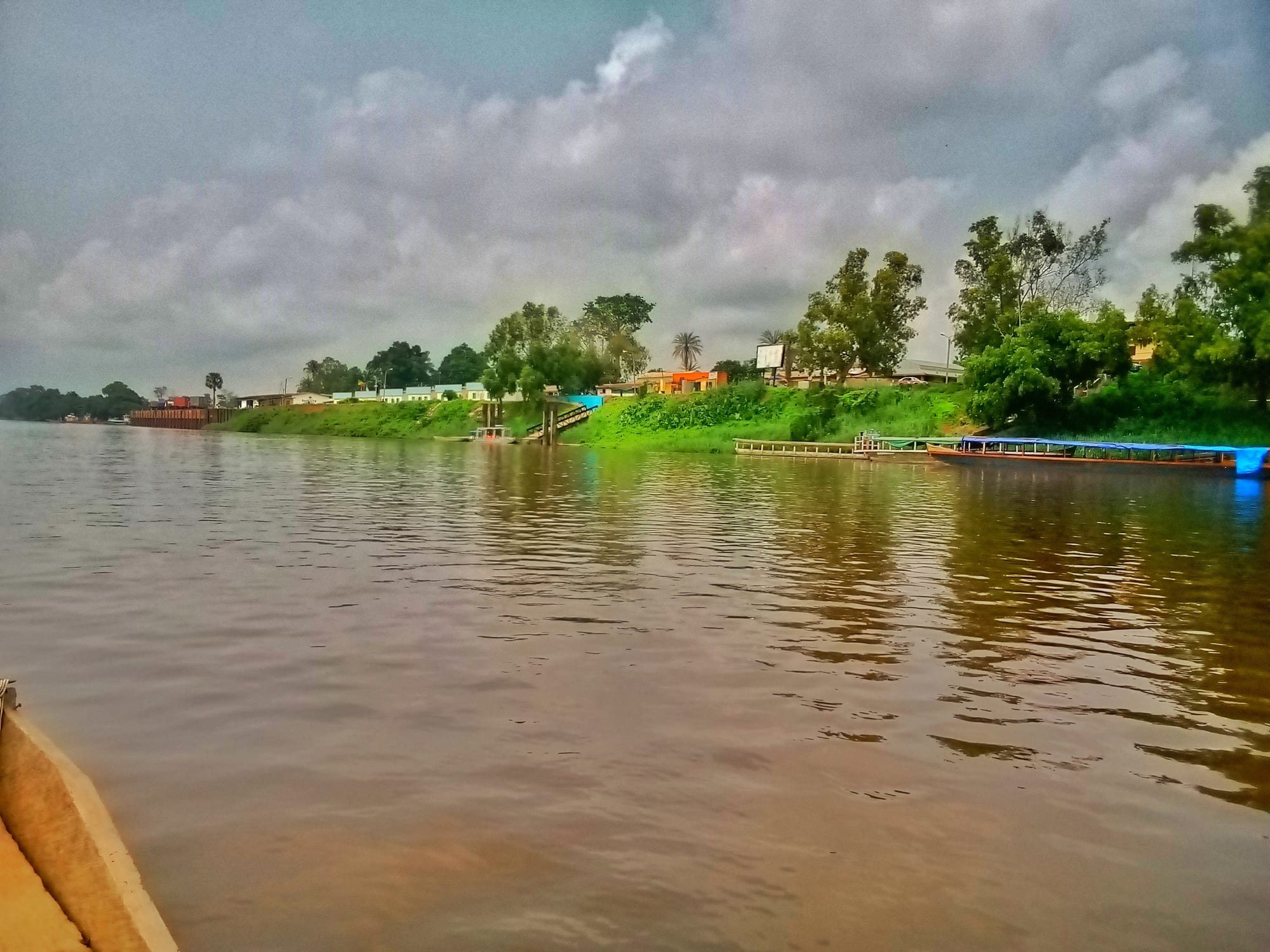
Wooden boats moored along a green riverbank at Ouesso, with low buildings among trees above the brown water

Odzala & the North, Republic of the Congo

Ouesso

Boats moored on the Sangha River at Ouesso. (Boussimanitou01 / Wikimedia Commons · CC BY-SA 4.0)

A river town on the Sangha in the far north of the Republic of the Congo, close to the Cameroon border and surrounded by rainforest. Capital of the Sangha department, it lives on timber, river trade and its market, and is the usual staging point for travel towards Nouabalé-Ndoki National Park.

Neighbourhoods

  • The centre and the administrative quarter
    • First-time visitors
    • Practicalities

    The few paved streets around the department offices, the church, banks and the town's guesthouses. Almost everything a visitor needs is within a short walk, and the road south towards Brazzaville begins here.

    Open in Maps
  • The riverfront and the port
    • River life
    • Markets

    The bank of the Sangha where pirogues and motor boats load timber, fuel, fish and passengers. It is the busiest part of town, with traders, boatmen and stalls along the shore.

    Open in Maps
  • The market quarter
    • Local life
    • Best for food

    The streets around the main market, where forest produce, smoked fish, cassava and imported goods change hands. Small eating houses and bars sit among the stalls.

    Open in Maps

Things to do

The town and the river

  • The Sangha Riverattraction

    The great northern tributary of the Congo, flowing past the town from the Cameroon border and carrying most of the region's traffic.

    Open in Maps
  • Ouesso marketmarket

    The town's central market, where forest produce, smoked fish, cassava and goods brought upriver or down the highway are sold.

    Open in Maps
  • Ouésso Airporttransit hub

    The town's airport just outside the built-up area, its air link with Brazzaville; the number of flights fell after the airport was renovated in 2020.

    Open in Maps

Short trips from the town

  • Nouabalé-Ndoki National Parkpark

    A roadless block of rainforest established in 1993, with western lowland gorillas, chimpanzees and forest elephants, and known for the clearing at Mbeli Bai, where gorillas gather.

    Open in Maps
  • Sangha Trinationalpark

    The transboundary UNESCO World Heritage Site inscribed in 2012, joining Nouabalé-Ndoki with protected forests in Cameroon and the Central African Republic.

    Open in Maps
  • Pokolaattraction

    A company town downstream on the Sangha, headquarters of one of the country's largest logging operations and a stop on the river route.

    Open in Maps

Seasonal events

  • Drier months on the riverJune to August and December to February

    The drier spells, when forest tracks firm up, park lodges run their main seasons and travel beyond the town is easiest.

  • High water on the SanghaSeptember to November

    The months of highest river levels, when boat traffic to the villages and logging towns upstream and downstream is at its busiest.

  • Independence Day15 August

    The national holiday marking independence from France in 1960, marked in the town with official ceremonies, football and music.

Eat and drink

Long-standing places and food districts in Ouesso. Hours, ratings and directions come from your maps app, always current.

What is eaten in Ouesso

  • Smoked fish from the Sanghamarket

    Fish caught in the river and smoked over wood fires is the staple protein, sold blackened in stacks at the market and eaten with cassava.

    Open in Maps
  • Koko and forest greensrestaurant

    Thinly shredded leaves of a wild forest vine cooked with palm oil and peanut paste, a northern dish served in the town's small eating houses.

    Open in Maps
  • Chikwangue and fufu kitchensrestaurant

    Cassava in its two everyday forms — the leaf-wrapped steamed loaf and the pounded paste — served with fish or meat in a tomato or groundnut sauce.

    Open in Maps

Market streets

  • Ouesso market stallsmarket

    Cassava, plantain, groundnuts, wild mushrooms and honey in season, alongside grilled snacks sold from braziers through the day.

    Open in Maps

Experience Ouesso

History

Ouesso grew from a river settlement of the Sangha peoples into a French post as the Sangha became the route into the northern forests. The wider region was handed over to concession companies that took rubber and ivory with forced labour; the abuses that followed led to a French government inquiry headed by Pierre Savorgnan de Brazza in 1905.

The river, not the road, made the place. Everything moving between the northern forests and the rest of the colony passed along the Sangha to the Congo, and Ouesso became the administrative centre for a vast, thinly settled district. It is the capital of the Sangha department, holding the prefecture, the courts, the hospital and the schools that serve a region of scattered villages and logging camps.

Timber has shaped the modern town. Industrial logging concessions opened in the surrounding forest through the second half of the twentieth century, with company towns such as Pokola downstream, and the roads they cut opened the forest to settlement and to hunting. From the 1990s conservation came with it: Nouabalé-Ndoki National Park was created in 1993 to the north-east, and in 2012 it was inscribed, with forests in Cameroon and the Central African Republic, as the Sangha Trinational World Heritage Site. The 828-kilometre RN2 road to Brazzaville, and a road west to Cameroon completed in 2021, have since ended the town's isolation.

Culture & Customs

Ouesso is a meeting point of peoples. The Sangha valley holds a mosaic of Bantu farming and fishing groups, and Aka and other forest hunter-gatherers live in and around the district, trading forest products with their neighbours and working as trackers and guides in the parks; they face long-standing discrimination, which a national law on indigenous rights was passed to address. Migrants from the Cuvette and the south work in the timber companies and the administration, and traders cross regularly from Cameroon.

Lingala is the common language of the town and the river, used alongside French in offices and local languages at home. Christianity is the majority faith, with Catholic and Protestant congregations and revivalist churches, while belief in ancestors and forest spirits remains strong in the villages. Music is Congolese rumba and its descendants, played from speakers in the bars, with Aka polyphonic singing a distinct tradition of the forest communities.

Village and town life turn on lineage, the chief and the church. Visitors are expected to greet, to explain themselves and to accept the pace at which things are settled. Bushmeat is part of ordinary diet and conversation here, even as the parks and their patrols work to stop the trade in protected species.

Daily Life

Ouesso had 75,095 residents at the 2023 census, which makes it the largest town in the Sangha department, and it grows as people arrive from the villages. The economy rests on three things: timber, the river and the state. Logging companies employ workers directly and support a chain of transport, workshops and trade; the Sangha carries goods, passengers and fish; and the departmental administration, the hospital and the schools provide most of the salaried jobs.

Conservation has become a significant employer too. Park staff, ecoguards, researchers and lodge workers pass through the town, and supplies for the camps in the forest are bought and shipped from here. Market trading, fishing and small-scale farming of cassava and plantain occupy most families, and much of the work is informal.

The town is low-built and spread along the river, with a small paved core and unpaved streets beyond it. Electricity and mobile coverage are patchy, fuel supply is uncertain, and most journeys are made on foot or by motorcycle taxi. The rhythm is set by the market in the morning, the heat in the middle of the day, and the arrival of boats and lorries, which draws crowds whenever they come.

Food

The Sangha feeds the town. Fish caught in the river is eaten fresh, or smoked over wood fires until it is blackened and hard, which preserves it for the markets of the interior and for sale as far away as Brazzaville. It is the protein that appears at most meals, cooked in a tomato or groundnut sauce and eaten with cassava.

Cassava comes as chikwangue, the dense fermented loaf steamed in leaves, or as fufu, the pounded paste, with plantain beside it. Koko, the thinly shredded leaves of a wild forest vine cooked with palm oil and peanut paste, is the northern green that visitors notice first; saka-saka, made from cassava leaves, is eaten here as everywhere in the country. Wild mushrooms and honey are gathered in season, and edible caterpillars are a seasonal delicacy in the markets.

Game from the forest — antelope, porcupine and other animals — is widely eaten, though hunting protected species such as gorillas and elephants is illegal and the parks work to curb the trade. Palm wine is the village drink, bottled lager comes up the road and the river, and strong sweet coffee and bissap are sold at stalls.

Planning tools

Budget

The town itself is cheap: basic guesthouses, local food and shared transport cost little. Everything beyond it is expensive, because vehicles, boats, fuel and guides must be hired, and the national park is visited on operator packages that cost far more than a night in town.

Daily Budget Midrange
USD 210–440 (private 4x4 with driver, better town hotels, boat hire)
Daily Budget Shoestring
USD 50–95 (basic guesthouse, local food, shared vehicles and river boats)

Carry XAF cash from Brazzaville, since cash machines are scarce and cards are not accepted.

Best Time to Visit

The drier spells, roughly June to August and December to February, are the best times, with firmer forest tracks and easier road travel from the south. Rain falls in every month, and the wettest periods make unpaved roads and forest trails hard going.

Suggested Number of Days

A day covers the town itself. Anyone travelling on into the forest should allow several more, since park visits are arranged as multi-day trips and transport by road and river is slow and weather-dependent.

First Visit
1 day
With Surroundings
4–6 days

Transportation

The town is small enough to cross on foot, with motorcycle taxis and a few shared vehicles for longer hops. Boats on the Sangha link Ouesso with villages, logging towns and the park base, and 4x4 vehicles use the logging roads into the forest. Journeys depend on river levels, weather and fuel supply.

Arrange vehicles, boats and guides through park operators or local contacts in advance, and allow generous margins for delays.

Airport & Station Connections

The Route Nationale 2 covers the 828 kilometres north from Brazzaville to Ouesso, a long journey of well over a day by bus or car. The airport beside the town carries the air link with Brazzaville. Boats work the Sangha to and from the towns upstream and downstream, and a road west to Cameroon, completed in 2021, removed the ferry crossing that route once needed.

Walkability

The centre, the market and the riverfront are all within walking distance of one another, and most people get about on foot. Streets away from the main road are unpaved and muddy after rain, there is little street lighting, and the heat and humidity make midday walking uncomfortable.

Safety

The north is calm and crime is lower than in the big southern cities. The practical risks are remoteness, poor roads, long distances from medical care, malaria and other tropical diseases. The border with Cameroon and the forest routes are patrolled, checkpoints are frequent, and forest wildlife is dangerous on foot without a guide.

Carry malaria prophylaxis and the yellow fever certificate, follow guides' instructions on foot in the forest, and arrange medical evacuation insurance. Check current official travel advice before travelling.

Climate

Equatorial and wet, just north of the Equator, with high humidity and little variation in temperature through the year. Rain falls in every month, with drier spells around June to August and December to February.

Summer
hot and humid, around 24–32°C, with heavy rain and thunderstorms
Winter
drier spells, still humid, around 22–30°C, with lower rivers and firmer forest tracks

Local Customs

French is the administrative language and Lingala the everyday speech of the town, alongside local Sangha languages. Greetings are long and expected before any request. Visitors travelling on to villages are expected to greet the local chief and explain their purpose. Aka and other forest communities live in and around the district and should be treated with the same courtesy as anyone else.

Ask before photographing people, especially forest communities, never photograph officials, soldiers or border posts, and keep identity documents to hand for checkpoints.

Common Payment Methods

The currency is the Central African CFA franc (XAF), pegged to the euro. Everything is paid in cash; cards are not accepted and cash machines cannot be relied on, so money is brought from Brazzaville. Mobile money is used by some traders.