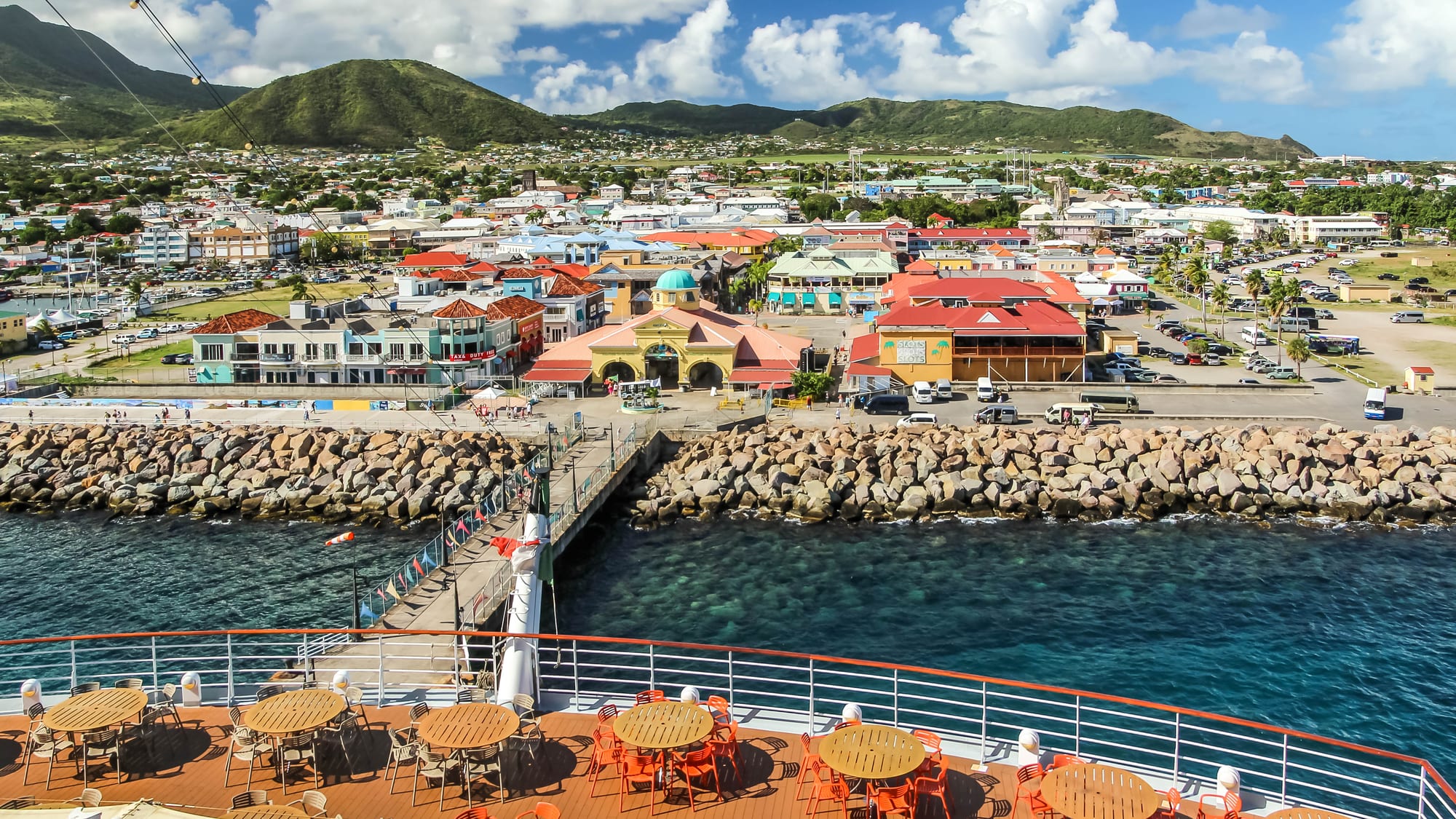
Basseterre's colourful waterfront buildings and the Port Zante terminal behind a rock breakwater, with green hills beyond

Saint Kitts and Nevis

Basseterre

Basseterre's waterfront and the Port Zante cruise terminal, with green hills behind the town. (Dr. Thomas Liptak / Wikimedia Commons · CC BY-SA 4.0)

The capital of Saint Kitts and Nevis, on a bay on the south-west coast of Saint Kitts. Founded by the French in 1627 and largely rebuilt after the great fire of 1867, it is a small grid of streets around the Circus and Independence Square, now a cruise port and the seat of the Eastern Caribbean Central Bank.

Neighbourhoods

  • Downtown, the Circus and Independence Square
    • First-time visitors
    • Historic district
    • Close to public transport

    The old centre is a small grid of streets — Bay Road, Liverpool Row, Central Street and Cayon Street, crossed by Fort Street and Bank Street with most of the shops and banks. It has two hubs: the Circus with its clock, geared to visitors, and Independence Square, with the cathedral, courthouse and most of the older buildings.

    Open in Maps
  • Port Zante and the waterfront
    • Cruise visitors
    • Shopping
    • Ferries

    Land reclaimed from the sea in 1995 in the middle of the bay, where cruise passengers step ashore into a duty-free, open-air shopping area that leads straight into downtown. The ferries to Charlestown on Nevis and the buses to the west of the island leave from the waterfront nearby.

    Open in Maps
  • Frigate Bay
    • Beaches
    • Restaurants and bars
    • Resorts

    Two bays south-east of the capital, at the neck of the Southeast Peninsula. The Atlantic side is extensively developed, while the calmer beach on the Caribbean side is popular with Basseterre locals, and a strip of restaurants and beach bars lines the southern beach.

    Open in Maps

Things to do

Famous landmarks

  • The Circus and the Berkeley Memoriallandmark

    The roundabout modelled on London's Piccadilly Circus, centred on a Glasgow-made memorial of 1883 with a drinking fountain and four clock faces, one looking down each of the streets that meet there.

    Open in Maps
  • Independence Squarepark

    The former Pall Mall Square, acquired by the government in 1750 and renamed at independence in 1983; enslaved men, women and children were sold here, on the spot where the fountain now stands.

    Open in Maps
  • St. George's Anglican Churchlandmark

    A stone church consecrated in 1859 on a site used for worship since a French Jesuit church of 1670, gutted in the great fire of 1867 and restored two years later.

    Open in Maps
  • Basseterre Co-Cathedral of Immaculate Conceptionlandmark

    The Roman Catholic cathedral on East Square Street, dedicated in 1928 on the site of an earlier church, its community strengthened by Portuguese migrants from Madeira from 1835.

    Open in Maps

Markets and shopping

  • Public Marketmarket

    Basseterre's public market, one of the town's shopping stops alongside the Amina Craft Market.

    Open in Maps
  • Amina Craft Marketmarket

    A craft market in Basseterre; among the island's crafts, its batik — sold as cloth, clothing and home decorations — is especially well regarded.

    Open in Maps
  • Port Zanteattraction

    The cruise pier and the duty-free open-air shopping area built on reclaimed land on the waterfront, where shops may ask for a cruise card or passport before giving duty-free prices.

    Open in Maps

Sport and beaches

  • Warner Park Sporting Complexattraction

    The cricket and football grounds that hosted matches in the 2007 Cricket World Cup, home of the St Kitts & Nevis Patriots in the Caribbean Premier League, with the open ground used for Carnival events.

    Open in Maps
  • Frigate Baybeach

    Swimming beaches south-east of the capital, with a calm Caribbean-side beach popular with Basseterre residents and a rougher, built-up Atlantic shore.

    Open in Maps

Short trips from the city

  • Brimstone Hill Fortress National Parklandmark

    One of the best-preserved historic fortifications in the Americas, designed by British military engineers and built by enslaved Africans on a steep hill above the west coast; a UNESCO World Heritage Site since 1999.

    Open in Maps
  • St. Kitts Scenic Railwayattraction

    An 18-mile narrow-gauge line laid between 1912 and 1926 to carry cane to the sugar factory in Basseterre, carrying tourists in open-topped double-deck carriages since 2003.

    Open in Maps
  • Romney Manorattraction

    A former sugar estate, worked by enslaved people until 1834, that is now home to a batik workshop and a botanical garden.

    Open in Maps
  • Mount Liamuigatrail

    The 3,792-foot volcano that forms the north-west of the island, its slopes rising through farmland and rainforest to cloud forest, with a hiking trail to the western rim of its summit crater.

    Open in Maps
  • Bloody Pointlandmark

    The headland where English and French colonists massacred some 2,000 Kalinago people in 1626.

    Open in Maps
  • Fort Charleslandmark

    The site of a British colonial fort established in 1670, also known as Cleverley Point Fort.

    Open in Maps

Seasonal events

  • Carnivalmid-December to early January

    Saint Kitts's biggest celebration, with calypso, soca, steelpan and masquerade troupes, running through Christmas and New Year.

  • St. Kitts Music FestivalJune

    A festival of popular music held every year since 1996, when it was first called the Shak Shak Festival.

Eat and drink

Long-standing places and food districts in Basseterre. Hours, ratings and directions come from your maps app, always current.

Basseterre classics

  • Goat waterrestaurant

    The best-known dish of the islands — goat stewed with breadfruit, green pawpaw and dumplings, known as droppers, in a tomato base.

    Open in Maps
  • Ting with a Stingrestaurant

    The unofficial national drink: Ting, a grapefruit soda, mixed with local rum, ideally CSR, the cane spirit distilled from fresh cane.

    Open in Maps

Food districts and markets

  • Basseterre Public Marketmarket

    The town's public market, alongside the shops of downtown Basseterre.

    Open in Maps
  • The Strip, Frigate Bayneighborhood

    A row of casual beach bars and restaurants on South Frigate Bay beach, one of the island's places to eat and drink by the sea.

    Open in Maps

Experience Basseterre

History

Basseterre was founded in 1627 by the French under Pierre Belain d'Esnambuc, as the capital of the colony of Saint-Christophe, which held the two ends of the island while the English held the middle. After Phillippe de Longvilliers de Poincy became governor in 1639 it grew into a large port that commanded trade across the eastern Caribbean, and he made it the capital of the whole French West Indies, Guadeloupe and Martinique included, until his death in 1660. Once the French had been expelled and Britain held the whole island, the town became the capital of Saint Kitts in 1727.

Few Caribbean capitals have suffered so much. Basseterre has been wrecked by colonial wars, fire, earthquakes, floods, riots and hurricanes; the church on the site of St. George's alone was burned in 1706, damaged in the fire of 1763 and ruined by the earthquake of 1842 and the hurricane of 1843. Most of today's centre was built after the great fire of 1867. The Circus was laid out on the model of Piccadilly Circus, and its fountain and clock were raised in 1883. Independence Square, bought by the government in 1750 as Pall Mall Square, was where enslaved Africans were auctioned.

The narrow-gauge railway laid from 1912 brought the island's cane to a central sugar factory in Basseterre, and sugar ran the town's economy until the factory closed in 2005. The square took its present name at independence in 1983, Port Zante was built on reclaimed land in 1995, and the city hosted Carifesta in 2000 and matches of the 2007 Cricket World Cup.

Culture & Customs

Carnival is the city's great festival, running through Christmas and New Year with calypso, soca, steelpan and masquerade troupes. Its musical roots are local: iron bands, playing percussion on car rims and other scrap, joined the celebrations in the 1940s, modern Carnival took shape in the late 1950s, and brass bands dominated the 1960s. Seasonal Christmas songs are the best-known traditional music. Each June the St. Kitts Music Festival, begun in 1996 as the Shak Shak Festival, brings Caribbean and international acts.

Sport means cricket above all. Warner Park staged first-round matches of the 2007 Cricket World Cup, and it is home to the St Kitts & Nevis Patriots in the Caribbean Premier League. The same park's open ground, Carnival City, hosts Carnival shows.

Basseterre has a large number of churches for its size. Most are Protestant — Anglican first, then Methodist, Moravian, Baptist, Pentecostal and others — while the cathedral is Catholic, and Afro-Christian traditions are also widespread. The everyday language is Saint Kitts Creole, an English-based creole shaped by West African speech.

Daily Life

About 14,000 people lived in Basseterre in 2018, in the low Basseterre Valley ringed by the Olivees Mountains and the Conaree hills. The College and Westbourne ghauts, dry for most of the year, even form streets downtown and have flooded the town many times.

Basseterre is the federation's commercial and financial centre. The Eastern Caribbean Central Bank, the Eastern Caribbean Securities Exchange and the St Kitts-Nevis-Anguilla National Bank are headquartered here, and industrial estates turn out electronics, food products, beverages and rum. Federal government offices are here too, while Nevis's are in Charlestown. Fort Street and Bank Street hold most of the shops and banks, and on cruise days thousands of passengers fill Port Zante and the streets beyond.

The town has four secondary schools and two private medical institutions, the Ross University School of Veterinary Medicine and the International University of Nursing. Buses start from the waterfront and the east of town for villages round the island, and the ferries to Charlestown run several times a day for workers, shoppers and visitors moving between the two islands.

Food

Goat water is the dish most associated with the islands: goat stewed with breadfruit and green pawpaw in a tomato base, with flour dumplings called droppers. Cook-up, or pelau, combines chicken, pig tail and saltfish with rice, pigeon peas and vegetables, and fresh seafood is plentiful.

The local drinks are a point of pride. CSR, Cane Spirits Rothschild, is distilled from fresh cane and counts as the national drink; mixed with Ting, the grapefruit soda, it becomes Ting with a Sting, the unofficial national drink. Carib and Stag beers have been brewed on Saint Kitts since 1997, and rum is as popular here as anywhere in the Caribbean.

The islands grow a wide variety of fresh produce, and the public market in town is one place to find it. For eating out, downtown has small local restaurants, while the strip of beach bars and restaurants at Frigate Bay offers meals by the sea.

Planning tools

Budget

Saint Kitts leans upmarket, especially around the resorts of Frigate Bay, but Basseterre itself is cheaper: guesthouses, local eateries and the public buses keep costs down. Taxis charge set, pre-calculated fares for each journey, and agreeing the fare before setting off is the norm.

Daily Budget Midrange
USD 180–400 (mid-range hotel or resort, restaurants, a hire car, tours and the scenic railway)
Daily Budget Shoestring
USD 70–120 (guesthouse, local restaurants, buses and the ferry)

Ask for the taxi fare before starting a journey; buses are the cheapest way round the island but do not run south to Frigate Bay and the Southeast Peninsula.

Best Time to Visit

December to April is the dry season and the busiest time, with Carnival filling Christmas and New Year. The wet season runs from May to November, though rain is usually brief and scattered; the hurricane risk is greatest from August to October. The St. Kitts Music Festival brings crowds in June.

Suggested Number of Days

Two or three days are enough for the town, the fortress and a beach. Four to six allow for the railway, a mountain hike and a crossing to Nevis. Cruise passengers usually have a single day ashore.

First Visit
2–3 days
With Surroundings
4–6 days

Transportation

Basseterre is the hub of every road on Saint Kitts, and traffic drives on the left. Public buses carry green plates starting with H and run five main routes from the waterfront and the east of town. Taxis, with yellow T plates, gather at the Circus and around the cruise terminal. Bicycles can be hired in town.

No public buses run south to Frigate Bay and the Southeast Peninsula, so a taxi or hire car is needed there.

Airport & Station Connections

Robert L. Bradshaw International Airport lies just north-east of the city, a short taxi ride from the centre, with direct flights from the United States, Canada, London and around the Caribbean. Cruise ships berth at Port Zante in the middle of the bay. Several ferries a day cross between Basseterre and Charlestown on Nevis, especially in the early morning and late afternoon.

Walkability

The centre is compact and flat — Basseterre means 'low land' — and the Circus, Independence Square, the market and Port Zante are all a short walk apart on a simple grid. Beyond downtown, Frigate Bay and the rest of the island need a car, taxi or bus. The ghauts, the river channels that cross the town, can flood in heavy rain.

Safety

The resort and tourist areas are generally safe, but the country has had a high per-capita homicide rate at times, driven by gang and drug violence among young men in specific neighbourhoods of Basseterre. This rarely touches visitors, but caution is advised after dark and away from the tourist areas, and petty theft from beaches, cars and rooms occurs.

Keep valuables off the beach and out of sight in cars, avoid isolated areas and walking alone at night, and swim on the calmer Caribbean side. Check current official travel advice before travelling.

Climate

Warm all year, with steady trade winds and plenty of sunshine. Basseterre is drier than much of the Caribbean, with about 35 inches of rain a year. The dry season runs from December to April and the wet season from May to November, when showers are usually short.

Summer
May to November is the wetter, hurricane-season half of the year; days reach about 84–88°F and nights stay around 73–77°F
Winter
December to April is dry and sunny, with daytime highs still around 84–88°F and nights about 73–77°F

Local Customs

English is the official language; the everyday speech is Saint Kitts Creole, in which the capital is 'Bastear'. The islands are strongly church-going: Anglicans are the largest denomination, followed by the Methodists, and there are many smaller congregations. Cricket is a shared passion, and Carnival is the social high point of the year.

Agree taxi fares before travelling, ask before photographing people, and keep beachwear for the beach.

Common Payment Methods

The currency is the Eastern Caribbean dollar (EC$), pegged at 2.70 to the US dollar; the Eastern Caribbean Central Bank has its headquarters in Basseterre. US dollars are accepted by virtually all merchants, cards work at hotels and larger restaurants, and there are ATMs in the town.