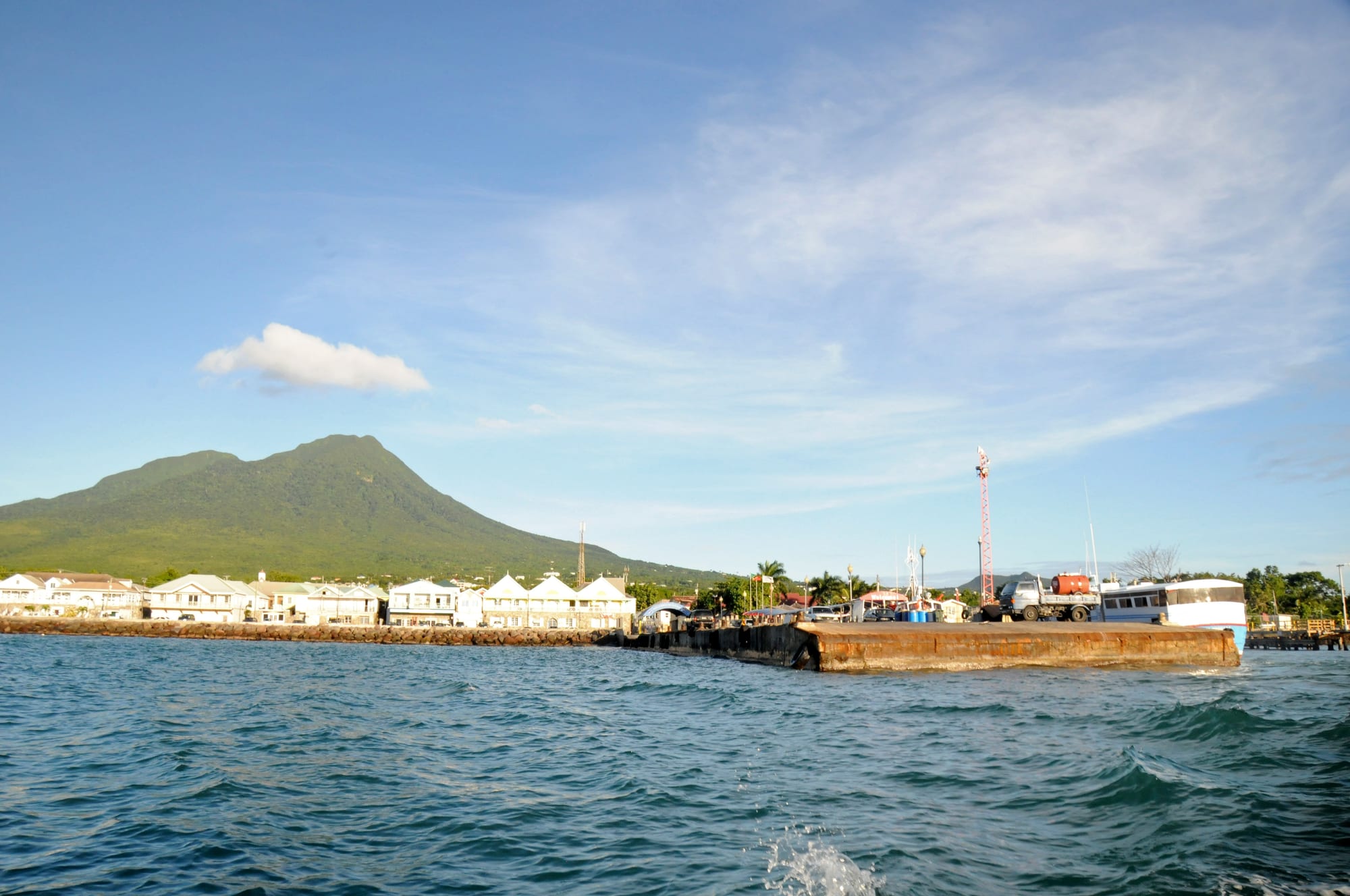
A row of white buildings along Charlestown's low waterfront and ferry pier, with the green cone of Nevis Peak rising behind

Saint Kitts and Nevis

Charlestown

Charlestown and its ferry pier seen from the sea, with Nevis Peak in the distance. (David Broad / Wikimedia Commons · CC BY 3.0)

The small capital of Nevis, on the island's sheltered west coast below the cloud-capped cone of Nevis Peak. Once a naval base and a spa town for the Caribbean's first tourist hotel, it is a ferry port of Georgian stone buildings with wooden upper floors, home to the island's government and the birthplace of Alexander Hamilton.

Neighbourhoods

  • Charlestown centre and the waterfront
    • First-time visitors
    • Historic district
    • Ferries

    The town's main street of Georgian stone buildings with balconies and wooden upper floors runs behind the ferry pier. Government offices, the courthouse and library, the post office, the museums, the market and Memorial Square are all within a few minutes' walk.

    Open in Maps
  • Bath
    • Hot springs
    • Quiet and residential
    • History

    A small village just south of town, named after the volcanic hot spring that has drawn bathers for centuries. The restored stone Bath Hotel of 1778 stands beside the spring, and the springs are open to the public.

    Open in Maps
  • Pinney's Beach
    • Beaches
    • Beach bars

    A long sandy beach that begins just outside the town and runs about three miles north to Cades Bay, with beach bars and a large resort along it.

    Open in Maps

Things to do

In town

  • Museum of Nevis Historymuseum

    A two-storey stone building, restored in 1983 on the site of the house where Alexander Hamilton was born, with the island's history museum downstairs and the Nevis Island Assembly's chamber upstairs.

    Open in Maps
  • Nevis Sport Museummuseum

    A small museum in the town devoted to the island's sporting history.

    Open in Maps
  • Nevis Philatelic Bureauattraction

    The bureau in Charlestown of interest to stamp collectors, with a large selection of stamps.

    Open in Maps
  • Fort Charleslandmark

    The overgrown ruins of the main fort that guarded Charlestown and its harbour from the 1630s, where an old wall, a cistern, a powder magazine and several cannon remain.

    Open in Maps

Hot springs, beaches and the mountain

  • Bath Hotel and the hot springsattraction

    The first tourist hotel in the Caribbean, built in 1778 by John Huggins over a thermal stream that drew Nelson and Coleridge; the restored building is closed but the springs are open to the public.

    Open in Maps
  • Pinney's Beachbeach

    Three miles of sand on the calm Caribbean coast, named after the Pinney family's 19th-century estate, with beach bars along its length.

    Open in Maps
  • Nevis Peaktrail

    The 3,232-foot volcano at the centre of the island, often wrapped in cloud, with trails on its lower slopes and a challenging route to the summit that should be walked with a qualified guide.

    Open in Maps
  • Vance W. Amory International Airporttransit hub

    The island's small airport near Newcastle in the north, with a single runway and regional flights.

    Open in Maps

Seasonal events

  • Culturamafirst week of August

    Nevis's annual cultural festival, held over the Emancipation Day weekend, with jamband music and J'ouvert dancing.

  • Christmas SportsChristmas and New Year

    A holiday-season tradition on Nevis, thought to be rooted in the days off the enslaved population was given at Christmas and New Year.

Eat and drink

Long-standing places and food districts in Charlestown. Hours, ratings and directions come from your maps app, always current.

Charlestown classics

  • Roti on the waterfrontrestaurant

    Roti, a flatbread rolled around a savoury filling, is widely available on the island; the Yellow Bus parked on the waterfront near the port is a well-known place to buy one.

    Open in Maps
  • Fancy Jamaican Bakerycafe

    A bakery facing the water, a little north of the port, known for raisin rolls, fresh bread and local bottled drinks.

    Open in Maps

Food districts and markets

  • Charlestown marketmarket

    An open-air market near the port selling fruit and vegetables, much of it grown on the island.

    Open in Maps
  • Pinney's Beach barsneighborhood

    A string of beach bars and grills along the sand north of town, each with its own rum punch and a barbecue night with music.

    Open in Maps

Experience Charlestown

History

The town was first known as Bath Bay, after Bath Stream and its curative waters, and became the island's chief town after Jamestown, the first settlement, was swamped by a tidal wave in 1680. Fort Charles, begun as early as the 1630s and later mounting 26 cannon, guarded it and its harbour, yet in the early 18th century a French force under Pierre Le Moyne d'Iberville overran the island, and in 1782 Nevis surrendered to Admiral de Grasse without a shot.

In the late 18th century Charlestown was both a naval base and a spa. The Bath Hotel, built in 1778 by John Huggins over a hot spring just south of town, was the first tourist hotel in the Caribbean, and its guests included Horatio Nelson, the poet Samuel Taylor Coleridge and Prince William Henry. Alexander Hamilton, later a founder of the United States, was born here; his birthplace was destroyed in an earthquake in 1840. Earthquakes repeatedly brought down the upper storeys of the town's stone buildings, which is why so many now have wooden upper floors over stone.

The town was almost destroyed by fire in 1873, and its hospital was wrecked by a hurricane in 1899. Electricity arrived in 1954, when two generators were shipped in to supply the area around Charlestown. Hamilton's birthplace was rebuilt in 1983 as the island's museum and assembly house, and a development programme in the early 2000s transformed the port.

Culture & Customs

As the seat of the Nevis Island Administration, Charlestown carries the island's strong sense of its own identity. The Nevis Island Assembly meets upstairs in the Hamilton house, and the island keeps a constitutional right to leave the federation if two-thirds of voters choose to.

Culturama, held over the Emancipation Day weekend at the start of August, is the island's great festival, driven by jamband music, the sound of J'ouvert dancing in the streets. The Christmas Sports, a holiday-season tradition, are thought to be rooted in the days off the enslaved population was given at Christmas and New Year before emancipation.

Manners matter. People greet everyone they pass, church attendance is high, swearing in public is illegal, and modest dress is expected away from the beach. Nevisians who do not work with visitors are often shy at first. The island is also proud of its literacy rate, one of the highest in the Western Hemisphere, and of its historic links to Hamilton and to Nelson, who married the young widow Frances Nisbet at Montpelier Estate in 1787.

Daily Life

About 1,500 people live in Charlestown, the island's administrative and commercial centre and its most built-up residential area. The courthouse and public library, the post office, the police station, the Alexandra Hospital and the tourism authority, in the old Treasury Building, are all in town, and the Cotton Ginnery Mall serves shoppers.

The ferry pier sets the rhythm of the day. Boats to and from Basseterre carry workers, shoppers and visitors, and departures often run late; minibuses run most often in the early morning and late afternoon, thin out in the middle of the day and stop at about nine at night. Banks, shops and government offices often have queues.

Children attend the island's five pre-schools, seven government primary schools and three secondary schools, and the education system follows the British model. The working week ends in quiet evenings: restaurants close early, and much social life happens in the snackettes, informal eating places that sell home-cooked meals and drinks in every village.

Food

Nevis cooking blends European and American styles with hints of African and Asian. Roti, a flatbread wrapped around a savoury filling, is widely available, and a yellow bus parked by the port is a well-known place to buy one. Breadfruit, coconut jelly, fresh mangoes and tamarind are local favourites, and goat water, perhaps the federation's best-known dish, stews goat with breadfruit, green pawpaw and dumplings. There are also several Chinese restaurants in and around town.

The open-air market near the port sells fruit and vegetables, much of it grown on the island. A bakery facing the water is known for its raisin rolls, and Charlestown has two ice-cream shops that make their own.

Drinks run from good tap water and home-made ginger beer brewed from local ginger to mildly alcoholic home-made sarsaparilla. Ting with a Sting mixes the grapefruit soda Ting with CSR, a spirit distilled from fresh sugar cane; Carib and Stag are the local beers; and every beach bar on Pinney's Beach has its own rum punch.

Planning tools

Budget

Nevis is the upmarket half of the federation, known for its plantation-inn and resort hotels, but Charlestown itself is straightforward: local bars and snackettes are informal, and the shared minibuses are cheap. Taxis are comfortable but relatively expensive, and fares may be quoted in either Eastern Caribbean or US dollars.

Daily Budget Midrange
USD 180–400 (mid-range hotel or resort, restaurants, a hire car, tours and the scenic railway)
Daily Budget Shoestring
USD 70–120 (guesthouse, snackettes and roti, buses and the ferry)

Ask the taxi fare in advance and confirm which currency it is in; the buses are the cheap way to see the island.

Best Time to Visit

December to April is drier, sunny and the main season. May to November is wetter and overlaps the hurricane season, which is riskiest from August to October. Culturama in early August is the liveliest week in town, and Christmas brings the Christmas Sports.

Suggested Number of Days

Two or three days are enough for the town, the hot springs and the beach. Four or five allow a guided climb of the peak, a tour round the island's old estates and a crossing to Saint Kitts. Most visitors come to slow down, which stretches the number.

First Visit
2–3 days
With Surroundings
4–5 days

Transportation

Charlestown is the hub of the island's transport. Buses are minivans with green plates beginning with H; they pick up and drop off anywhere on the 17-mile ring road, run most often early and late in the day, and stop at about 9pm. Taxis are vans with yellow T plates and can be hired for island tours. Hire cars come with a temporary local licence; driving is on the left.

Flag a bus with a downward wave of the hand, and watch for livestock and pedestrians on the road when driving.

Airport & Station Connections

Several passenger ferries a day cross from Basseterre on Saint Kitts to the pier in Charlestown, taking about 40 minutes; departure times are approximate and runs are sometimes cancelled. A car ferry, which also takes foot passengers, crosses in about 15 minutes from Majors Bay on Saint Kitts to Cades Bay, a few miles north of town. Vance W. Amory International Airport in the north of Nevis takes regional flights.

Walkability

The town is small and easy on foot: the ferry pier, main street, market, museums and government buildings are all close together, and Bath and the south end of Pinney's Beach are just outside the centre. Beyond that, the island is best reached by bus, taxi or car.

Safety

The resort and tourist areas are generally safe, but the country has had a high per-capita homicide rate at times, driven by gang and drug violence among young men in specific neighbourhoods of Basseterre. Nevis itself has a very low crime rate, and only very rarely is a visitor in danger.

Hike Nevis Peak only with a guide and tell someone the route, keep valuables off the beach, and take care with sunburn in the first few days. Check current official travel advice before travelling.

Climate

Tropical and warm all year, tempered by the trade winds. In Basseterre, across the Narrows, mean monthly temperatures run from about 75 to 81°F. A drier season runs from December to April and a wetter one from May to November; Nevis Peak is often in cloud.

Summer
May to November is the wetter, hurricane-season half of the year; Basseterre's monthly means stay within about 75–81°F
Winter
December to April is drier and sunnier; Basseterre's monthly means stay within about 75–81°F

Local Customs

Greeting people is expected: 'good morning', 'good afternoon' or 'good night', which is said instead of 'good evening'. Nevisians are church-going and can be shy with strangers at first. Swearing in public is against the law, provocative dress is frowned on, and topless sunbathing is not allowed. Queues and slow service are normal, and patience helps.

Always ask before photographing people or their houses — doing otherwise is considered very rude.

Common Payment Methods

The currency is the Eastern Caribbean dollar (EC$), pegged at 2.70 to the US dollar. US dollars are widely accepted, cards work at hotels and larger restaurants, and there are ATMs in Charlestown. EC dollar coins are handy for bus fares.