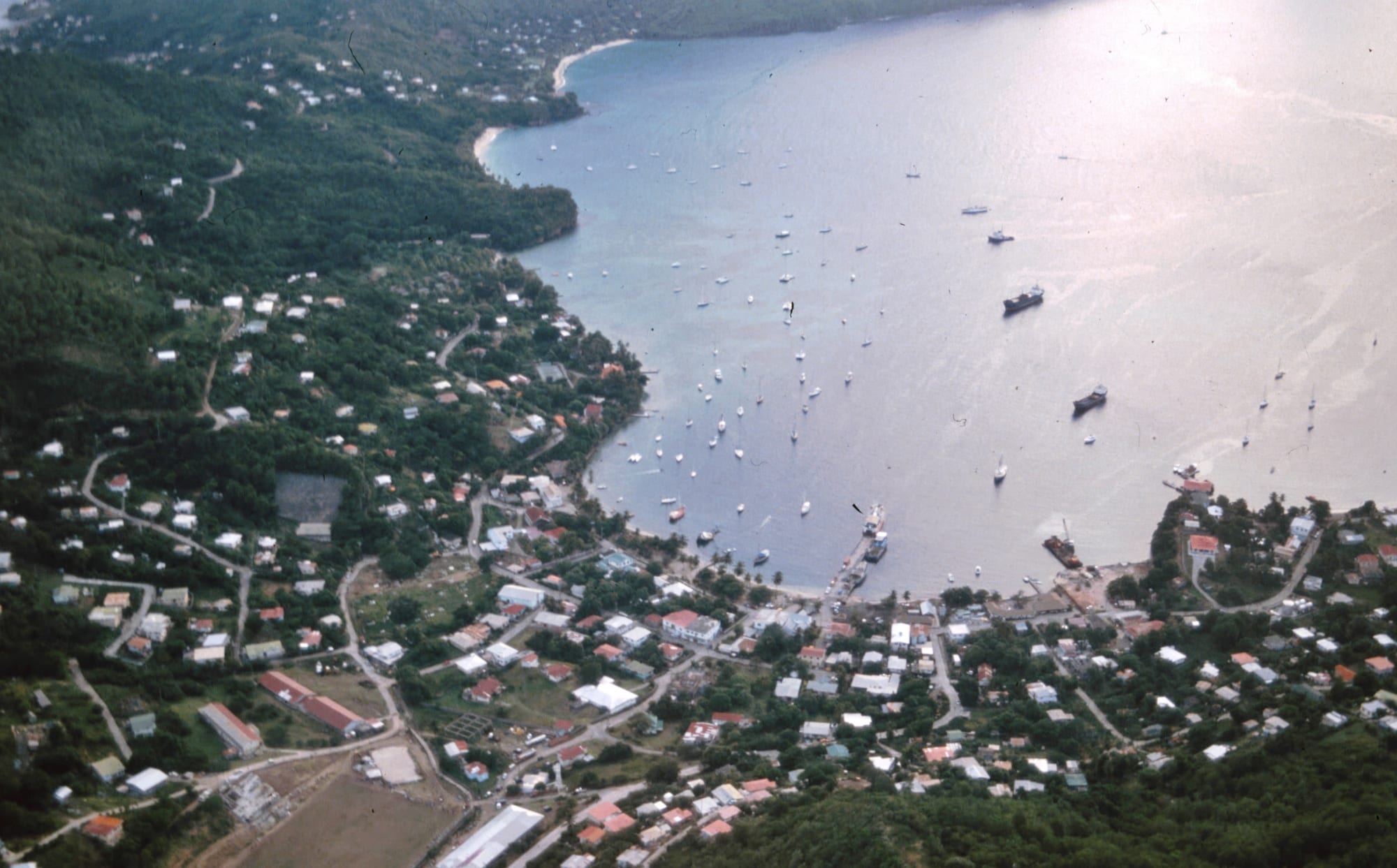
View over Port Elizabeth's houses and jetty on Admiralty Bay, with yachts at anchor and green hills around

Saint Vincent and the Grenadines

Bequia

Port Elizabeth and the anchorage of Admiralty Bay on Bequia. (qwesy qwesy / Wikimedia Commons · CC BY 3.0)

The second-largest island of the Grenadines, about 9 miles by sea south of Kingstown, whose capital, Port Elizabeth, lies on the deep, sheltered harbour of Admiralty Bay. Shaped by plantations, ship repair and a small whaling tradition, it is now a favourite of cruising yachts, with beaches and hillside villages close to the harbour.

Neighbourhoods

  • Port Elizabeth
    • First-time visitors
    • Sailing
    • Close to the ferry

    The island capital and the capital of Grenadines Parish, on the shore of Admiralty Bay, named in 1937 after Princess Elizabeth. The ferry terminal, the dinghy dock, waterfront bars and a vegetable market on the main street are all here, with yachts anchored across the bay.

    Open in Maps
  • Lower Bay and Admiralty Bay's beaches
    • Beaches
    • Quiet evenings

    Lower Bay is one of the island's villages, and Princess Margaret Beach, inside Admiralty Bay next to Port Elizabeth, is still called Tony Gibbons locally. Most places on the island are within walking distance of town.

    Open in Maps
  • Paget Farm and the south
    • Local life
    • Close to the airport

    The southern side of the island, where Paget Farm is home to the airport, built on reclaimed land, and the masons who helped build Moonhole on the western tip came from.

    Open in Maps
  • Mount Pleasant
    • Quiet and residential
    • Views

    A hill district settled by white Barbadians in the 1860s, many of whose descendants still live there.

    Open in Maps

Things to do

Beaches and the harbour

  • Princess Margaret Beachbeach

    A beach inside Admiralty Bay next to Port Elizabeth, renamed after Princess Margaret visited in the 1950s and still known locally as Tony Gibbons.

    Open in Maps
  • Admiralty Bayviewpoint

    The large natural harbour on the west coast, once thought the safest anchorage in the Eastern Caribbean in the hurricane season and now popular with cruising yachts.

    Open in Maps
  • Bequia dive sitesattraction

    Dive shops run trips to 28 identified sites around the island, including wrecks and shallow caves, where hawksbill turtles, lobsters and moray eels are often seen.

    Open in Maps

Island heritage

  • Whaling museummuseum

    A small museum on the island telling the history of Bequia's whaling, which began in the late 19th century.

    Open in Maps
  • Old Hegg Turtle Sanctuaryattraction

    The site of a turtle sanctuary at Park Bay.

    Open in Maps
  • Moonholelandmark

    A private community and nature preserve on the narrow western tip, founded in the 1960s by Thomas and Gladys Johnston, who began by building a house beneath a great natural arch; its homes use native stone, whalebone and hardwoods.

    Open in Maps

Walks and viewpoints

  • Mount Peggytrail

    A hike of about 45 minutes to a lookout with wide views.

    Open in Maps
  • J. F. Mitchell Airporttransit hub

    The island's small airport at Paget Farm, built on land reclaimed from the sea, with flights to Saint Vincent, Barbados and Saint Lucia.

    Open in Maps

Seasonal events

  • Bequia Easter Regatta and Music FestEaster

    One of the busiest times of the year on the island, when sailing races in the bay are joined by music on shore.

  • New Year's Day Lilo Regatta1 January

    A light-hearted race begun in 2010, when nearly 100 people set off across the bays on anything unmotorised that floats.

Eat and drink

Long-standing places and food districts in Bequia. Hours, ratings and directions come from your maps app, always current.

Bequia classics

  • Whaleboner Bar & Restaurantrestaurant

    A waterfront bar in Port Elizabeth, long known for its beach entrance through an arch of two whale ribs, with whale vertebrae for bar seats and a rib running the length of the bar.

    Open in Maps
  • Frangipanirestaurant

    A harbourside bar and restaurant that has traditionally held a small regular party on Thursday evenings.

    Open in Maps

Markets

  • Port Elizabeth vegetable marketmarket

    Fruit and vegetables on the main street near the dinghy dock, with cheaper stalls on the back streets.

    Open in Maps

Experience Bequia

History

The island's name is said to mean "island of the clouds" in the language of the ancient Arawak. Its early inhabitants were the Kalinago, who used it mainly for fishing and farming; early French accounts thought it too inaccessible to colonise. In the 18th century French settlers set up small plantations of indigo, cotton and sugar worked by enslaved Africans, and the Kalinago population was gradually displaced or absorbed. Under the Treaty of Paris of 1763 France ceded Bequia to Britain; the French seized it again in 1779 but soon had to give it back. Among the settlers who came under a British scheme granting land to poor colonists was James Hamilton, father of Alexander Hamilton, who lived by Southeast Bay from 1774 to 1790.

Admiralty Bay was the island's fortune. It is thought that buccaneers such as Henry Morgan anchored there, as it was then the safest natural harbour in the Eastern Caribbean in the hurricane season, and with cedar trees for timber and deep, sheltered water Bequia became a place for building and repairing wooden ships. Whaling was introduced by Yankee whalers in the 19th century, and in the 1860s white Barbadians settled at Mount Pleasant.

Port Elizabeth took its name in 1937, after Princess Elizabeth, to mark her parents' coronation. In the 1950s Princess Margaret visited and had a beach renamed in her honour; in the 1960s Thomas and Gladys Johnston founded Moonhole on the western tip. In 2024 Hurricane Beryl caused considerable damage on Bequia.

Culture & Customs

Bequia's identity is bound up with the sea. Boatbuilding, sailing and fishing run deep, and the island remains one of the few places in the world where limited whaling is still allowed. The International Whaling Commission classifies the hunt under its rules for aboriginal subsistence whaling: islanders may take up to four humpback whales a year by traditional methods, with hand-thrown harpoons from small open sailboats, but the limit is rarely met and some years see no catch. In 2012 the commission renewed the quota despite objections from several delegations that the hunt is not truly aboriginal and has broken the rules; a small museum on the island tells the history of the hunt.

The islanders are mainly of mixed African, Scottish and Kalinago descent, with descendants of 19th-century Barbadian settlers at Mount Pleasant. For its size the island has produced a notable number of people in politics and the arts: Sir Sydney Gun-Munro, the first Governor-General, and James Mitchell, Prime Minister from 1984 to 2000, both came from Bequia, and writers, editors, publishers, painters and graphic designers work here.

The sailing calendar shapes the social one. The Easter Regatta and Music Fest is one of the busiest times of the year, and since 2010 the New Year's Day Lilo Regatta has sent nearly a hundred people across the bays on anything that floats, as a cure for the night before.

Daily Life

About 5,300 people live on Bequia, an island of 7 square miles. Port Elizabeth, the capital of Grenadines Parish, holds the ferry terminal, and Paget Farm in the south the airport; other villages include Lower Bay, La Pompe, Hamilton and Belmont, while Spring, once a coconut plantation, keeps farm animals. The island's low hills catch fewer rain showers than the peaks of Saint Vincent, 10 miles to the north.

The island is popular with cruising yachts, expatriates and tourists, and two dive shops run trips to the reefs and wrecks offshore. Ferries run between Port Elizabeth and Kingstown several times a day, carrying passengers, cars and cargo, and many residents keep in touch by marine VHF radio on channel 68 as well as by telephone and the internet.

Hurricane Beryl, in July 2024, caused considerable damage on Bequia, while on Canouan, Mayreau and Union Island 80 to 90 per cent of dwellings were damaged to some degree; across the country it killed eight people.

Food

Bequia eats as the rest of the country does, from Creole cooking built on the sea and the garden. The national dish is roasted breadfruit with fried jackfish, and callaloo soup, stewed and grilled fresh fish, souse and provisions such as dasheen, sweet potato and plantain are the staples. Fresh fruit and vegetables are sold on the main street in Port Elizabeth near the dinghy dock, with cheaper produce on back-street stalls.

The island's plantation past included sugar, molasses and rum, and the country's rums, among them Hairoun and Vincy strong rum, are now exported, mainly to the European Union. Fresh juices, mauby and sorrel are the everyday drinks.

Eating out centres on the harbour. Waterfront bars and restaurants have lined Admiralty Bay, among them the Whaleboner, long known for its entrance through an arch of two whale ribs and its whale-vertebra bar stools, and Frangipani, traditionally home to a small party on Thursday nights.

Planning tools

Budget

Bequia is the affordable way into the Grenadines, with modest guesthouses and local eateries alongside more expensive villas and waterfront restaurants. The ferry from Kingstown and the island's local buses are cheap; boat charters, diving and dinners on the harbour are the bigger costs.

Daily Budget Midrange
USD 160–360 (mid-range hotel or villa, harbourside dinners, a dive or a boat trip)
Daily Budget Shoestring
USD 60–110 (guesthouse, local eateries and market fruit, local buses and walking)

Walk or use the local buses rather than taxis, and buy fruit and vegetables at the back-street stalls rather than the main market.

Best Time to Visit

December to May is the drier season and the sailing high season, when Admiralty Bay fills with yachts. The Easter Regatta and Music Fest is one of the busiest times of the year. June to November is the wetter hurricane season, with the greatest risk from August to October; Hurricane Beryl caused considerable damage on the island in 2024.

Suggested Number of Days

Two or three days cover the island at an easy pace. Allow a week to combine it with Saint Vincent or a sail further south; ferry and flight timings, and the weather in the hurricane season, can change the number.

First Visit
2–3 days
With Surroundings
5–7 days

Transportation

The island is small enough to walk across, and a local bus covers most of it cheaply; the walk from Admiralty Bay to Friendship Bay takes less than an hour. Charter and tour boats are based in Port Elizabeth, and many visitors move around by yacht.

Many people on the island use marine VHF radio on channel 68 to keep in touch — useful to know when arranging boats.

Airport & Station Connections

Scheduled ferries make the 9-mile crossing from Kingstown to Port Elizabeth in about an hour, several times a day with fewer at weekends; the ferry pier in Kingstown is about 45 minutes' drive from Argyle International Airport. J. F. Mitchell Airport at Paget Farm has connections with Kingstown, Barbados and Saint Lucia. The Grenadines mail boat calls at irregular intervals on its way south.

Walkability

Port Elizabeth is compact and the waterfront, market and nearby beaches are easy on foot. The island's hills are low compared with Saint Vincent's, and Admiralty Bay to Friendship Bay is less than an hour's walk.

Safety

The country is generally low-key and safe, and the Grenadines are calm. Petty theft occurs, and dinghy theft and boardings at anchor have occurred at some Grenadines anchorages over the years. Hurricane Beryl caused considerable damage on Bequia in 2024.

Lock dinghies and keep valuables out of sight on deck, and follow official warnings during the hurricane season. Check current official travel advice before travelling.

Climate

Tropical and warm year-round, tempered by the trade winds. Across the islands temperatures run at about 24–31°C. Bequia's hills are much lower than Saint Vincent's peaks, so it receives fewer rain showers, and the Grenadines are drier and sunnier than the main island.

Summer
June to November is the wetter season and the hurricane season, still warm at about 24–31°C, with the greatest risk from August to October
Winter
December to May is the drier, sunnier season and the sailing high season, at about 24–31°C

Local Customs

The culture is Afro-Caribbean, English-speaking and church-going, with a strong attachment to the sea, sailing and boatbuilding. Islanders are of mixed African, Scottish and Kalinago descent, with a community of Barbadian descent at Mount Pleasant. The whale hunt is a sensitive subject, and opinions about it differ.

Greet people before asking for help, cover up away from the beach, and ask before photographing people or boats being worked on.

Common Payment Methods

The currency is the Eastern Caribbean dollar (EC$), pegged to the US dollar at 2.70. US dollars are widely accepted; cards work at hotels and larger restaurants, and there are ATMs on Bequia. Buses, market stalls and small eateries are cash only in practice.