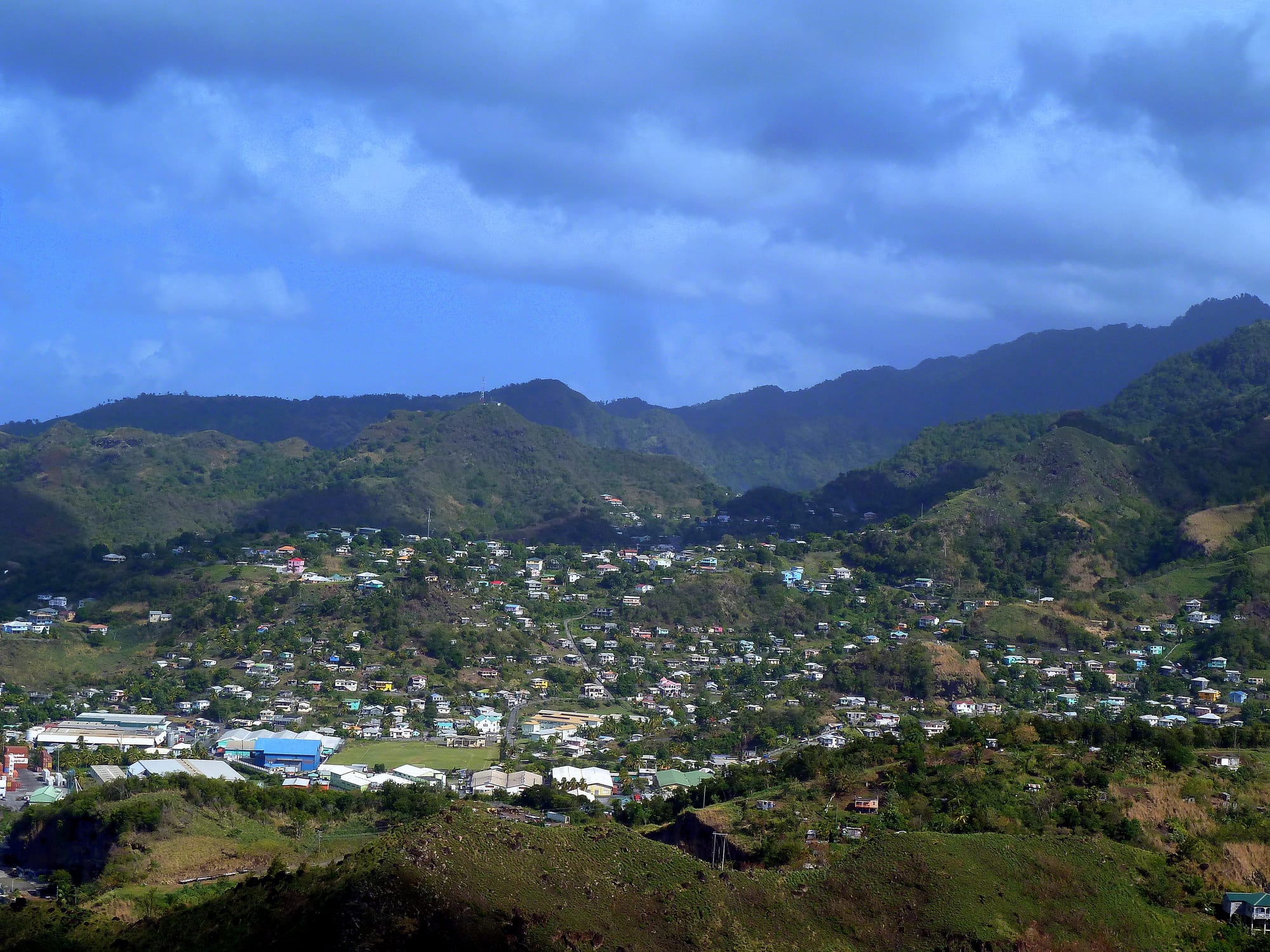
Houses spread across green hillsides in a valley above Kingstown, with forested mountains and heavy cloud behind

Saint Vincent and the Grenadines

Kingstown

The hillside districts of Kingstown seen looking north from Fort Charlotte. (giggel / Wikimedia Commons · CC BY 3.0)

The capital and main port of Saint Vincent and the Grenadines, on the south-west coast of Saint Vincent and ringed by steep green hills. Founded by French settlers in the 1720s and later a British garrison town, it keeps an 18th-century botanic garden and a hilltop fort, and remains the islands' commercial centre and the starting point for ferries south.

Neighbourhoods

  • Downtown and the harbour
    • First-time visitors
    • Close to public transport
    • Shopping

    The compact commercial centre on Kingstown Bay, with the port, the ferry pier, the Catholic cathedral, and Bay Street and Halifax Street with their eateries and the national museum. Steep hills rise straight behind the town.

    Open in Maps
  • Arnos Vale
    • Sport
    • Quiet and residential

    A former agricultural estate about 3 miles south-east of the capital, on Greathead Bay. The old E. T. Joshua Airport occupied part of the area until 2017, and the Arnos Vale Sports Complex, with its 18,000-seat cricket and football stadium, is here.

    Open in Maps
  • Calliaqua
    • Local life
    • Best for food

    A small town in the far south of Saint Vincent, close to the island's southernmost point, with a local fishing market, a sports field and a scattering of restaurants and bars. It is where the French landed when they invaded in 1779.

    Open in Maps

Things to do

Famous landmarks

  • Saint Vincent and the Grenadines Botanic Gardenspark

    Established in 1765 and described as the oldest botanic garden in the Western Hemisphere, it holds a third-generation clone of a breadfruit tree grown from a plant Captain William Bligh landed in 1793.

    Open in Maps
  • Fort Charlottelandmark

    A British fort on a hill above the harbour, begun after 1763 and completed by 1806, with views over Kingstown, the leeward coast, Bequia and the Grenadines, and a lighthouse marking the entrance to Kingstown Bay.

    Open in Maps
  • Assumption Cathedrallandmark

    The Roman Catholic cathedral of the Diocese of Kingstown, also called St Mary's, which became a co-cathedral in 1971 and the city's cathedral in 1989.

    Open in Maps

Museums and sport

  • SVG National Trust museummuseum

    A small national museum run by the Saint Vincent and the Grenadines National Trust on Halifax Street in the centre of town.

    Open in Maps
  • Arnos Vale Stadiumattraction

    The country's main ground, holding about 18,000 people and used mostly for cricket and football.

    Open in Maps

Short trips from the town

  • Calliaquaneighborhood

    The south-coast town near the tip of the island, with a fishing market, restaurants and bars.

    Open in Maps
  • La Soufrièretrail

    The active volcano at the north of the island, which erupted explosively between 9 and 22 April 2021; during periods of inactivity a hiking trail climbs through rainforest to the crater rim.

    Open in Maps
  • Chateaubelairattraction

    A farming town on the leeward coast just south of the volcano, near Trinity Falls, Dark View Falls and rock carvings attributed to the Kalinago.

    Open in Maps
  • Bequiaattraction

    The second-largest of the Grenadines, a short ferry ride south of Kingstown, with a walkable harbour town and a boat-building tradition.

    Open in Maps

Seasonal events

  • Vincy Maslast week of June and first week of July

    The national carnival and the biggest festival of the year, with calypso, soca and steelpan competitions and the Road March.

  • Nine Morningsthe nine days before Christmas

    A Vincentian tradition of early-morning street celebrations in the run-up to Christmas.

Eat and drink

Long-standing places and food districts in Kingstown. Hours, ratings and directions come from your maps app, always current.

Kingstown classics

  • Kye's Vegetarian Cuisinerestaurant

    A popular lunch spot on Paul's Avenue that began by serving pie and peas and now also offers roti, soups, burgers and fresh juices.

    Open in Maps
  • Bay Street eateriesneighborhood

    A downtown street with places serving cheap traditional Vincentian Creole cooking.

    Open in Maps

Food districts and markets

  • Calliaqua fishing marketmarket

    The local fish market of the south-coast town, the place to see the day's catch landed.

    Open in Maps

Experience Kingstown

History

Kingstown was founded by French settlers shortly after 1722, at a time when the Kalinago and the Garifuna still opposed European settlement on Saint Vincent. The British took the island from the French in 1763, and Kingstown became a British garrison town. They began Fort Charlotte on the hill above the harbour soon afterwards, finishing it by 1806, after a French invasion at Calliaqua in 1779 had shown that an attack could come from anywhere on the coast. During the Second Carib War rebels took the fort at Dorsetshire Hill, just outside the town, on 12 March 1795.

The town's botanic garden dates from 1765, when the governor, Robert Melville, and the military surgeon George Young set aside land to grow medicinal and useful plants. Captain William Bligh completed his breadfruit voyage here in January 1793, landing plants from the South Seas. In the 19th century Kingstown grew slowly, from about 3,000 people in 1825 to just over 5,000 by 1861, despite cholera and smallpox epidemics. In 1841 a crowd protested the arrest of three militiamen, and a riot destroyed the police station; there were further riots under Governor Edward John Eyre. A large fire in 1866 destroyed much of the town, and a piped water supply followed in 1871.

The population stood at about 17,100 in 1970 and then fell as people moved out to the growing suburbs. In 2025 the government announced plans to rename places across the country, Kingstown among them, as part of a decolonisation project.

Culture & Customs

The culture of Kingstown is Afro-Caribbean, English-speaking and church-going. The Roman Catholic Assumption Cathedral, the seat of the Diocese of Kingstown, stands in the centre. The everyday language is Vincentian Creole, an English-based creole, alongside the official English. The country's Kalinago and Garifuna heritage, kept alive mainly in the north-east of the island, is part of the national story told in the capital.

Carnival is the biggest event of the year. Vincy Mas fills the last week of June and the first of July with calypso, soca and steelpan competitions — the Raga Soca contest among them — and the race to win the Road March. Before Christmas comes Nine Mornings, the Vincentian tradition of early-morning street celebrations on the nine days leading up to the holiday, together with the Nine Nights of Lights. String-band music, calypso and soca fill out the musical life.

Cricket and football are followed closely, and the Arnos Vale Stadium south-east of town is the country's main ground, holding about 18,000 people. Sailing, fishing and the sea are part of daily identity in a port from which boats leave for the Grenadines.

Daily Life

Kingstown had a population of 12,909 at the 2012 census, the largest settlement in the country, and it lies in the parish of Saint George, the most populous and most densely populated parish. The town itself has been shrinking for decades while its suburbs have grown: between 1980 and 1991 the town lost almost 8 per cent of its people while the surrounding districts grew by more than a quarter, and in 1991 more than two-fifths of the country's people lived in Kingstown, its suburbs and Calliaqua.

The town is the main port and the biggest commercial centre of the islands, the centre of Saint Vincent's agricultural trade and a port of entry for visitors. The town is hemmed in by steep hills, and privately run minibuses carry people in from the surrounding districts. Ferries shuttle from the harbour to Bequia.

The country is acutely exposed to natural disaster. The 2021 eruption of La Soufrière forced some 16,000 people from the north of Saint Vincent and wrecked crops, and many evacuees were sheltered elsewhere on the island. Remittances from a large diaspora are a steady support for many households.

Food

Vincentian cooking is Creole, and the national dish is roasted breadfruit with fried jackfish — a fitting choice for a town whose botanic garden still grows a descendant of a breadfruit plant brought by Captain Bligh in 1793. Callaloo soup, stewed and grilled fresh fish and souse are everyday fare, served with provisions such as dasheen, sweet potato and plantain.

As the centre of the island's agricultural trade, Kingstown handles the island's produce, bananas and arrowroot among it, alongside the catch of the island's fishing boats. Arrowroot, for decades one of the island's biggest exports, still turns up in porridges and baking. The botanic garden's early collections were built to grow useful plants for the colony, and in 1766 the governor arranged for cinnamon seeds to be sent to it from Guadeloupe. One popular downtown lunch spot, Kye's on Paul's Avenue, started out serving pie and peas and now adds roti and soups. Fish comes in to the market at Calliaqua on the south coast.

Fresh juices, mauby and sorrel are the everyday drinks, with local beer and rum for the evening.

Planning tools

Budget

Saint Vincent itself is inexpensive and little-touristed compared with the private-island resorts of the Grenadines. Minibuses cost very little, local eateries are cheap, and the Bequia ferry is inexpensive; the bills rise with hotels on the south coast, taxis and private boat trips to the Tobago Cays.

Daily Budget Midrange
USD 150–320 (mid-range hotel on the south coast, restaurant dinners, taxis, a boat trip)
Daily Budget Shoestring
USD 55–100 (guesthouse, local eateries and roti shops, minibuses)

Use the minibuses rather than taxis for short hops around the south of the island, and treat Kingstown as the cheap base for the Bequia ferry.

Best Time to Visit

December to May is the drier season and the main sailing season. Late June and early July bring Vincy Mas, the biggest festival of the year, and the days before Christmas bring Nine Mornings. The wetter months of June to November cover the hurricane season, whose greatest risk falls from August to October.

Suggested Number of Days

The town itself needs a day or two. Allow four to six to take in the rest of the island and a ferry crossing to the Grenadines; the volcano's alert level and ferry timetables can change the number.

First Visit
1–2 days
With Surroundings
4–6 days

Transportation

Saint Vincent is mountainous and rugged, and getting around takes time. Privately owned minibuses, recognisable by an H at the start of their licence plates, work as the island's bus service and are fast and cheap. Taxis and hire cars are also available. Ferries to Bequia run frequently from the harbour; services further south are less frequent.

Ferry timetables to the southern Grenadines are infrequent and change, so confirm them before planning a connection.

Airport & Station Connections

Argyle International Airport, which opened in February 2017 and replaced the old E. T. Joshua Airport at Arnos Vale, is about 5 miles from Kingstown on the island's south-east coast — roughly 30 minutes by taxi, or a cheap ride by minibus from the main road. It has non-stop flights to Canada, the United States and the United Kingdom and regional links. Many visitors arrive by yacht.

Walkability

Downtown is small and walkable, with shops, the cathedral and the port close together. The town is surrounded by steep hills, so the fort and the hillside districts are a hard climb on foot; a minibus or taxi saves the climb to the Botanic Gardens and Fort Charlotte.

Safety

The country is generally low-key and safe, and the Grenadines are calm. Saint Vincent has some gang- and drug-related violent crime affecting specific areas rather than tourists, plus petty theft. La Soufrière, an active volcano at the north of the island, erupted explosively in 2021, and the hurricane season runs from June to November.

Take the usual precautions in Kingstown after dark, keep valuables out of sight, and follow the volcano observatory's alert level before heading north. Check current official travel advice before travelling.

Climate

Tropical and warm year-round, tempered by the trade winds. Across the islands temperatures run at about 24–31°C through the year. A drier season runs from December to May and a wetter one from June to November; the interior of Saint Vincent behind the town is wet rainforest.

Summer
June to November is the wetter season and the Atlantic hurricane season, still warm at about 24–31°C, with the greatest hurricane risk from August to October
Winter
December to May is the drier, sunnier season, warm throughout at about 24–31°C

Local Customs

The culture is Afro-Caribbean, English-speaking and church-going. English is the official language, while Vincentian Creole, an English-based creole, is the everyday speech.

Greet people before asking for directions or help, dress modestly in town and in church, and ask before photographing people.

Common Payment Methods

The currency is the Eastern Caribbean dollar (EC$), pegged to the US dollar at 2.70. US dollars are widely accepted; cards work at hotels and larger restaurants, and there are ATMs in Kingstown. Minibuses, markets and small eateries are cash only in practice, so carry small notes.