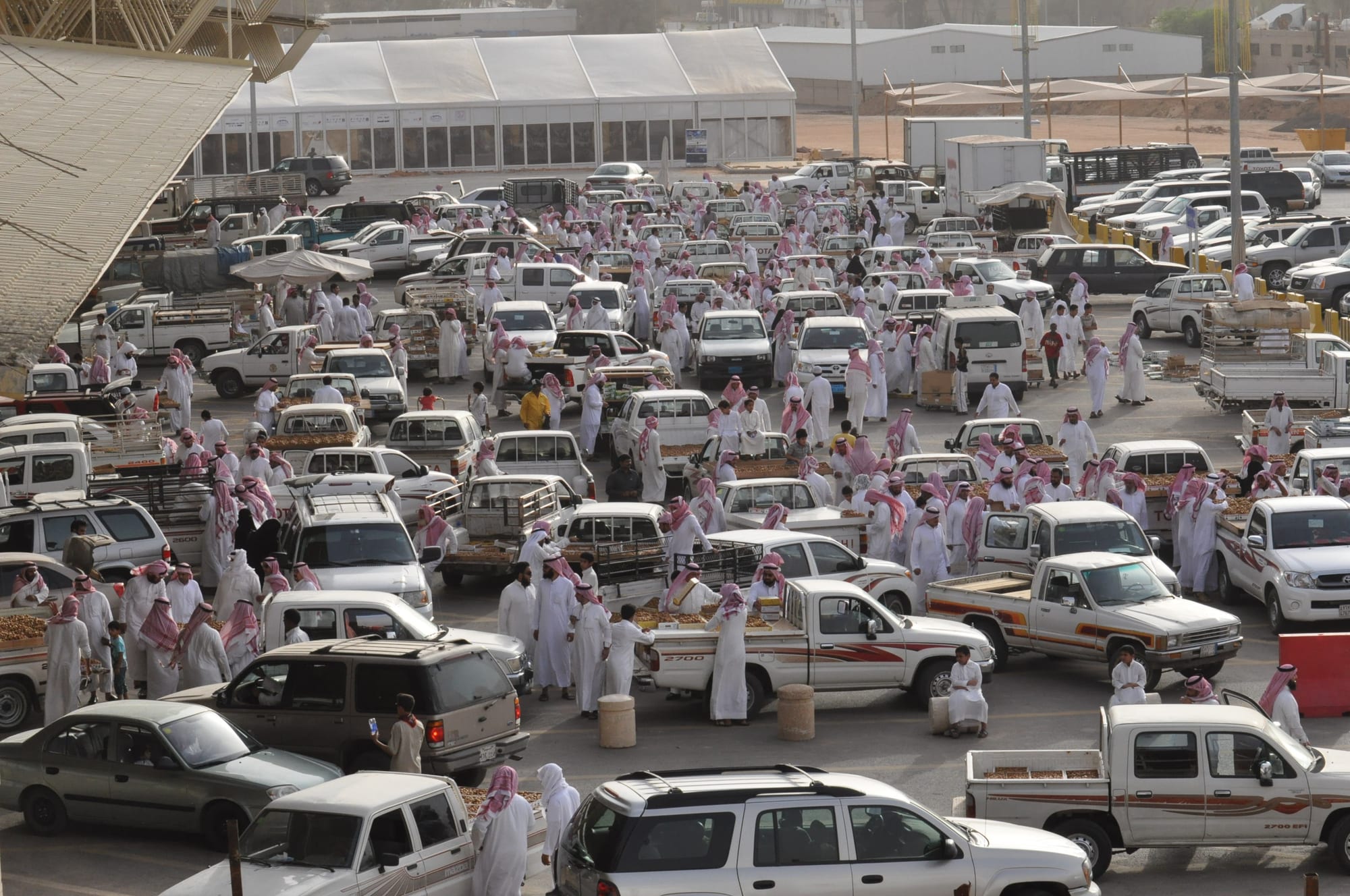
A crowded open market yard where men in white robes and red headscarves trade beside pickup trucks piled with dates

Riyadh & the Najd, Saudi Arabia

Buraydah

Trading at the date market in Buraydah, where fruit is sold by the truckload. (Suliman Al-Kurishan / Wikimedia Commons · CC BY 2.0)

The capital of Al-Qassim province, an oasis city on Wadi ar-Rummah in the central Najd. Built by farmers and caravan traders, it is the centre of Saudi Arabia's date growing, with a wholesale market where fruit is auctioned by the pickup load, camel sales on the edge of town, and a reputation as one of the most conservative cities in the kingdom. This page is written to explain the city, not to encourage travel.

Neighbourhoods

  • The central district
    • First-time visitors
    • Markets
    • Close to services

    The old core around the grand mosque and the covered market, rebuilt in concrete but still the place for gold shops, textile sellers, perfume and coffee traders, and small restaurants. Government offices, banks and most of the city's hotels are within a short drive.

    Open in Maps
  • The date market quarter
    • Markets
    • Local life

    A large walled trading ground surrounded by warehouses, packing sheds and date shops. Business begins very early, and the roads around it fill with loaded pickups through the late-summer harvest.

    Open in Maps
  • The university and western suburbs
    • Quiet and residential
    • Budget stays

    Newer grid-planned districts of villas and apartment blocks spread west and north-west towards the ring road and the road out to the Qassim University campus, with shopping streets, cafés and chain restaurants along the main avenues.

    Open in Maps
  • The palm gardens and farms
    • Quiet and residential
    • Countryside

    Buraydah is ringed by palm groves and irrigated fields watered from deep wells, and many families keep a farm with a house, a majlis and a few animals. These edges of the oasis are where the city goes at weekends.

    Open in Maps

Things to do

Markets

  • Buraydah date marketmarket

    One of the largest wholesale date markets in the world, where growers sell from the back of their trucks and buyers bid by the load; it is busiest from the late-summer harvest onwards.

    Open in Maps
  • Camel marketmarket

    A livestock ground on the edge of the city where camels, sheep and goats are traded, and where prized breeding camels change hands for large sums.

    Open in Maps
  • The central souqmarket

    Shops and stalls around the grand mosque selling dates, Arabic coffee beans and cardamom, incense, rugs, farm tools and gold.

    Open in Maps

Parks and public spaces

  • Buraidah Water Tower and the central parkattraction

    A 40-metre water tower that has become the city's best-known landmark, with a central park beside it whose lawns and play areas fill with families after sunset.

    Open in Maps
  • Wadi ar-Rummahpark

    The largest seasonal wadi in the Arabian Peninsula, almost 600 kilometres long, ending in the dunes near the city; it is dry for long stretches and floods after heavy rain.

    Open in Maps

Education and sport

  • Qassim Universityattraction

    The province's university, with tens of thousands of students and a campus of several square kilometres out to the west of the city, near the airport.

    Open in Maps

Short trips from the city

  • Unaizahneighborhood

    Qassim's second city, about 30 kilometres south, historically a rival of Buraydah and known for its merchant families, restored heritage houses and a museum of local life.

    Open in Maps

Seasonal events

  • Buraydah date seasonlate summer and autumn

    The harvest fills the wholesale market with fruit sold by the truckload and brings a season of trading, auctions and date festivals to the city.

  • Ramadan and Eid al-Fitrshifts through the year with the Islamic calendar

    Daytime fasting empties the streets and restaurants close until sunset, after which markets and cafés stay busy late; the Eid holiday closes offices for several days.

  • Winter desert camping seasonNovember to February

    Families set up tents on the sands and plains outside the city through the cool months, a Najdi institution built around fires, coffee and grilled meat.

Eat and drink

Long-standing places and food districts in Buraydah. Hours, ratings and directions come from your maps app, always current.

Qassim classics

  • Najdi wheat dishesrestaurant

    Jareesh, margoog, matazeez and qursan — cracked wheat and dough slow-cooked with meat and vegetables — are the everyday cooking of Qassim, served alongside platters of kabsa.

    Open in Maps
  • Kleija bakeriesrestaurant

    Kleija, a flat biscuit of flour, dates and spices such as ginger and cinnamon, is the signature sweet of Qassim and is baked in the city's small bakeries and sold in boxes as a gift.

    Open in Maps

Markets and food streets

  • The date marketmarket

    Dozens of varieties are sold fresh, dried and pressed into paste, with sukkari, a soft, golden and very sweet variety, among the best known of them.

    Open in Maps
  • Grill and mandi housesrestaurant

    Roadside kitchens across the city serve pit-cooked mandi, grilled chicken, shawarma and rice platters, the standard evening meal out.

    Open in Maps

Experience Buraydah

History

Buraydah grew out of a group of farming settlements in the Qassim oasis, watered by wells along Wadi ar-Rummah, and the town is dated to the late sixteenth century, when Rashid al-Duraiby of the Banu Tamim built it as the seat of an emirate. Its position on the routes between the Gulf, Iraq, the Hejaz and the interior made it a caravan town as much as a farming one: pilgrims and traders passed through, and Qassimi merchants became known across Arabia and beyond, with family businesses reaching into Iraq, Egypt and India.

Politically the Qassim towns were a prize fought over by the powers of the Najd. The Al Saud, the Rashidi emirs of Ha'il and the leading local families — the Aba al-Khail of Buraydah among them — contested control through the nineteenth century, and rivalry between Buraydah and neighbouring Unaizah runs through the same story. In July 1904 Abdulaziz Ibn Saud defeated Rashidi and Ottoman forces at the battle of al-Bukayriyah in Qassim, one of the fights of the Saudi-Rashidi war of 1903-1907, at the end of which the province passed to the emerging Saudi state.

The twentieth century turned the oasis into the agricultural heart of the kingdom. Deep wells and centre-pivot irrigation put wheat, fodder and vegetables on land that had been desert, the date groves expanded, and a wholesale market was built that handles a large share of the country's crop. Government offices, hospitals and a university followed, and the mud-brick town was replaced almost entirely by concrete, wide roads and suburbs, leaving the markets rather than the buildings as the record of what the city has always done.

Culture & Customs

Qassim's reputation in Saudi Arabia is for religious seriousness, and Buraydah is its capital. Mosque attendance is high, prayer times empty the shops, and the province has produced many of the kingdom's scholars and judges. Social codes are stricter than in Riyadh or on the coast, and visitors who dress and behave modestly are treated with the same generosity found anywhere in the Najd.

Hospitality follows fixed forms. Guests are received in a majlis and served pale, cardamom-scented Najdi coffee in small handleless cups with dates; refills continue until the cup is tilted or shaken. Kleija and date sweets accompany visits, and a sheep slaughtered for guests is the highest form of welcome. Weddings, condolences and holiday visits move through extended families over several days.

Beyond religion, the local culture is agricultural and Bedouin in origin. Nabati poetry and the ardah, a line dance with swords, drums and chanted verse, belong here, as do falconry, camel breeding and winter camps in the sand. Dates are a matter of provincial pride, with growers competing over varieties and prices at seasonal festivals, and the camel market is a social occasion as much as a commercial one. The university has brought a large student population and a younger, more mixed feel to parts of the city.

Daily Life

About 570,000 people live in Buraydah, which with neighbouring Unaizah and ar-Rass forms the main urban cluster of Qassim. The economy rests on agriculture — dates above all, with wheat, fodder, olives and vegetables grown on irrigated fields — and on the trade, transport, packing and wholesale businesses that depend on it, alongside government administration, health care, education and retail. The city is a national hub for the date trade, and produce from it reaches markets across the kingdom and abroad; in 2021 Buraydah was named a UNESCO Creative City of Gastronomy, the first in the Gulf to be given the title.

Life is car-based and spread out. Households live in villas and apartment blocks on the grid of newer districts, work and school start early, the afternoon heat clears the streets, and the evening after sunset prayer brings families out to parks, markets, restaurants and the farms on the edge of town. Friday and Saturday form the weekend, and a farm or a desert camp is the standard outing.

The concerns are those of an agricultural region in a dry country: groundwater levels falling under decades of irrigation, the cost of farming, the summer heat and jobs for a young population. The regional war that began in late February 2026 has disrupted flights and events.

Food

Buraydah eats the wheat-based cooking of the Najd. Jareesh — cracked wheat cooked slowly with lamb or chicken and finished with fried onion and sometimes yoghurt — is the dish most associated with Qassim homes. Margoog and matazeez are stews of meat, pumpkin, courgette and other vegetables with pieces or discs of dough cooked in the broth, and qursan is thin dry bread broken into a tray and soaked in meat sauce. Kabsa, spiced rice with lamb or chicken on a shared platter, is the dish for guests, and a whole lamb on rice marks a celebration.

Dates define the city. The oasis grows many varieties, and sukkari, soft, golden and very sweet, is among the best known; others are eaten fresh as rutab in late summer, dried through the year, stuffed with nuts, or boiled down into dibs, a thick syrup. Kleija, a dry flat biscuit of flour, dates and warm spices, is the regional sweet, and hanini, dates worked with flour or crumbled bread, ghee and cardamom, is a winter dish. Luqaimat, fried dough balls in syrup, appear in Ramadan.

To drink there is Arabic coffee, lightly roasted and heavy with cardamom and often saffron, poured from a long-spouted dallah, sweet black tea, laban, a salty buttermilk drunk with meals, and camel's milk, sold fresh in the markets. Shawarma, grilled chicken and Yemeni mandi shops cover everyday eating out, and alcohol is prohibited throughout the kingdom.

Planning tools

Budget

Buraydah is inexpensive by Saudi standards. Hotels and furnished apartments cost a fraction of Riyadh prices, restaurants are cheap, and the main additional cost is a hire car, which is close to essential for the farms, the markets on the edge of town and the road to Unaizah.

Daily Budget Midrange
USD 120–220 (comfortable hotel, restaurants, a hire car, trips into the oasis and to Unaizah)
Daily Budget Shoestring
USD 45–80 (budget hotel or apartment, local restaurants, ride-hailing)

Stay here rather than in Riyadh for the price, and visit the markets very early, when trading is at its height and the heat is bearable.

Best Time to Visit

November to March gives mild days and cold nights, and is the season for the desert and for outdoor life. The date harvest from late summer is when the market is at its busiest and most photogenic, but the heat is then intense. Since the war began in late February 2026, air travel, events and tourism across the region have been disrupted, so dates should be confirmed before booking.

Suggested Number of Days

A day or two is enough for the city. Two or three suit anyone adding the neighbouring towns and the farmland of the oasis. Early starts matter more than extra days, because trading and outdoor life happen at the cool ends of the day.

First Visit
1–2 days
With Surroundings
2–3 days

Transportation

A car is the practical way to move around a low, spread-out city built around wide roads and a ring road. Ride-hailing apps work well and are cheap; public buses are limited. Hire cars are available at the airport and in the centre, and the road to Unaizah takes well under an hour.

Traffic around the markets is heavy in the early morning, and drivers are fast on the ring road; parking is easiest outside the central district.

Airport & Station Connections

Prince Naif bin Abdulaziz International Airport lies west of the city, with domestic flights and a limited number of regional routes. The railway from Riyadh to Qurayyat has a station in the north-east of the city, with trains to Riyadh, Majma'ah and Ha'il, and coaches run to Riyadh, about 320 kilometres away by road. Air travel across the region has been disrupted by the war since late February 2026.

Walkability

Low. The central district and the market grounds can be walked, and the markets are best seen on foot, but the city spreads for many kilometres along wide roads with patchy pavements and few crossings. From May to September the heat makes walking unwise except early and late in the day.

Safety

Crime is very low and the city is quiet. The hazards are heat and sun, fast driving on the highways and ring road, dust storms, and flash floods in the wadis after heavy winter rain. Qassim is the most religiously conservative part of the Najd, and dress and behaviour should be especially modest. A regional war has been under way since late February 2026, and Saudi Arabia, with other Gulf states, has taken part in strikes on Iran; the conflict is continuing.

Carry plenty of water, avoid the open desert in summer and after dark, keep out of wadis in heavy rain, and dress conservatively. Check current official travel advice before travelling.

Climate

Hot desert climate on the plateau, dry through the year, with a wide gap between day and night temperatures. The little rain there is falls between November and April and can arrive as sudden storms that flood roads and fill the wadi; dust storms are most common in spring.

Summer
very hot and dry, commonly 42–45°C by day and still warm at night
Winter
mild days of about 18–22°C; cold nights that can fall near freezing

Local Customs

Qassim is known throughout the kingdom for its religious conservatism, and visitors should be more careful here than in Riyadh or Jeddah. Modest dress is expected of everyone: long trousers and covered shoulders for men, loose clothing covering the arms and legs for women, who commonly wear an abaya here even though it is not required. Shops close at prayer times. Alcohol and pork are prohibited, as are public displays of affection. Hospitality is formal: coffee and dates are offered at once and the right hand is used for eating and giving.

Do not photograph people, especially women, without asking, and avoid photographing government or military buildings; tipping is not expected, though small change is welcome.

Common Payment Methods

The currency is the Saudi riyal, pegged to the US dollar. Cards and phone wallets are taken in hotels, supermarkets and chain restaurants, and ATMs are easy to find. Cash is still the currency of the souq, the date market and the livestock ground.