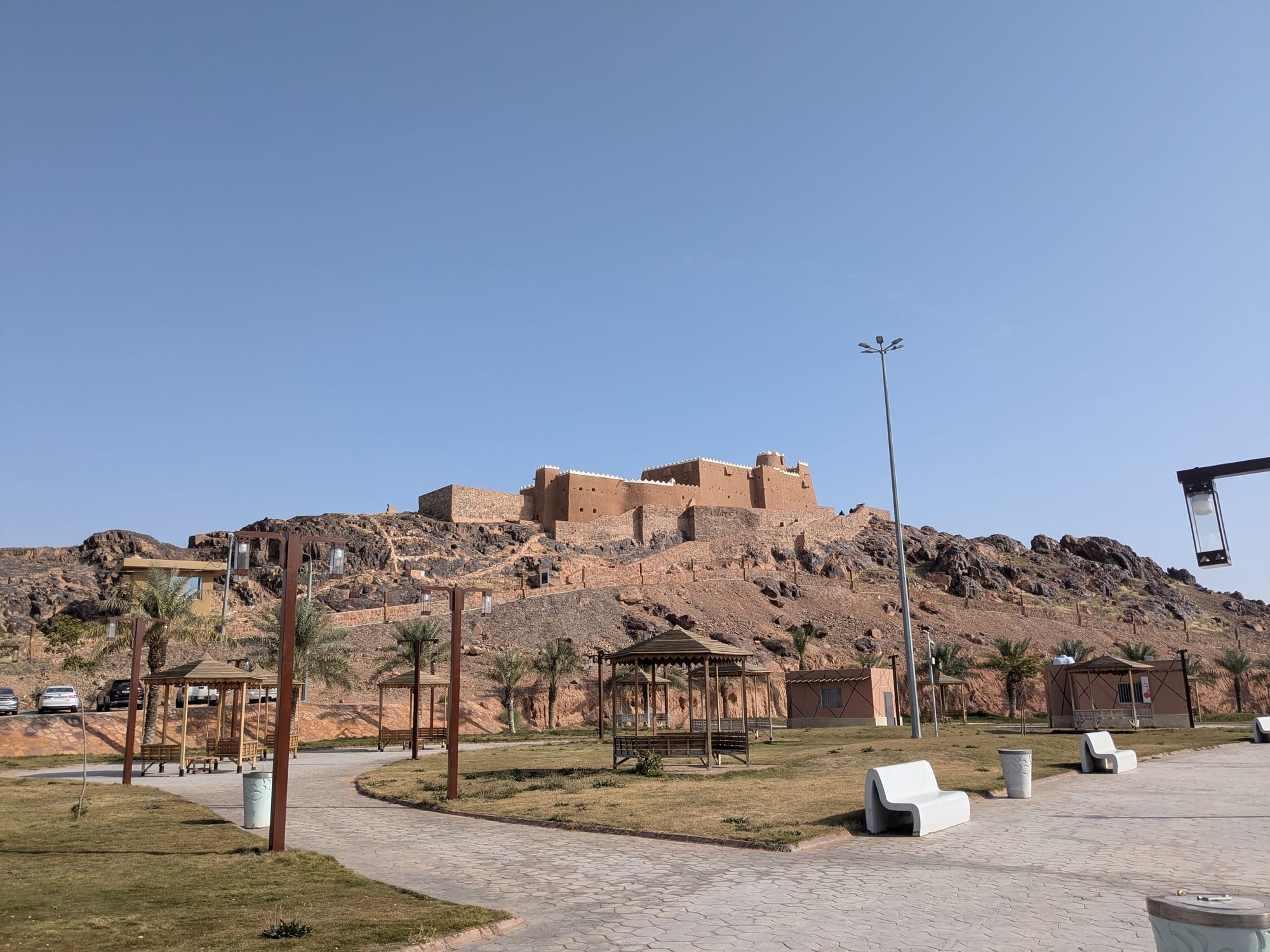
A mud-brick fort with crenellated walls standing on a rocky hill above a park of palms and shaded shelters under a clear blue sky

Riyadh & the Najd, Saudi Arabia

Ha'il

A'arif Fort on its rocky hill above the centre of Ha'il. (Iain Cheyne / Wikimedia Commons · CC BY-SA 4.0)

An oasis city in the north of the Najd, between the Aja mountains and the red sands of the Nafud. Home of the Shammar and capital of the Rashidi emirate that ruled much of Arabia in the 19th century, it is now a farming and university city of about half a million people, known for its forts, date groves and nearby rock art. This page is written to explain the city, not to encourage travel.

Neighbourhoods

  • The old centre around Barzan
    • First-time visitors
    • Markets
    • Historic district

    The heart of the town, where the Rashidi palace of Barzan once stood. Today it is a square surrounded by shops, the old souq selling dates, coffee, spices and textiles, and the mosques and low buildings of the original settlement, with most of the heritage sites within walking distance.

    Open in Maps
  • Below A'arif hill
    • Views
    • Parks

    The rocky outcrop with its restored fort rises straight out of the built-up area, and the ground at its foot has been laid out as gardens with paths, shelters and a lake. It is where residents walk in the cool of the evening, and the climb gives the standard view over the city.

    Open in Maps
  • The western districts towards Aja
    • Quiet and residential
    • Close to the mountains

    Villas, farms and palm gardens spread west from the centre towards the granite ridges of the Aja range. This is the greener side of the city, with irrigated fields and weekend farms, and the roads into the mountains and the desert begin here.

    Open in Maps
  • The northern and university districts
    • Quiet and residential
    • Budget stays

    Newer grid-planned suburbs of villas, apartment blocks and shopping streets spread north and east towards the airport and the University of Ha'il campus. Hotels, chain restaurants and cafés are concentrated along the main roads through this part of town.

    Open in Maps

Things to do

Forts and old buildings

  • A'arif Fortlandmark

    A restored mud-brick fort on a rock above the city, built as a lookout over the oasis and the plain, with a park laid out at its foot.

    Open in Maps
  • Qishlah Fortresslandmark

    A large mud-brick barracks in the centre of the city, with corner towers, courtyards and rows of arcaded rooms, built as a garrison after the region came under Saudi rule.

    Open in Maps
  • Barzan Squarelandmark

    The site of the Rashidi rulers' palace in the centre of town, demolished in the 20th century; its name still marks the central square and the surrounding old market.

    Open in Maps

The university

  • University of Ha'ilattraction

    The city's university, founded in 2006 out of a community college opened in 1998, whose large campus on the edge of town has brought students from across the kingdom to Ha'il.

    Open in Maps

Mountains and desert

  • Aja Mountainsviewpoint

    The granite range west of the city, dark and weathered into towers and clefts, with farms and small villages in its valleys.

    Open in Maps

Short trips from the city

  • Jubbah rock artattraction

    Sandstone outcrops in the Nafud north-west of Ha'il carved with thousands of figures of people, cattle, ibex and camels, part of the UNESCO World Heritage Site of Rock Art in the Hail Region.

    Open in Maps
  • Rock Art in the Hail Regionattraction

    The UNESCO World Heritage Site inscribed in 2015, in two parts — the outcrops at Jubbah in the Nafud, and Jabal al-Manjor and Jabal Raat at Al-Shuwaymis, some 250 kilometres to the south-west.

    Open in Maps

Seasonal events

  • Ha'il Rallyvaries from year to year

    A cross-country motor rally over the dunes and gravel plains around the city, the first car rally held in Saudi Arabia, run since 2006 and recognised by motor sport's international federation since 2008.

  • Date harvest and market seasonlate summer

    The date gardens are picked from about July, and the city's market and roadside stalls fill with fresh and dried fruit of many varieties.

  • Ramadan and Eid al-Fitrshifts through the year with the Islamic calendar

    Daytime fasting quietens the city and restaurants close until sunset, after which the streets are busy late; the Eid holiday that follows closes offices for several days.

Eat and drink

Long-standing places and food districts in Ha'il. Hours, ratings and directions come from your maps app, always current.

Ha'il classics

  • Najdi wheat dishesrestaurant

    Jareesh, margoog, matazeez and qursan — cracked wheat and dough slow-cooked with meat and vegetables — are the everyday cooking of the northern Najd, alongside platters of kabsa.

    Open in Maps
  • Kleija and date sweetsrestaurant

    Kleija, a flat biscuit filled with date paste and spiced with cardamom, is the regional sweet, sold by bakeries and given to guests with coffee.

    Open in Maps

Markets

  • The old souq at Barzanmarket

    Stalls and small shops around the central square selling dates, Arabic coffee beans, cardamom, incense, rugs and Bedouin textiles.

    Open in Maps
  • Date farms and roadside stallsmarket

    The oasis is ringed by palm gardens, and growers sell fresh rutab and dried dates by the box from stalls on the approach roads in the harvest months.

    Open in Maps

Experience Ha'il

History

The oasis at the foot of the Aja mountains has been settled for thousands of years: the sandstone outcrops of the surrounding Nafud carry carvings of cattle, ibex and human figures made when the desert was far wetter. In pre-Islamic times this was the country of the Tayy tribe, whose chief Hatim al-Tai became the Arab byword for generosity, and the plain to the south was crossed by the Darb Zubaydah, the pilgrim road from Kufa to Mecca, with a walled station and cisterns at Fayd.

Ha'il's greatest period began in 1836, when the Al Rashid of the Shammar tribe established an emirate here. Under Muhammad ibn Abdullah Al Rashid in the 1870s and 1880s it became the strongest power in central Arabia, taking Riyadh in 1891 and driving the Al Saud into exile in Kuwait. The rulers held court in the great mud-brick palace of Barzan, protected caravans and won the loyalty of the Bedouin, and the emirate drew the European travellers who wrote the first outside accounts of the city, among them William Gifford Palgrave, Charles Doughty and Lady Anne Blunt.

Rashidi power collapsed in a series of family killings and in defeats by the resurgent Al Saud, and in 1921 Abdulaziz Ibn Saud took Ha'il, ending the emirate and completing his hold on the Najd. The Barzan palace was pulled down, and the town became a provincial centre of the new kingdom. In the second half of the 20th century deep wells turned the surrounding plains into large irrigated farms, and since 2006 a university, an expanded airport and the restoration of the forts have reshaped the city again.

Culture & Customs

Ha'il is Shammar country, and tribal identity remains strong. The generosity that Hatim al-Tai stands for is a matter of local pride, expressed in the forms of the majlis: guests are received with dates and pale, cardamom-scented Najdi coffee poured in small measures, and a meal for visitors is a matter of honour. Nabati poetry, composed and recited in the Bedouin dialect, is still a living art here, and camel husbandry, falconry and horse breeding all have deep roots in the region.

The city's culture is also shaped by the desert around it. Winter camps in the Nafud, with tents, fires and grilled meat, are the standard family weekend, and motor sport has grown out of the same landscape, with cross-country rallies drawing international teams to the dunes. The province is conservative in religion and custom, and the rhythm of prayer times structures shops, offices and the working day.

Crafts survive in the souq: woven camel-hair rugs and bags, coffee pots and palm-fibre work. Traditional Najdi building, with thick mud walls, crenellated parapets and small triangular openings, is visible in the restored forts and quoted by newer public buildings. The university has brought a younger and more mixed population, and the mix of old tribal forms with a student city is part of how residents describe the place.

Daily Life

About 500,000 people live in Ha'il, the largest city of its province, in a low-rise spread of villas and apartment blocks around the old centre. Agriculture is the base of the economy: wheat, fodder, fruit, vegetables and above all dates grown on irrigated fields and in the palm gardens of the oasis, with large farming companies alongside family holdings. Government offices, the university, hospitals, transport and trade employ most of the rest, and mining and logistics have been promoted as part of the province's development plans.

Daily life follows the pattern of the Najd. Offices and schools start early, the afternoon heat empties the streets, and the evening after sunset prayer is when families go out to the parks, the markets, the cafés and the shopping streets. Weekends fall on Friday and Saturday, and many households have a farm or a desert camp to go to. The city is quieter and more traditional than Riyadh, and residents often point out that everything in it is within a short drive.

The pressures are those of the whole region: falling groundwater under the irrigated farms, summer heat, and the need to create work for a young population. The regional war that began in late February 2026 has disrupted flights and events.

Food

The food of Ha'il is the wheat-and-meat cooking of the northern Najd. Jareesh, cracked wheat simmered for hours with lamb or chicken and topped with fried onion and sometimes yoghurt, is the dish most associated with home cooking; margoog and matazeez are stews of meat and vegetables with pieces or discs of dough cooked in the sauce; and qursan is thin dry bread broken into a tray and soaked in broth with meat. Kabsa, spiced rice with lamb or chicken, is served whenever there are guests, and a whole lamb on rice is the dish of celebration.

Dates run through everything. The oasis grows many varieties, eaten fresh as rutab in late summer and dried through the year, pressed into paste or boiled into syrup. Kleija, a flat biscuit filled with spiced date paste, is the regional sweet and is made in both Ha'il and neighbouring Qassim, and hanini, dates mashed with crumbled bread and ghee, is a winter breakfast. Luqaimat, fried dough balls soaked in syrup, appear during Ramadan.

The drinks are Arabic coffee, lightly roasted and heavy with cardamom, served from a long-spouted dallah in small handleless cups, sweet black tea, laban, a salty buttermilk, and fresh camel's milk, which is still common in the countryside. Shawarma, grilled chicken and Yemeni mandi shops line the main roads, and alcohol is prohibited throughout the kingdom.

Planning tools

Budget

Ha'il is one of the cheaper Saudi cities. Modest hotels and furnished apartments cost far less than in Riyadh, restaurants are inexpensive, and the main extra cost is a hire car, which is close to essential for the mountains, Jubbah and the desert. Prices rise when rally and festival crowds arrive.

Daily Budget Midrange
USD 120–220 (comfortable hotel, restaurants, a hire car, a guided trip to Jubbah or the dunes)
Daily Budget Shoestring
USD 45–80 (budget hotel or apartment, local restaurants, shared taxis and ride-hailing)

Hire a car in the city rather than driving the long road from Riyadh, and take a guide for the Nafud dunes.

Best Time to Visit

November to March, when days are mild and the desert and mountains are comfortable, and when the rally and other winter events are held; nights in this season are cold and can reach freezing. Spring after rain turns the plains green. Summer is very hot and dry. Since the war began in late February 2026, air travel, events and tourism across the region have been disrupted, so dates should be confirmed before booking.

Suggested Number of Days

A day or two is enough for the city itself. Three or four suit anyone adding the desert and the mountains, which are a long drive apart. Without a car, the city alone is as much as most visitors manage.

First Visit
1–2 days
With Surroundings
3–4 days

Transportation

A car is the practical way to get around: the city is low and spread out, public buses are limited, and the sites outside town are far apart. Ride-hailing apps work in the built-up area and taxis wait at the airport. Hire cars are available at the airport and in the centre, and a four-wheel drive is needed for soft sand.

Fill the tank before long desert drives, carry water, and avoid driving outside the city after dark, when camels stray onto the roads.

Airport & Station Connections

Ha'il International Airport lies a short drive north-east of the city, with domestic flights to Riyadh, Jeddah and Dammam and some regional services. The north–south railway links the city to Qassim and Riyadh, roughly 650 kilometres away by road, and coaches serve the same route. Air travel across the region has been disrupted by the war since late February 2026.

Walkability

The old centre around Barzan Square, the souq and the park below A'arif hill can be covered on foot, and the climb up the rock takes only minutes. Everything else — the university, the newer suburbs, the airport — is far apart on wide roads with patchy pavements, and from May to September the heat rules out walking except in the evening.

Safety

Crime is very low and the city is quiet. The hazards are heat and sun, fast driving on the highways, loose sand and unmarked tracks in the desert, and dust storms that cut visibility. The Najd is known for its religious conservatism, and dress and behaviour should be especially modest. A regional war has been under way since late February 2026, and Saudi Arabia, with other Gulf states, has taken part in strikes on Iran; the conflict is continuing.

Carry plenty of water, avoid the desert in summer and after dark, travel with a guide or a second vehicle in the dunes, and dress conservatively. Check current official travel advice before travelling.

Climate

Hot desert climate, but the city stands high on the plateau and is a few degrees cooler than Riyadh, with a bigger swing between day and night. Rain is scarce and falls mostly between November and April, sometimes heavily enough to flood wadis and to green the plains for a few weeks.

Summer
very hot and dry, often around 40°C by day, with cooler nights than the lowlands
Winter
mild days of around 18°C; cold nights that often fall to freezing, with frequent frost

Local Customs

This is one of the most conservative parts of a conservative country. Modest dress is expected of everyone: long trousers and covered shoulders for men, loose clothing covering the arms and legs for women, who often carry an abaya even though it is no longer required. Shops close briefly at prayer times. Alcohol and pork are prohibited. Shammar hospitality is taken seriously: coffee and dates are offered at once, the cup is refilled until it is shaken to signal enough, and the right hand is used for eating.

Ask before photographing people, especially women, and avoid photographing government or military buildings; tipping is not expected, though small change is welcome.

Common Payment Methods

The currency is the Saudi riyal, pegged to the US dollar. Cards and phone wallets are accepted in hotels, chain restaurants and supermarkets, and ATMs are easy to find in the city. Cash is useful in the souq, at date stalls and in villages outside town.