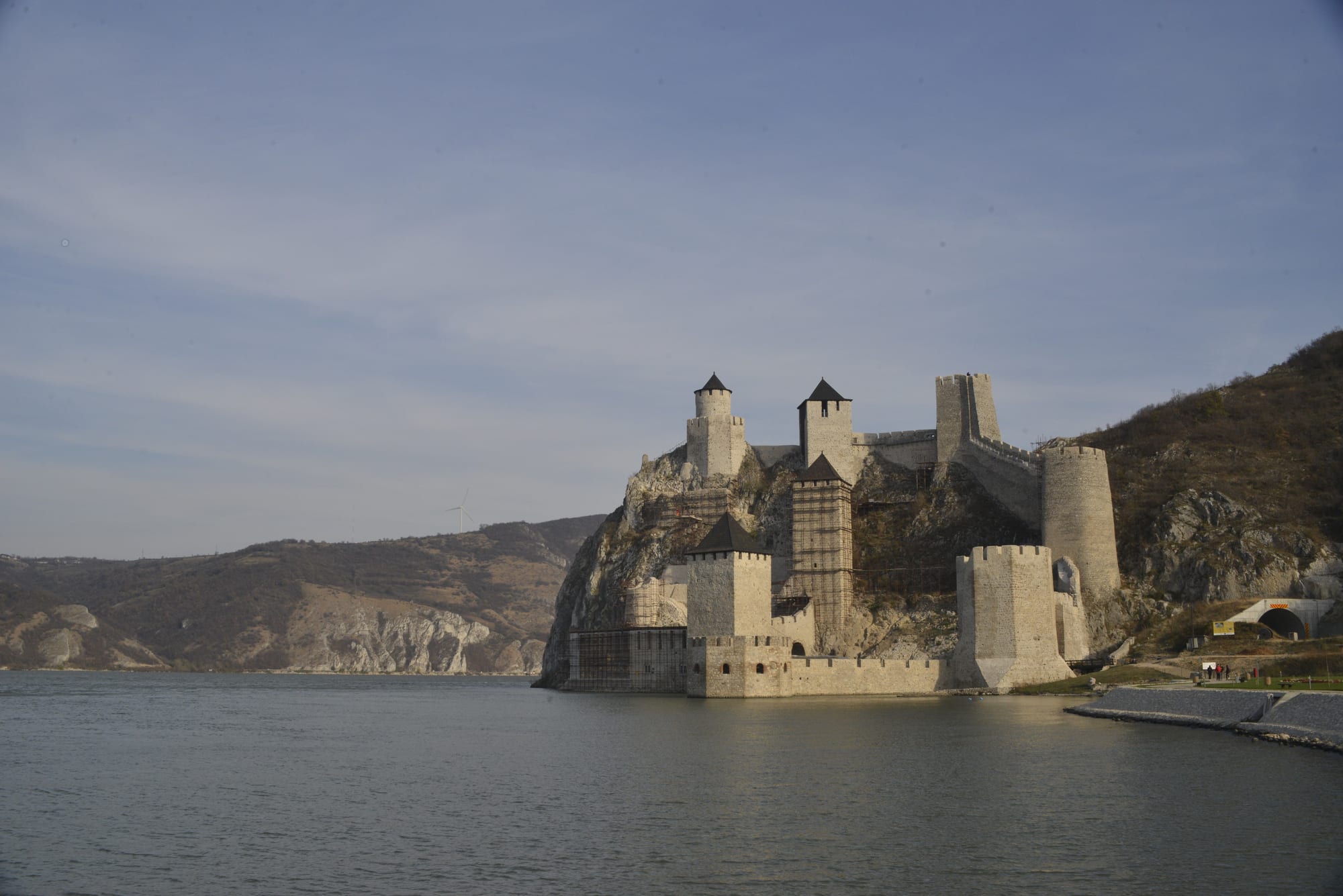
A stone castle with square and round towers climbing a rocky crag above the wide, calm Danube, with bare hills behind

Eastern Serbia, Serbia

Golubac

Golubac Fortress at the upstream entrance to the Iron Gates gorge of the Danube. (Miomir Magdevski / Wikimedia Commons · CC BY-SA 4.0)

A small town on the right bank of the Danube in eastern Serbia, facing Romania where the river enters the Iron Gates gorge. Its medieval fortress, fought over for centuries by Hungarians, Ottomans and Serbs, was fully restored in 2019, and the town is a popular fishing and sailing destination and a stop for river cruises at the head of Đerdap National Park.

Neighbourhoods

  • The old town and the quay
    • First-time visitors
    • Riverside walks
    • Close to the Danube

    The older part of Golubac on a narrow strip along the Danube, with the main square, cafés and restaurants and a quay that makes an easy riverside walk. Across the water, where the Danube is more than 6 km wide, lies Romania.

    Open in Maps
  • The upper town
    • Quiet and residential

    The newer part of the town, on higher ground to the south, a short walk above the river.

    Open in Maps
  • The fortress
    • Historic site
    • Views

    About 4 km downstream, the restored fortress stands where the gorge begins, with piers on the river, and the road now passes it through a tunnel.

    Open in Maps

Things to do

The fortress and the river

  • Golubac Fortresslandmark

    A 14th-century fortified town of ten towers on a crag above the Danube, besieged again and again by Hungarians and Ottomans, restored between 2014 and 2019 and open in zones graded by difficulty.

    Open in Maps
  • Zawisza the Black fountainlandmark

    A memorial drinking fountain in the moat near the fortress, raised in honour of the Polish knight killed after the siege of 1428.

    Open in Maps
  • Golubac quaytrail

    The town's promenade along the Danube, popular for relaxed walks at the water's edge.

    Open in Maps

Short trips from the town

  • Đerdap National Parkpark

    Established in 1974, the park runs along the Serbian bank of the Danube from Golubac Fortress through the Iron Gates gorge; its wider area became Serbia's first UNESCO global geopark in 2020.

    Open in Maps
  • Lepenski Virmuseum

    A prehistoric settlement of Mesolithic hunter-gatherers and early farmers beside the Danube, known for its trapezoid houses and large stone sculptures.

    Open in Maps
  • Silver Lakebeach

    An oxbow lake on the Danube near Veliko Gradište, upstream of Golubac, and a popular summer resort.

    Open in Maps
  • Ram Fortresslandmark

    A 15th-century fort on a steep rock above the Danube in the village of Ram, further upstream.

    Open in Maps
  • Viminaciummuseum

    The excavated capital of the Roman province of Moesia Superior near Kostolac, a city of perhaps 40,000 people at its peak, with more graves found than any other Roman site.

    Open in Maps

Seasonal events

  • Golubac sailing regattaAugust

    A sailing regatta traditionally held each August off the town, where the Sailing Association of Serbia has its training centre.

Eat and drink

Long-standing places and food districts in Golubac. Hours, ratings and directions come from your maps app, always current.

Golubac classics

  • Fish restaurants on the Danubeneighborhood

    Restaurants along the quay and on the road towards the fortress serve Danube fish, including fish soup, which Serbian cooks rank among their delicacies.

    Open in Maps
  • Cafés on the main squareneighborhood

    The small square and the quay near it are where the town takes its coffee, with views of the river.

    Open in Maps

Experience Golubac

History

Golubac stands on one of the oldest frontiers in Europe. Under Rome the site was a stronghold called Cuppae, which became a town named Columbria in the 6th century; the name, like the Serbian Golubac, means the place of doves. The fortress 4 km downstream, first recorded in Hungarian sources in 1335 and dating from the 14th century, guarded the point where the Danube narrows into the Iron Gates, and in the Middle Ages a chain across the river to the rock of Babakaj may have controlled the traffic.

The castle changed hands repeatedly. It passed between Hungary, the Ottomans and Serbia through the late 14th century, was granted to Despot Stefan Lazarević in 1403, and after his death in 1427 its commander sold it to the Ottomans rather than hand it to Hungary. King Sigismund besieged it in 1428 and was nearly captured; the Polish knight Zawisza the Black was killed, and Cecília Rozgonyi, who commanded one of the attacking ships, was credited with saving the king. The Ottomans held Golubac for most of the next four centuries, with Habsburg interludes, until it was handed to Serbia in 1867 and the town in 1868.

The Iron Gate dam, built in 1964–72, raised the river and flooded the lower parts of the fortress and the town's riverside sports grounds, though Golubac was the first settlement upstream that did not have to be moved. A road through the fortress gates carried traffic from the 1930s until a tunnel opened in 2017, and the full restoration of the fortress was completed in 2019.

Culture & Customs

Golubac's identity is tied to its fortress and its legends. The best known, though plainly much later than the castle, tells of a Serbian girl named Golubana who refused the gifts of an Ottoman pasha and was left to die on a rock in the river; other stories link the name to the towers rising "like doves" towards the sky. The town also has names in Romanian, Hungarian, German and Turkish, a reminder of the powers that fought over it.

The river shapes local life. Golubac is a well-known sailing centre: the Sailing Association of Serbia has its training base here, used by the national team before major events, and the town hosts a regatta each August and summer sailing camps for beginners. Fishing has long been part of daily life, and the riverside quay is the town's place for evening walks.

The surrounding landscape has international standing: Đerdap National Park, which begins at the fortress, became Serbia's first UNESCO global geopark in 2020. In 2023 Serbian and Romanian municipalities signed an agreement on the idea of a bridge across the Danube nearby.

Daily Life

The town had 1,445 inhabitants at the 2022 census and is the seat of a larger, mostly rural municipality in the Braničevo District. The older part of Golubac lies on a narrow strip along the river at about 75 metres above sea level, and the newer part rises on higher ground to the south.

Since the 2000s the town has been rebuilt around tourism. The fortress drew 63,000 visitors in 2017, before its restoration was even finished, and international cruise ships have docked there since it was declared a port area in 2018. Plans for the area between the town and the fortress include new restaurants, guesthouses, roads and cycle and footpaths. Fishing and sailing remain part of the town's working life.

The main square and park have been renovated, and the town has a modern quay with a cycle path.

Life is quiet and seasonal. Summer brings visitors and sailors, and the quay fills in the evenings; in winter the town is calm.

Food

Golubac eats from the Danube. Fish soups are counted among the delicacies of Serbian cooking, and in the town's restaurants they are made from the river's catch, alongside fried and grilled fish. Lamb and veal soups are held in the same esteem.

East of the Great Morava, which includes Golubac, hard cheeses are the dairy speciality rather than the kajmak of the west. Kačamak, a maize porridge whose name comes from Turkish, is a common breakfast dish, and bread is eaten with butter, yogurt, sour cream or cheese at breakfast, with bacon, sausage or eggs.

Rakia, the fruit brandy of south-eastern Europe, is normally around 40 per cent alcohol, though home-made versions can be much stronger, and many people distil their own. Serbian wine makers grow the aromatic Tamjanika, a muscat-family grape used mainly for white wines and named after frankincense for the scent of its ripe fruit, which is planted mostly in the Morava wine regions.

Planning tools

Budget

Golubac is one of the cheapest stops on the Danube. Guesthouses and small hotels cost well below Belgrade prices, and fish restaurants are good value. The fortress has an entry fee, and transport is the real expense, since the sights along the river are spread out and public transport is thin.

Daily Budget Midrange
USD 70–130 (riverside hotel, fish restaurants, a hire car, site entry fees)
Daily Budget Shoestring
USD 30–50 (private room, grill houses and bakeries, local buses)

Golubac, the fortress and the Danube road through the gorge combine naturally in one drive with a car.

Best Time to Visit

May to October. Summer suits sailing, swimming at Silver Lake upstream and boat trips, and river cruise ships call at the fortress. Spring and autumn are quieter and pleasant for walking. Winter is very quiet.

Suggested Number of Days

A day is enough for the town and its fortress. Three or four days allow time for the gorge, the national park and the archaeological sites along the river. Having a car makes a large difference, as buses along the Danube are infrequent.

First Visit
1 day
With Surroundings
3–4 days

Transportation

The town is small enough to walk, and the fortress is about 4 km away along the riverside road. Beyond that, a car is by far the easiest way to see the scattered sights: the Danube road through the gorge is scenic but slow, with tunnels, and buses along it are infrequent. Boat trips run in summer.

Fill up with fuel before driving into the gorge, where petrol stations are few.

Airport & Station Connections

Golubac is reached by road along the Danube from the direction of Belgrade, or from the east through the gorge; buses along the river are infrequent, so most visitors come by car or on an organised trip. River cruise ships dock at the fortress, which has been a port since 2018. International travellers usually fly into Belgrade.

Walkability

The centre and the quay are compact and flat, and the walk along the river is the town's main pleasure. The upper town involves a short climb. Walking to the fortress means following the main road for about 4 km; inside the fortress, the higher towers involve steep stone steps.

Safety

Serbia is a safe country for visitors, with low violent crime. In Golubac the risks are the narrow Danube road and its tunnels, strong currents in the river and fatigue on long rural drives. Parts of the fortress are steep: the upper towers are open only to adults, and the highest sections only with an escort.

Swim only at recognised beaches, keep to the permitted zones inside the fortress, and wear sturdy shoes on its steps. Check current official travel advice before travelling.

Climate

A moderate continental climate, with warm summers and cold winters. In winter the košava wind blows especially hard here, as it funnels up the Iron Gates gorge.

Summer
warm — in Smederevo, upstream on the Danube, July averages about 22°C
Winter
cold, with strong košava winds — in Smederevo, upstream on the Danube, January averages just below 0°C

Local Customs

A small Orthodox Serbian town where life is unhurried and centred on the river, and rakija is a common drink. Modest dress is expected in churches.

Ask before photographing people, and dress modestly when visiting churches and monasteries.

Common Payment Methods

The currency is the Serbian dinar (RSD). Cards are accepted in hotels and larger restaurants, but carry cash for guesthouses, cafés and small shops. Euros are easily exchanged.