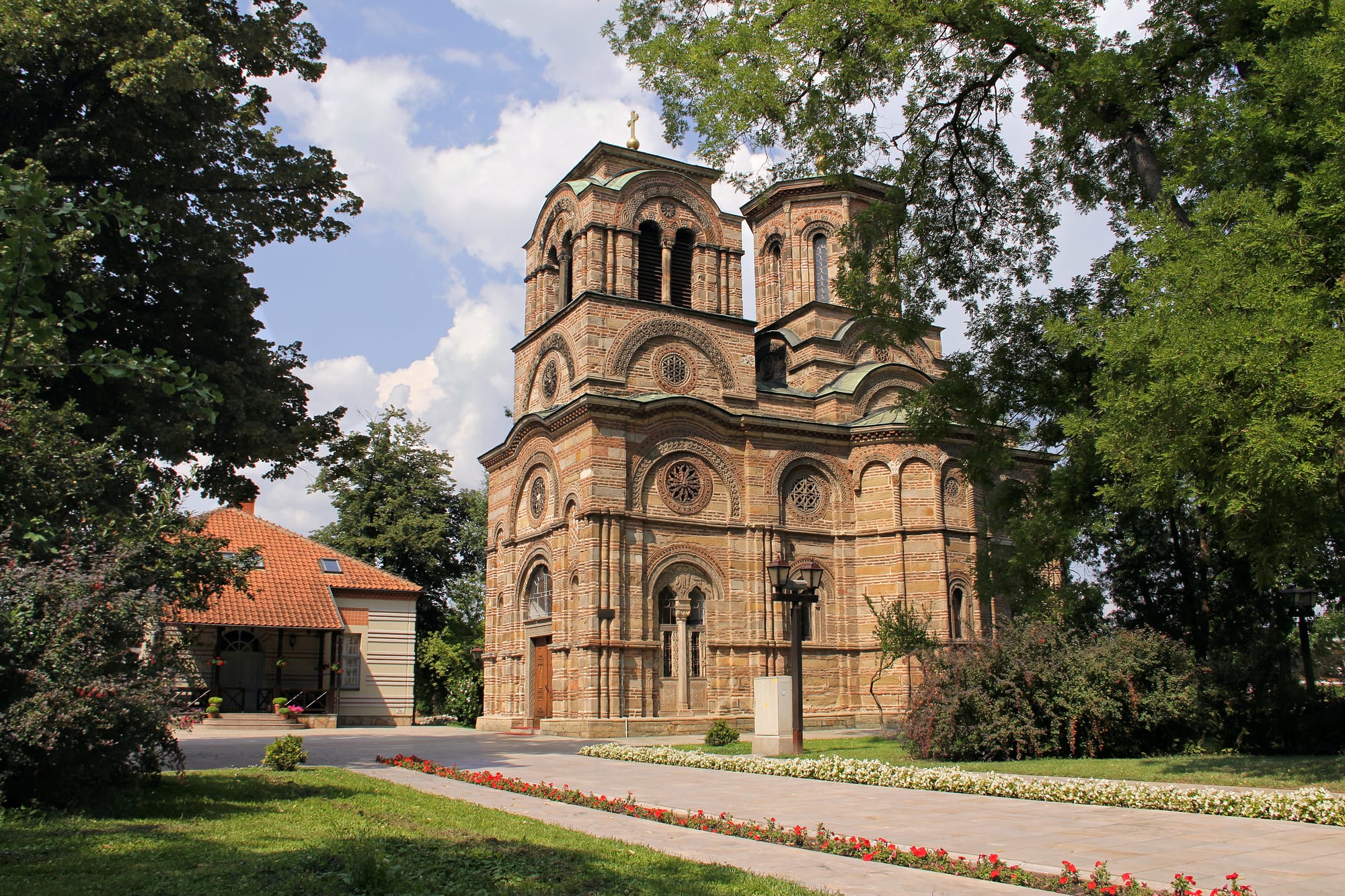
A medieval church of banded stone and brick with two domed towers and rose windows, among trees and flower beds

Southern Serbia, Serbia

Kruševac

The Lazarica church, Prince Lazar's court church of the 1370s, in the centre of Kruševac. (BrankaVV / Wikimedia Commons · CC BY-SA 4.0)

The administrative centre of the Rasina District, on the Rasina river near the West Morava in central Serbia. It was the capital of Prince Lazar, who led the Serbs at the Battle of Kosovo in 1389, and his court church of Lazarica still stands in the park of his ruined fortress. Later an Ottoman town and a big Yugoslav industrial centre, it is now a modest regional city.

Neighbourhoods

  • The centre and Heroes of Kosovo Square
    • First-time visitors
    • Cafés
    • Close to public transport

    The heart of the city around the square of the Heroes of Kosovo, given its present look in 2021 for the city's 650th anniversary, with the 1904 monument at its centre and the main shopping streets, cafés and restaurants around it.

    Open in Maps
  • Lazar's town
    • Historic district
    • Museums
    • Parks

    The park on the site of Prince Lazar's fortress, a short walk from the square, with the Lazarica church, the surviving Donjon tower, part of the eastern wall and the city museum.

    Open in Maps
  • Bagdala
    • Quiet
    • Memorials
    • Views

    The hill above the city where about 1,650 people were shot during the German occupation, now the Slobodište memorial park.

    Open in Maps

Things to do

Prince Lazar's city

  • Lazaricalandmark

    Lazar's palace church of Saint Stephen, built in 1375–78 as a prototype of the Morava school of architecture, built of rows of white sandstone and brick.

    Open in Maps
  • Kruševac Fortresslandmark

    The remains of Lazar's capital — the Donjon tower, once the gateway into the city and plastered with pebbles, and part of the eastern wall — in a park around the church.

    Open in Maps
  • National Museum Kruševacmuseum

    The city museum, founded in 1951, which stands in the area of the former fortress beside Lazarica.

    Open in Maps

Monuments and memorials

  • Monument to the Heroes of Kosovolandmark

    Đorđe Jovanović's marble monument of 1904 to the Battle of Kosovo, topped by the wounded standard-bearer Boško Jugović, with a figure of the blind poet Filip Višnjić.

    Open in Maps
  • Slobodištepark

    A memorial park on Bagdala hill where about 1,650 people, mainly Partisans, Chetniks and Roma, were shot during the German occupation.

    Open in Maps

Short trips from the city

  • Ljubostinjalandmark

    Princess Milica's convent on the West Morava near Trstenik, built on the eve of the Battle of Kosovo, where she is said to have first met Prince Lazar.

    Open in Maps
  • Jastrebacpark

    A well-forested mountain rising to 1,491 metres between Kruševac, Niš and Prokuplje, popular for hiking.

    Open in Maps
  • Aleksandrovacattraction

    The small town at the centre of the Župa wine country south-west of Kruševac.

    Open in Maps

Seasonal events

  • Vidovdan28 June

    The city's most important day, the feast of Prince Lazar and the fallen of the Battle of Kosovo, marked each year with a memorial service in the Lazarica church.

Eat and drink

Long-standing places and food districts in Kruševac. Hours, ratings and directions come from your maps app, always current.

Kruševac classics

  • Cafés and restaurants in the centreneighborhood

    The streets around the main square hold most of the city's cafés and restaurants, serving Serbian grilled meat, stews and pies.

    Open in Maps
  • Grill housesrestaurant

    Grills serving pljeskavica and ćevapi with onions, kajmak and flatbread, the everyday fast food of southern and central Serbia.

    Open in Maps

Experience Kruševac

History

Kruševac takes its name from krušac, a word for the river stone used in its buildings. Prince Lazar Hrebeljanović made it the seat of his realm in the 1370s; the city traditionally dates its founding to 1371, and the fortress is first mentioned in 1381. Lazar built his court church, Lazarica, in 1375–78, and in a charter of 1387 called Kruševac "the famous city of my dominion". The Serbian army assembled here before the Battle of Kosovo in 1389, and legend says crows brought news of the defeat to Princess Milica, who held the town after Lazar's death. Their son Stefan Lazarević ruled from Kruševac until he moved his capital to Belgrade in 1405.

The town was fought over through the first half of the 15th century and fell to the Ottomans in 1454. They called it Aladža Hisar, the "colourful fortress", probably for the mixed materials of its walls, and made it the seat of a sanjak. Lazarica was abandoned and used as a stable; during the Austrian occupation of 1736–39 it was partly repaired and painted with new frescoes. After Serbia's revival in the 19th century the church was restored, and in 1904 King Petar I unveiled the Monument to the Heroes of Kosovo in the main square.

During the Second World War about 1,650 people were shot by the German occupiers on Bagdala hill. In socialist Yugoslavia Kruševac became one of the country's strongest industrial centres; the machine works 14. oktobar alone employed about 7,000 people. The transition after 2000 was harsh: between 2002 and 2014, 27 factories closed and about 11,000 workers lost their jobs.

Culture & Customs

Kruševac is closely tied to the story of Kosovo. Vidovdan, 28 June, the feast of Prince Lazar and the warriors who fell in 1389, is Kruševac's most important day, marked each year with a memorial service in Lazarica for the fallen of Kosovo and of later wars of liberation. The Monument to the Heroes of Kosovo shows the wounded standard-bearer Boško Jugović, still holding the flag, with a vila, a fairy of Serbian legend, with a figure of the blind epic poet Filip Višnjić on one side; in 2000 protesters knocked the bow from his hands, and a new one was later cast.

Until 2002 the Slobodište memorial park hosted the "Festivities of Freedom", created by the writer Dobrica Ćosić, who is among the city's best-known residents. The city has had its own theatre since 1946, a national museum since 1951 and an art gallery since 1962. The composer Stanislav Binički, author of the March on the Drina, and the comedian Miodrag Petrović Čkalja are among the figures associated with Kruševac.

Football supporters follow FK Napredak, now in the second tier of Serbian football, whose nickname, Čarapani, "the sock-men", is traced to rebels of the First Serbian Uprising who crept up on the Ottomans in their socks.

Daily Life

The 2022 census counted about 114,000 people in the city's administrative area, which covers the urban area and 100 surrounding settlements in the valleys of the Rasina and West Morava. Kruševac is the administrative centre of the Rasina District, and the city lies at about 137 metres above sea level in the broad valley floor. In Yugoslav times the city grew quickly, and a large number of factories were built around it.

The collapse of much of the Yugoslav-era industry left deep marks: in 2015 unemployment stood at almost 39 per cent. The largest employers today include Trayal Corporation, the machine works 14. oktobar, the drinks company Rubin and a tyre factory owned by Cooper Tire, and the city has one of Serbia's free economic zones to attract new investment.

The main square, the Square of the Heroes of Kosovo, was first renovated for the city's 600th anniversary in 1971 and given its present look in 2021, for the 650th.

Food

Kruševac eats in the central Serbian way. Grilled meat is the everyday favourite: pljeskavica, a spiced patty of minced pork, beef and lamb and one of Serbia's national dishes, comes on a plate or in a lepinja flatbread with onions, kajmak and sometimes ajvar or urnebes; ćevapi, small fingers of grilled minced meat, are served in fives or tens with chopped onion. At home, sarma — minced meat and rice rolled in cabbage leaves — and gibanica, an egg and cheese pie of filo pastry, are national dishes, and proja, a cornbread, is eaten with kajmak and sour cream.

The city is also a drinks town. Rubin, a Serbian drinks company, has its headquarters here, with a factory making alcoholic and soft drinks. Kruševac gives its name to a wine subregion, and Aleksandrovac, to the south-west, is the centre of the Župa wine country. Prokupac, a traditional Serbian red grape, is planted mostly in the Morava wine regions and their neighbours.

Rakija, the fruit brandy of the Balkans, most popularly of plums in Serbia, is widely drunk; home-made versions can be far stronger than the usual 40 per cent.

Planning tools

Budget

Kruševac is cheaper than Niš and far cheaper than Belgrade. Grill houses, bakeries and cafés cost little, and the church, the fortress park and the memorials are free to visit. A hire car is the main extra cost for the monasteries and wine country around it.

Daily Budget Midrange
USD 70–130 (central hotel, restaurants, a hire car for Devil's Town and the mountains)
Daily Budget Shoestring
USD 30–50 (private room, grills and bakeries, buses)

Kruševac fits well into a trip between Niš and the monasteries of central Serbia; a car lets Ljubostinja and the Župa vineyards be seen in one outing.

Best Time to Visit

May, June, September and October are the most comfortable months. Late June brings Vidovdan, the city's great day, and September is the grape harvest in the Župa wine country nearby. Summers are hot and winters cold, with snow in the hills.

Suggested Number of Days

A day covers the city itself. Two or three allow time for the monasteries, mountains and wine country around it. Without a car, allow a little more time for the bus connections.

First Visit
1 day
With Surroundings
2–3 days

Transportation

The centre is compact and walkable. City buses and taxis cover the rest. Intercity buses link Kruševac with Niš and the other towns of the region; trains are slow. A car makes the monasteries, Jastrebac and the Župa vineyards far easier.

Drive carefully on minor rural roads, especially at night and in winter.

Airport & Station Connections

Most visitors arrive by intercity bus, which links Kruševac with Niš and the other towns of the region, or by car from the Belgrade–Niš motorway through the Morava valley. Niš Constantine the Great Airport is the main airport of the south; Belgrade has the widest choice of flights.

Walkability

Good in the centre: the main square, Lazarica and the fortress park are a few minutes apart on fairly level ground. Bagdala and Slobodište involve a walk uphill from the centre.

Safety

Serbia is a safe country for visitors, with low violent crime. In Kruševac the main concerns are petty theft, poorly maintained minor roads and winter conditions in the hills.

Keep an eye on belongings at the bus station and drive with care on rural roads. Check current official travel advice before travelling.

Climate

A continental climate with hot summers and cold winters. In Niš, to the south-east, the mean annual temperature is about 12.4°C, and snow lies on about 41 days a year.

Summer
hot — in Niš, to the south-east, July averages about 23°C
Winter
cold — in Niš, to the south-east, January averages about 1°C

Local Customs

Kruševac is overwhelmingly Serbian Orthodox, and the memory of Prince Lazar and the Battle of Kosovo is central to local identity. Families keep the slava, their patron-saint day, and rakija is a common drink. Modest dress is expected in Lazarica and the monasteries nearby.

Treat Lazarica and the wartime memorials with respect, especially around Vidovdan, and ask before photographing services.

Common Payment Methods

The currency is the Serbian dinar (RSD). Cards are accepted in larger shops, hotels and restaurants, but cash is needed in markets, small cafés and for buses. Cash machines are easy to find in the centre, and euros are easily exchanged.