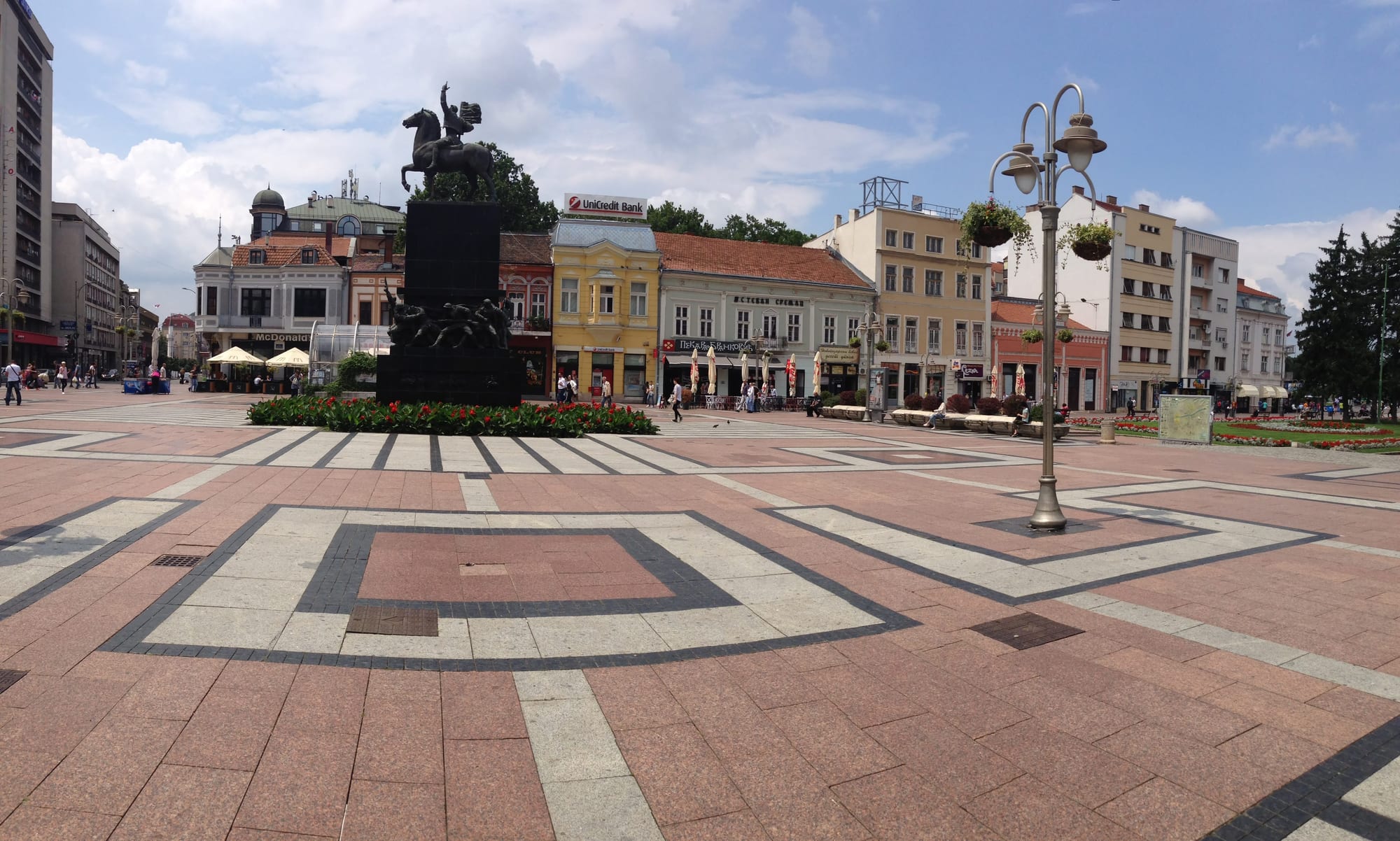
A wide paved square with an equestrian statue on a dark pedestal, flower beds and a row of pastel-coloured older buildings

Southern Serbia, Serbia

Niš

King Milan Square, the main square in the centre of Niš. (Intermedichbo - Dr Milorad Dimić, Serbia / Wikimedia Commons · CC BY-SA 4.0)

Serbia's third-largest city, on the Nišava river where the main road from Central Europe forks towards Istanbul and Thessaloniki. The Roman Naissus where Constantine the Great was born, it spent about four centuries under Ottoman rule, and today it is a university and industrial city of cafés, grill houses and an 18th-century Ottoman fortress at its heart.

Neighbourhoods

  • The city centre
    • First-time visitors
    • Shopping
    • Close to public transport

    The area south of the river around King Milan Square, with the shopping centres of Milana Obrenovića Street and an underground shopping passage. Many hotels and cafés are here.

    Open in Maps
  • The fortress and the market
    • Historic district
    • Festivals
    • Parks

    North of the river, the walled Ottoman fortress encloses a park, Roman remains, an old bath and a mosque, with cafés, restaurants and the summer stage of the city's festivals. The bus station and the green market lie just behind it.

    Open in Maps
  • Tinkers Alley
    • Best for food
    • Nightlife
    • Historic district

    Kazandžijsko sokače, an 18th-century street of craftsmen's workshops and houses from the Ottoman period in the centre, now protected and lined with cafés and restaurants.

    Open in Maps
  • Niška Banja
    • Spa
    • Quiet and residential

    A spa town 9 km east of the centre at the foot of Suva Planina, one of the city's five municipalities, known for its mildly radioactive hot springs and close to the Sićevo and Jelašnica gorges.

    Open in Maps

Things to do

Famous landmarks

  • Niš Fortresslandmark

    An Ottoman fortress built in 1719–23 on the right bank of the Nišava over Roman, Byzantine and medieval forts, entered by the Stambol Gate and holding an old bath, an arsenal and a mosque.

    Open in Maps
  • Skull Towerlandmark

    The tower the Ottomans built from the skulls of Serbian rebels after the Battle of Čegar in 1809, now inside an 1890s chapel; 58 skulls remain in its walls.

    Open in Maps
  • Tinkers Alleyneighborhood

    The old craftsmen's street of the 18th century, protected as an architectural complex and now the city's best-known strip of cafés and restaurants.

    Open in Maps
  • King Milan Squarelandmark

    The main square of the city centre, with the Monument to the Liberators of Niš.

    Open in Maps
  • Memorial to Constantine the Greatlandmark

    A monument in the city centre raised in 2013, when Niš marked 1,700 years since Constantine's Edict of Milan.

    Open in Maps

Roman and wartime history

  • Medianamuseum

    The excavated late-Roman imperial residence in the eastern suburbs, dating from the reign of Constantine, with a peristyle villa, baths, a granary and a water tower.

    Open in Maps
  • Crveni Krst concentration campmuseum

    A Gestapo-run camp of the Second World War, one of the few Nazi camps in Europe preserved in its entirety, with a memorial museum opened in 1967.

    Open in Maps
  • Bubanj Memorial Parkpark

    A memorial of three giant fists on the hill where more than 10,000 people were shot during the Second World War, many of them prisoners of the Crveni Krst camp.

    Open in Maps

Markets, sport and nights out

  • Niš green marketmarket

    The lively market between the fortress and the bus station, where hundreds of smallholders sell fruit and vegetables in the covered hall.

    Open in Maps
  • Čair Stadiumattraction

    The home ground of the football club Radnički Niš, reopened after reconstruction in 2012.

    Open in Maps

Short trips from the city

  • Sićevo Gorgepark

    The gorge cut by the Nišava between Niška Banja and Bela Palanka, a river gorge and archaeological site east of the city.

    Open in Maps
  • Jelašnica Gorgepark

    A protected gorge south of the village of Jelašnica, near the Pešturina cave, one of the last known Neanderthal homes.

    Open in Maps
  • Devil's Townpark

    About 200 earth pyramids capped with stones on the slopes of Radan mountain, the most numerous and tallest formation of its kind.

    Open in Maps

Seasonal events

  • Nišville Jazz Festivalmid-August

    An international jazz festival of four days on the summer stage of the fortress, one of the best-known in South-East Europe.

  • Niš Film Festivallate August

    A long-running festival of film acting, once among the largest film festivals in Yugoslavia.

Eat and drink

Long-standing places and food districts in Niš. Hours, ratings and directions come from your maps app, always current.

Niš classics

  • Burek bakeriesrestaurant

    Bakeries selling burek, flaky filo pastry filled with meat or cheese and eaten with yogurt; the round form of burek was developed in Niš.

    Open in Maps
  • Grill housesrestaurant

    Grills serving pljeskavica, the spiced patty of minced pork, beef and lamb, and ćevapčići, with onions, kajmak and the hot cheese spread urnebes.

    Open in Maps

Food districts and markets

  • Tinkers Alleyneighborhood

    The old craftsmen's street in the centre, now the city's best-known cluster of cafés and restaurants.

    Open in Maps
  • Fortress caféscafe

    Cafés and restaurants inside the fortress, a short walk across the river from the centre.

    Open in Maps
  • Niš green marketmarket

    The covered market behind the fortress, with local fruit and vegetables.

    Open in Maps

Experience Niš

History

Niš was the Roman Naissus, a garrison and market town on the military road from the Danube to Constantinople. Constantine the Great was born here in 272 and lived in the city from 316 to 322, enlarging it with public buildings; in 364, at the imperial villa of Mediana, the emperors Valentinian and Valens met and divided the Roman Empire between them. The Huns sacked the city in the 440s, and Justinian restored it before it was destroyed by the Avars.

Byzantium, Bulgaria and Serbia fought over Niš through the Middle Ages. By 1188 it was the capital of the Serbian ruler Stefan Nemanja, who received Emperor Frederick Barbarossa and his crusaders here in 1189. The Ottomans took it after a 25-day siege in 1385, and apart from Serbian and Austrian interludes held it until 1878, rebuilding the fortress in 1719–23. In 1809 Serbian rebels were defeated at nearby Čegar, and the Ottoman commander built their skulls into a tower as a warning. The Serbian army entered the city on 11 January 1878; many of its Muslim inhabitants were forced to flee, and most of its mosques were pulled down.

The railway from Belgrade arrived in 1884, and for a few years Niš was the end of the line of the Orient Express. In the First World War it was Serbia's wartime capital until late 1915. During the Second World War the Germans ran the Crveni Krst camp here, and more than 10,000 people were shot on Bubanj hill. The University of Niš was founded in 1965, and NATO air strikes in 1999 killed 56 people in the city.

Culture & Customs

Niš is the cultural centre of south-eastern Serbia. Its best-known event is Nišville, an international jazz festival held over four days each August on the summer stage of the fortress, and the city also hosts a long-running festival of film acting, a classical music festival in autumn and a biennial choral festival. The National Theatre began in 1889 as the Sinđelić Theatre, the poet Branko Miljković is the city's leading literary figure, and the rock bands Galija and Kerber came from here. In 1905 the painter Nadežda Petrović founded an artists' colony in nearby Sićevo, and a literary colony has met there each year since 1991.

The city is proud of its Roman past, which it remembers through Constantine: in 2013 Niš celebrated 1,700 years since his Edict of Milan with a new memorial in the centre, and the airport bears his name. Orthodox Christianity shapes the calendar, with family slava feasts and church holidays.

Football is followed through Radnički Niš, whose home is the Čair Stadium, and evenings are spent in the cafés of Tinkers Alley and around the fortress.

Daily Life

According to the final results of the 2022 census, about 183,000 people live in the city proper and about 260,000 in the wider city area, which is divided into five municipalities. The University of Niš has about 22,000 students, and the city has more high-rise buildings than any in Serbia except Belgrade.

Niš was an industrial city in Yugoslav times, known for electronics, mechanical engineering, tobacco and textiles, and in 1981 its income per head was above the Yugoslav average. Several big firms went bankrupt in the 1990s and 2000s; the tobacco factory was sold to Philip Morris in 2003, and since then foreign manufacturers have opened plants, helped by a free economic zone. A large new building for the Clinical Centre opened in 2017.

The green market behind the fortress, where hundreds of smallholders sell fruit and vegetables, the shopping centres of Milana Obrenovića Street and the underground shopping passage are busy, and since July 2025 city buses have been free for everyone.

Food

Grilled meat is a southern Serbian tradition best known from nearby Leskovac, and pljeskavica is everywhere in Niš. Pljeskavica, a spiced patty of minced pork, beef and lamb and one of Serbia's national dishes, is served on a plate or in a lepinja flatbread with onions, kajmak and sometimes ajvar. Ćevapčići, small fingers of spiced minced beef, pork and lamb, are served the same way, and the fast-food tradition of grilled meat goes back to the Ottoman towns of the Balkans, among them Niš.

Burek is a common breakfast: thin flaky pastry, usually filled with cheese or minced meat, eaten with yogurt. The round form of burek was developed in Niš, and Niš is said to produce the best burek. Urnebes, whose name means "mess", is a spread of white cheese, kajmak and hot chilli peppers that is especially associated with Niš and the south, and shopska salad, chopped tomato, cucumber and onion topped with white cheese, is a simple staple.

The green market sells local fruit and vegetables, and the cafés of Tinkers Alley and the fortress fill from morning to night. Rakija, usually of plums or apricots, is the local spirit, and the city's tap water is drinkable — something residents are proud of.

Planning tools

Budget

Niš is among the cheapest cities in Serbia, with hostels, apartments and grill restaurants at prices well below Belgrade. City buses have been free for everyone since July 2025. A hire car adds to the bill but makes the gorges and Devil's Town easy to reach.

Daily Budget Midrange
USD 70–130 (central hotel, restaurants, a hire car for Devil's Town and the mountains)
Daily Budget Shoestring
USD 30–50 (hostel or private room, burek and grills, free city buses)

The fortress, Tinkers Alley and the riverside are free to wander.

Best Time to Visit

May, June, September and October are the most comfortable months. Summer is hot but brings the festivals at the fortress, Nišville above all. Winters are cool, with snow cover on about 41 days a year, and the museums and cafés are quiet.

Suggested Number of Days

Two days cover the city. Four or five allow time for the spa, the gorges and the southern Serbian towns within reach, and Niš works well as a base for them. Festival weeks are worth planning around.

First Visit
2 days
With Surroundings
4–5 days

Transportation

The city has a well-established bus network, with almost all lines stopping at or near the central square, and local transport has been free since July 2025. Taxis are plentiful and cheap; make sure the meter is on. A car is the easiest way to reach the gorges, Devil's Town and the mountains.

Parking in the centre is charged in two zones, paid by ticket or SMS; use hotel car parks overnight.

Airport & Station Connections

Niš Constantine the Great Airport, the second busiest in Serbia, is about 4 km north-west of the centre, with buses and taxis into town. Buses from Belgrade take about three hours, and international buses between Belgrade and Bulgaria, Greece or North Macedonia stop here. The motorway from Belgrade takes about two hours by car. Rail services are much reduced while the line is rebuilt, with many replaced by buses.

Walkability

The centre is flat and compact: King Milan Square, the shopping street, Tinkers Alley and the fortress across the river are minutes apart, and the bus station is just behind the fortress. The railway station is about half an hour's walk away. Away from the centre the city climbs into hills, and crossing it on foot takes two or three hours.

Safety

Serbia is a safe country for visitors, with low violent crime. In Niš the main concern is that cars with foreign plates parked in the centre can attract petty criminals at night. Football matches can draw rowdy crowds.

Watch belongings in crowds, use secure parking, and avoid football crowds on match days. Check current official travel advice before travelling.

Climate

A humid subtropical climate with continental influences. The mean annual temperature is about 12.4°C, and rain or snow falls on about 134 days a year. Temperatures have risen by about 1°C over the last 15 years, and January is now the only month whose average lows fall below freezing.

Summer
hot — July, the warmest month, averages about 23°C
Winter
cool to cold — January averages about 1°C, with snow lying on about 41 days a year

Local Customs

Niš is overwhelmingly Serbian Orthodox. Street signs are mostly in Cyrillic with English translations; younger people usually speak English. Tap water is drinkable, and rakija, usually plum or apricot, is the local drink.

Dress modestly in churches and at the Skull Tower chapel, and treat the wartime memorials with respect.

Common Payment Methods

The currency is the Serbian dinar (RSD), and shops may not legally take euros, so cash must be changed at a bank or exchange office — there are many in the centre. Cards are welcome in most city shops. Vendors must give a fiscal receipt for every purchase.