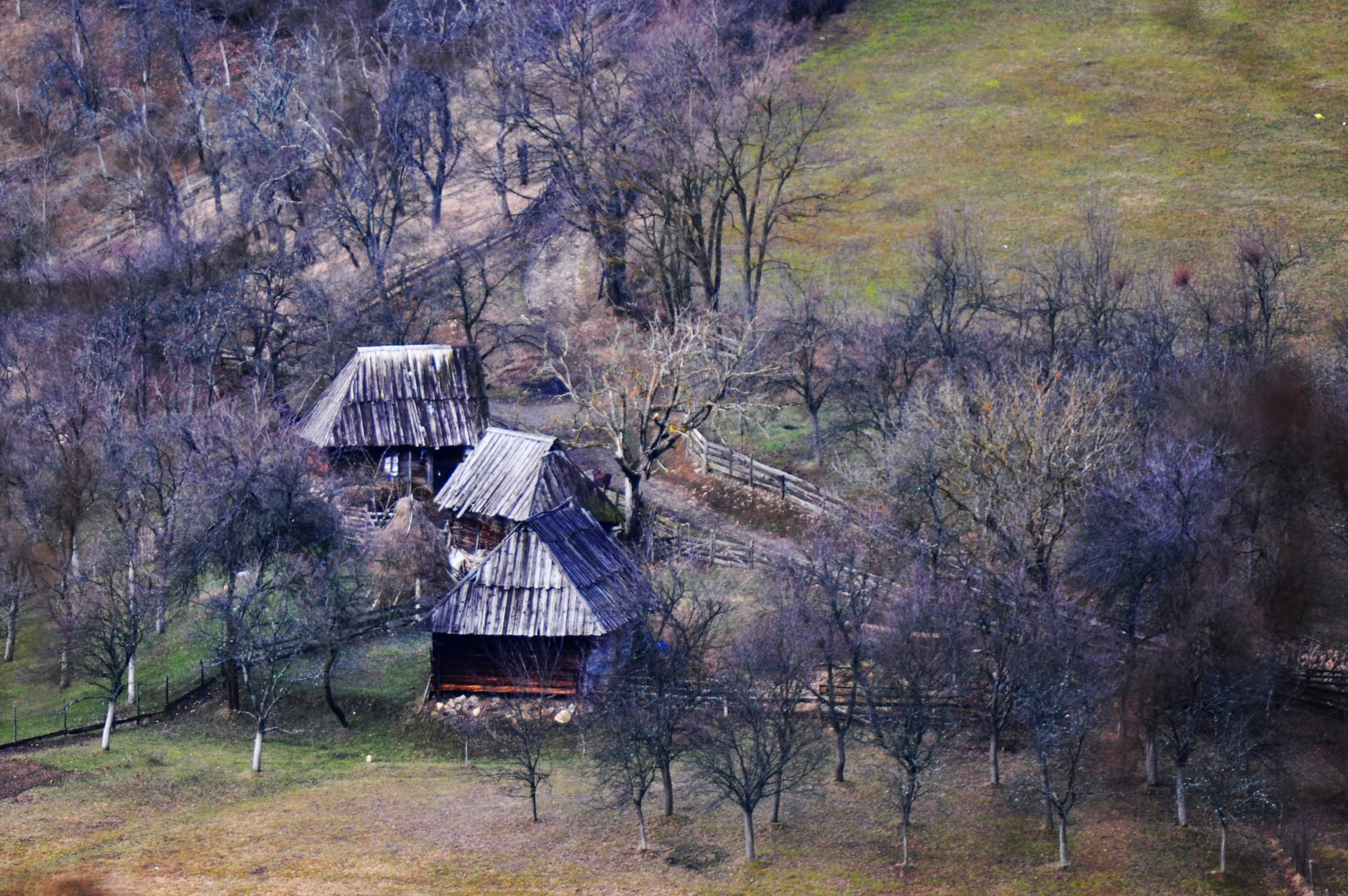
Three old wooden farm buildings with grey shingle roofs among bare fruit trees on a grassy hillside

Western Serbia & Šumadija, Serbia

Mokra Gora

Old timber farm buildings on a hillside in the village area of Mokra Gora. (Anita.Palceska / Wikimedia Commons · CC BY-SA 4.0)

A small village of the city of Užice in western Serbia, in a valley between the Tara and Zlatibor mountains on the border with Bosnia and Herzegovina. Its narrow-gauge railway closed in 1974; the rebuilding of the Šargan Eight line and Emir Kusturica's timber village of Drvengrad have since made it a well-known tourist destination.

Neighbourhoods

  • The station and the village
    • First-time visitors
    • Railway heritage

    The valley floor around Mokra Gora station, where the Šargan Eight trains start, with the restored station buildings, a small railway museum and the scattered houses and churches of the village along the main road between Užice and Višegrad.

    Open in Maps
  • Drvengrad
    • Architecture
    • Film and culture

    The timber village Emir Kusturica built on Mećavnik hill above the station, with log buildings, a small cinema, a library, a gallery and streets named after people the director admires. It is reached by road or by steps up from the station.

    Open in Maps
  • Bele Vode and the Kamišina valley
    • Quiet and rural
    • Walks

    The side valley along the Kamišina river, with a hiking path, small waterfalls, the Bele Vode spring and an Orthodox church — a walk of an hour or two from the station on a minor road.

    Open in Maps

Things to do

The railway and Drvengrad

  • Šargan Eightattraction

    A restored narrow-gauge heritage railway that climbs from Mokra Gora to Šargan Vitasi in a figure-of-eight loop through tunnels and over bridges, worked by the old-style train known as Ćira.

    Open in Maps
  • Mokra Gora railway museummuseum

    A small museum of the line at Mokra Gora station, the starting point of the Šargan Eight.

    Open in Maps
  • Golubići stationattraction

    An intermediate stop on the line that served as a set for Kusturica's film Life Is a Miracle, with a clear view across to Drvengrad.

    Open in Maps
  • Drvengradlandmark

    Kusturica's village of log houses, built in 2003–04 for his film, with a church dedicated to Saint Sava and a theatre named after Stanley Kubrick; Kusturica received the Philippe Rotthier European Architecture award in 2005.

    Open in Maps

Walks and nature

  • Bele Vode springtrail

    A spring declared medicinal after its discovery in 1994, reached on foot along the Kamišina river, with an Orthodox church beside it.

    Open in Maps
  • Kamišina path and waterfallstrail

    A hiking path up the Kamišina valley past small waterfalls and the disused tracks of an even narrower forest railway once used for timber.

    Open in Maps
  • Šargan–Mokra Gora Nature Parkpark

    The protected area, declared in 2008, that covers the whole Mokra Gora basin, the Šargan pass and the facing slopes of Tara and Zlatibor.

    Open in Maps

Short trips from the village

  • Tara National Parkpark

    A mountain of dense forest, high meadows and cliffs above the Drina canyon, reached from Mokra Gora by the road through Kremna.

    Open in Maps
  • Zlatiborattraction

    One of the most popular places in Serbia for tourism, known for skiing, hiking, health tourism and the longest panoramic gondola lift in the world.

    Open in Maps
  • Mehmed Paša Sokolović Bridgelandmark

    The Ottoman bridge over the Drina at Višegrad in Bosnia and Herzegovina, completed in 1577 and a UNESCO World Heritage Site since 2007.

    Open in Maps
  • Andrićgradattraction

    Kusturica's second purpose-built town, in stone, in Višegrad, dedicated to the Nobel Prize-winning novelist Ivo Andrić and opened in 2014.

    Open in Maps
  • Dobrun Monasterylandmark

    A 14th-century monastery dedicated to the Dormition of the Virgin in the Rzav gorge on the Bosnian side of the border.

    Open in Maps

Seasonal events

  • Küstendorf Film and Music Festivalearly January

    Kusturica's festival in Drvengrad, held since 2008, which shows films and music from around the world and is known for having no red carpet.

Eat and drink

Long-standing places and food districts in Mokra Gora. Hours, ratings and directions come from your maps app, always current.

Eating along the railway

  • Šargan Eight station restaurantrestaurant

    The restaurant inside the Mokra Gora station building, serving traditional Serbian food.

    Open in Maps
  • Drvengrad restaurant and cake shoprestaurant

    The eating places inside Kusturica's timber village, among the log houses on Mećavnik hill.

    Open in Maps
  • Rock-cut restaurant at Šarganrestaurant

    A restaurant carved into the rock at Šargan, at the top of the line, one of the attractions along the route.

    Open in Maps

Experience Mokra Gora

History

Mokra Gora means "Wet Mountain"; local legend says a passing army camped here and found its firewood too wet to burn. For centuries it was a scattered upland village on the route between the Užice area and the Drina valley. Its modern story begins with the railway. During the First World War the Austro-Hungarian occupiers began a line across the Šargan pass to link Serbia with Bosnia, using Russian and Italian prisoners of war; in 1916 a tunnel collapse killed between 150 and 200 of them, and work stopped.

The new Kingdom of the Serbs, Croats and Slovenes resumed the works in 1921, designing the figure-of-eight loop that lets the line drop 300 metres in a short distance, and the first train passed through in January 1925. The narrow-gauge line formed part of the main route from Belgrade to Sarajevo and the Adriatic until it closed in February 1974.

A society to bring the railway back was founded in 1994. The state took up the plan in 1999, the Šargan section was rebuilt by 2003, and an extension to Višegrad followed in 2010. Kusturica built Drvengrad in 2003–04, the area became the Šargan–Mokra Gora Nature Park in 2008, and in 2021 the UN World Tourism Organization named Mokra Gora one of the best tourism villages in the world.

Culture & Customs

The village's cultural life has been shaped above all by the film director Emir Kusturica, who built Drvengrad, also called Küstendorf or Mećavnik, as a set for his film Life Is a Miracle and then kept it as his home and a place for workshops and seminars. Its streets carry the names of figures he admires, among them Nikola Tesla, Federico Fellini, Ingmar Bergman, Diego Maradona and Ivo Andrić, and since 2008 it has hosted the Küstendorf Film and Music Festival each January, a deliberately informal event without a red carpet that has brought directors such as Jim Jarmusch to the mountains.

Older traditions are Orthodox and rural. The village has several churches, including one dedicated to Saint John the Baptist and a small wooden church built in 2011 with the blessing of both the Serbian and Russian Orthodox churches, a memorial to everyone who worked on the railway, the prisoners of war who died included. Families keep the slava, the household's patron-saint day, and the village holds its own homeland days. The railway itself, with its restored 1930s-style carriages and the train nicknamed Ćira, has become a point of local pride.

Daily Life

Mokra Gora is a village of the city of Užice and had 393 inhabitants at the 2022 census, a number that has fallen at each of the last three counts. The houses are spread over a large area, about 55 square kilometres, from around 460 metres on the valley floor to the 1,544-metre summit of Zborište on Tara.

For decades the main employer in the area was the Kotroman chemical works, which lost most of its market after the break-up of Yugoslavia and went bankrupt. Tourism has largely replaced it. The Šargan Eight carried 88,000 passengers in the 2019 season, and the area around the line has grown into a tourist complex of inns, a small ski area, walking paths and picnic grounds.

Life follows the seasons. Summer and autumn bring coach groups and weekend visitors to the station and Drvengrad, while in snowy winters the train runs only part of the line and the village is much quieter. The valley sits on a large deposit of nickel-rich iron ore, which gives many of its mineral springs their unusual chemistry.

Food

Mokra Gora eats like the rest of the Zlatibor and Užice country, which is dairy and smoked-meat territory. Kajmak, a rich clotted-cream dairy product made by slowly boiling and simmering milk and skimming off the cream, appears on almost every table, and west of the Great Morava it is considered at its best. A popular breakfast is komplet lepinja, the "complete flatbread", with kajmak, egg and roasted meat drippings. Proja, a cornbread made with corn flour, is eaten with kajmak and ajvar.

Smoked meats are the area's speciality. Užička pršuta, smoked beef, pork or mutton from nearby Užice, and Zlatibor's own smoked ham are served sliced as a starter, with Užice bacon alongside. Sarma, minced meat and rice rolled in cabbage leaves, and gibanica, an egg and cheese pie made with filo pastry, are among the national dishes cooked at home.

Visitors eat mostly at the restaurant in the station building, in Drvengrad and at a restaurant cut into the rock at Šargan at the top of the line. Rakija, the fruit brandy of the Balkans, most popularly of plums in Serbia, may be served alongside coffee, and home-made versions can be considerably stronger than the usual 40 per cent.

Planning tools

Budget

Mokra Gora is cheap by European standards but is a single village with a small choice of places to stay and eat, mostly guesthouses and inns around the station and in Drvengrad. The Šargan Eight ride, the entry fee to Drvengrad and getting there are the main costs; a car makes the surrounding mountains much easier to reach.

Daily Budget Midrange
USD 80–160 (inn or mountain hotel, restaurant meals, a hire car, the Šargan Eight train)
Daily Budget Shoestring
USD 35–60 (private room or village guesthouse, simple meals, the train ride, buses via Užice)

The train is popular in season, so tickets are best bought early; the walks along the tracks and to Bele Vode are free.

Best Time to Visit

Late spring to early autumn, when the Šargan Eight runs its full route and the walks and springs are easy to reach. Autumn colours on the surrounding mountains are a draw in October. In snowy periods the train runs only part of the line, but early January brings the Küstendorf film festival and winter sports are close by.

Suggested Number of Days

Most visits last one or two days. Three or four allow time for the neighbouring mountains and a crossing into Bosnia and Herzegovina. The season and whether the train is running the full route make the most difference.

First Visit
1–2 days
With Surroundings
3–4 days

Transportation

The village is spread along the main road between Užice and Višegrad and is best explored on foot, with the station, Drvengrad and the start of the Bele Vode walk close together. Public transport is very limited — a single daily bus to and from Užice — so a car, or a taxi from Užice, is the practical way to reach the mountains around it.

Mountain roads are narrow and winding; allow extra time and carry winter equipment in the snowy months.

Airport & Station Connections

Mokra Gora lies on a major road between Serbia and Bosnia and Herzegovina. From Užice there is one daily bus in the morning, taking about an hour, which returns in the late afternoon; most visitors come by car or on an organised trip. Travellers flying in usually arrive at Belgrade Nikola Tesla Airport and continue by bus or car through Užice.

Walkability

Good for a village: the station, the railway museum and Drvengrad are linked by road and by steps, and the paths beside the tracks let walkers reach the intermediate stations without taking the train. The houses are scattered across the valley, and the main road carries through traffic to the border.

Safety

Serbia is a safe country for visitors, with low violent crime. In Mokra Gora the hazards are natural: winding mountain roads and fast local driving, winter ice and snow, sudden summer storms, and brown bears in the remote forests of neighbouring Tara. The valley has dozens of mineral springs, and some of them are toxic.

Drink only from springs known to be safe, such as Bele Vode, keep to marked trails, and carry snow chains in winter. Check current official travel advice before travelling.

Climate

A cool mountain climate: the village lies at about 460 metres on the valley floor, with Tara rising to over 1,500 metres above it. Summers are fresh, with afternoon storms, and winters are long and snowy. In nearby Zlatibor the mean annual temperature is about 7.5°C.

Summer
fresh — in nearby Zlatibor, August, the warmest month, averages about 15°C
Winter
cold and snowy — in nearby Zlatibor, January averages about −2.5°C

Local Customs

This is Orthodox Serbian village country, with small churches including a wooden memorial chapel to those who built the railway. Rakija may be served alongside coffee. Modest clothing is expected inside churches, and permission should be asked before taking photographs inside them.

Ask before photographing people or private houses and farmyards; Drvengrad charges an entry fee and is also the director's home.

Common Payment Methods

The currency is the Serbian dinar (RSD). Cards are accepted at the larger places around the station and Drvengrad, but cash is needed for buses, small guesthouses and stalls, so it is best to carry dinars. Euros are easily exchanged in Serbia.