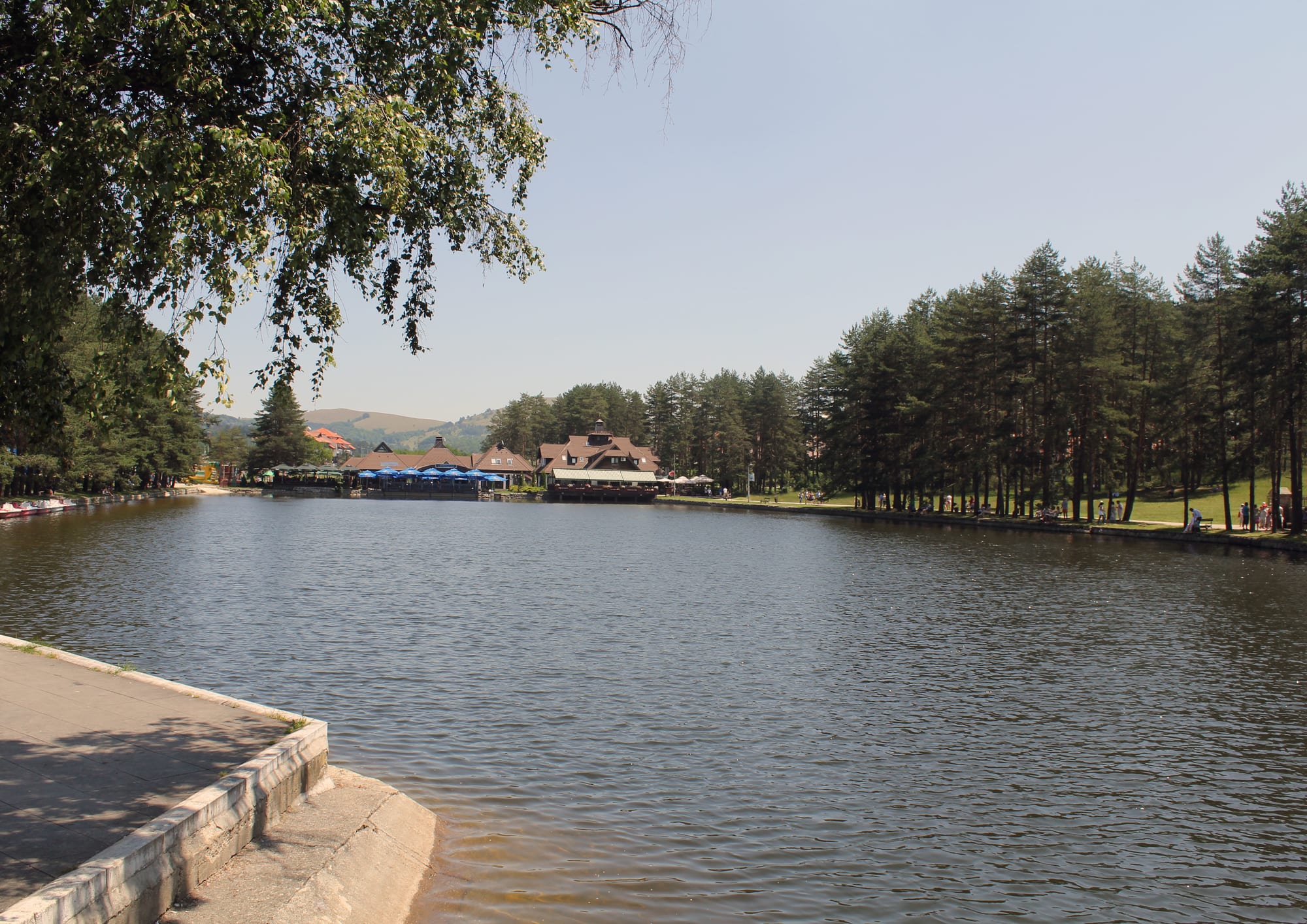
A small lake fringed with tall pines and lawns, with wooden-roofed lakeside buildings and low green hills beyond on a sunny day

Western Serbia & Šumadija, Serbia

Zlatibor

The lake in the centre of Zlatibor town, ringed by pine woods. (Andris Malygin / Wikimedia Commons · CC BY 3.0)

A mountain resort town at just over 1,000 metres on the Zlatibor plateau in western Serbia, a health resort since King Aleksandar Obrenović's visit in 1893. Pine woods, meadows and a small lake surround a town that has grown fast and without much planning, with skiing on Tornik, a record-breaking gondola, marked hiking trails and smokehouses known for pršuta.

Neighbourhoods

  • Zlatibor town
    • First-time visitors
    • Nightlife
    • Close to buses

    The resort town itself, grown from a cluster of holiday homes into a busy place of hotels, apartments, restaurants and pools around the lake and King's Square. The gondola starts here, and the town's own ski lift stands nearby.

    Open in Maps
  • Čajetina
    • Quiet and residential
    • Local life

    The small municipal town near the resort, on the bus road from Užice, quieter and more everyday than the resort.

    Open in Maps
  • The villages of the plateau
    • Rural life
    • Folk heritage
    • Walking

    Villages such as Sirogojno, Gostilje, Jablanica and Mačkat, many of which have opened their homes to visitors. Sirogojno is known for its open-air museum and woollen knitwear, Gostilje for its waterfall and Mačkat for its cured meats.

    Open in Maps

Things to do

The resort

  • Zlatibor Lake and King's Waterpark

    The small artificial lake formed in 1947 beside Kraljeva Voda, the fountain raised where King Aleksandar Obrenović had lunch in 1893, now with a floating fountain with light and water shows.

    Open in Maps
  • Gold Gondolaattraction

    The longest panoramic gondola lift in the world when it opened in January 2021, running about 9 km from the town centre past Ribnica Lake to the summit of Tornik.

    Open in Maps
  • Tornikviewpoint

    The highest point of the Zlatibor mountains at 1,496 metres, with the area's main ski slopes and a popular paragliding launch on its southern side.

    Open in Maps

Villages, caves and waterfalls

  • Sirogojno Old Village Museummuseum

    An open-air museum of old wooden houses gathered from across Zlatibor, in a village declared a Monument of Culture of Exceptional Importance in 1983.

    Open in Maps
  • Stopića Caveattraction

    A limestone cave near Sirogojno, protected as a natural monument and by 2022 the most visited cave in Serbia.

    Open in Maps
  • Gostilje waterfallattraction

    A waterfall 22 metres tall in the village of Gostilje, on the mountain.

    Open in Maps
  • Uvac Monasterylandmark

    A medieval monastery at Stublo, dedicated to the Nativity of Mary, destroyed by the Ottomans in the late 17th century and rebuilt in the last years of the 20th century.

    Open in Maps

Short trips from the resort

  • Šargan Eightattraction

    A narrow-gauge heritage railway at Mokra Gora, restored in 2003, which climbs the Šargan hill in a figure-of-eight loop, with 22 tunnels and five larger bridges on the route.

    Open in Maps
  • Drvengradattraction

    A traditional village of timber that the film director Emir Kusturica built near Mokra Gora in 2003–04 for his film Life Is a Miracle, also known as Küstendorf or Mećavnik.

    Open in Maps
  • Užiceattraction

    The administrative centre of the Zlatibor District on the river Đetinja, at the foot of the mountain and linked to the resort by the Zlatibor road.

    Open in Maps
  • Uvac Special Nature Reservepark

    A protected canyon of the river Uvac, known for the successful conservation of the griffon vulture.

    Open in Maps

Eat and drink

Long-standing places and food districts in Zlatibor. Hours, ratings and directions come from your maps app, always current.

Zlatibor classics

  • Mačkat smokehousesneighborhood

    The village on the road from Užice famous for its meat products, above all Zlatibor pršuta, smoked pork ham.

    Open in Maps
  • Zlatibor cheese and kajmakrestaurant

    Zlatibor cheese and kajmak, a creamy dairy food like clotted cream, are served in the resort's restaurants, often with lepinja flatbread.

    Open in Maps

Experience Zlatibor

History

In the Middle Ages the area was Rujno, a district of Raška, a centre of the medieval Serbian state, and the monasteries of Uvac and Dubrava stood on the plateau; Uvac was destroyed by the Ottomans in the late 17th century. The name Zlatibor appears in the 18th century; it probably means golden pine, after a local variety of Scots pine of which only grafted trees in the towns survive. Cigla, a hill near Jablanica, still carries boundary marks of the Kingdom of Serbia, Austria-Hungary and the Ottoman Empire.

Organised tourism began on 20 August 1893, when King Aleksandar Obrenović decided to found a health resort at the spot now called Kraljeva Voda, the King's Water, where a fountain marks his lunch. The Užice road, built in 1923–27, opened the plateau to visitors. In the autumn of 1941 Zlatibor was caught up in the fall of the short-lived Partisan Republic of Užice: the retreating Partisans buried paper money and silver on the mountain, and much of it was lost or taken by others. In 1944, 47 Allied airmen shot down over the mountain were hidden by local Chetniks and later flown out.

In 1945 the settlement was renamed Partizanske Vode, and in 1947 the lake was finished by a youth work action; the town took the name Zlatibor again in 1991. Part of the mountain became a nature park in 2017, and in January 2021 the gondola to Tornik opened. The town has grown so fast, with crowded and unplanned buildings, that it has been nicknamed Kaluđerica on the Mountain, after a sprawling Belgrade suburb.

Culture & Customs

The plateau's culture is pastoral and craft-based. In the 19th century its caravan merchants, the kiridžije, carried goods on strings of 15 to 20 horses, and a photograph of one of them became a postcard icon, Zlatibor's fast train; wooden statues of the merchant and his horse stand at the start of the promenade. Wool was the other great trade: under the designer Dobrila Smiljanić, knitting at Sirogojno grew into a brand known abroad, and the village's Old Village open-air museum gathers wooden houses from across the region.

Every year since 2005 the village of Jablanica has held a village multisport event of old tasks — lighting tar kilns, log sawing, horse races, stone throwing, pole climbing, folk songs and dancing, and above all oxen dragging tree trunks down the mountain.

The rebuilt Uvac monastery stands on the plateau again, and village life follows the Orthodox calendar of slavas and church feasts. The resort is busiest at New Year and in July and August.

Daily Life

Zlatibor town had about 2,800 permanent residents in 2011, and the municipality of Čajetina, to which most of the plateau belongs, had about 14,600 in 2022; Užice, at the foot of the mountain, is the largest city of the area. Tourism dominates the economy: hotels, apartments, restaurants, pools and ski lifts, with residents of the villages renting rooms and building guesthouses.

The town's growth has brought problems as well as income. Construction since the 2010s has crowded the centre, and a new wastewater treatment plant opened in 2021. Brown bears have settled on the mountain, and by 2023 they were raiding stables, orchards and beehives, leading to proposals for bear-proof fences and more shepherd dogs.

The year runs on two seasons. Winter brings skiers to Tornik and the town slope, and summer brings walkers, paragliders and families escaping the heat of the lowlands. Outside these peaks the resort is quiet.

Food

Zlatibor is meat and dairy country. The village of Mačkat is famous for its cured meats, above all Zlatibor pršuta, smoked pork ham, while neighbouring Užice gives its name to Užice pršuta, smoked beef, pork or mutton. Serbian cooking more widely grew from keeping pigs for the annual cull and making sausages, bacon and ham, and the plateau's smokehouses continue that tradition.

West of the Great Morava kajmak is the prized dairy product: a creamy food similar to clotted cream, most prized when only a day or two old, eaten for breakfast, as a condiment, or melted over a pljeskavica. Zlatibor also has its own cheese. Komplet lepinja, the complete flatbread, is a popular breakfast filled with kajmak, egg and roasted meat drippings.

The mountain's meadows and woods supply medicinal herbs such as gentian and thyme, and wild blackberries, blueberries and woodland strawberries, and rakija is offered as a welcome in village homes.

Planning tools

Budget

Zlatibor is generally cheaper than Belgrade, though prices climb at New Year and in July and August, when apartments must be booked early. Village guesthouses on the plateau often include home cooking and are better value than resort apartments.

Daily Budget Midrange
USD 80–160 (mountain hotel, restaurant meals, the gondola, a hire car for the villages and the Šargan Eight)
Daily Budget Shoestring
USD 35–60 (private room or village guesthouse, bakeries and grill houses, buses)

Visit outside the New Year and high-summer peaks for lower prices and quieter trails.

Best Time to Visit

June to September for hiking, the lake and the Šargan Eight, when the plateau is fresh while the lowlands swelter. December to March brings snow and skiing on Tornik and the town slope. May and October are quiet and green or colourful.

Suggested Number of Days

Two or three days suit the resort, the gondola and a walk or two. Four or five allow time for the villages, caves and the railway at Mokra Gora, which are easiest with a car.

First Visit
2–3 days
With Surroundings
4–5 days

Transportation

The resort town is walkable, and local buses run between Užice and Zlatibor through Čajetina and Mačkat. Taxis are available. The villages, caves, Mokra Gora and the Uvac canyon are far easier with a car; mountain roads are narrow and winding.

Carry winter equipment from November to March and allow extra time on mountain roads.

Airport & Station Connections

Direct buses run from Belgrade and from across Serbia and Montenegro. Zlatibor lies on the Zlatibor road from Užice, a 27 km road, and more than 15 buses a day make the trip from Užice in about 45 minutes. The station called Zlatibor on the Belgrade–Bar railway is actually in the village of Semegnjevo, about 10 km away, so many train travellers get off at Užice instead. Ponikve Airport near Užice has had no regular passenger flights; most visitors fly into Belgrade.

Walkability

The town is compact and easy on foot around the lake, King's Square and the promenade, with pine woods at its edges. Twenty marked hiking trails, about 300 km in all, cross the mountain.

Safety

Serbia is a safe country for visitors, with low violent crime. On Zlatibor the hazards are natural: winter ice and snow, sudden summer storms, and winding mountain roads with fast local driving. Brown bears have settled on the mountain in recent years.

Keep to marked trails, carry snow chains in winter, and keep food away from bears when walking or camping. Check current official travel advice before travelling.

Climate

A cool mountain climate at about 1,000 metres, with clean air, long sunny spells in summer and heavy snow cover in winter.

Summer
fresh — August, the warmest month, averages about 15°C
Winter
cold and snowy — January averages about −2.5°C

Local Customs

Zlatibor is a holiday place, relaxed and family-minded. Villages keep their old crafts and festivals, and monasteries expect modest dress. Hospitality in village guesthouses is warm and often includes food and home-made rakija.

Dress modestly at monasteries and ask before photographing services.

Common Payment Methods

The currency is the Serbian dinar (RSD). Cards are widely accepted in the resort's hotels and larger restaurants; carry cash for buses, markets, monasteries and the villages. Euros are easily exchanged.