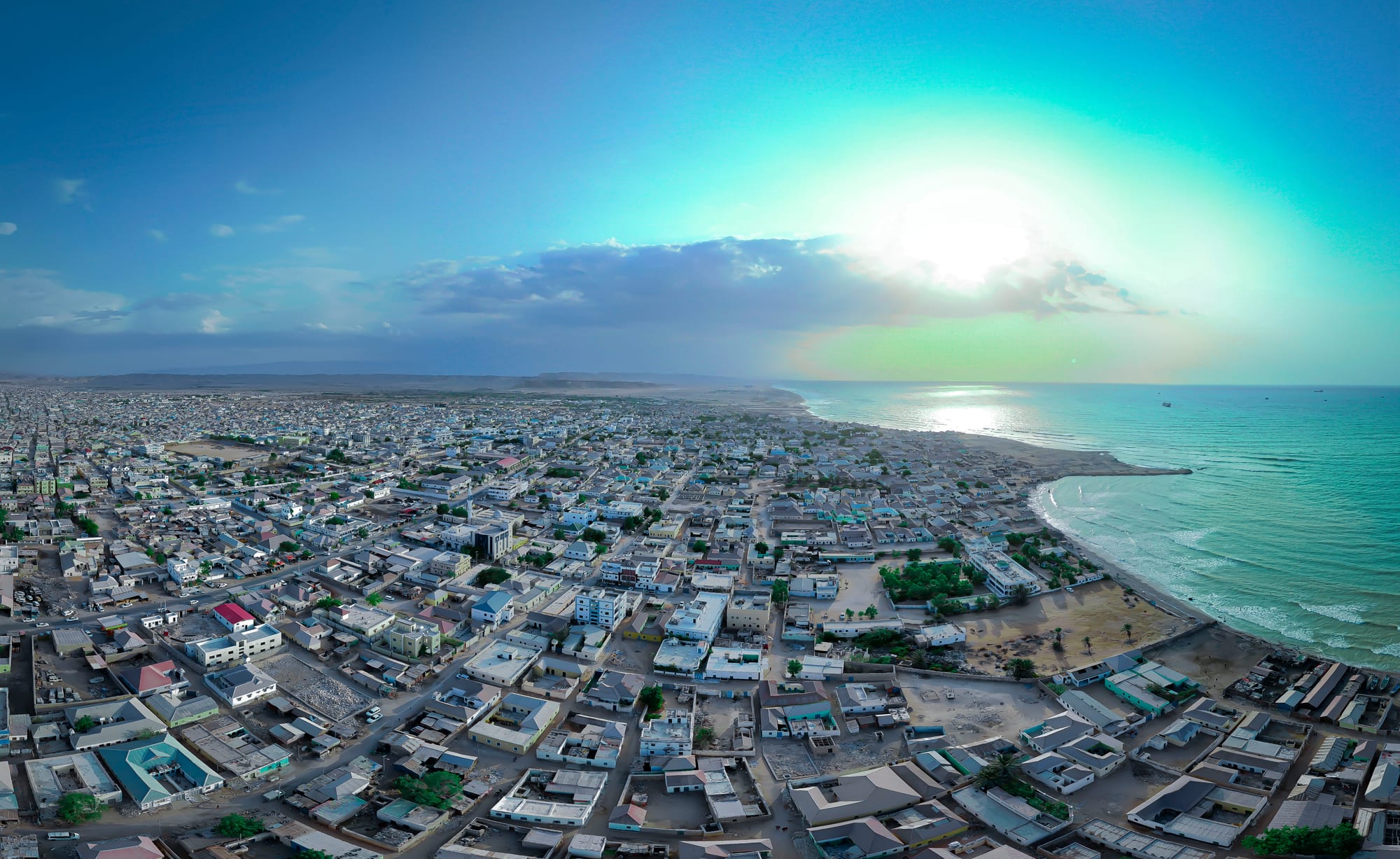
Aerial view of a low-rise city of flat-roofed houses spreading along a curving shoreline, with hills inland and sun on the sea

Puntland, Somalia

Bosaso

Bosaso spreading along the Gulf of Aden shore, seen from the air. (Omar Abdulkadir / Wikimedia Commons · CC BY-SA 2.0)

The main port and commercial centre of the Puntland region of north-eastern Somalia, on the Gulf of Aden, with the dry hills of the Bari interior rising behind it. Livestock, fish, frankincense and imported goods pass through its harbour, and the city has swollen with people displaced from the south. This page is written to explain the city, not to encourage travel.

Neighbourhoods

  • The port and the seafront
    • Local life
    • Trade and business

    The working edge of the city, where the harbour, the customs yards, fuel depots, warehouses and haulage offices sit behind the shoreline. Lorries and handcarts move between the quays and the town, and the fishing boats land their catch a short way along the shore.

    Open in Maps
  • The central market quarter
    • Markets
    • First-time visitors

    The dense blocks of shops, stalls, tea houses and money-changers inland from the port, where imported food, cloth, electronics and khat are traded. It is busiest in the morning and in the hours after the afternoon heat breaks.

    Open in Maps
  • The airport road and the newer districts
    • Newer housing
    • Quiet and residential

    Housing, compounds, hotels and offices strung along the road out towards the airport, built as the city expanded away from the old core. Streets are wide and sandy, with walled villas behind them.

    Open in Maps
  • The outskirts
    • Local life

    The edges of the city, where settlements of people displaced by drought and by conflict in southern Somalia have grown into permanent neighbourhoods of shelters and simple block houses, with their own markets and schools.

    Open in Maps

Things to do

The port and the shore

  • The harbourlandmark

    Puntland's main seaport, handling livestock exported to the Arabian Peninsula and food, fuel, vehicles and consumer goods brought in from the Gulf.

    Open in Maps
  • The fish landingattraction

    The shore where small boats bring in tuna, kingfish and reef fish from the Gulf of Aden, sold and cleaned on the sand in the early morning.

    Open in Maps
  • The city beachesbeach

    Stretches of sand either side of the harbour where families walk in the cooler hours; the water is warm year-round and the shore is working rather than developed.

    Open in Maps

Markets

  • The central marketmarket

    Stalls and shopfronts selling dates, rice, fruit, cloth, camel milk and khat, alongside the money-changers and mobile-money agents who handle most payments.

    Open in Maps
  • The livestock yardsmarket

    Pens on the edge of the city where goats, sheep and camels brought down from the interior are held before being shipped across to Saudi Arabia and the Gulf.

    Open in Maps

Short trips from the city

  • The frankincense hillsviewpoint

    The dry hills rising inland from the coast, where wild frankincense and myrrh trees are tapped for resin that is brought down to the city for export, as it has been for thousands of years.

    Open in Maps

Arriving and leaving

  • Bender Qassim International Airporttransit hub

    The city's airport, on the outer edge of the city, the main air entry to Puntland and the second largest airport in Somalia after Mogadishu's.

    Open in Maps

Seasonal events

  • Eid al-Fitr and Eid al-Adhadates move through the year with the Islamic calendar

    The two main Islamic festivals, when families gather, meat is shared and the markets are at their busiest in the days beforehand.

  • The livestock export seasonthe weeks before the Hajj

    Not a festival but the port's great annual rush, when sheep, goats and camels are shipped in large numbers to the Arabian Peninsula.

  • The cool seasonNovember to February

    The months when the heat eases, the seas are calmer and most trade, travel and building work happens.

Eat and drink

Long-standing places and food districts in Bosaso. Hours, ratings and directions come from your maps app, always current.

Bosaso classics

  • Grilled fish placesrestaurant

    Fish landed that morning, grilled over charcoal or fried and served with rice, flatbread and a chilli and coriander relish, in simple restaurants near the shore.

    Open in Maps
  • Canjeero and tea housescafe

    Breakfast places serving canjeero, the soft fermented flatbread, with ghee, sugar or liver, and tea boiled with cardamom and cloves.

    Open in Maps

Markets and food streets

  • The central market stallsmarket

    Dates imported by the sack from across the Gulf, camel milk, fruit, spices and sesame oil, with sambuusa fried to order in the late afternoon.

    Open in Maps

Experience Bosaso

History

Bosaso stands on a shore that has traded with Arabia for millennia. The hills behind it produce frankincense and myrrh, the goods that gave this coast its ancient fame, and classical guides to the Red Sea and Indian Ocean trade describe ports along the Horn shipping incense and aromatics. The town was long known as Bandar Qasim, the name its airport still carries, and it was one of several harbours on the Majeerteen coast.

In the nineteenth century the Majeerteen Sultanate controlled this stretch of the Gulf of Aden from ports along the Majeerteen coast, signing a protectorate treaty with Italy in 1889 while keeping considerable autonomy. Italian forces conquered the sultanate in the mid-1920s, and the area became part of Italian Somaliland and then, from 1960, of the Somali Republic. Bosaso remained a small port under both.

Its growth came after the Somali state collapsed in 1991. While the south fell into war, the north-east stayed comparatively calm, and Bosaso's harbour took on trade that could no longer pass through Mogadishu. Elders and politicians of the Harti clans founded the Puntland State of Somalia at Garowe in 1998, and the port became its commercial engine and main customs revenue. People displaced by war and drought in the south arrived in large numbers and settled on the outskirts, and the city expanded far beyond its old core. It has also become a departure point for migrants attempting the sea crossing to Yemen.

Culture & Customs

The city is Somali and Sunni Muslim, and the Harti clans of the Darod family, the Majeerteen above all, predominate; clan membership shapes business partnerships, dispute settlement and politics as much as any formal institution. Elders mediate between families, and mosques and Qur'anic schools anchor the week.

Trade defines the outlook. Bosaso looks north across the Gulf of Aden to Yemen and the Arabian Peninsula rather than south to Mogadishu, and its merchant families have long-standing ties to Dubai, Jeddah and the Gulf ports. Arabic is used in religion and in business, and imported goods, dress and tastes arrive with the ships. Many households have relatives working abroad, and the money they send supports a large part of the city.

Beneath the commerce the culture is pastoral. Most families have roots among the herders of the interior, the camel is a measure of wealth and a favoured subject of verse, and Somali oral poetry, including the buraanbur composed and sung by women, is prized here as elsewhere. Hospitality is close to obligatory. Dress is conservative, Ramadan is strictly kept, and the two Eids are the great celebrations. The population is also mixed by displacement: families from the southern rivers, including Somali Bantu communities, have made their own neighbourhoods on the city's edge.

Daily Life

Estimates of the population vary widely and no recent census settles them: an earlier United Nations urban planning study put it at about 250,000, while the figure usually given now is around 700,000 as of 2020, which would make Bosaso the third largest city in Somalia after Mogadishu and Hargeisa. The day begins before dawn with the fishing boats and the first prayers, the market and the port work through the morning, activity stops in the worst of the heat, and the streets fill again in the evening.

The economy is the port: livestock exported to the Arabian Peninsula, especially before the Hajj; fish landed along the shore; frankincense and myrrh brought down from the mountains for export; and a steady inflow of food, fuel, building materials and consumer goods that are trucked on to Garowe, Galkayo and beyond. Haulage, customs work, telecoms, money transfer and construction employ much of the rest of the city, and mobile money handles nearly every transaction.

Life is hard at the edges. Settlements of people displaced by drought and southern conflict ring the city, water is scarce and often bought by the jerrycan, electricity is expensive and privately generated, and public services are thin. Armed groups in the mountains inland and the security operations against them weigh on the city, and many young people try to leave, either inland to Garowe or across the sea.

Food

The Gulf of Aden gives Bosaso its distinguishing dish: fish, landed in the morning and grilled whole over charcoal or fried, served with rice or with flatbread and a green chilli and coriander relish. Tuna, kingfish and reef fish are the common catch, and lobster is landed for export more than for local tables.

The rest of the diet is northern Somali. Breakfast is canjeero, also called laxoox, the soft fermented flatbread, eaten with ghee and sugar or with liver and onions and washed down with shaah, tea boiled with cardamom, cinnamon and cloves. Lunch is the main meal: bariis iskukaris, rice spiced with cumin, cardamom and cloves with goat or camel, or baasto, pasta with a heavy meat sauce, often with a banana alongside. Muqmad, also called oodkac, is meat cut small, dried and kept in ghee, the old pastoralist preserve and still made in kitchens here.

Camel milk, fresh or soured, is drunk through the day, and dates arrive in quantity through the port from across the Gulf, eaten daily and above all to break the Ramadan fast. Sambuusa, fried pastries filled with spiced meat, are the evening snack, and xalwo, the dense confection of sugar, ghee and spices, is served at weddings and on Eid. No alcohol is sold.

Planning tools

Budget

There is no tourism industry. Hotels in the city serve traders, aid workers and officials, and local food is cheap, but armed security, a vehicle and a local fixer are required for any visit and dominate the cost. Payment is in US dollar cash or by mobile money.

Daily Budget Midrange
USD 250 and upwards (hotel, vehicle, driver and armed security, arranged through local contacts)
Daily Budget Shoestring
USD 250 and upwards — security costs rule out budget travel here

Security, transport and accommodation are arranged in advance through a trusted local organisation, and the whole cost is fixed before arrival.

Best Time to Visit

November to February is the least punishing period, when the coastal heat eases and the sea is calmer. From about May to September the city is extremely hot and humid. Security conditions, not the season, decide whether any visit is possible at all.

Suggested Number of Days

Visits here are made for work, family or trade rather than sightseeing, and are as short as the business allows. Heat and the time taken to arrange movement and security shape the length of a stay far more than anything else.

First Visit
1–2 days
With Surroundings
2–3 days

Transportation

Movement within the city is by taxi, shared minibus or hired four-wheel drive, usually with security. A paved highway runs inland to Garowe and on to Galkayo, but road travel means checkpoints, clan boundaries and risk, and the coast east of the city is reached only by rough tracks or by sea.

Flying between towns is preferred to driving, and any road movement is made only with vetted local security.

Airport & Station Connections

Bender Qassim International Airport, on the edge of the city, is the main air entry to Puntland and the second largest airport in Somalia after Mogadishu's. Garowe lies several hours south by the inland highway. The port receives cargo and livestock vessels rather than passenger traffic, and Puntland's authorities control entry separately in practice.

Walkability

The market quarter is compact and can be crossed on foot, but pavements are rare, the ground is sand and dust, and the heat makes walking unpleasant for most of the day. Foreigners on foot are conspicuous, and in practice movement is by vehicle.

Safety

Puntland has been more stable than southern Somalia, but the risks in and around the city are severe. Kidnapping of foreigners is a serious threat, armed groups have operated in the mountains inland, where Puntland forces have fought them, clan disputes can turn violent, and medical care is very limited.

Most governments advise against all travel. Anyone who must go should do so only with professional security arrangements, a local host and full evacuation insurance. Check current official travel advice before travelling.

Climate

Hot, humid and very dry — the Gulf of Aden coast is among the hottest inhabited places in the region, and rainfall is slight and unreliable, with recurrent drought in the interior behind the city.

Summer
extreme heat, often above 40°C, with high humidity and little relief at night
Winter
warm and dry, with lows levelling out around 20°C, the most bearable season

Local Customs

Society is conservative and Sunni Muslim, and the mosque and the Qur'anic school are central to the week. Dress is modest for men and women, the day pauses for prayer, and tea and hospitality are offered to any visitor. Many men chew khat in the afternoon, which slows business. Photographing the port, security forces, checkpoints or people without permission causes serious problems.

No alcohol is sold. Greetings are unhurried, handshakes between men and women are not always welcome, and a hand placed over the heart is the safe response.

Common Payment Methods

US dollar cash is used for hotels, vehicles and anything substantial, and Somali shilling notes serve only as small change. Mobile money covers almost every other payment, including market stalls. International cards are not usable and there are no ordinary ATMs, so cash is brought in.