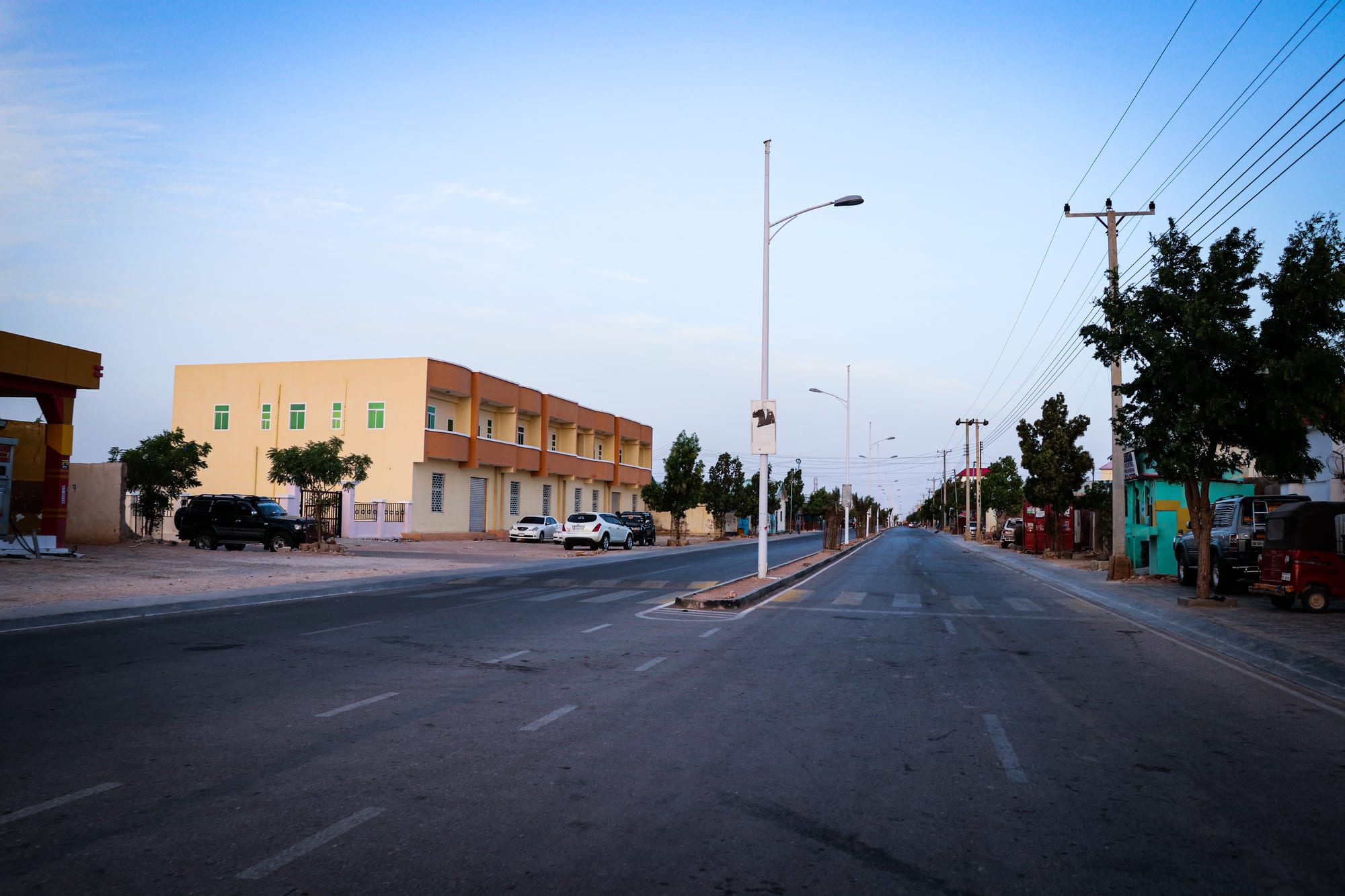
A wide resurfaced avenue with street lights and young trees, low two-storey buildings and parked vehicles under a pale sky

Puntland, Somalia

Garowe

A resurfaced avenue lined with low buildings and young trees in Garowe. (Omar Abdulkadir / Wikimedia Commons · CC BY-SA 2.0)

An inland town in the Nugaal valley of north-eastern Somalia and the administrative centre of the Puntland region, chosen as its seat when the state was formed in 1998. Offices, a university, an airport and a livestock market have grown up around a crossroads of the highway from the coast. This page is written to explain the town, not to encourage travel.

Neighbourhoods

  • The town centre
    • First-time visitors
    • Markets
    • Local life

    The blocks either side of the main avenue, where the market, shops, tea houses, money-changers and small hotels are concentrated. Business runs through the morning, slows in the heat of the afternoon and picks up again after dusk.

    Open in Maps
  • The government quarter
    • Administration
    • Quiet and residential

    The area of offices, ministries and compounds that grew up after Puntland made the town its seat in 1998, guarded and walled, with wide sandy roads between the buildings and little street life.

    Open in Maps
  • The airport road
    • Newer housing
    • Business

    The strip of newer hotels, offices, fuel stations and villas along the road out to the airport, the most visibly built-up part of the town's recent growth.

    Open in Maps
  • The outskirts
    • Local life

    The edges of the town, where families displaced by drought or by conflict further south have settled in shelters and simple block houses, and where herders bring animals in from the valley to sell.

    Open in Maps

Things to do

The town

  • The central marketmarket

    The commercial heart of the town, selling imported food, cloth, fruit, dates and khat, with money-changers and mobile-money agents working alongside the stalls.

    Open in Maps
  • The livestock marketmarket

    Yards where goats, sheep and camels brought in from the Nugaal valley change hands before being trucked north to the port for export.

    Open in Maps
  • The Nugaal watercourseattraction

    The dry riverbed that runs past the town and fills only after heavy rain, the feature the settlement grew around and still a route for herds and vehicles.

    Open in Maps
  • Puntland State Universityattraction

    A public university in the town, one of the institutions that made Garowe an administrative and educational centre rather than only a trading stop.

    Open in Maps

Short trips from the town

  • The Nugaal valley grazing landsviewpoint

    The open pastoral country around the town, of wells, seasonal grazing and scattered herding camps, which floods briefly after good rains and carries herds towards the coast.

    Open in Maps

Arriving and leaving

  • Garowe International Airporttransit hub

    The town's airport, officially opened in 2010 and formally named General Mohamed Abshir International Airport, handling domestic flights and limited regional services.

    Open in Maps

Seasonal events

  • Eid al-Fitr and Eid al-Adhadates move through the year with the Islamic calendar

    The two main Islamic festivals, when families gather, meat is shared and the market is at its busiest in the days beforehand.

  • Puntland's founding anniversarythe anniversary of the 1998 founding conference

    The anniversary of the 1998 conference in the town that created the Puntland administration, marked with official ceremonies and flags.

  • The livestock trading seasonthe weeks before the Hajj

    Not a festival but the busiest trading period of the year, when animals are bought in the valley's markets for export through the coast.

Eat and drink

Long-standing places and food districts in Garowe. Hours, ratings and directions come from your maps app, always current.

Garowe classics

  • Rice and goat restaurantsrestaurant

    Lunch places serving bariis iskukaris, spiced rice with goat or camel, the standard midday meal of the interior, often with a banana on the side.

    Open in Maps
  • Canjeero and tea housescafe

    Morning places serving canjeero, the soft fermented flatbread, with ghee, sugar or liver, and tea boiled with cardamom and cloves.

    Open in Maps

Markets and food streets

  • The central market stallsmarket

    Dates, camel milk, fruit, rice, spices and sesame oil sold from stalls in the middle of town, with sambuusa fried to order late in the day.

    Open in Maps

Experience Garowe

History

Garowe began as a watering point and meeting place in the Nugaal valley, a wide seasonal watercourse that carries grazing and floodwater from the interior plateau towards the Indian Ocean. Herders of the Majeerteen and other Harti clans moved through it with camels and goats, and the settlement that grew at the crossing served them rather than any coastal trade. Under the Majeerteen Sultanate and then Italian and post-independence administrations it remained a small inland town, overshadowed by the ports.

Its rise came out of the collapse of the Somali state. After 1991 the north-east avoided the worst of the fighting, and clan elders, politicians and businessmen from the Harti clans held a series of conferences to organise the region. The meetings held in Garowe in 1998 founded the Puntland State of Somalia, with Abdullahi Yusuf Ahmed as its first president, defining it as an autonomous state within a future federal Somalia rather than a breakaway country, and the town was made its seat.

Everything since has followed from that decision. Ministries, a parliament, a university, foreign missions and aid offices were established here, drawing people from across the region and from the diaspora, and later conferences in the town helped shape Somalia's federal arrangements. The town has grown outwards with new roads, hotels and housing, and its politics have turned on relations with Mogadishu — strained since Puntland stated in 2024 that it no longer recognised the federal government's authority while still considering itself part of Somalia — and on the disputed districts to the west.

Culture & Customs

Garowe is a Somali town, Sunni Muslim and organised by clan, with the Harti clans of the Darod family, the Majeerteen above all, predominant. Clan lineage shapes appointments, business and the settlement of disputes, and the region's presidents are chosen by its parliament rather than by popular vote, which makes the town's politics a matter of negotiation among elders and members as much as of campaigns.

Being the administrative seat gives the place an unusual character for its size. A university, television and radio stations, newspapers and the offices of international organisations concentrate teachers, journalists, officials and returnees from the diaspora here, and public argument about federalism, elections and security is a normal part of conversation. Poetry retains its old prestige, including the buraanbur composed and performed by women, and verse still carries political comment.

The surrounding culture is pastoral. Most families keep ties to relatives herding camels and goats in the valley, the camel remains a measure of wealth and a subject of verse, and drought is felt personally in the town. Hospitality is close to obligatory, tea is offered at every visit, and the two Eids are the great celebrations of the year. Dress is conservative, Ramadan is strictly kept, and in the afternoons many men gather to chew khat brought in by road.

Daily Life

Population estimates for Garowe vary widely and no recent census settles them: the broader Garowe District is put at about 190,000 residents. It is a small city by Somali standards, far smaller than the coastal port and grown mainly since the late 1990s. Mornings are the working part of the day: offices open early, the market fills, and herders bring animals in from the valley. The heat empties the streets in the early afternoon, and life resumes towards evening.

Government is the town's largest employer, alongside the university, telecoms and money-transfer companies, construction and trade. Goods arrive by lorry from the coast for sale here and for onward distribution; livestock moves in the opposite direction. Mobile money handles almost every payment, from a hotel bill to a handful of dates, and remittances from relatives abroad support many households.

The constraints are water, power and rain. Water is scarce and often bought by the tank, electricity is privately generated and expensive, and a failed rainy season sends herding families into the town to look for work and aid. Settlements of displaced people have become permanent neighbourhoods on the edges. Security operations against armed groups in the region, and the long argument with Mogadishu over federal authority, are constant background to daily life.

Food

Garowe eats what the interior eats. Lunch, the main meal, is usually bariis iskukaris, rice spiced with cumin, cardamom and cloves and served with goat or camel, or baasto, pasta in a heavy meat sauce, generally with a banana on the side. Meat is central and mostly goat, with camel meat regarded as the better dish, and suqaar, meat diced small and quickly fried with onion and spices, is common.

Breakfast is canjeero, also called laxoox, the soft fermented flatbread cooked on a griddle and eaten with ghee and sugar or with liver and onions, alongside shaah, tea boiled with cardamom, cinnamon and cloves. Muqmad, also called oodkac — meat cut small, dried and preserved in ghee — is the traditional food of the herding life and is still made at home and carried on journeys.

Camel milk, fresh or soured, is drunk through the day and sold in the market, where dates imported through the coast are stacked by the sack; they are eaten daily and above all to break the Ramadan fast. Sambuusa, fried pastries filled with spiced meat, are the evening snack, and xalwo, the dense confection of sugar, ghee and spices, appears at weddings and on Eid. Fish is uncommon this far inland. No alcohol is sold.

Planning tools

Budget

There is no tourism industry. The hotels serve officials, traders, aid workers and visiting families, and local food is cheap, but armed security, a vehicle and a local fixer are needed for any visit and dominate the cost. Payment is in US dollar cash or by mobile money.

Daily Budget Midrange
USD 250 and upwards (hotel, vehicle, driver and armed security, arranged through local contacts)
Daily Budget Shoestring
USD 250 and upwards — security costs rule out budget travel here

Accommodation, transport and security are arranged in advance through a trusted local organisation, with the whole cost agreed before arrival.

Best Time to Visit

November to February is the least hot period on the inland plateau, warm by day and cooler at night. The months from about May to September are hot, dry and windy. Security conditions, rather than the season, decide whether a visit is possible.

Suggested Number of Days

Visits are made for work, family or official business rather than sightseeing, and the town is small. Longer stays are governed by the time taken to arrange movement and security, and by the heat of the middle of the day.

First Visit
1 day
With Surroundings
2–3 days

Transportation

The town is crossed by taxi, minibus or hired four-wheel drive, on a mix of paved avenues and sand roads. A paved highway runs north to the coast and south towards Galkayo, but road travel means checkpoints, clan boundaries and risk, and the eastern coast is reached only by rough tracks.

Flying between towns is preferred to driving, and road movement is made only with vetted local security.

Airport & Station Connections

Garowe's airport, a short drive outside the town, handles domestic flights within Somalia and limited regional services. By road the town sits on the highway between the Gulf of Aden coast to the north, several hours away, and Galkayo to the south, and it is the usual overland stop between them.

Walkability

The centre is small enough to cross on foot in a short walk, but pavements are limited, the ground is sandy and the heat is heavy for much of the day. Government compounds and the airport road are spread out, and foreigners on foot are conspicuous, so movement is normally by vehicle.

Safety

Puntland has been more stable than southern Somalia, and the seat of the administration is heavily guarded, but the risks remain severe. Kidnapping of foreigners is a serious threat, armed groups operate in the region, clan disputes can turn violent, and medical care is very limited.

Most governments advise against all travel. Anyone who must go should do so only with professional security arrangements, a local host and full evacuation insurance. Check current official travel advice before travelling.

Climate

Hot and dry on the inland plateau, with slight and unreliable rainfall in two short seasons and recurrent drought. Nights are cooler than on the coast, and dust carried by the wind is a constant in the hot months.

Summer
hot and windy, with average temperatures reaching around 41°C, dust and little rain
Winter
warm and dry, averaging about 23–25°C from November to February and noticeably cooler after dark

Local Customs

Society is conservative and Sunni Muslim, and the mosque and Qur'anic school shape the week. Dress is modest for men and women, the day pauses for prayer, and tea and hospitality are offered to any visitor. Many men chew khat in the afternoon, which slows offices and business. Photographing government buildings, security forces, checkpoints or people without permission causes serious problems.

No alcohol is sold. Greetings are unhurried, handshakes between men and women are not always welcome, and a hand over the heart is the safe response.

Common Payment Methods

US dollar cash covers hotels, vehicles and anything substantial, while Somali shilling notes serve only as small change. Mobile money is used for nearly every other payment, including at market stalls. International cards are not usable and there are no ordinary ATMs, so cash is brought in.