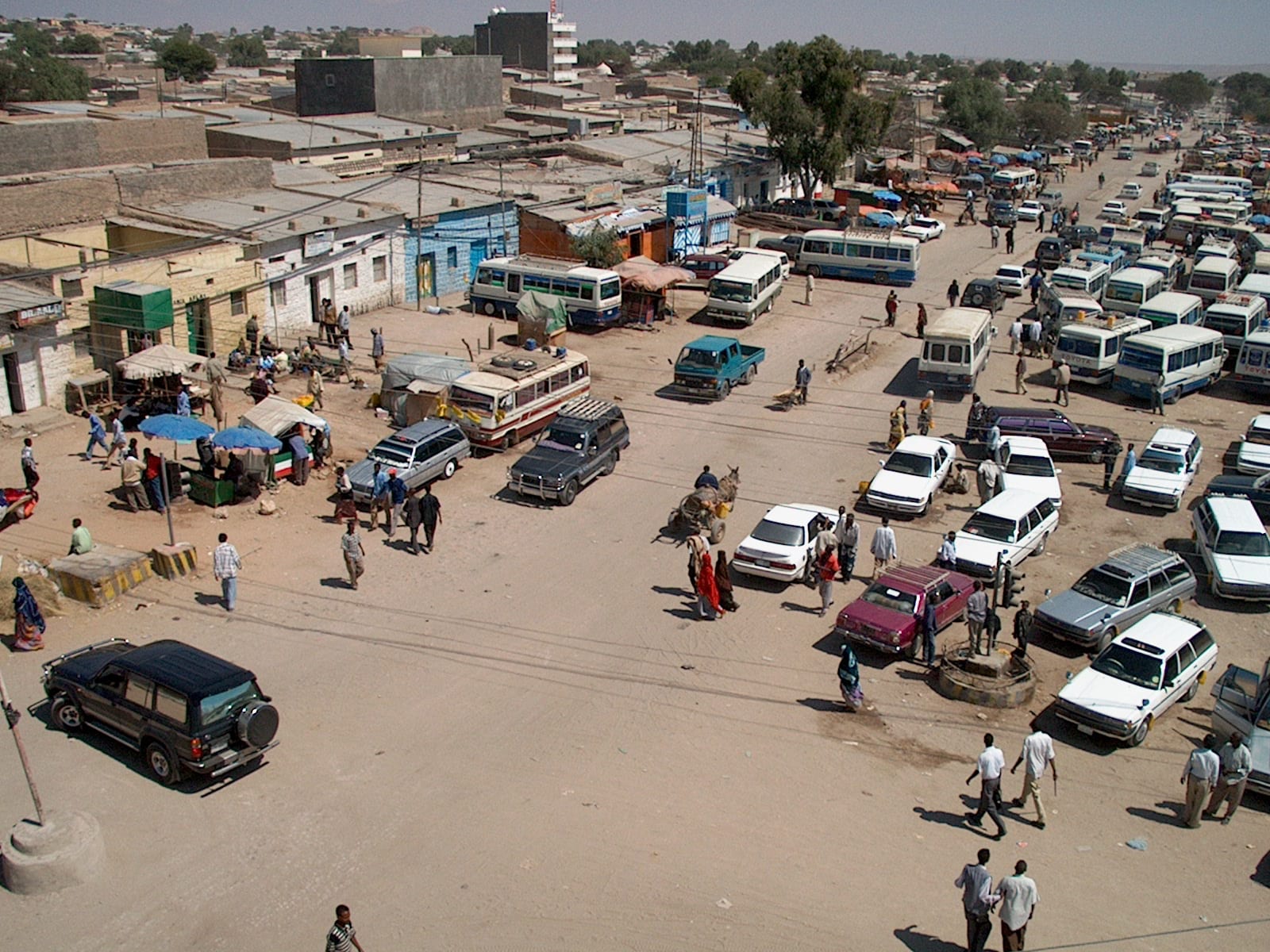
Minibuses, four-wheel drives and pedestrians spread across a wide unpaved street lined with low shops

Somaliland, Somalia

Hargeisa

Minibuses and traders on a wide unpaved street in Hargeisa. (J Hazard / Wikimedia Commons · CC BY-SA 4.0)

The largest city of the Somaliland region in north-western Somalia, set on a plateau about 1,300 metres above sea level. Destroyed by government bombing in 1988 and rebuilt by returning residents, it is now a trading centre of money-changers, livestock markets and new concrete buildings. This page is written to explain the city, not to encourage travel.

Neighbourhoods

  • The city centre
    • First-time visitors
    • Markets
    • Money-changers

    The commercial core either side of the dry Maroodi Jeex watercourse, where the main market streets, the money-changers' tables stacked with shilling notes, the larger hotels and the war memorial are concentrated. It is busiest in the morning and quiet in the afternoon heat.

    Open in Maps
  • Ahmed Dhagah
    • Local life
    • Close to the centre

    One of the central districts of the city, a dense mix of shops, small businesses and family compounds a short way from the markets. Streets are mostly unpaved and life runs around the mosques, tea stalls and corner kiosks.

    Open in Maps
  • 26 June
    • Government offices
    • Quiet and residential

    A central district named for the date of British Somaliland's independence in 1960, holding government buildings, offices and residential compounds. It is calmer than the market quarters and much of it was rebuilt after the late 1980s.

    Open in Maps
  • Ga'an Libah
    • Quiet and residential
    • Newer housing

    A district on the edge of the built-up area where the city has expanded outwards with new concrete villas and walled compounds. Development thins into open scrub and low hills towards the boundary.

    Open in Maps
  • Ibrahim Koodbuur
    • Local life
    • Markets

    A large residential district on the northern side of the city, with its own small markets and schools. Much of Hargeisa's population growth since the 1990s has been absorbed by districts like this one.

    Open in Maps

Things to do

City landmarks

  • Hargeisa War Memoriallandmark

    A Somali Air Force MiG-17, which crashed nearby, mounted on a plinth in the city centre as a memorial to the Somaliland War of Independence and the shelling and aerial bombing of the city in 1988.

    Open in Maps
  • Naasa Habloodviewpoint

    Twin conical hills of granite and sand on the outskirts of the city, a landmark visible across Hargeisa and the subject of many local stories about their name.

    Open in Maps

Markets

  • Central market streetsmarket

    The blocks of covered stalls and shopfronts in the centre, selling cloth, gold, household goods, electronics, fruit and khat, and surrounded by tables of money-changers dealing in bundled Somaliland shilling notes.

    Open in Maps
  • Livestock marketmarket

    The large open yard on the edge of the city where goats, sheep and camels are traded, the ground floor of an economy built on livestock exports through Berbera.

    Open in Maps

Short trips from the city

  • Laas Geellandmark

    Rock shelters on a granite outcrop about 50 kilometres north-east of the city, painted with decorated cattle and human figures estimated at about 5,500 to 4,500 years old, documented by a French archaeological survey in 2002.

    Open in Maps

Seasonal events

  • Hargeisa International Book Fairsummer

    A literary festival held in the city since 2008, drawing writers, poets and readers from Somaliland, the wider Somali world and the diaspora.

  • Somaliland national day18 May

    The anniversary of the 1991 declaration in Burao, marked in Hargeisa with parades, flags and public gatherings.

  • Eid al-Fitr and Eid al-Adhadates move through the year with the Islamic calendar

    The two main Islamic festivals, when families gather, meat is shared and the markets are at their busiest beforehand.

Eat and drink

Long-standing places and food districts in Hargeisa. Hours, ratings and directions come from your maps app, always current.

Hargeisa classics

  • Camel meat grillsrestaurant

    Camel meat, grilled or stewed and served with rice, is a speciality of the city's restaurants and one of the things Somalis from elsewhere come to Hargeisa to eat.

    Open in Maps
  • Canjeero and tea stallscafe

    Small places in the centre serving the fermented flatbread canjeero with ghee, sugar or liver at breakfast, alongside tea boiled with cardamom and cloves.

    Open in Maps

Markets and food streets

  • Central market food stallsmarket

    Fruit, dates, camel milk, spices and sesame oil sold from stalls and handcarts in the middle of the city, with sambuusa fried to order in the late afternoon.

    Open in Maps

Experience Hargeisa

History

Hargeisa grew from a watering place and religious settlement on the Maroodi Jeex watercourse, where a Qadiriyya religious teacher established a community in the nineteenth century and pastoralists brought their herds to water. Its position on the plateau, on the caravan routes between the Ethiopian highlands and the Gulf of Aden port of Berbera, made it a trading stop, and under the British protectorate it became an administrative centre, taking over from Berbera as the seat of government in 1941.

After British Somaliland's independence on 26 June 1960 and union with former Italian Somalia five days later, the town became a provincial capital of the Somali Republic, and many northerners came to feel that power and investment had moved south. From the late 1970s the Somali National Movement fought a guerrilla war against the government of Siad Barre. In 1988 government forces bombarded and bombed Hargeisa, destroying most of the city and killing very large numbers of civilians; the surviving population fled, much of it to camps across the Ethiopian border.

People returned from 1991 onwards, after the fall of Barre and the declaration of the Republic of Somaliland at a conference in Burao, and rebuilt on the ruins, largely without outside aid and with money sent home by relatives abroad. Hargeisa became the seat of the Somaliland administration, which Somalia regards as part of its own territory. Since then the city has grown quickly, with new concrete buildings, universities and a spreading ring of suburbs on the plateau.

Culture & Customs

Hargeisa is a Somali city, Sunni Muslim and organised by clan, with the Isaaq clans predominant. Elders carry real authority: the councils that ended the fighting of the early 1990s grew into the upper house of the Somaliland parliament, and disputes are still often settled between families rather than in court.

Poetry is the prestige art. Somali verse is composed, memorised and judged closely, and it has long carried news, argument and political criticism; the city has produced and hosted many of the best-known modern Somali poets and singers, and the songs of the independence period remain widely known. Since 2008 the Hargeisa International Book Fair has brought writers and audiences from across the Somali world and the diaspora to the city each year, one of the few literary festivals of its kind in the Horn of Africa.

The diaspora shapes daily culture as much as anything. Families in Britain, Scandinavia, the Gulf and North America send money, return in the summer, build houses and open businesses, and their children bring back accents and habits from abroad. Dress is conservative, Ramadan is widely kept, and the two Eids and 18 May, the anniversary of the 1991 declaration, are the great public occasions. English is more widely used in education and administration here than in southern Somalia, a legacy of the British period.

Daily Life

An estimate for 2019 put the population at about 1.2 million people, though no census settles the figure, and the city has grown outwards across the plateau with each drought and each return of families from abroad. The day starts early, before the heat, with markets and offices busy through the morning; in the afternoon much of the male population gathers to chew khat brought in by road from Ethiopia, and business slows until the cooler evening.

The economy runs on trade, livestock and remittances. Goats, sheep and camels are bought in the city's markets and exported through Berbera to the Arabian Peninsula; traders import food, fuel, vehicles and consumer goods through the same port; and money sent by relatives overseas sustains a large share of households. Money-changers on the main streets sit behind walls of banded Somaliland shilling notes, and mobile money has replaced cash for most purchases. Several universities and the offices of the administration and of aid organisations are significant employers.

Water is short, electricity expensive and largely generated privately, and the lack of international recognition limits banking, lending and travel. Youth unemployment is high, and many young people attempt the journey to Europe or the Gulf. Displaced people from drought-hit rural districts live in settlements on the edge of the city.

Food

Breakfast in Hargeisa is canjeero, also called laxoox, a soft fermented flatbread cooked on a griddle and eaten with ghee and sugar, with liver and onions, or dipped in tea boiled with cardamom, cinnamon and cloves. Lunch is the main meal and usually means bariis iskukaris, rice spiced with cumin, cardamom and cloves and served with goat, camel or chicken, or baasto, pasta with a rich meat sauce, often with a banana alongside.

Camel meat is the city's speciality. Grilled over charcoal or slow-cooked, it appears on restaurant menus across Hargeisa in a way it does not in most Somali cities, and camel milk, fresh or soured, is sold at the markets and drunk through the day. Muqmad, meat cut small, dried and preserved in ghee, is the traditional travelling and pastoral food and is still made at home.

Sambuusa, fried triangular pastries filled with spiced meat, are the standard evening snack and are everywhere during Ramadan. Sweets mean xalwo, a dense confection of sugar, ghee and spices cooked in large pans and served at weddings and on Eid. Dates, imported in quantity, are eaten to break the fast. Fresh fish comes up from Berbera on the Gulf of Aden. No alcohol is sold; tea and soft drinks accompany every meal, and coffee is far less common than in Ethiopia next door.

Planning tools

Budget

There is no tourism industry and no budget circuit. Rooms and local food are cheap by international standards, but the armed police escort required of foreigners outside the city, a vehicle and a driver dominate the daily cost. Almost everything larger than a market purchase is paid in US dollar cash or by mobile money.

Daily Budget Midrange
USD 150–250 in cash (better hotels, a private vehicle and driver, escort and guide)
Daily Budget Shoestring
USD 80–120 in cash (simple hotel, local food, shared vehicle and the required escort)

Carry clean US dollar notes, arrange mobile money through a local contact, and price the escort and vehicle into every day spent outside the city.

Best Time to Visit

November to February is the most comfortable period on the plateau, warm by day and cool at night. The rains come in short bursts around April to June and again around October to December, and the summer months bring heat and dusty winds. Security conditions matter more than the season.

Suggested Number of Days

The city itself is quickly seen, so a day or two covers it. Three or four allows for the rock art outside town and the slow pace of arranging permits, escorts and vehicles, which sets the rhythm of any stay far more than the number of sights does.

First Visit
1–2 days
With Surroundings
3–4 days

Transportation

Movement inside the city is by shared minibus, taxi or hired four-wheel drive, on a mix of paved and unpaved roads. There is no formal public transport network and no timetable. Foreigners travelling beyond the city must take an armed police escort, arranged through a hotel or a local operator, which usually means hiring a vehicle as well.

Arrange a driver and the escort in advance through a local operator, and expect journeys beyond the city to start early to avoid the afternoon heat.

Airport & Station Connections

Hargeisa's Egal International Airport, named after Somaliland's second president, lies on the edge of the city and handles scheduled regional and domestic flights. The main road runs west to the Ethiopian border at Wajaale and north-east to Berbera, about 160 kilometres away on the Gulf of Aden. The Somaliland administration issues its own visa, which is not valid for the rest of Somalia.

Walkability

The central market area can be walked, and distances between the main streets are short, but pavements are intermittent, the ground is dusty and traffic is unregulated. Away from the centre the city spreads out over the plateau and walking between districts is impractical in the heat. Foreigners on foot draw attention.

Safety

Hargeisa has been markedly calmer than southern Somalia and has not seen attacks on the scale of Mogadishu, but strong official warnings apply to the whole country. Kidnapping of foreigners, occasional terrorism, crime and road accidents are the main risks, medical care is basic, and the contested districts to the east are a separate and more serious matter.

Most governments advise against all travel. Some treat Somaliland less severely than the south but still warn against all or most travel; travel there is made with a reputable local operator, the required escort and a low profile. Check current official travel advice before travelling.

Climate

The city sits high enough that its climate is milder than the coast, hot and dry for most of the year with cool nights. Rainfall is light, concentrated in two short and unreliable seasons, and drought recurs.

Summer
warm to hot, around 30°C by day, with strong dusty winds from about June to September
Winter
pleasant, roughly 20–28°C by day and noticeably cool after dark

Local Customs

Society is conservative and Sunni Muslim. Dress is modest for both men and women, most women wear long robes and headscarves, and the working day pauses for prayer. Tea is offered at every visit and refusing hospitality is awkward. Many men chew khat in the afternoon, which empties offices and slows business. Photographing people, soldiers, checkpoints or government buildings causes trouble and permission should be asked first.

No alcohol is sold. Tipping is not expected, though drivers and guides are usually given something. Greetings are unhurried and handshakes between men and women are not always welcome, so a hand over the heart is the safe response.

Common Payment Methods

The Somaliland shilling is used for small purchases and is changed in bundles on the street, while US dollar cash covers hotels, vehicles and anything larger. Mobile money is used for almost everything, including market stalls. International cards are not usable and there are no ATMs of the kind travellers expect, so money is brought in as cash.