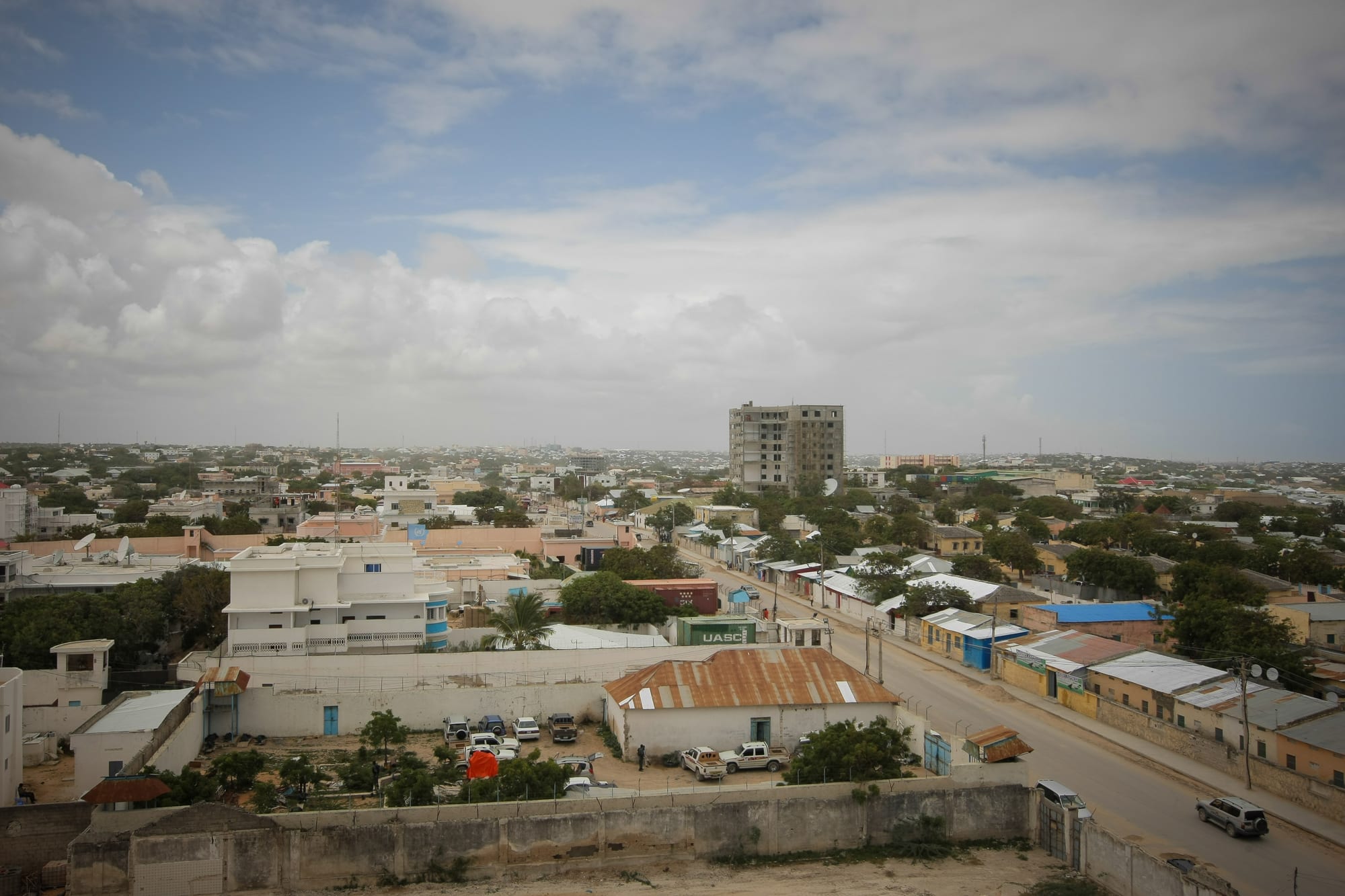
Flat-roofed and tin-roofed houses stretching to the horizon under a cloudy sky, with a tall unfinished block and a wide street below

Mogadishu & the South, Somalia

Mogadishu

A view across the rooftops of Mogadishu towards the city centre. (AMISOM Public Information / Wikimedia Commons · CC0)

Somalia's capital, on the Indian Ocean at the centre of the Benadir coast, and a wealthy Muslim city-state by the thirteenth century. Wrecked by civil war after 1991 and still the main target of the al-Shabaab insurgency, it has rebuilt in parts, with an old coral-stone quarter, a long seafront and a crowded market economy. This page is written to explain the city, not to encourage travel.

Neighbourhoods

  • Hamar Weyne
    • Historic district
    • First-time visitors
    • Markets

    The oldest quarter of the city, behind the port, with narrow streets of coral-stone houses, carved wooden doors and the medieval mosques that made the place famous. It has long been the home of the Benadiri merchant families and remains a dense, busy trading district.

    Open in Maps
  • Shangani
    • Historic district
    • Seafront

    The other old quarter, on the sea beside Hamar Weyne; until the late 1930s the two of them made up the whole city, and it was badly damaged in the fighting of the 1990s. Ruined and rebuilt buildings stand side by side along the shore.

    Open in Maps
  • The Lido seafront
    • Beaches
    • Restaurants
    • Evenings

    The stretch of coast north-east of the old town, where the city's best-known beach is lined with seafood restaurants, cafés and hotels. It fills with families in the late afternoon and on holidays, and has also been a target of attacks.

    Open in Maps
  • Hodan
    • Business
    • Local life

    A large inland district of shops, hotels, offices and dense housing, crossed by main roads and much rebuilt with money from the diaspora. It is one of the busiest commercial districts of the modern city.

    Open in Maps
  • Wadajir
    • Close to the airport
    • Quiet and residential

    A southern coastal district, also known as Medina, holding residential streets and running towards the airport and the fortified compound beside it where most foreign missions and international offices are based.

    Open in Maps

Things to do

The old town

  • Arba'a Rukun Mosquelandmark

    One of the oldest Islamic places of worship in the city, in the Shangani quarter, its mihrab inscription dating it to 667 AH (1268–69).

    Open in Maps
  • Fakr ad-Din Mosquelandmark

    A mosque in the Hamar Weyne quarter dated by a 1269 inscription to Sultan Fakhr ad-Din, the first sultan of Mogadishu, with a mihrab of marble from northern India.

    Open in Maps
  • Mogadishu Cathedrallandmark

    The shell of the Roman Catholic cathedral built between 1923 and 1928 in a Norman style modelled on the cathedral of Cefalù in Sicily; it was no longer regularly used after 1991 and much of it was destroyed in 2008.

    Open in Maps
  • Coral-stone streets of Hamar Weyneneighborhood

    Lanes of lime-plastered coral houses with carved doors and shuttered windows, the built record of centuries of Indian Ocean trade.

    Open in Maps

Landmarks

  • Villa Somalialandmark

    The presidential palace on high ground above the old town, built under Italian rule and now the heavily fortified seat of the federal government; it cannot be visited.

    Open in Maps
  • Port of Mogadishulandmark

    The harbour laid out as a modern port by the Italian administration in the late 1920s and improved in the 1960s, rebuilt after the war years and the main entry for imported goods.

    Open in Maps
  • Mogadishu Stadiumattraction

    The national stadium, built in the 1970s, used as a military base for much of the conflict and later returned to football.

    Open in Maps

Museums

  • National Museum of Somaliamuseum

    The country's national collection of antiquities and ethnographic material; its buildings were destroyed and its collections largely lost in the civil war, and it reopened in July 2020 after rebuilding.

    Open in Maps

Beaches and the seafront

  • Lido Beachbeach

    The city's main beach, a long strip of sand backed by restaurants and cafés where crowds gather in the evenings and on Eid.

    Open in Maps
  • Jazeera beachbeach

    A quieter beach south-west of the city, used at weekends by families from the capital.

    Open in Maps
  • The seafront roadviewpoint

    The coastal road running north from the old town past the lighthouse and the beaches, with the Indian Ocean on one side and rebuilt blocks on the other.

    Open in Maps

Markets

  • Bakaara Marketmarket

    The largest market in the country, created in late 1972 and long the commercial heart of the city, selling food, clothes, electronics, building materials and much else; it has been fought over and bombed repeatedly.

    Open in Maps
  • The fish marketmarket

    The landing and market near the shore where the morning's catch from the Indian Ocean is sold, including shark, tuna and lobster.

    Open in Maps
  • Hamar Weyne trading streetsmarket

    Blocks of gold dealers, cloth merchants, spice sellers and importers in the old quarter, the city's traditional wholesale trade.

    Open in Maps

Arriving and leaving

  • Aden Adde International Airporttransit hub

    The capital's airport on the coast south-west of the centre, with flights to Istanbul, Djibouti and Jeddah and services to other Somali towns, set inside a large secured compound.

    Open in Maps

Seasonal events

  • Eid al-Fitr and Eid al-Adhadates move through the year with the Islamic calendar

    The two main Islamic festivals, when families gather, meat is shared and the beaches and seafront fill; they are also recognised as periods of heightened threat.

  • Somalia Independence Day1 July

    The anniversary of the union of the former British and Italian territories in 1960, marked with parades and public ceremonies.

  • Ramadandates move through the year with the Islamic calendar

    A month of fasting when working hours shorten, the city is quiet by day and markets, cafés and streets become busy after dark.

  • The Gu rainsApril to June

    Not an event but the season that shapes the calendar, bringing humidity, downpours and flooding to low-lying districts, followed by the shorter Deyr rains later in the year.

Eat and drink

Long-standing places and food districts in Mogadishu. Hours, ratings and directions come from your maps app, always current.

Mogadishu classics

  • Lido seafront restaurantsneighborhood

    The row of places along the main beach known for grilled and fried fish, lobster and rice, and for the crowds that come out in the evening.

    Open in Maps
  • Hamar Weyne eating housesneighborhood

    Small restaurants and tea houses in the old quarter serving spiced rice with goat or camel, pasta with meat sauce and sweet tea.

    Open in Maps

Markets

  • Bakaara Marketmarket

    The main market for food of every kind — rice, sorghum, sesame oil, dates, fruit from the river valleys, camel milk and spices.

    Open in Maps
  • The fish marketmarket

    Where the morning's catch is landed and sold, from tuna and kingfish to shark and lobster, much of it cooked a short distance away.

    Open in Maps

Experience Mogadishu

History

Mogadishu was already a wealthy trading city by the thirteenth century, one of the great Muslim ports of the Indian Ocean, minting its own coins and exporting cloth, ivory and hides to Arabia, Persia, India and China. The traveller Ibn Battuta described its sultan, its hospitality and its woven cloth in 1331. The coral-stone mosques of the old quarters — the Fakr ad-Din, named after the first sultan, and the Arba'a Rukun — date from that period, and the Benadiri merchant families of Hamar Weyne and Shingani trace their ancestry to it.

The Sultanate of Zanzibar later kept officials in the town to collect customs, and leased and then sold its rights to Italy at the end of the nineteenth century. Mogadishu became the capital of Italian Somaliland, gaining a cathedral, an Italianate administrative quarter and a seafront promenade. After the Second World War the territory returned to Italian administration under United Nations trusteeship, and in 1960 the city became the capital of the independent Somali Republic, and from 1969 the seat of Siad Barre's government.

The state's collapse in 1991 destroyed much of it. Clan militias fought street by street, the population scattered, and a United Nations and American intervention ended after the battle in the city in October 1993 that became known as Black Hawk Down. The Islamic Courts Union briefly governed in 2006 before Ethiopian forces removed it, and al-Shabaab emerged and was pushed out of the city in 2011 by African Union and government forces, though it has continued to attack it. Since then diaspora money has funded a partial reconstruction of hotels, housing and streets, alongside camps of displaced people.

Culture & Customs

Mogadishu is the most mixed city in the country. The Hawiye clans predominate, but the old quarters are home to the Benadiri, merchant families of Arab, Persian and Indian descent who speak their own dialect and have their own traditions of trade and craft, and people from the river valleys, including Somali Bantu communities, and from every region have settled here through displacement and migration.

Before the war the capital was known for cinemas, bands, a theatre and a seafront café society, and something of that has returned with the diaspora: restaurants, poetry evenings, music, basketball and football, and in 2013 the first international music festival held in the city in two decades. Sufi orders were long central to religious life along this coast, with shrines that drew pilgrims, many of them destroyed during the insurgency's control of the city.

Life is conservative and observant, with modest dress, gender separation in many settings and strict keeping of Ramadan. Poetry remains the prestige art, and political argument often takes verse form. A handful of Italian words survive in everyday speech, a residue of the colonial period. Above all, the city's culture is shaped by return: families who left in the 1990s send money, build houses, open businesses and come back for the summer, and their expectations and accents are part of the street.

Daily Life

Mogadishu is by far the largest city in Somalia, with an estimated urban population of about 4.1 million, swollen by people displaced from the countryside by drought and conflict who live in large settlements on the edges. The day starts early, slows in the humid middle hours, and comes alive again in the evening along the seafront and around the markets.

The economy is trade, services and construction. Goods land at the port and are distributed from Bakaara market; telecoms, money-transfer firms and mobile money are unusually sophisticated for a country with so weak a state; and building funded by remittances and returning families has raised new hotels, flats and shopping blocks. Fishing supports part of the coast, and the river valleys inland supply fruit, maize and sesame.

Insecurity organises everything. Blast walls, checkpoints, armed guards and closed roads shape routes across the city, and attacks are part of living memory for every household. Water, electricity and schooling are mostly bought from private providers, and clan connections often matter more than paperwork. Flooding after heavy rain, food prices and unemployment are the everyday worries, and many young people look for a way out to the Gulf, Turkey or Europe.

Food

The capital's cooking shows both the Indian Ocean and the Italian past. Fish is eaten more here than inland: tuna, kingfish and shark landed in the morning and grilled over charcoal or fried, served with rice or flatbread and a hot green relish of chilli, coriander and lime. Lobster appears on the seafront tables along the beach.

The standard lunch is bariis iskukaris, rice spiced with cumin, cardamom and cloves with goat, camel or chicken, often with a banana beside it, or baasto, pasta with a heavy meat and tomato sauce, a direct legacy of the Italian period. From the farming country behind the city come soor, a stiff maize or sorghum porridge eaten with stew, and muufo, a maize flatbread baked against the wall of a clay oven. Cambuulo, adzuki beans cooked soft and served with butter, sugar and sesame oil, is a favourite supper.

Breakfast is canjeero, the soft fermented flatbread, with ghee and sugar or with liver, and shaah, tea boiled with cardamom, cinnamon and cloves; coffee, a survival of the Italian years, is drunk in the city's cafés more than elsewhere in the country. Sambuusa, fried pastries filled with spiced meat, are the Ramadan snack, dates break the fast, and xalwo, the dense sweet of sugar, ghee and spices, is served at weddings and on Eid. No alcohol is sold.

Planning tools

Budget

There is no tourism industry. Almost all visitors come for business, aid or diplomatic work and stay in fortified hotels or inside the secured compound by the airport, paying heavily for armed guards, armoured vehicles and fixers. Local food and local transport are cheap, but neither is used in the ordinary way by foreigners.

Daily Budget Midrange
USD 300 and upwards (secure hotel, armoured vehicle and armed guards, arranged by a local security firm)
Daily Budget Shoestring
USD 300 and upwards — security costs rule out budget travel here

Security, accommodation and movement are arranged in advance by a professional provider, with the full cost agreed before arrival.

Best Time to Visit

The dry Jilaal season from about December to March is the least difficult period for movement, before the Gu rains bring humidity and flooding from April. Security conditions, not the season, determine whether a visit can happen, and national holidays and the two Eids are periods of heightened threat.

Suggested Number of Days

Stays are as long as the business requires and no longer. Movement is slow because every journey has to be planned and escorted, so two or three days achieve less here than elsewhere, and the surroundings are rarely accessible at all.

First Visit
2–3 days
With Surroundings
3–4 days

Transportation

Within the city, foreigners move by armoured vehicle with armed escorts, arranged by hotels or security firms. Residents use minibuses, shared taxis and three-wheelers on congested roads with frequent checkpoints and blast barriers. Roads out of the city pass through areas contested or controlled by the insurgency and are not used by visitors.

Movement is planned in advance and routes are varied; travel between cities is by air rather than by road.

Airport & Station Connections

Aden Adde International Airport, on the coast a few kilometres south-west of the centre, is the way in, with flights to Istanbul, Djibouti and Jeddah and domestic services to other Somali towns. The airport sits inside a large secured compound that also holds international offices and accommodation, and transfers into the city are made under escort. Most visitors to Somalia must obtain an online travel authorisation (eTAS) before arrival.

Walkability

The old quarters are dense and walkable in principle, and residents walk everywhere, but foreigners do not move on foot. Blast walls, checkpoints and closed roads break up the street grid, pavements are irregular, and traffic is heavy along the main avenues.

Safety

This is one of the most dangerous cities in the world. The insurgency carries out bombings, suicide attacks and assaults on hotels, restaurants and government sites in the capital, including on the seafront; kidnapping is a serious risk; and clan disputes, floods and disease outbreaks add to the danger. Medical care is minimal.

Most governments advise against all travel. Anyone who must go should travel only with professional security, a trusted local host and full evacuation insurance. Check current official travel advice before travelling.

Climate

Hot and humid all year, with the sea breeze keeping temperatures fairly even. Rain comes in two seasons, the Gu from April to June and the shorter Deyr from October to December, and can flood low-lying districts; failed rains bring drought to the countryside behind the city.

Summer
hot and humid, with daytime temperatures near 30°C, strong south-west monsoon winds and rough seas from about June to September
Winter
hot and humid and slightly hotter than the summer months, around 30°C by day, drier and calmer

Local Customs

Society is conservative and Sunni Muslim. Dress is modest for men and women, the day pauses for prayer, and swimming is done clothed. Hospitality is a strong obligation and tea is offered at every visit. Photographing security forces, checkpoints, government buildings, the port or the airport is dangerous, and people should be asked before being photographed. Many men chew khat in the afternoon.

No alcohol is sold. Greetings are unhurried, handshakes between men and women are not always welcome, and a hand over the heart is the safe response; a few Italian loanwords survive in everyday Somali here.

Common Payment Methods

US dollar cash and mobile money dominate; Somali shilling notes are used only as small change, and many transactions never involve cash at all. International cards are not usable and there are no ordinary ATMs, so money is brought in as dollars and converted to mobile credit through a local contact.