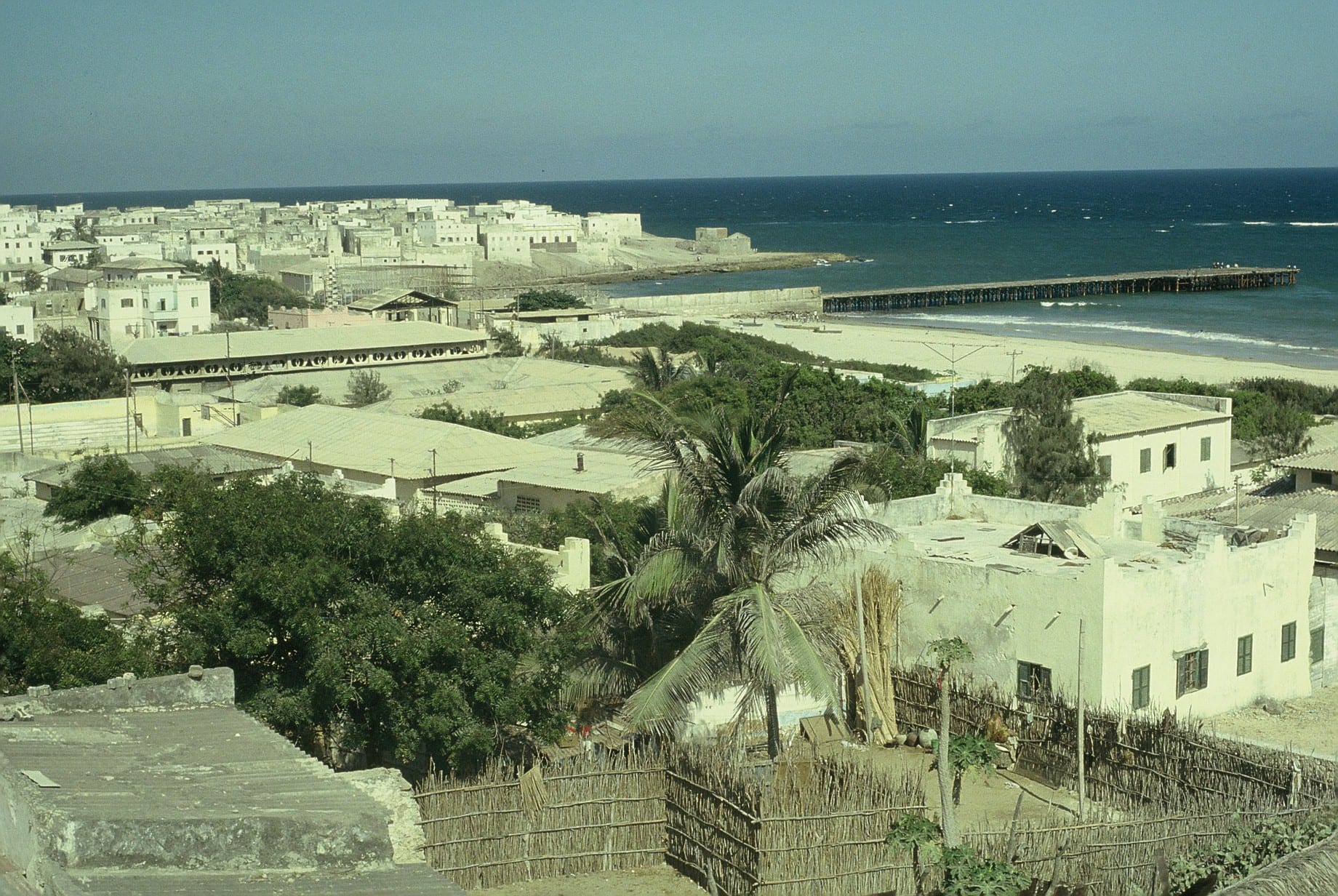
White flat-roofed houses and palm trees running down to a beach, with a long pier reaching into the ocean

Somalia

Mogadishu & the South

A view over the port town of Merca, on the Indian Ocean coast of southern Somalia. (Bacciy / Wikimedia Commons · Public domain)

Southern and central Somalia, from the capital Mogadishu on the Indian Ocean through the farmland of the Shabelle and Juba river valleys to Baidoa, the port of Kismayo and the Bajuni islands near Kenya — the country's most populous and fertile part, and the main battleground between the federal government and al-Shabaab. This page is written to explain the region, not to encourage travel.

Explore Mogadishu & the South

History

The Benadir coast has been part of the Indian Ocean trading world for over a thousand years. Mogadishu grew into a wealthy Muslim city-state by the 13th century, minting its own coins and trading cloth, ivory and gold with Arabia, Persia, India and China; the traveller Ibn Battuta described its sultan and its cloth in 1331. Merca and Barawa were smaller ports of the same world. Inland, the Ajuran state controlled the Shabelle valley and its wells and irrigation for centuries, and the Geledi sultanate at Afgooye later dominated the river trade.

In the 19th century the sultans of Zanzibar kept officials in the Benadir ports to collect customs, and later leased and then sold their installations to Italy. Italian Somaliland was run from Mogadishu, and colonists laid out plantations of bananas, cotton and sugar along the Shabelle, while Jubaland, around Kismayo, was ceded by Britain from its Kenya colony to Italy in 1925. After the Second World War the south returned to Italian administration under UN trusteeship before independence and union with the north in 1960.

The state's collapse in 1991 hit the south hardest. Fighting between clan militias wrecked Mogadishu, and the 1992 famine centred on Baidoa and the Bay region led to the US–UN intervention. In 2006 the Islamic Courts Union briefly ran Mogadishu before Ethiopian forces ousted it, and al-Shabaab emerged from its youth wing. An African Union force has backed the federal government since 2007. Four federal member states now cover the region — Jubaland, the South West State, Hirshabelle and Galmudug — alongside the capital, Banaadir, and their relations with Mogadishu are often tense. The 2011 famine struck Bay, Bakool and Lower Shabelle. A government offensive from 2022, which began in Hiiraan, retook ground, but in 2025 al-Shabaab launched a large offensive of its own and captured dozens of towns.

Culture & Customs

The south is Somalia at its most diverse. The Hawiye clans predominate in Mogadishu and the Shabelle valley, and the Rahanweyn, or Digil and Mirifle, in Bay and Bakool, where people speak Maay, a form of Somali only partly intelligible to speakers of the standard northern language. The Somali Bantu, farming communities along the rivers, many descended from people brought as slaves in the 19th century, have long faced discrimination. The Benadiri families of Mogadishu's old quarters and Merca are merchant communities with Arab and Persian ancestry, and in Barawa people speak Chimwiini, a language related to Swahili.

Mogadishu was once a cosmopolitan capital of cinemas, bands and the Italian-built seafront, and some of that has returned with the diaspora: music, poetry evenings, beach cafés and restaurants. Sufi orders were long central to religious life in the south, and the shrines of their saints were places of pilgrimage, though al-Shabaab has destroyed shrines.

Society is conservative and Sunni Muslim, and a few Italian loanwords survive in Somali from the colonial period.

Daily Life

Mogadishu, with an estimated population of several million, is growing fast, with new hotels and shopping centres funded by remittances and returnees, alongside vast camps of people displaced by drought and conflict. Bakaara market is the commercial heart. Kismayo, Baidoa, Beledweyne, Jowhar, Afgooye and Merca are the other main towns.

The river valleys grow maize, sorghum, sesame, bananas and fruit, and the Bay plateau is Somalia's sorghum belt; herders move camels and cattle across the plains between them. Telecoms, mobile money, construction and remittance companies are the modern economy, and mobile payments are used for almost everything.

Daily life is shaped by insecurity: blast walls, checkpoints and armed guards in Mogadishu, and in the countryside the pressure of al-Shabaab's taxes and courts on villages in the areas it controls or contests. Drought, river floods and high food prices regularly push families into the towns.

Food

Southern cooking shows the Indian Ocean and the Italian past. Bariis iskukaris, spiced rice with goat or camel, is a favourite lunch, and baasto, pasta with a meat and tomato sauce, is everyday lunch, often with a banana on the side, while Mogadishu's cafés serve coffee and sweet spiced tea.

In the farming areas the staple is maize or sorghum: soor, a stiff porridge eaten with stews or soup, and muufo, a flatbread of maize flour baked in a clay oven. Cambuulo, adzuki beans cooked soft and served with butter and sugar, is a popular evening meal. The river valleys supply sesame oil and the bananas that have long been one of Somalia's main exports.

The coast adds fish, widely eaten in Mogadishu. Xalwo is served at weddings and Eid, and no alcohol is sold.

Attractions & Natural Wonders

Mogadishu's old town of Hamar Weyne and Shingani keeps coral-stone houses with carved doors, the Fakr ad-Din mosque from the 13th century and the Arba'a Rukun mosque, while the shell of the Italian-era cathedral shows the scars of war. Lido beach, lined with cafés and seafood restaurants, and the quieter Jazeera beach are the capital's open spaces.

Down the coast from Mogadishu, Merca and Barawa are old stone-built trading towns of the Benadir coast. Inland, the Shabelle River enters from Ethiopia at Beledweyne and flows past Jowhar and Afgooye through the farmland of Middle and Lower Shabelle before fading into swamps near the Juba. The Juba, formed at Dolow on the Ethiopian border, runs through Gedo and the Juba valley to reach the sea near Kismayo.

Kismayo is an old port near the mouth of the Juba, and beyond it the coast runs south to Ras Kamboni and the Bajuni islands, an archipelago off the coast close to the Kenyan border. Baidoa sits on the Bay plateau, surrounded by sorghum fields.

Cities in Mogadishu & the South

Planning basics

Budget

There is no tourism industry. Visitors to Mogadishu, almost all on business, aid or diplomatic work, stay in fortified hotels or inside the secure zone by the airport, and pay heavily for armed security, armoured vehicles and fixers. Local food is cheap, but outside the capital travel is rarely possible at all. US dollars and mobile money dominate; SOS notes serve only for small change.

Daily Budget Midrange
USD 300 and upwards (secure hotel, armoured vehicle and armed guards, arranged by a local security firm)
Daily Budget Shoestring
Not realistic: security costs rule out budget travel

Visits are made only for work or family, with security planned in advance by a professional provider.

Safety

This is one of the most dangerous regions in the world. Al-Shabaab carries out bombings, suicide attacks and assaults on hotels, restaurants and government sites in Mogadishu, including on Lido beach, and controls or contests much of the countryside. Kidnapping, clan fighting, floods and disease outbreaks add to the danger, and medical care is minimal.

Most governments advise against all travel. Anyone who must go should travel only with professional security, a trusted local host and full evacuation insurance. Check current official travel advice before travelling.

Climate

The coast is hot and humid all year, with the sea breeze keeping Mogadishu's temperatures fairly even at around 27–32°C. The interior, including Baidoa and the Hiiraan plains, is hotter and drier. The Gu rains from April to June and the Deyr from October to December bring floods along the Shabelle and Juba, especially around Beledweyne, while failed rains bring drought.

Summer
hot and humid on the coast, around 28–32°C, with strong south-west monsoon winds and rough seas
Winter
hot and humid, 30–33°C on the coast, hotter and dry inland

Transportation

Aden Adde International Airport in Mogadishu has flights to Istanbul, Djibouti, Jeddah and other regional cities, and domestic services reach Baidoa and other towns. Roads between cities pass through al-Shabaab checkpoints and the risk of roadside bombs, and are not used by foreigners; within Mogadishu movement is by secured vehicle.

Fly between towns and never travel by road without professional security.

Best Time to Visit

The dry Jilaal season, from about December to March, is the least difficult time for movement, but security, not season, decides whether any visit can happen. Somalia's national day on 1 July and the two Eids fill Mogadishu's beaches and are also periods of heightened threat.