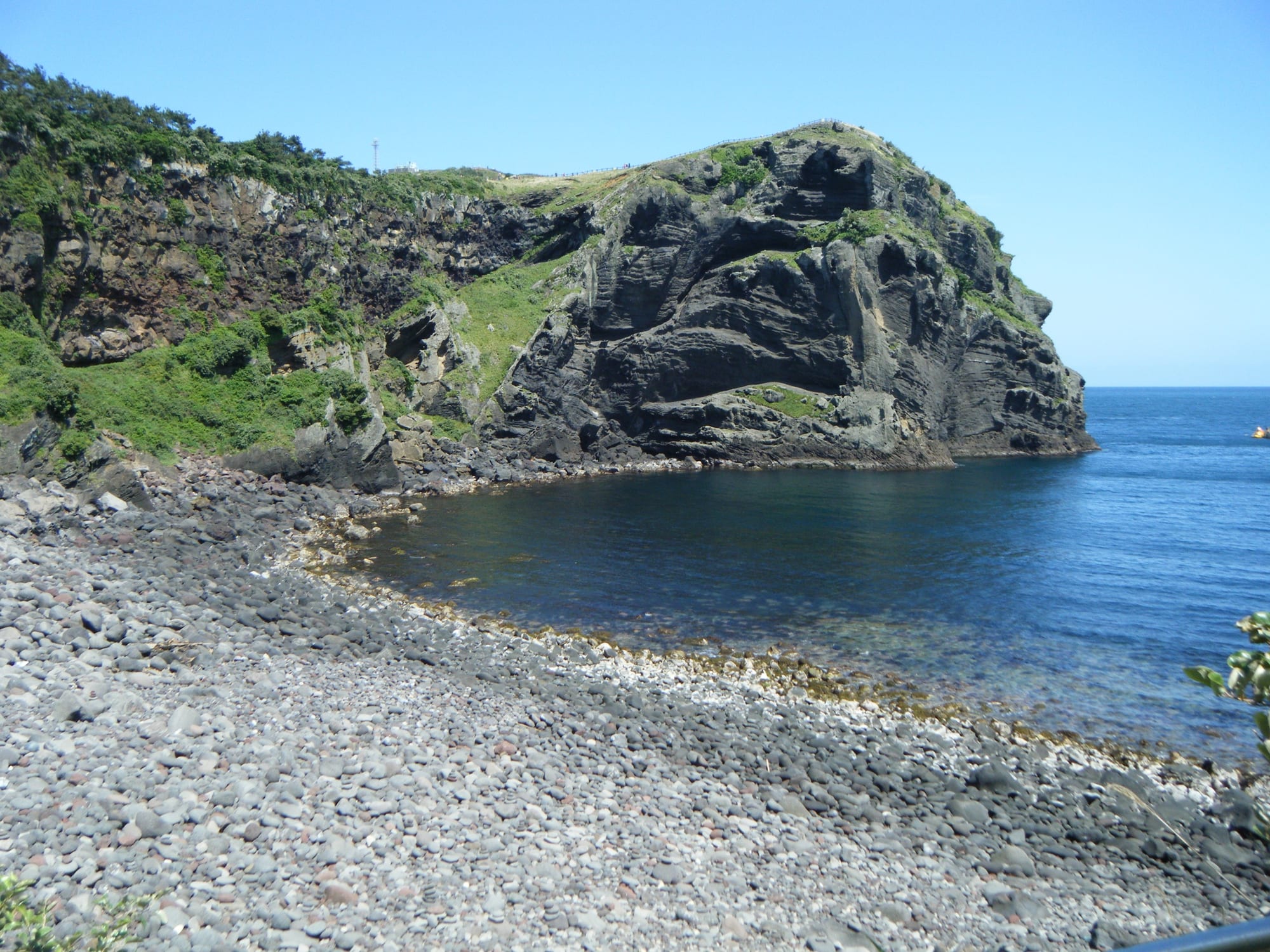
A dark basalt headland with green grass on its ledges rising above a pebble beach and clear blue sea under a cloudless sky

Jeju Island, South Korea

Udo

Basalt cliffs above a pebble shore on Udo, the small island off the east coast of Jeju. (gary4now / Wikimedia Commons · CC BY 3.0)

A small volcanic island off the east coast of Jeju, named for its resemblance to a reclining cow and reached by a short ferry crossing from Seongsan. Low basalt fields, stone walls and a single hill ringed by a coast road make it an easy day out, and its women divers, pale coral-sand beach and peanut ice cream are what visitors come for.

Neighbourhoods

  • Cheonjin and the ferry harbours
    • First-time visitors
    • Close to public transport

    The two harbours on the west side face Jeju across the strait and take the ferries from Seongsan. Around them are the island's shops, rental counters, restaurants and most of its guesthouses, and the coast road and island bus start here.

    Open in Maps
  • Hagosudong and the north shore
    • Beaches
    • Quiet and residential

    A long white-sand beach with shallow, unusually clear water, backed by a small cluster of cafés and pensions. It is the island's main swimming beach in summer and an easy walk from the harbour side.

    Open in Maps
  • Udobong and the southern cliffs
    • Walks and views
    • Coastal scenery

    The south-eastern corner rises to the island's only hill, with a lighthouse on top and basalt cliffs falling to a black pebble shore. Fields of stone-walled plots and grazing land spread below it.

    Open in Maps
  • The eastern farming villages
    • Quiet and residential
    • Local life

    Low houses with weighted roofs, garlic and peanut plots and small diving inlets make up the eastern side of the island, where the haenyeo still work the shallows and traffic thins to almost nothing.

    Open in Maps

Things to do

Beaches and the coast

  • Seobinbaeksabeach

    A bright white beach on the west coast, also called Udo Sanho Beach, protected as a natural monument, its pale grains made of coral fragments rather than ordinary sand and the water above them turning turquoise in sunshine.

    Open in Maps
  • Hagosudong Beachbeach

    The island's main swimming beach on the north shore, a shallow crescent of white sand with a view back to the hills of Jeju.

    Open in Maps
  • Geommeolle Beachbeach

    A beach of black volcanic pebbles and sand directly beneath the cliffs of Udobong, reached by a steep path from the coast road.

    Open in Maps

Walks and viewpoints

  • Udobongviewpoint

    The island's high point, a grassy volcanic hill topped by a lighthouse, with views over the whole island, the strait and Seongsan Ilchulbong.

    Open in Maps
  • Jeju Olle Trailtrail

    One of the waymarked Olle routes is a circuit of Udo itself, following the shore, the fields and the climb to the lighthouse.

    Open in Maps
  • The island coast roadtrail

    A single road rings the island past harbours, beaches and stone-walled fields, and is the usual route for the island bus, bicycles and the small rented vehicles used here.

    Open in Maps

Short trips

  • Seongsan Ilchulbonglandmark

    The tuff cone above the ferry port on Jeju, part of the island's UNESCO World Heritage Site, visible from most of Udo's western shore.

    Open in Maps
  • Seongeup Folk Villageattraction

    An inland village of thatched houses, stone walls and old administrative buildings on Jeju, preserved as a traditional settlement.

    Open in Maps

Eat and drink

Long-standing places and food districts in Udo. Hours, ratings and directions come from your maps app, always current.

Udo specialities

  • Peanut ice cream standscafe

    The island grows small, sweet peanuts in its sandy soil, and soft-serve ice cream made with them — sprinkled with crushed nuts — is sold at cafés around the harbours and the beaches.

    Open in Maps
  • Seafood noodle restaurantsneighborhood

    Haemul-jjamppong and knife-cut noodle soups loaded with conch, shellfish and seaweed are the standard lunch, along with seongge-guk, a clear soup of sea urchin harvested by the island's divers.

    Open in Maps
  • Cheonjin harbour restaurantsneighborhood

    The strip beside the main ferry pier has most of the island's kitchens and cafés, serving grilled fish, abalone dishes, Jeju black pork and peanut makgeolli.

    Open in Maps

Experience Udo

History

Udo is the exposed top of a volcanic cone and its surrounding lava shelf, one of the many small islands formed around Jeju. For centuries it was not lived on at all: under Joseon it was kept as pasture for government horses and cattle, and people from the Jeju mainland crossed only to graze animals and to fish. Its name, "cow island", comes from its low, reclining profile seen from Seongsan rather than from the herds.

Permanent settlement was permitted in 1840, and villages grew around the sheltered western harbours. The islanders lived on barley, millet, garlic and peanuts grown in thin volcanic soil behind stone windbreaks, and above all on the sea. Women divers, the haenyeo, worked the shallow reefs for abalone, conch and seaweed, which they sold or dried; in a place with almost no other cash income, their earnings often supported whole households, and Udo became one of the strongholds of the diving tradition.

A lighthouse stands high on the hill to guide shipping through the strait. The 20th century otherwise brought hardship and emigration, and the population fell steadily as young people left for Jeju City, the mainland and Japan. Tourism changed the island's fortunes from the 1990s onwards, as day trips from Seongsan grew into a steady flow, and cafés, guesthouses and rental yards replaced some of the farming. The number of visitors a small island can absorb is now the central local question.

Culture & Customs

Udo's culture is Jeju's, concentrated. The island speech belongs to Jejueo, the distinct island language that UNESCO lists as critically endangered, and older residents still use it among themselves. Village shrines stand in small groves, and rites for the sea and the wind, once the backbone of the year, are kept up by a shrinking number of families.

The haenyeo define the place. Women who dive without breathing equipment for abalone, conch, sea urchin and seaweed have worked these shallows for generations, organised into village diving collectives with their own rules about who may harvest what and when. The tradition is inscribed on the UNESCO intangible heritage list, and Udo's divers are among the best known; most are now elderly, and the orange floats bobbing offshore are a rarer sight each year.

Everything else is shaped by wind and stone. Houses sit low behind basalt walls with roof ropes tied in a grid, fields are divided by the same black stone, and round stone enclosures protect family graves. Visitors are part of daily life now — the island's economy depends on them — but residents draw a firm line between the coast road and the working parts of the island, and the quiet after the last ferry leaves is something people here value and talk about.

Daily Life

Fewer than two thousand people live on Udo, spread across a handful of villages on the second-largest island of Jeju Province, 2.8 kilometres off its east coast. The population is old: many houses belong to families whose younger members live on Jeju or the mainland, and the school is small.

The economy now rests on visitors. Ferries bring several thousand people on a busy summer day, and residents run guesthouses, cafés, restaurants and the bicycle, scooter and electric-cart hire yards along the harbour road. Farming continues on a small scale — garlic, barley and the peanuts the island is known for — and the haenyeo still dive in season, selling their catch to restaurants and to buyers on Jeju.

The rhythm of the day is set by the ferry timetable. Mornings are quiet until the first boats arrive, the coast road is busy through the middle of the day, and by evening the island is left to its residents. Winter is slow, with fewer sailings, many businesses shut and gales that can cut the island off for a day or two at a time. Local debate turns on the pressure of day trips, road safety on the narrow circuit, rubbish and fresh water, and the balance between tourism and the farming and diving that came before it.

Food

The island's signature is ttangkong, its small peanuts, grown in sandy volcanic soil and sweeter and smaller than the usual crop. They are roasted and sold in bags, ground into a paste, blended into makgeolli, the cloudy rice beer, and above all churned into peanut soft-serve ice cream, sprinkled with crushed nuts and sold at cafés around the harbours and the beaches.

The sea supplies the rest. Sea urchin gathered by the haenyeo goes into seongge-guk, a clear soup thickened with brown seaweed, and is spooned over rice; conch is sliced raw or boiled, and abalone appears grilled or in jeonbok-juk, a mild rice porridge. Haemul-jjamppong, a spicy seafood noodle soup, and kalguksu, hand-cut wheat noodles in shellfish broth, are the most ordered lunches, and grilled or braised hairtail and tilefish come across from the Jeju ports.

Jeju's staples are all here too: heuk-dwaeji black pork grilled over charcoal with the salty anchovy dip meljeot, gogi-guksu noodles in pork broth, and gamgyul tangerines and hallabong citrus in winter, pressed into juice or turned into cakes and chocolate. Because supplies come by boat, menus are short and seasonal, and many kitchens close early once the last ferry has gone.

Planning tools

Budget

Udo is cheap to visit but has few beds, so prices for its guesthouses and pensions rise sharply in July and August and at weekends. The ferry fare is small, the island bus and bicycle or electric-cart hire are modest, and food costs about what it does in eastern Jeju. Most visitors come for a day and spend little beyond lunch, ice cream and transport.

Daily Budget Midrange
USD 110–200 (island pension or a Jeju hotel nearby, seafood meals, ferry, bicycle or cart hire)
Daily Budget Shoestring
USD 35–65 (guesthouse bed, noodle and market meals, ferry and island bus)

Day visitors should check the time of the last ferry back before setting out, as sailings finish in the late afternoon and earlier in winter.

Best Time to Visit

Late spring and autumn are the most comfortable, with clear air, calm seas and quiet roads; May and October are particularly good for cycling the coast. July and August bring swimming weather but crowds on every ferry, and the typhoon risk. Winter is bleak and windy, and rough seas cancel crossings.

Suggested Number of Days

Most people come for half a day or a full day from Jeju and go back on an afternoon ferry. Staying a night suits anyone who wants the island empty after the last boat leaves. Two or three days make sense only when combined with the eastern coast of Jeju.

First Visit
half a day to 1 day
With Surroundings
2–3 days

Transportation

The coast road is the only route, and it can be covered by the circular island bus, by bicycle or by one of the small rented vehicles used here. Restrictions have been placed on renting cars and all-terrain vehicles on the island because of traffic and noise, and visitors' cars face limits on the ferries, so most people cross on foot. Distances are short, and walking the whole circuit is possible in a long day.

Hire desks ask for a driving licence recognised in South Korea before renting anything motorised, and what may be rented on the island is restricted.

Airport & Station Connections

Ferries run from Seongsan Port on Jeju's east coast, crossing the 2.8 kilometres to Udo's harbours in about fifteen minutes, with departures roughly every half hour through the day and fewer in winter. Seongsan is roughly an hour by bus or car from Jeju International Airport and a similar distance from Seogwipo. Passengers register their details before boarding, so identification is needed.

Walkability

The island is small and almost flat apart from Udobong, so walking works well; the full coast circuit is a substantial but manageable day, and the beaches and harbours are close together. There are few pavements, and the road carries bicycles, carts and the bus, so walkers share it. Shade is scarce and the wind is constant.

Safety

Crime is effectively absent and the island is calm. The hazards are the sea and the weather: strong currents and sudden swell on the rocky shore, slippery basalt, cliff edges without railings below Udobong, and gales or typhoons that stop the ferries at short notice. Cart and scooter accidents on the narrow coast road are the most common injuries.

Watch the forecast before crossing, keep back from unfenced cliff edges, swim only at the supervised beaches in season, and drive rented carts slowly on blind bends. Check current official travel advice before travelling.

Climate

The same mild maritime climate as the rest of Jeju, but more exposed: wind blows across the island almost all year and there is little shelter. Rain is heaviest in summer, when typhoons can pass close, and winter days are chilly and grey rather than freezing.

Summer
warm and humid, generally 25–30°C, with heavy rain and a typhoon risk from July to September
Winter
cool and very windy, generally 4–10°C, with rough seas and occasional snow flurries

Local Customs

Tipping is not practised in South Korea. This is a working island of small farms and diving grounds as much as a day-trip destination, so field walls, drying seaweed and moored boats are private property; haenyeo divers and their gear should not be photographed without permission. Shoes come off in guesthouses and traditional restaurants.

Take rubbish back to Jeju where possible, as the island's waste and water systems are small, and keep noise down in the villages at night.

Common Payment Methods

The currency is the South Korean won. Cards work at most restaurants, cafés and rental desks, and at the ferry ticket office, but a small amount of cash is useful for roadside stalls and the smallest village shops. There are few cash machines on the island, so it is easier to withdraw money on Jeju beforehand.