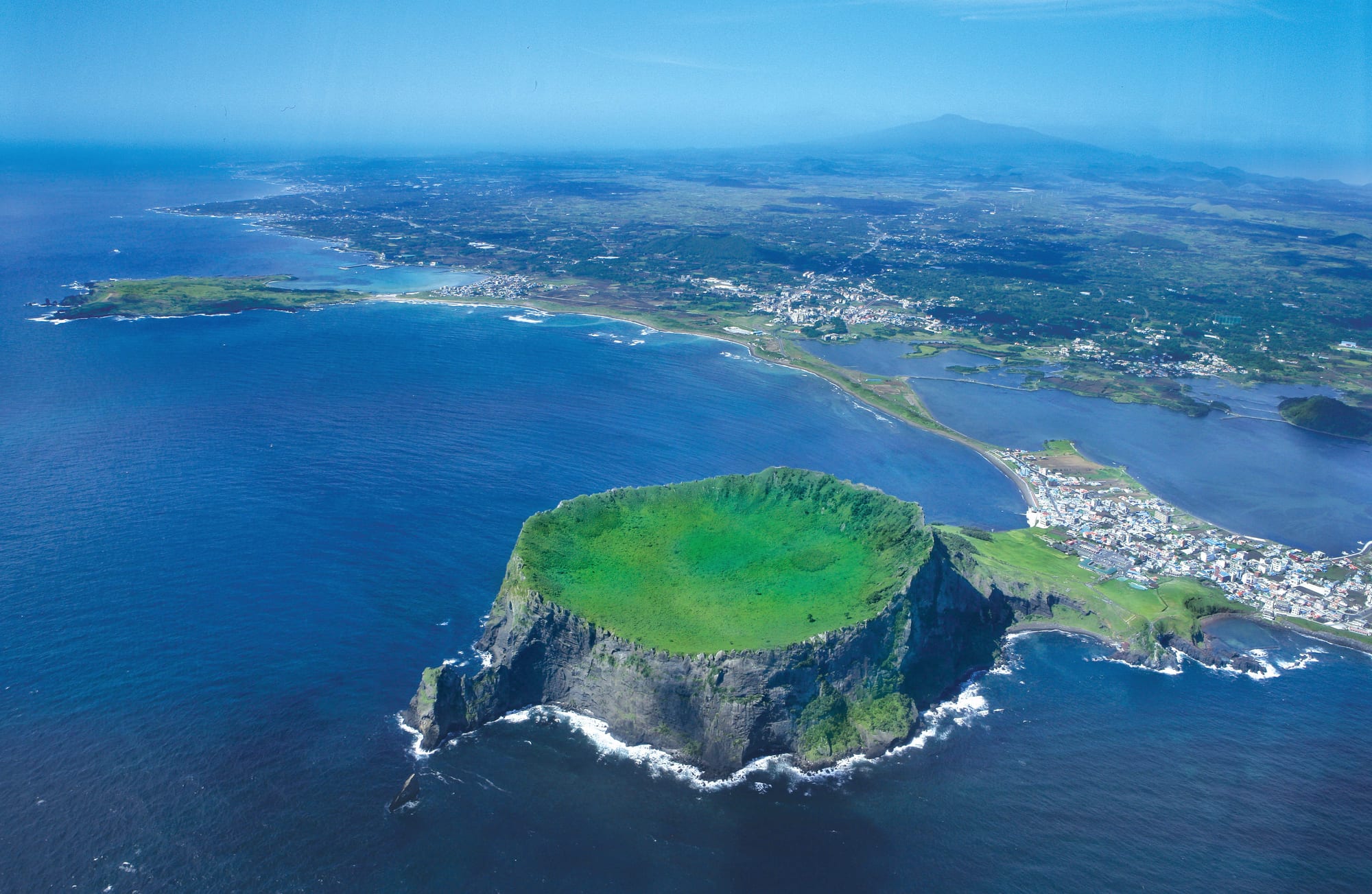
Aerial view of a green, bowl-shaped crater on a sea cliff, joined to a coastal town, with a large mountain in the haze behind

South Korea

Jeju Island

The tuff cone of Seongsan Ilchulbong on Jeju's east coast, with Hallasan on the horizon. (Korea.net / Korean Culture and Information Service / Wikimedia Commons · CC BY-SA 2.0)

South Korea's largest island and its only self-governing province, a volcanic island off the southern coast built around the cone of Hallasan, the country's highest peak — a place of lava tubes, crater hills and black basalt shores, with its own dialect, shamanic traditions and women divers, now the favourite holiday island of the Korean mainland.

Explore Jeju Island

History

Jeju was formed by volcanic eruptions over roughly the last two million years, and legend says its first people emerged from three holes in the ground at Samseonghyeol in Jeju City. For centuries it was the kingdom of Tamna, which paid tribute to the mainland kingdoms before being absorbed by Goryeo in the 12th century. After the Sambyeolcho rebels made a last stand on Jeju against the Mongols in 1273, the Mongol Yuan dynasty controlled the island until the mid-14th century and bred horses on its grasslands.

Under Joseon, Jeju was a remote place of exile and a source of horses, tangerines and abalone for the court, and islanders were long forbidden to leave for the mainland. The Dutch sailor Hendrick Hamel was shipwrecked here in 1653, and his later account was one of the first descriptions of Korea published in Europe.

The darkest chapter came after liberation. On 3 April 1948 an armed uprising against the police and the division of the peninsula began a counter-insurgency campaign in which many thousands of islanders were killed and whole villages burned. The Jeju 4.3 incident, as it is known, was barely discussed for decades; the government apologised in 2003. From the 1960s Jeju became the honeymoon island, and in 2006 it was made a special self-governing province.

Culture & Customs

Jeju has kept a culture distinct from the mainland. Its speech, often classed as a separate language called Jejueo, is hard for other Koreans to understand and is listed by UNESCO as critically endangered. Its old names include Samdado, the island of "three abundances", and Sammudo, the island of "three absences".

The haenyeo, women who dive for conch, abalone, sea urchins and seaweed on a single breath, are the best-known symbol of that culture, and their tradition is inscribed on the UNESCO intangible heritage list, as is the Chilmeoridang Yeongdeunggut, a shamanic rite held in the second lunar month for the wind goddess Yeongdeung Halmang and the Dragon King of the sea. Shamanic belief remains stronger here than on the mainland, with village shrines across the island.

The dol hareubang, round-eyed "stone grandfathers" carved from basalt, stand at town entrances and have become the island's emblem. Low walls of black lava stone surround fields, houses and graves, and the island's many oreum, small volcanic cones, are woven into local lore and celebrated at the Jeju Fire Festival, when a hillside is set alight early in the lunar year.

Daily Life

About 670,000 people live on Jeju, some 490,000 of them in Jeju City in the north and most of the rest in Seogwipo on the south coast.

Tourism dominates the economy, with more than ten million visitors a year, mostly Korean, and the Seoul–Jeju air route is one of the busiest in the world. Tangerines are the main crop, alongside vegetables, fishing and livestock farming. The number of active haenyeo has fallen sharply, and most of those still diving are elderly women.

Current debates concern overtourism, the pace of building, plans for a second airport near Seongsan, the navy base at Gangjeong, and the protection of the island's water and gotjawal, lava-rock forests. Life slows in the villages, where days still revolve around the tide, the tangerine harvest in winter and the markets of Jeju City and Seogwipo.

Food

Jeju's best-known food is heuk-dwaeji, black pork, grilled over charcoal and dipped in a salty anchovy sauce called meljeot. Pork also goes into gogi-guksu, wheat noodles in a rich pork-bone broth topped with slices of boiled pork, and into momguk, a thick pork broth cooked with a seaweed called mojaban.

The sea supplies okdom-gui, grilled tilefish, galchi-jorim, hairtail fish braised in spicy sauce, and jeonbok-juk, porridge made with abalone, while haenyeo-run restaurants on the coast serve sea urchin, conch and abalone freshly caught. Bingtteok are thin buckwheat pancakes rolled around seasoned radish, and omegi-tteok are rice cakes made from millet and coated with red-bean.

The island's gamgyul tangerines and the larger, knobbly hallabong citrus are eaten fresh and made into juice, chocolate and sweets. Local drinks include omegi-sul, a traditional millet liquor, and the Hallasan brand of soju, and the green-tea fields around Seogwipo and Andeok supply a large museum and tea house.

Attractions & Natural Wonders

Hallasan, the island's central volcano, rises to about 1,950 metres and is a national park and part of the UNESCO World Heritage Site "Jeju Volcanic Island and Lava Tubes". The Seongpanak and Gwaneumsa trails climb to the crater lake of Baengnokdam at the summit, while the shorter Eorimok and Yeongsil trails reach the high plateau.

The lava tubes of the Geomunoreum system in the northeast form the second part of the site; Manjanggul, several kilometres long, has a stretch opened to visitors, with lava stalagmites and flow lines on its walls. Seongsan Ilchulbong, the third part, is a tuff cone on the east coast climbed for the sunrise. Udo island, reached by ferry, lies just offshore, and the Haenyeo Museum lies along the northeast coast.

Jeju's coastal walks follow the Olle routes, which link fishing villages, beaches and cliffs around the whole island. Highlights on the south coast include the Jeongbang and Cheonjiyeon waterfalls in Seogwipo, the hexagonal basalt columns of Jusangjeolli, and the Sanbangsan and Yongmeori coast in the southwest. Hyeopjae is one of the best-known beaches, Bijarim is an ancient nutmeg-yew forest, and the Jeju 4.3 Peace Park explains the island's modern tragedy.

Cities in Jeju Island

Planning basics

Budget

Jeju is a domestic holiday island, so prices follow the Korean holiday calendar: pensions and resort hotels are expensive in late July, August and over long weekends, and much cheaper midweek in the off-season. Guesthouses are plentiful. Most visitors hire a car, which is the main extra cost, and restaurant meals — especially black pork and seafood — cost more than on the mainland.

Daily Budget Midrange
USD 120–230 (pension or resort hotel, black-pork and seafood dinners, hire car, park entry fees)
Daily Budget Shoestring
USD 40–75 (guesthouse, local noodle and soup restaurants, island buses)

Book flights and cars early for summer and holidays, and eat at the traditional markets in Jeju City and Seogwipo for lower prices.

Safety

Jeju has low crime. The real risks are natural: weather that changes fast on Hallasan, ice on its trails in winter, typhoons in late summer, strong currents and waves on rocky coasts, and slippery basalt. Heavy winds can cancel flights and ferries.

Keep to the marked parts of the coastal paths, respect trail cut-off times on Hallasan, and allow a spare day before onward flights in typhoon season. Check current official travel advice before travelling.

Climate

Jeju is the warmest and wettest part of South Korea. Winters are mild on the coast but windy, while Hallasan's upper slopes get deep snow. Summers are hot and very humid, rainfall is heavy, and the island lies in the path of typhoons. The south side around Seogwipo is noticeably milder than the north.

Summer
hot and humid, around 26–32°C, with heavy rain and typhoon risk from July to September
Winter
mild on the coast, around 3–10°C, with strong winds; snow and ice on Hallasan

Transportation

Jeju International Airport, in Jeju City, has frequent flights from Seoul and other mainland cities, taking about an hour from Seoul, and some international routes. Car ferries sail from several southern mainland ports. Buses circle the island and cross it to Seogwipo, but a hire car is the easiest way to reach the scattered sights.

Allow a full day for Hallasan, start early, and check whether summit trails are open; bring an International Driving Permit to hire a car.

Best Time to Visit

Spring brings rapeseed flowers and cherry blossom in late March and April, and autumn, from September to November, has clear weather, silver pampas grass on the oreum hills and good walking. Winter is quiet, with tangerines in season and snow on Hallasan. July and August are hot and crowded.