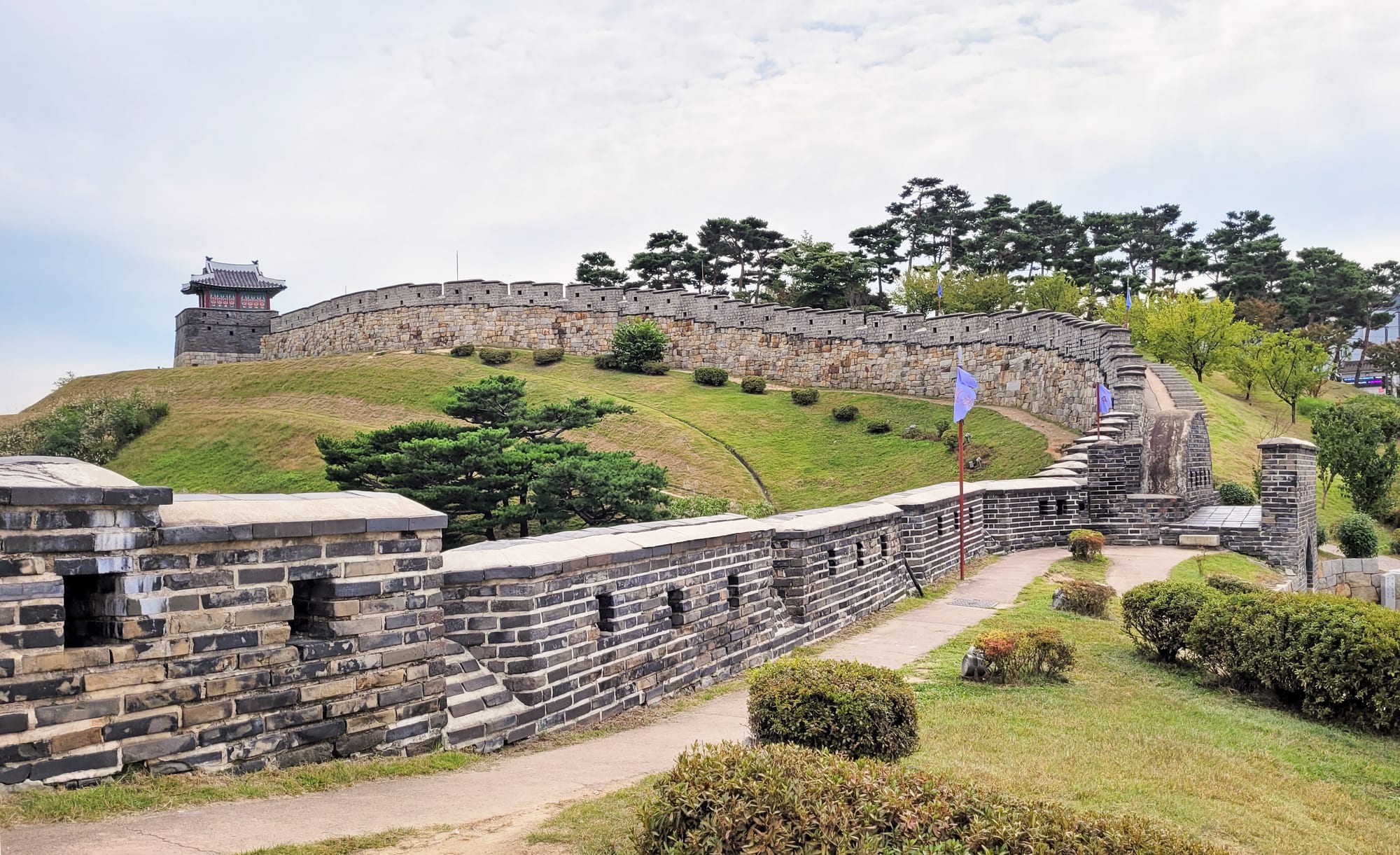
Grey stone fortress wall with battlements curving over a grassy hill with pine trees and a wooden watchtower

South Korea

Seoul & the Capital Area

The ramparts of Hwaseong Fortress, the late-18th-century walled city at the heart of Suwon. (Bernard Gagnon / Wikimedia Commons · CC0)

The northwest corner of South Korea around the lower Han River, where Seoul, the port city of Incheon and the surrounding province of Gyeonggi hold about half the nation's people — the Joseon royal capital turned megacity, ringed by fortress walls, royal tombs, satellite cities and, to the north, the Demilitarized Zone.

Explore Seoul & the Capital Area

History

The Han River basin has been fought over since the Three Kingdoms. Baekje built its first capital here, with earthen walls whose remains survive in southeastern Seoul, until Goguryeo drove it south in 475; Silla took the basin in the 6th century and used it as the gateway to China across the Yellow Sea. Under Goryeo the capital lay just to the north at Kaesong, and the site of Seoul was a secondary capital.

In 1394 the founder of the Joseon dynasty, Taejo, moved his court to Hanyang — today's Seoul — enclosing it with a city wall over the surrounding peaks and building Gyeongbokgung palace and the Jongmyo royal shrine. Japan's invasions of the 1590s burned the palaces, and in 1636–37 King Injo held out against the Manchu Qing in the mountain fortress of Namhansanseong before surrendering. In the 1790s King Jeongjo built Hwaseong at Suwon, partly to honour his father's tomb nearby. Ganghwa Island, at the mouth of the Han, saw French and American expeditions in 1866 and 1871, and the 1876 Treaty of Ganghwa with Japan led to the opening of Incheon's port.

Under Japanese rule Seoul was the colonial capital. During the Korean War it changed hands four times, and General MacArthur's landing at Incheon in September 1950 turned the course of the war. The armistice line of 1953 runs across northern Gyeonggi, placing the capital close to the border. From the 1960s the city exploded south of the river into Gangnam and outward into planned new towns, and it hosted the 1988 Summer Olympics.

Culture & Customs

The speech of Seoul is the basis of standard South Korean, and the capital area sets the national pace in fashion, media, entertainment and technology. The big music and entertainment companies behind K-pop are based in Seoul, and districts carry distinct identities: Hongdae's student and indie music scene, Gangnam's wealth, Itaewon's international mix, and Jongno and Insadong's older world of teahouses, antique shops and calligraphy supplies.

Royal ritual survives here as nowhere else. The Jongmyo Jerye, the ancestral rite for the Joseon kings performed each May with court music, is on the UNESCO intangible heritage list, and a changing-of-the-guard ceremony is staged at Gyeongbokgung's gate. In spring the Lotus Lantern Festival, also UNESCO-listed, brings a parade of paper lanterns through central Seoul before Buddha's Birthday, and Suwon's Hwaseong Cultural Festival in mid-October celebrates the fortress and its history.

Much of the capital area's population arrived within living memory, from the provinces or as refugees from the North in the 1950s, so regional ties, hometown associations and North Korean food traditions remain part of city life. Incheon has the country's best-known Chinatown, founded by merchants after the port opened in 1883.

Daily Life

About 26 million people live in the capital area: some 9.4 million in Seoul, around 3 million in Incheon and more than 13 million in Gyeonggi, whose cities include Suwon, Goyang, Yongin, Seongnam and Bucheon. Most live in high-rise apartment complexes, and commuting across city lines on the metro and red intercity buses is routine.

The economy is dominated by services, finance, government and technology. Samsung Electronics is headquartered in Suwon, Pangyo Techno Valley is known as Korea's Silicon Valley, and Incheon combines the airport, the port and the Songdo business district. Many government ministries have moved to Sejong in recent years, but political and corporate power remains in Seoul.

Days are long: early starts, office dinners, cram schools running into the evening for children, and 24-hour convenience stores and delivery. The pressing issues are housing costs — Seoul apartment prices are far above the national average — the concentration of jobs and universities in the capital, and a very low birth rate. The Itaewon crowd crush of October 2022, which killed 159 people, led to a national debate about crowd safety.

Food

The capital area eats everything the country produces, but has its own dishes. Seolleongtang, a milky soup of long-simmered ox bones, is a Seoul specialty, as are the dishes of the Joseon court — sinseollo, a hotpot served in a brass vessel with a central chimney, and gujeolpan, a nine-section platter of eight fillings wrapped in thin pancakes. Gwangjang Market in the old centre is known for bindaetteok, crisp mung-bean pancakes, and bite-sized mayak gimbap rice rolls.

Suwon is famous for Suwon galbi, broad beef short ribs grilled over charcoal, and Incheon's Chinatown claims jjajangmyeon, wheat noodles in black-bean sauce, which has a museum there. Budae-jjigae, "army stew" of sausage, ham, instant noodles and kimchi, grew out of US army base supplies after the Korean War, and Uijeongbu claims to have first made it. Naengmyeon, cold buckwheat noodles in an iced broth and once a speciality of Pyongyang and Hamhung, became popular across the South after the Korean War.

Icheon, in southeastern Gyeonggi, is known for its rice and its ceramics kilns. Makgeolli, a milky rice wine, and soju are drunk throughout, and Seoul's traditional liquor makers have seen a revival of craft makgeolli.

Attractions & Natural Wonders

In Seoul, the five Joseon palaces stand close together north of the river: Gyeongbokgung, with its throne hall and Gyeonghoeru pavilion; Changdeokgung and its Secret Garden, a UNESCO World Heritage Site; Changgyeonggung and Deoksugung. Jongmyo shrine is also UNESCO-listed. Between them lie the hanok alleys of Bukchon and the shops of Insadong. The restored Cheonggyecheon stream runs through the centre, and Namsan's N Seoul Tower, Myeongdong, Dongdaemun Design Plaza, the Lotte World Tower and the National Museum of Korea complete the city sights, with Bukhansan National Park rising on the northern edge.

Incheon offers its Chinatown, the old open-port quarter, the high-rise district of Songdo and ferries to islands in the Yellow Sea. Ganghwa Island has dolmens that are part of a UNESCO World Heritage Site, along with fortifications from the 19th-century clashes.

North of Seoul, the DMZ tour from Paju starts at Imjingak park and visits the Third Infiltration Tunnel, dug by North Korea, and the Dora Observatory. Organised tours to the Joint Security Area at Panmunjom run when conditions allow.

South of the capital, Suwon's fortress, Hwaseong, is a UNESCO World Heritage Site whose walls can be walked in a few hours. In Yongin, the Korean Folk Village recreates a Joseon-era village with farmhouses, a yangban mansion and craft workshops, and Everland, the country's biggest theme park, lies in the hills nearby. The mountain fortress of Namhansanseong and several of the UNESCO-listed Joseon royal tombs are within an hour of Seoul.

Cities in Seoul & the Capital Area

Planning basics

Budget

The capital area is the most expensive part of South Korea to sleep in: hotels in central Seoul, Gangnam and Myeongdong cost well above the national average. Eating and moving around are still good value — market food, set lunches and the metro are cheap — and guesthouses in Hongdae, Jongno and around Seoul Station keep costs down. Everland and DMZ tours are the main paid extras.

Daily Budget Midrange
USD 140–260 (mid-range hotel in Seoul, restaurant meals, palace tickets, a DMZ tour or theme-park day)
Daily Budget Shoestring
USD 55–90 (guesthouse or capsule-style hostel, market and street food, metro and buses)

Use one T-money card across Seoul, Incheon and Gyeonggi, where metro, buses and suburban lines share a transfer system; book DMZ tours a few days ahead.

Safety

Seoul and its satellite cities are very safe, day and night. The practical risks are crowds in nightlife districts such as Itaewon and Hongdae on busy weekends, traffic when crossing roads, summer heat, fine dust in spring and flash flooding during the monsoon. Access to the DMZ is controlled, and tours are occasionally cancelled when military tension rises.

Follow guides' rules exactly at the DMZ, carry a passport on those tours, and check air-quality alerts in spring. Check current official travel advice before travelling.

Climate

The capital area has a sharper continental climate than the south coast: winters are colder and drier than in Busan or on Jeju, with dry winds from Siberia, and summers are hot and humid, with most of the year's rain falling in the July monsoon. Incheon and the coast are slightly milder in winter. Spring brings periods of fine dust.

Summer
hot and humid, often 30–35°C in the day, with heavy monsoon rain in July
Winter
cold and dry, often below −5°C at night in January, with occasional light snow

Transportation

Incheon International Airport is linked to Seoul Station by the AREX airport railway in under an hour, and Gimpo airport sits inside Seoul. The metro network covers Seoul and reaches Incheon, Suwon and much of Gyeonggi, with buses filling the gaps. Suwon is also on the main railway south. DMZ sites in Paju are mostly visited on organised tours, and Everland and the Folk Village are reached by bus or light rail from Seoul's southern suburbs.

Allow extra time on cross-region metro trips — Seoul to Suwon or central Incheon takes about an hour — and avoid rush hour with luggage.

Best Time to Visit

April and May, and late September to early November. Cherry blossom lines the Han and the Yeouido riverbanks in early April, the Lotus Lantern Festival fills central Seoul before Buddha's Birthday, and autumn colour reaches the palaces, Bukhansan and Namhansanseong in late October. July is wet and August steamy; winter is cold but clear and good for indoor sights.