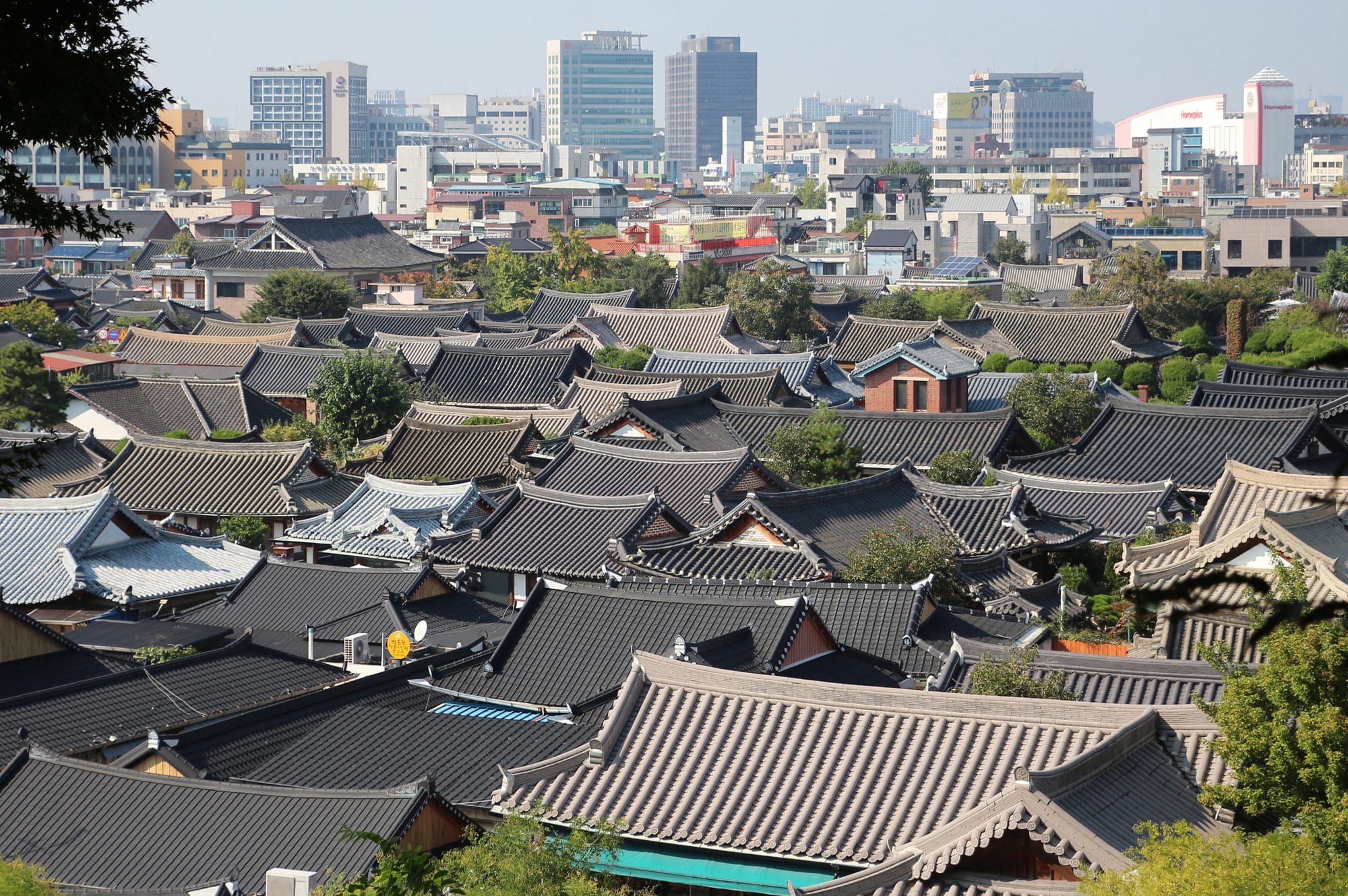
Dense rows of dark tiled hanok roofs in the foreground with modern high-rise buildings behind under a hazy sky

South Korea

Jeonju, Gwangju & the Southwest

The tiled roofs of Jeonju Hanok Village, with the modern city of Jeonju beyond. (Bernard Gagnon / Wikimedia Commons · CC0)

The Jeolla provinces and the city of Gwangju in South Korea's southwest — a region of rice plains, tidal flats and island-strewn coast, famous at home for the richest cooking in the country, for the pansori singing tradition and for the 1980 Gwangju Uprising, with the hanok quarter of Jeonju in the north and the tea hills and bays of the south coast.

Explore Jeonju, Gwangju & the Southwest

History

The southwest was part of Baekje, whose last royal sites include the Mireuksa temple site and Wanggung-ri at Iksan. After Silla's conquest, the rebel general Gyeon Hwon founded Later Baekje around 900 with its capital at Jeonju, before it fell to Goryeo in 936. In the 9th century Jang Bogo ran a maritime trading base at Cheonghaejin on Wando, controlling shipping between Korea, China and Japan. Dolmens from far earlier, at Gochang and Hwasun, are part of a UNESCO World Heritage Site.

Jeonju was the ancestral seat of the Yi clan that founded the Joseon dynasty, and the Gyeonggijeon shrine was built there to hold a portrait of its founder. The fertile plains made the region the kingdom's rice bowl, and heavy taxes fed repeated unrest. During the Japanese invasions of the 1590s, Admiral Yi Sun-sin defended the Jeolla coast, winning the Battle of Myeongnyang in 1597 in the fast-flowing strait off Jindo. In 1894 the Donghak Peasant Revolution broke out in Jeolla and briefly took Jeonju.

In modern times the region felt neglected by the Gyeongsang-born military governments that drove industrialisation elsewhere. In May 1980, when students and citizens of Gwangju protested against Chun Doo-hwan's martial law, paratroopers killed hundreds of people before the army retook the city. The uprising is now officially honoured as a turning point toward democracy. The sinking of the Sewol ferry off Jindo in April 2014, which killed 304 people, most of them schoolchildren, remains a national trauma.

Culture & Customs

The southwest, historically called Honam, sees itself as Korea's home of art, food and resistance. Pansori, the long sung narratives performed by a single singer and a drummer and inscribed as UNESCO intangible heritage, grew up here, and Namdo folk songs, Jindo's version of Arirang and the island's funeral and shamanic rites are strongly regional. Jeonju is known for handmade hanji paper and its film festival, and Gwangju hosts one of Asia's leading contemporary art biennales.

The Jeolla dialect, with its distinctive sentence endings, is instantly recognisable to other Koreans and often used on screen for warmth or comedy. Politically the region has voted overwhelmingly for liberal candidates since the 1980s, and the old rivalry with the Gyeongsang southeast is still felt. The May 18 anniversary is commemorated each year in Gwangju, and the novelist Han Kang, a native of the city who won the 2024 Nobel Prize in Literature, wrote about the uprising in Human Acts.

Jindo is home to the Jindo dog, a native breed, and to a spring festival marking the sea parting, when an exceptionally low tide opens a path across the sea to a nearby islet.

Daily Life

Gwangju, with about 1.4 million people, is the region's largest city, followed by Jeonju with around 640,000, and the port and industrial cities of Suncheon, Yeosu, Mokpo, Iksan and Gunsan. Much of the countryside and many islands are ageing fast, and the Jeolla provinces are among those losing population most quickly.

Farming and fishing still matter more here than in most of South Korea: rice on the plains, pears at Naju, tea at Boseong, sea salt on the islands of Sinan, and seaweed around Wando. Industry is concentrated in Kia's car plant in Gwangju, the petrochemical complex at Yeosu and the steelworks at Gwangyang. The huge Saemangeum seawall on the North Jeolla coast, built to reclaim tidal land, remains controversial, and the 2023 World Scout Jamboree held there was cut short amid a heatwave.

Market days, long meals and slower rhythms mark daily life outside the cities, while Jeonju's hanok village and Yeosu's harbour fill with domestic visitors every weekend.

Food

Koreans generally regard Jeolla food as the country's best, and a set meal, hanjeongsik, can cover a table with dozens of banchan side dishes. Jeonju bibimbap is the famous one: rice topped with seasoned vegetables, meat, egg and gochujang, traditionally mixed in a brass bowl. Jeonju is also known for kongnamul gukbap, a bean-sprout soup with rice eaten for hangovers, moju, a sweet herbal drink based on makgeolli, and makgeolli houses that serve a stream of free dishes with each kettle.

Gwangju and Damyang are known for tteokgalbi, patties of minced short-rib meat grilled over charcoal, and Naju for gomtang, a clear beef soup. The coast supplies the strongest flavours: hongeo, fermented skate with a sharp ammonia smell, is a southwestern specialty, Mokpo is known for small octopus, and Yeosu for gejang, raw crab marinated in soy sauce, and gat kimchi, made with mustard leaves from Dolsan island.

Boseong's green tea is drunk hot and used to flavour local dishes, and the islands of Sinan county are known for sun-dried sea salt.

Attractions & Natural Wonders

In North Jeolla, Jeonju's hanok village holds more than 800 traditional houses along with Gyeonggijeon shrine, the brick Jeondong Cathedral and the Omokdae viewpoint, and is the best place to eat bibimbap in its home town. Nearby are the Baekje temple site of Mireuksa at Iksan, part of a UNESCO World Heritage Site, the maple valleys of Naejangsan National Park, the dolmens of Gochang and the cliffs of the Byeonsan peninsula.

Gwangju has the May 18th National Cemetery, the old provincial office and the Asia Culture Center on the site of the uprising, and Mudeungsan National Park on its edge. Damyang's bamboo forest and the Soswaewon garden are close by.

On the south coast, Boseong's green tea fields climb the hillsides of the Daehan Dawon estate and others. Suncheon Bay's reed beds and tidal flats, part of a UNESCO-listed tidal-flat site, sit beside the Suncheon Bay National Garden, and the walled folk village of Naganeupseong and the temples of Songgwangsa and Seonamsa lie inland. Yeosu offers Odongdo, the Hyangiram hermitage above the sea, the wooden Jinnamgwan hall and the cable car over the harbour.

In the far southwest, Wando has the Cheonghaejin site and boat links to Bogildo, with its Joseon-era garden, and Cheongsando, with its terraced fields. Jindo has the Uldolmok strait, scene of the Myeongnyang battle, the Jindo dog centre and the spring sea parting. Haenam's Daeheungsa temple and the headland of Ttangkkeut, the mainland's southern tip, lie across the water.

Cities in Jeonju, Gwangju & the Southwest

Planning basics

Budget

The southwest is one of the cheapest parts of South Korea to travel in. Motels and guesthouses in Gwangju, Mokpo and Suncheon are inexpensive, and set meals come with a famously generous spread of side dishes at no extra cost. Jeonju's hanok guesthouses and Yeosu's sea-view hotels charge more at weekends and in summer, and island ferries add to the bill.

Daily Budget Midrange
USD 100–190 (hanok stay or sea-view hotel, full Jeolla-style dinners, KTX and ferries)
Daily Budget Shoestring
USD 35–65 (motel or guesthouse, local set meals, intercity buses)

Visit Jeonju's hanok village on weekdays, when rooms are cheaper and the lanes calmer, and order a set meal to see how much the region serves.

Safety

The region is safe. Natural hazards are the main risks: typhoons and heavy rain in late summer, fast tides on the mudflats and around Jindo, rough seas that can cancel island ferries, and heat on exposed tea terraces. Winter snow can close rural roads on the western plains.

Leave the mudflats well before the tide turns, check ferry sailings on the day, and allow spare time on island trips. Check current official travel advice before travelling.

Climate

Milder than the capital area, especially along the south coast around Yeosu, Wando and Jindo, where winters are short. The west-facing plains are an exception in winter: cold winds off the Yellow Sea bring some of the heaviest snowfalls in the country's lowlands. Summers are hot and humid, and the south coast is exposed to typhoons.

Summer
hot and humid, around 30–34°C inland in Gwangju and Jeonju; typhoon risk on the coast in August and September
Winter
cool to cold, around −5 to 8°C, with heavy snow at times on the western plains

Transportation

The KTX reaches Gwangju Songjeong from Seoul in about an hour and a half, Jeonju in under two, and Suncheon and Yeosu on the Jeolla line. Mokpo is at the end of the Honam line. Boseong, Wando and Jindo are reached by bus from Gwangju or Mokpo; both islands are linked to the mainland by bridge. Ferries run to Jeju and to smaller islands from Mokpo, Wando and Yeosu.

A hire car makes the coast, Boseong and the islands far easier; without one, base in Gwangju or Suncheon and use express buses.

Best Time to Visit

April and May bring tea picking in Boseong, green paddies and, in spring, the sea parting at Jindo. From late October to November the reed beds of Suncheon Bay turn gold, migrating cranes arrive and the maples of Naejangsan are at their peak. Summer is humid, with island beaches busy in late July and August.