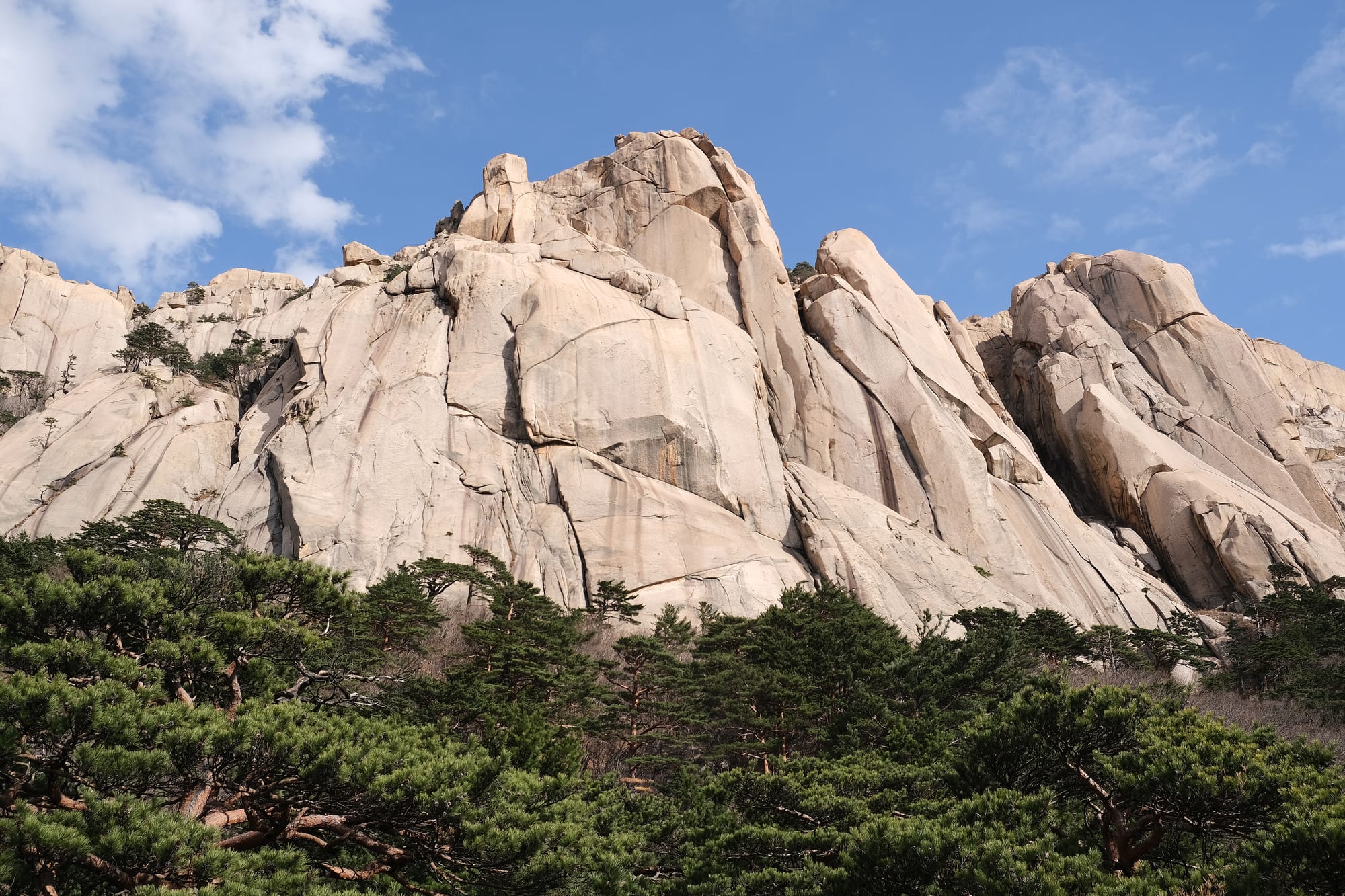
Pale granite crags of Ulsanbawi rising above a band of dark green pine trees under a blue sky

South Korea

Gangwon & the Chungcheong Centre

The granite peaks of Ulsanbawi in Seoraksan National Park, Gangwon. (kallerna / Wikimedia Commons · CC BY-SA 4.0)

The mountainous east and the agricultural middle of South Korea — Gangwon's Taebaek ranges, ski slopes and East Sea beaches, and the Chungcheong provinces with the science city of Daejeon, the new administrative capital of Sejong, the gorges of Danyang and the royal tombs and fortresses of Baekje's last two capitals.

Explore Gangwon & the Chungcheong Centre

History

The Chungcheong lowlands were the heart of Baekje in its later centuries. After Goguryeo captured its capital on the Han in 475, the kingdom retreated to Ungjin, today's Gongju, and in 538 moved again to Sabi, today's Buyeo, where it built fortresses and temples and passed Buddhism and crafts on to Japan. The tomb of King Muryeong, found intact at Gongju in 1971, shows how rich that court was. In 660 a Silla and Tang alliance took Sabi, and legend says Baekje court women leapt from the Nakhwaam cliff into the river rather than be captured.

Gangwon, across the mountains, was a thinly settled frontier of Goguryeo and later Silla, valued for timber, Buddhist monasteries such as Woljeongsa on Odaesan and Sinheungsa below Seoraksan, and the coastal road. In the Joseon era Gangneung was a centre of yangban scholarship: Yulgok Yi I, one of the dynasty's leading Confucian thinkers, and his mother Shin Saimdang, a painter, are both linked to Ojukheon. Cheongju, in North Chungcheong, is where Jikji, the oldest surviving book printed with movable metal type, was produced in 1377.

The 1953 armistice split Gangwon in two, and the north of the old province lies in North Korea; refugees from the North resettled at Sokcho. Industrial growth came later than elsewhere, but Daejeon grew into a science city from the 1970s and hosted Expo '93, Sejong was founded in 2012 to take government ministries out of Seoul, and PyeongChang and Gangneung hosted the 2018 Winter Olympics.

Culture & Customs

Chungcheong people are known across Korea for an unhurried, indirect manner and a drawn-out dialect, the subject of endless jokes, and the region, historically called Hoseo, prides itself on its Confucian gentry heritage. Gongju and Buyeo mark their past each autumn with the Baekje Cultural Festival, and Boryeong's Mud Festival on the west coast has become one of the country's best-known summer events.

Gangwon's identity comes from the mountains and the sea. The Gangneung Danoje, held around the fifth day of the fifth lunar month, combines shamanic rites, a mask drama and markets and is on the UNESCO intangible heritage list. Arirang songs from Jeongseon are among the best known of that folk tradition. In winter, towns in the interior stage ice festivals with fishing through holes in frozen rivers, such as the Hwacheon trout festival.

Buddhist mountain temples are part of daily culture here: Beopjusa on Songnisan and Magoksa near Gongju belong to the UNESCO-listed group of Korean mountain monasteries and offer temple stays. The coast around Sokcho keeps the food and customs brought by refugees from the North's Hamgyong province.

Daily Life

Daejeon, with about 1.4 million people, is the largest city; the other main centres are Cheongju, the capital of North Chungcheong, Cheonan, and the Gangwon towns of Wonju, Chuncheon and Gangneung. Sejong has grown quickly to more than 350,000 people since ministries began moving there in 2012. Gangwon, dominated by mountains, has long been thinly settled.

The economy is mixed. Daejeon's Daedeok research district holds government institutes and KAIST, Cheonan and Asan have large electronics and car plants, and the Chungcheong plains grow rice, ginseng — Geumsan is the best-known market town for it — and fruit. Gangwon depends on tourism, the military, farming and fishing; its old coal towns around Taebaek and Jeongseon declined after the mines closed, and the casino at Jeongseon, the one open to South Korean citizens, was built partly to revive them.

Life in the Gangwon countryside follows the seasons — summer holidays on the coast, autumn hiking, winter skiing — and many villages are ageing and emptying. Sejong, by contrast, is a new city that is still growing.

Food

Gangwon's cooking reflects poor mountain soils: potatoes, corn and buckwheat. Gamja-ongsimi are potato dumplings in soup, and makguksu, cold buckwheat noodles, is a specialty of Chuncheon, along with dakgalbi, spicy stir-fried chicken with cabbage and rice cakes cooked on a hot plate at the table. Bongpyeong, in PyeongChang county, is known for buckwheat dishes. Gangneung's Chodang village makes soft tofu curdled with seawater, eaten as chodang sundubu, and the town has a busy coffee street by Anmok beach.

On the coast, Sokcho's refugee village serves abai sundae, a sausage in the northern style, and squid sundae, squid stuffed with rice and vegetables. In winter, pollack is hung to freeze and thaw on racks in the mountains around Inje to make hwangtae, a dried fish used in soups.

Chungcheong eats more simply. Daejeon is known for the bakery Sungsimdang, a local institution since the 1950s. Cheonan's hodu-gwaja are small walnut-shaped cakes filled with red-bean paste. Geumsan ginseng goes into chicken soups and teas, and the west-coast mudflats supply clams, oysters and salted seafood.

Attractions & Natural Wonders

In Gangwon, Seoraksan National Park is the great sight: Sinheungsa temple and its bronze Buddha, the Gwongeumseong fortress site, the hike to the Ulsanbawi crags and, for the fit, the climb to Daecheongbong, one of the highest peaks in South Korea. Below it, the Sokcho coast has fishing harbours, the refugee village of Abai and beaches. Gangneung has Gyeongpo lake and beach, Ojukheon, the Anmok coffee street and the Jeongdongjin sunrise beach. PyeongChang has the Alpensia and Yongpyong ski resorts used in the 2018 Olympics, and Odaesan National Park with the temple of Woljeongsa. Chuncheon sits among lakes, with Nami Island in the river nearby.

In South Chungcheong, the Baekje Historic Areas, a UNESCO World Heritage Site, cover Gongju — the Gongsanseong fortress above the Geum River and the royal tombs at Songsan-ri, including King Muryeong's — and Buyeo, with the Busosanseong fortress, the Nakhwaam cliff, the stone pagoda of Jeongnimsa and the Neungsan-ri tombs. The coast has the Taean peninsula and Boryeong's Daecheon beach, and Asan has Hyeonchungsa, the shrine to Admiral Yi Sun-sin.

Daejeon offers the Expo Science Park, the Daedeok science district and nearby hot springs at Yuseong, while Sejong has its lake park and government complex.

In North Chungcheong, the Danyang gorges along the Namhan River are the highlight: the three rock islets of Dodamsambong, the stone arch of Seokmun, the cliffs of Sainam and the Gosu Cave, with Chungju Lake close by. Songnisan National Park and Beopjusa, with its tall wooden pagoda, lie to the southwest.

Cities in Gangwon & the Chungcheong Centre

Planning basics

Budget

Costs are lower than in Seoul across most of the region. Daejeon, Cheongju, Gongju and Buyeo have inexpensive motels and restaurants, and Danyang is cheap outside peak weekends. Gangwon's coast and ski resorts are the exception: Sokcho, Gangneung and the PyeongChang resorts charge high-season prices in July and August and during the ski season.

Daily Budget Midrange
USD 110–200 (hotel or resort room, restaurant meals, KTX, park and heritage tickets; more at ski resorts in winter)
Daily Budget Shoestring
USD 40–70 (motel or guesthouse, local restaurants, intercity buses)

Visit the east coast on weekdays outside the summer holidays, when beach-town prices fall sharply, and combine Gongju and Buyeo in one bus trip.

Safety

The region is safe. Hazards are natural: steep, rocky trails and sudden weather in Seoraksan and Odaesan, winter ice, summer rip currents on some east-coast beaches, and forest fires in the dry spring on Gangwon's coast. Parts of northern Gangwon lie close to the DMZ, with military areas that are off limits.

Stay on marked trails, check trail closures in fire season and winter, and swim only on patrolled beaches. Check current official travel advice before travelling.

Climate

Gangwon is split by the Taebaek mountains: the inland Yeongseo side is among the coldest parts of South Korea in winter, while the Yeongdong coast around Gangneung and Sokcho is milder but gets the country's heaviest snowfalls when winds come off the sea. Chungcheong has the standard inland climate — cold dry winters and hot humid summers with July monsoon rain — and Daejeon sits in a basin that traps summer heat.

Summer
hot and humid inland, around 30°C or more; slightly cooler on the east coast and in the mountains
Winter
cold, often −10°C or lower on the Gangwon plateau; heavy snow possible on the east coast and in the mountains

Transportation

The KTX reaches Gangneung from Seoul via PyeongChang, and Daejeon is under an hour from Seoul on the main high-speed line, with Sejong reached by bus from nearby stations. Sokcho, Gongju, Buyeo and Danyang are best reached by express bus from Seoul or Daejeon. Mountain roads in Gangwon can close or slow in heavy snow.

Take express buses for the smaller towns and trains for the cities; a hire car helps for the east coast and the Danyang area but is not essential.

Best Time to Visit

Mid-October is peak foliage in Seoraksan and the Taebaek ranges, and the mountains are very crowded on autumn weekends. May and early June suit the Baekje sites and Danyang. July and August bring the beach season on the east coast and the Boryeong Mud Festival on the west. December to February is ski season around PyeongChang, with ice-fishing festivals in Gangwon's interior.