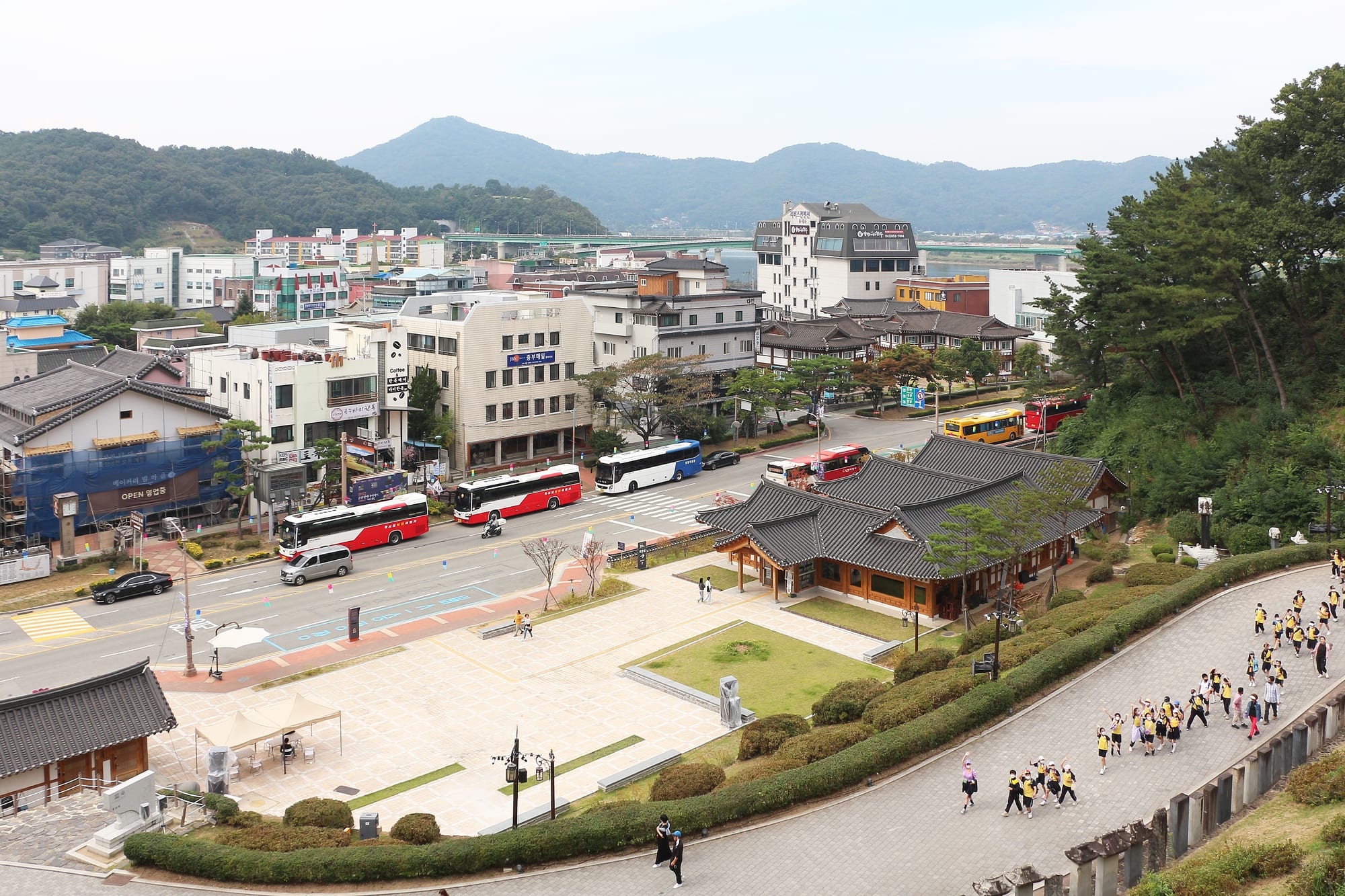
A low provincial town of tiled-roof and concrete buildings below wooded hills, with buses on a wide road and a river beyond

Gangwon & the Chungcheong Centre, South Korea

Gongju

The centre of Gongju seen from the walls of Gongsanseong fortress. (Bernard Gagnon / Wikimedia Commons · CC0)

A small city on the Geum River in South Chungcheong that served as Ungjin, capital of the Baekje kingdom, from 475 to 538. Its hillside fortress and royal tombs are part of a UNESCO World Heritage listing, the mountain temple of Magoksa stands in the hills to the north-west, and the modern town is a quiet provincial centre known for chestnuts.

Neighbourhoods

  • The old centre below Gongsanseong
    • First-time visitors
    • Historic district
    • Best for food

    The compact grid of streets between the fortress hill and the Geum River, with the traditional market, small restaurants and guesthouses, and the riverside path to the Gomanaru ferry landing. Almost everything historic in the town is within a short walk.

    Open in Maps
  • Ungjin-dong and the tomb quarter
    • History
    • Museums
    • Quiet and residential

    The western side of the old town, where the royal tombs of Songsan-ri, the Gongju National Museum and a cluster of rebuilt hanok guest houses sit among low residential streets. It is calmer than the market district and closer to the main heritage sites.

    Open in Maps
  • Sinkwan-dong
    • Students and nightlife
    • Shopping
    • Close to public transport

    The newer district on the south bank of the Geum River, built around the main campus of Kongju National University. Apartment blocks, chain shops, cheap restaurants and late-opening bars give it the busiest evening life in the city, and the intercity bus terminal is on this side of the water.

    Open in Maps
  • The Gyeryongsan foothills
    • Nature
    • Temples
    • Quiet and residential

    Farming villages and pensions spread through the valleys south-east of the town, below the granite ridges of Gyeryongsan. The temples of Gapsa and Donghaksa are reached from here, and the area fills with walkers on autumn weekends.

    Open in Maps

Things to do

Baekje Gongju

  • Gongsanseonglandmark

    The earth and stone fortress on a hill above the Geum River, raised in 475 as the citadel of the Baekje capital and later rebuilt with stone ramparts, with a circuit of walls of about 2.7 kilometres, gates and pavilions.

    Open in Maps
  • Tomb of King Muryeonglandmark

    The brick-built tomb of King Muryeong, who ruled Baekje from 501 to 523, and his queen, found undisturbed in 1971 among the Songsan-ri burial mounds and one of the major archaeological discoveries made in Korea.

    Open in Maps
  • Gongju National Museummuseum

    The museum that holds the gold diadem ornaments and other finds from King Muryeong's tomb among some 10,000 objects excavated in Daejeon and South Chungcheong.

    Open in Maps

Temples and mountains

  • Magoksalandmark

    A large Buddhist monastery in a wooded valley north-west of the town, set on both banks of a stream and a head temple of the Jogye Order.

    Open in Maps
  • Gyeryongsan National Parkpark

    The country's second national park, designated in 1968, a compact area of granite ridges and forested valleys on the border of Gongju and Daejeon, rising to 845 metres, with marked ridge walks and several long-established temples.

    Open in Maps
  • Gapsalandmark

    An old temple on the western side of Gyeryongsan, reached along a stream and an avenue of trees that draws crowds for autumn colour.

    Open in Maps
  • Donghaksalandmark

    A temple on the eastern slopes of Gyeryongsan, long associated with the training of Buddhist nuns.

    Open in Maps

Short trips from the town

  • Busosanseonglandmark

    The fortress hill above the river at Buyeo, the Baekje capital that followed Gongju, with the Nakhwaam cliff and wooded paths inside the walls.

    Open in Maps
  • Buyeo National Museummuseum

    The main collection of finds from Sabi-period Baekje, whose central exhibit is the gilt-bronze incense burner of Baekje.

    Open in Maps
  • Daejeonattraction

    The research and transport city on the far side of Gyeryongsan, with national science institutes, large markets and the region's main high-speed rail interchange.

    Open in Maps

Seasonal events

  • Baekje Cultural Festivalautumn, usually late September or October

    A heritage festival of processions, rites and riverside lantern displays marking the Baekje kingdom, staged at Gongju and at Buyeo downstream.

  • Buddha's Birthday lanternsMay

    Rows of paper lanterns are hung through the courtyards of Magoksa, Gapsa and Donghaksa for the national Buddhist holiday.

Eat and drink

Long-standing places and food districts in Gongju. Hours, ratings and directions come from your maps app, always current.

Gongju classics

  • Gongju Sanseong Marketmarket

    The town's traditional market beside the fortress, with produce stalls, chestnut and ginseng sellers, kalguksu and gukbap counters and a covered arcade of small food shops.

    Open in Maps
  • Restaurants below Gongsanseongneighborhood

    The streets between the fortress gate and the river hold family-run places serving river fish stews, pork gukbap, hand-cut noodles and chestnut-based dishes.

    Open in Maps
  • Sinkwan-dongneighborhood

    The student quarter across the river, where cheap grill restaurants, fried chicken places, cafés and bars stay open late during term.

    Open in Maps

Experience Gongju

History

The site was settled long before it had a name in the records: the Palaeolithic layers excavated at Seokjang-ri on the Geum River in the 1960s are among the earliest evidence of human occupation on the peninsula. Gongju's importance began in 475, when Goguryeo armies took the Baekje capital on the Han River and the court fled south. The kingdom re-established itself here as Ungjin, in a loop of the Geum protected by a hill that became the fortress of Gongsanseong, and stayed for sixty-three years. It was a period of recovery and of unusually wide contact: King Muryeong, who died in 523, was buried in a chamber of moulded brick built in a Chinese manner, with wooden coffins and gold and jade ornaments inside.

In 538 the capital moved downstream to Sabi, today's Buyeo, and Gongju became a provincial town. Under Joseon it was the seat of the governor of Chungcheong province, and the fortress's ramparts were rebuilt in stone; the court of King Injo fled south during Yi Kwal's rebellion in 1624. The provincial capital moved to Daejeon in the 1930s, once the railway had passed Gongju by, and the town settled into a long quiet period.

Muryeong's tomb was found by accident in 1971 during drainage work at the Songsan-ri mounds, and the flood of objects it produced transformed the study of Baekje. Gongju's fortress, tombs and temple sites were inscribed as part of the Baekje Historic Areas on the UNESCO World Heritage list in 2015.

Culture & Customs

Gongju understands itself through Baekje. The kingdom's reputation — for refined metalwork, elegant roof tiles, and the transmission of Buddhism, writing and craft skills to Japan — is the town's central story, and the Baekje Cultural Festival each autumn fills the riverbank with processions, memorial rites and lantern displays, alternating its main staging with Buyeo downstream. School groups come from across the country to the museum and the tombs.

Chungcheong province has a reputation elsewhere in Korea for an unhurried, indirect way of speaking, drawn out and full of understatement, and Gongju fits the description. It is also a strongly Confucian town: the provincial school, clan rites and a conservative sense of propriety shaped local life for centuries, and ancestral ceremonies are still observed carefully in the surrounding countryside.

Buddhism is the other thread. Magoksa, a head temple of the Jogye Order set between two arms of a mountain stream, runs temple stays that draw visitors into early-morning chanting and monastic meals, and Gapsa and Donghaksa on Gyeryongsan have long histories of their own. Gyeryongsan has attracted religious movements of many kinds, and small shrines and hermitages are scattered through its valleys. Education matters here as everywhere in Korea, and Kongju National University, which grew out of a teacher-training college, gives the town a student population and a long tradition of supplying schoolteachers.

Daily Life

About 100,000 people live in Gongju, spread between the old town, the newer district across the river and a wide rural hinterland of farming villages. Like most provincial cities in Korea it is ageing and slowly shrinking: young people leave for Daejeon, Sejong and Seoul, and rural schools have closed. The opening of Sejong, the administrative city built a short drive east, has cut both ways, drawing shoppers and workers away while making Gongju an affordable place to live for people who commute there.

Agriculture remains important. The hills around the city are planted with chestnut trees, a long-established local crop, along with pears, shiitake mushrooms, strawberries and rice from the Geum floodplain. Otherwise the economy rests on public administration, the university and its hospital, schools, and tourism built around the heritage sites.

The daily rhythm is provincial and early. The market beside the fortress is busiest in the morning, offices and schools empty in the late afternoon, and by mid-evening the old town is quiet while the student streets of Sinkwan-dong are just filling up. Weekends bring day-trippers from Daejeon and coach parties to the tombs and temples. Local concerns are those of much of inland Korea: an ageing population, the future of the rural districts, and flood management along the Geum.

Food

Chestnuts run through everything. Gongju's hills produce them in quantity and the town sells them roasted in the market, boiled, candied, ground into cakes and biscuits, made into a sweet paste for pastries, and fermented into bam makgeolli, a cloudy chestnut rice wine sold in the market and in local restaurants. Chestnut rice, bam-bap, appears on set-meal tables with an array of vegetable side dishes.

The Geum River supplies the other local speciality. Restaurants along the riverside and below the fortress serve freshwater fish dishes — eoril-guksu and maeuntang, a fiery stew of river fish with red pepper paste, radish and crown daisy — and some serve steamed river snails. Gukbap, a rice and soup bowl usually made with pork bones, is the standard cheap lunch, and hand-cut kalguksu noodles are sold from counters in the covered market.

Temple food is a genuine local cuisine rather than a novelty: Magoksa's temple stays serve the vegetarian monastic meals that exclude garlic and onion, and a few restaurants near the mountain temples offer sanchae bibimbap, rice topped with wild mountain greens gathered in the valleys. Ginseng from the Chungcheong hills turns up in chicken soup, in sweets and in the market's medicinal stalls, and roadside stalls sell dried persimmons and jujubes in autumn.

Planning tools

Budget

Gongju is one of the cheaper places to stay in the centre of the country. Motels in the old town and around the bus terminal cost little, hanok guesthouses near the tombs are the main mid-range option, and heritage admission charges are small. Costs rise only during the autumn festival and on peak foliage weekends in Gyeryongsan.

Daily Budget Midrange
USD 90–160 (hanok guesthouse or hotel, restaurant meals, museum and heritage tickets, taxis between sites)
Daily Budget Shoestring
USD 35–65 (motel or guesthouse, market food and gukbap, city buses)

Staying overnight is far cheaper here than in Daejeon or Sejong, and the fortress walls, riverside paths and temple grounds cost nothing or very little.

Best Time to Visit

April and May, when cherry and pear blossom line the Geum River and the temple valleys are green, and October, for autumn colour on Gyeryongsan and the Baekje Cultural Festival. Summer is hot, humid and wet in the monsoon; winter is cold and dry, and the town is very quiet.

Suggested Number of Days

One to two days suits the historic core, which is compact. Add a day for the mountain temples and for Buyeo downstream. Anyone relying on rural buses rather than a car should allow longer.

First Visit
1–2 days
With Surroundings
3 days

Transportation

The old town is small enough to cross on foot. City buses link it with the bus terminal, the university district and the outlying temples, though services to Magoksa and the Gyeryongsan valleys are infrequent. Taxis are cheap and plentiful, and many visitors hire a car for the temples.

Check the return times of rural bus services before setting out for Magoksa or Gapsa, as the last bus back can be early in the evening.

Airport & Station Connections

Express buses from Seoul take roughly two hours to the terminal on the south bank, and there are frequent buses from Daejeon and Sejong, both less than an hour away. Gongju's high-speed railway station sits well outside the town to the south, on the line between Seoul and the south-west, and is connected to the centre by bus and taxi. The nearest international airport is Incheon, reached by direct airport bus.

Walkability

The historic core is easy on foot: the fortress, the market, the tombs and the museum lie within a couple of kilometres of one another, linked by riverside paths and quiet streets. Pavements are good and the ground is flat apart from the fortress hill itself, which is steep. Anything beyond the old town — the university district, the temples, the mountains — needs a bus, a taxi or a car.

Safety

Gongju is a very safe small city with little crime of any kind. The practical hazards are the summer monsoon, when the Geum River rises and heavy rain can close paths, heat and humidity in July and August, and icy steps on the fortress walls and temple stairs in winter. Mountain trails on Gyeryongsan are rocky and steep in places.

Carry water in summer, watch rainfall warnings in the monsoon, and stay on marked trails in the national park. Check current official travel advice before travelling.

Climate

An inland climate with four sharply marked seasons. Winters are cold and dry, spring and autumn are mild and clear, and summer is hot and humid with most of the year's rain falling between late June and August.

Summer
hot and humid, typically around 30°C in the afternoon, with monsoon rain and occasional typhoon remnants
Winter
cold and dry, with daytime highs around 3–5°C and nights well below freezing, light snow and many clear days

Local Customs

Tipping is not practised and is best not offered. Shoes come off at the door of hanok guesthouses, temple halls and many traditional restaurants. At temples, visitors walk quietly, keep to the paths around halls where services are under way and avoid photographing monks without asking. Age and seniority shape how people speak to one another, and two hands are used when giving or receiving money or a drink.

Drinking is social rather than solitary here, and pouring for others rather than for oneself is the norm; English is less widely spoken than in Seoul, so a translation app helps.

Common Payment Methods

The currency is the South Korean won. Cards and phone payments work in almost every shop, restaurant and taxi, and ATMs in convenience stores accept foreign cards, though not all of them do. A small amount of cash is useful at market stalls, rural bus stops and temple donation boxes.