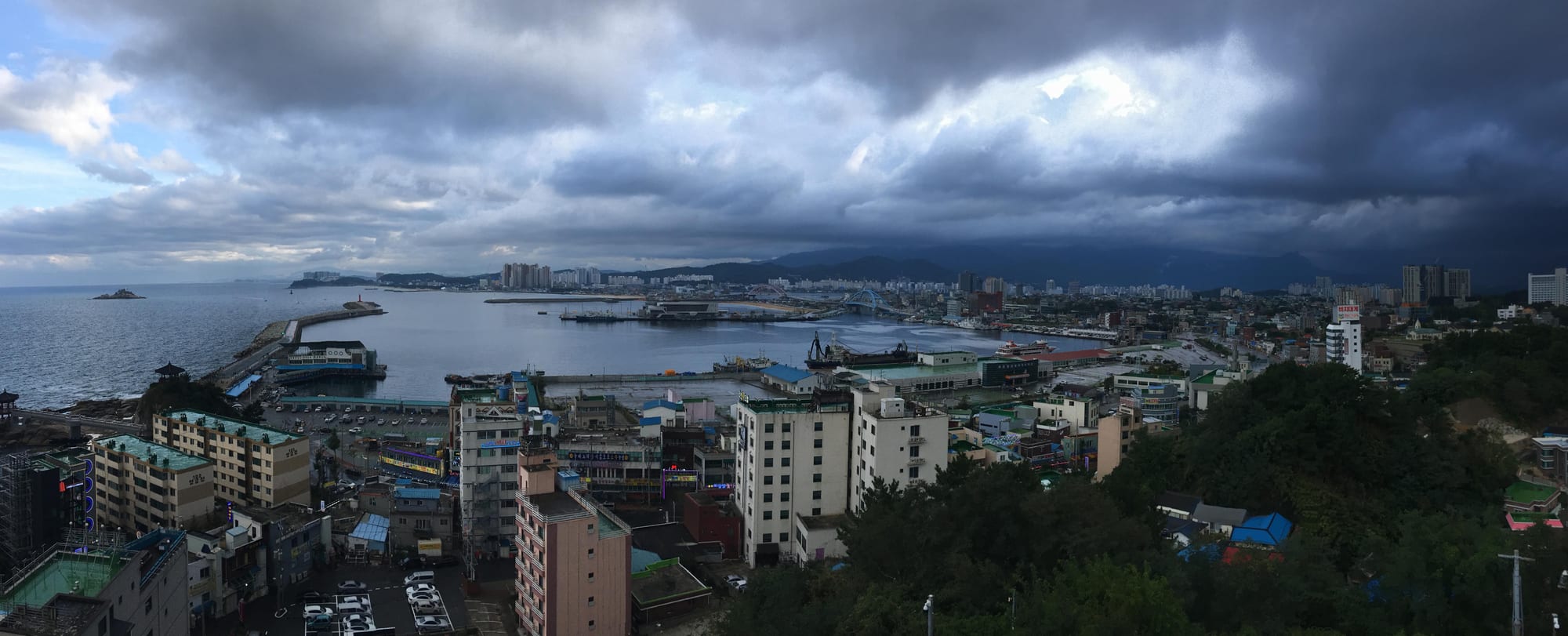
Wide view over Sokcho's low buildings, fishing harbour and breakwaters to the East Sea, with mountains and heavy cloud behind

Gangwon & the Chungcheong Centre, South Korea

Sokcho

Sokcho, its harbour and the East Sea seen from the lighthouse observatory. (Christophe95 / Wikimedia Commons · CC BY-SA 4.0)

A fishing port on the north-east coast of South Korea, wedged between the East Sea and the granite ridges of Seoraksan. Two lagoons cut into the middle of the town, a hand-pulled ferry still crosses one of them, and a quarter built by refugees from the northern province of Hamgyong gave the place its best-known food. Fishing, the national park and summer visitors keep it going.

Neighbourhoods

  • Jungang-dong and the market quarter
    • First-time visitors
    • Best for food
    • Close to public transport

    The commercial centre behind the inner harbour, built around the tourist and fishery market. Narrow streets of seafood restaurants, dried-fish sellers and fried-chicken counters run down to the quay where the hand-pulled ferry crosses to Abai village.

    Open in Maps
  • Abai Village
    • Historic district
    • Best for food
    • Local life

    A low-lying quarter on a sandspit across the harbour channel, settled after the Korean War by people from Hamgyong province in the North. Single-storey houses, drying racks and small kitchens serving northern sausage and stuffed squid; the crossing on the flat gaetbae ferry is part of the visit.

    Open in Maps
  • Daepohang and the southern shore
    • Best for food
    • Harbour life

    The larger fishing port at the south end of town, with a raw-fish market, rows of stalls frying seafood, and boats unloading beside the breakwater. Oedaepo beach and the rocky shore lie just beyond.

    Open in Maps
  • Seorak-dong
    • Hiking
    • Nature

    The cluster of hotels, restaurants and car parks at the national park gate, about 10 kilometres inland from the harbour. It exists for Seoraksan, and empties outside the walking and skiing seasons.

    Open in Maps
  • The beach and lagoon strip
    • Beaches
    • Quiet and residential

    The northern side of town, where Sokcho beach runs for the best part of a kilometre of pale sand beside the Yeongnang lagoon. Newer apartment towers, cafés and guesthouses face the water, and a coastal path links the beach to the lighthouse headland.

    Open in Maps

Things to do

Seoraksan National Park

  • Seoraksan National Parkpark

    One of South Korea's best-known mountain parks, a mass of granite peaks, ravines and pine forest rising directly behind the town, on the UNESCO biosphere reserve list.

    Open in Maps
  • Sinheungsalandmark

    The Buddhist temple at the main park entrance, founded in the Silla period and rebuilt several times, approached past a large seated bronze Buddha.

    Open in Maps
  • Ulsanbawiviewpoint

    A wall of six granite domes above the temple, reached by a steep stepped climb that ends with views over the coast and the ranges inland.

    Open in Maps
  • Biseondaetrail

    A broad rock shelf in a stream valley below the peaks, the destination of the easiest well-known walk from the park gate.

    Open in Maps
  • Gwongeumseongviewpoint

    The ruined hilltop fortress site reached by the park's cable car, with a short scramble at the top to a rock platform above the valley.

    Open in Maps

The harbour and the lagoons

  • Abai Villageneighborhood

    The refugee quarter on the sandspit, reached by a flat ferry that passengers pull across the channel on a cable, and the home of Sokcho's northern cooking.

    Open in Maps
  • Cheongchohopark

    The brackish lagoon that reaches into the middle of the town, twin to Yeongnangho to the north, ringed by a walking and cycling path and spanned by bridges.

    Open in Maps
  • Yeongranghopark

    The larger northern lagoon, quieter than its neighbour, with a lakeside path, reed beds and pavilions looking towards Seoraksan.

    Open in Maps
  • Sokcho Tourist and Fishery Marketmarket

    The covered market at the centre of town, stacked with dried pollack, squid, crab and seaweed, and lined with stalls frying chicken and seafood.

    Open in Maps
  • Daepo Portattraction

    The busier of the town's two fishing harbours, where the catch is sold beside the boats and eaten at plastic tables a few metres away.

    Open in Maps

Beaches and viewpoints

  • Sokcho Beachbeach

    Just under a kilometre of sand at the north of the town, open as a bathing beach since 1976, crowded in July and August and used for walking and sunrise watching the rest of the year.

    Open in Maps
  • Sokcho Lighthouse Observatoryviewpoint

    A white lighthouse on the headland above the old harbour with a viewing gallery taking in the coast, the port and the mountains.

    Open in Maps

Short trips from the city

  • Naksansalandmark

    A coastal temple south of Sokcho in Yangyang, with a tall stone bodhisattva above the sea; much of it was rebuilt after a forest fire in 2005.

    Open in Maps
  • Osaek hot springsattraction

    Mineral springs in the Osaek valley in Yangyang, on the southern edge of Seoraksan, protected as a natural monument and long a stop for walkers coming off the mountain.

    Open in Maps

Seasonal events

  • Autumn colour in SeoraksanOctober

    The first foliage of the Korean autumn usually turns on these ridges, and the park and the town fill with walkers for several weekends.

  • New Year sunrise on the east coast1 January

    Crowds gather on Sokcho's beaches and at the seaside pavilions before dawn to watch the first sunrise of the year, a long-standing east-coast custom.

  • Summer beach seasonJuly and August

    The beaches open with lifeguards and stalls, the population of the town swells, and rooms are booked out well in advance.

Eat and drink

Long-standing places and food districts in Sokcho. Hours, ratings and directions come from your maps app, always current.

Sokcho classics

  • Abai sundae and squid sundaerestaurant

    The town's signature dishes, brought by refugees from Hamgyong — a thick sausage of pig intestine stuffed with rice and vegetables, and ojingeo sundae, squid filled with the same mixture, sliced and served with dipping sauce.

    Open in Maps
  • Dakgangjeong from the marketmarket

    Sweet and spicy fried chicken sold by the boxful from a row of competing stalls inside the covered market, a standard souvenir for visitors going home.

    Open in Maps
  • Raw fish and mulhoe at the portsrestaurant

    Fish chosen from the tanks at Daepohang or the inner harbour and eaten as hoe, or as mulhoe — raw fish in a cold, tart chilli broth eaten in summer.

    Open in Maps

Food districts and markets

  • Sokcho Tourist and Fishery Marketmarket

    The main market, with dried pollack and squid, crab, seaweed, fried-food alleys and restaurants on the upper floors.

    Open in Maps
  • Daepohang stallsneighborhood

    A line of stands at the southern port frying shrimp, squid and fish cakes, with tables looking over the moored boats.

    Open in Maps

Experience Sokcho

History

Sokcho grew from a scatter of fishing villages on a stretch of coast with two lagoons and no natural deep harbour. It was a minor place through the Joseon period, the seaward end of a poor mountain district whose links ran north and south along the coast rather than west over the Taebaek passes. Under Japanese rule the port was developed for the fishing fleet and used to ship iron ore, and roads improved the connection over the passes to the interior.

The division of the peninsula at the 38th parallel in 1945 left Sokcho just north of the line, and for five years it was administered from the North. The Korean War changed that: the armistice of 1953 fixed the military demarcation line well to the north of the town, and Sokcho became a South Korean border port. Thousands of people from Hamgyong province, who had moved south during the fighting and expected to return within weeks, settled on the sandspit by the harbour channel. The quarter they built became Abai Village, and their cooking became the town's best-known food.

Post-war Sokcho lived on pollack, squid and crab, and on the naval and military presence that the border brought. It was made a city in 1963. As the pollack disappeared from these waters the fishing economy narrowed, and tourism took its place: Seoraksan was designated a national park in 1970, the motorway and improved roads from Seoul cut the journey to a few hours, and the town rebuilt itself around walkers, beachgoers and seafood. Apartment towers have gone up along the shore, and the population has held roughly steady while much of inland Gangwon has emptied.

Culture & Customs

Sokcho's identity rests on two things that meet here, the mountains and the sea, and on a third that is particular to it — the northern families who make up a large share of the population. Abai village keeps dialect words, ancestral rites and dishes from Hamgyong, and the idea of a temporary settlement that became permanent runs through the town's sense of itself. The hand-pulled ferry across the channel, worked by passengers hauling on a cable, is the emblem of that quarter and appears in films and television dramas set here.

The mountain side of local life is equally strong. Seoraksan has been a Buddhist landscape for more than a thousand years, with Sinheungsa and smaller hermitages in its valleys, and temple visits, mountain hiking and the autumn foliage season structure the year for residents as much as for visitors. Older customs of the east coast survive too, including rites for a safe catch and the New Year habit of gathering on the shore before dawn.

Day to day, manners are those of provincial Korea: age determines forms of address, elders are served first, and hospitality is expressed through food. The wider region's shamanic and folk traditions, best known from the Gangneung Danoje festival down the coast, are part of the cultural background here, and Sokcho people follow the fortunes of Gangwon's teams and the fishing season with equal attention.

Daily Life

About 80,000 people live in Sokcho, in a narrow strip of town squeezed between the sea and the park boundary. It is one of the few places in Gangwon whose population has not fallen sharply, because visitors and retirees have replaced some of those who left; even so, the town is ageing, and school rolls and the fishing fleet have both shrunk. Most residents live in apartment blocks near the lagoons and the coast road, with the older single-storey neighbourhoods surviving around the harbours.

The economy is fishing, food processing, construction and above all tourism. Squid, crab, flatfish and shellfish are landed at the two ports, and dried and salted products are made and sold in the markets; hotels, condominiums, restaurants and the cable car employ many people seasonally. The military is a steady presence, as it is everywhere near the border, and a share of the working population commutes to Yangyang or Gangneung.

The rhythm is seasonal to an extreme degree. Summer and the autumn foliage weeks bring traffic jams on the coast road and queues at the market stalls; February and March are slow and cold, when the restaurants run on local custom. Recurring concerns are the wildfires that have swept this coast in dry springs, the decline of catches, winter storms that damage harbour works, and the pressure that peak weekends put on parking, water and waste.

Food

The dish most associated with Sokcho is abai sundae, a fat sausage of pig intestine packed with rice, vegetables and seasoning, steamed and sliced — a Hamgyong recipe carried south by refugees and now cooked in the small kitchens of Abai village. Beside it is ojingeo sundae, squid stuffed with the same mixture, cut into rounds, dipped in egg and fried. Both are eaten with a chilli and soy sauce and taste more of the northern provinces than of the south.

The sea supplies the rest. Squid in all forms is the town's staple, fresh, dried or seasoned; crab, flatfish, sea squirt and shellfish are sold at the quayside and eaten raw as hoe within sight of the boats. In summer comes mulhoe, raw fish and vegetables in a cold, sharp chilli broth poured over ice, a speciality of this coast. Winter brings soups of pollack, the fish that built the local fleet, including dried hwangtae from the racks in the mountain valleys inland and the clear haejangguk-style broths eaten in the cold.

The market is the other food landmark: alleys of dried-fish sellers and a much-photographed row of stalls selling dakgangjeong, crisp fried chicken tossed in a sticky sweet-hot glaze, which visitors carry home by the box. Gangwon staples appear everywhere too, from gamja-ongsimi potato dumplings to buckwheat makguksu, and local makgeolli and soju are drunk with the seafood.

Planning tools

Budget

Sokcho is inexpensive outside the peak, but prices swing hard with the season. Rooms in July and August, over the autumn foliage weekends and at New Year can cost two or three times what they do in spring, and the seafront hotels are the priciest beds in town. Seafood eaten at the ports is cheaper than the same fish in Seoul, and the national park charges little to enter.

Daily Budget Midrange
USD 110–200 (hotel or sea-view room, seafood meals, cable car and park entry, taxis)
Daily Budget Shoestring
USD 40–75 (guesthouse or motel room, market food, local buses)

Travel midweek and outside the school holidays for the lowest room rates, and book anything on the seafront weeks ahead for August or the October weekends.

Best Time to Visit

Late September to early November for the mountains, when Seoraksan colours and the air is clear, and May to June for mild coastal weather without the crowds. July and August are hot, humid and busy, with the monsoon rains early in the period. Winter is cold and windy on the coast, with the heaviest snowfalls in the country when the wind comes off the sea.

Suggested Number of Days

Two days covers the town and one walk in the national park. Three or four allow a longer mountain route, the lagoons and the coast to the south. Weather decides as much as anything: high trails can be closed in snow or in the spring fire season.

First Visit
2 days
With Surroundings
3–4 days

Transportation

The town has no railway station. City buses link the terminals, the market, the beaches and the national park gate, and run often enough to be useful; taxis are cheap over the short distances involved. Bicycles suit the flat lagoon and coastal paths. A car helps for the coast road and the valleys south of the park, though car parks at the park gate fill early on autumn weekends.

The bus to the Seoraksan entrance from the town centre takes roughly half an hour; check the last return, which is earlier than most visitors expect.

Airport & Station Connections

Almost everyone arrives by road. Express buses from Seoul take about two and a half hours on the motorway through the mountains, running through the day to the express and intercity terminals in town. There are also buses from Incheon airport and from other east-coast cities. The nearest railway is at Gangneung, about an hour south by bus, which is the end of the KTX line from Seoul.

Walkability

The centre is flat and compact, and the market, the harbour, the ferry crossing and the lighthouse are all within a half-hour walk of each other. Paths run around both lagoons and along the shore, so the seafront can be covered on foot for several kilometres. The national park is too far to walk to and needs a bus, taxi or car.

Safety

Sokcho is a safe, quiet town with very little crime affecting visitors. The risks are outdoors: strong currents and sudden drop-offs on unpatrolled beaches, steep and slippery granite trails in Seoraksan, rapid weather changes on the ridges, ice in winter and forest fires in the dry spring, which have burned close to the town in recent years. Some areas along the coast north of the city are military zones with access restrictions.

Swim only on patrolled beaches in season, start mountain walks early and carry water and warm layers, obey trail and fire-season closures, and respect signs and fences on restricted stretches of coast. Check current official travel advice before travelling.

Climate

A coastal climate moderated by the East Sea and sheltered from the west by the Taebaek mountains. Winters are milder than inland Gangwon but very snowy; summers are hot and humid; spring is dry and windy, autumn clear.

Summer
warm and humid, usually 26–30°C by day, a little cooler than inland, with monsoon rain in July
Winter
cold and windy, typically around or just below 0°C by day, with some of the heaviest snowfalls in South Korea

Local Customs

Tipping is not expected anywhere. Shoes are removed in guesthouses and in restaurants with raised floors, food is shared from the middle of the table, and drinks are poured for others with two hands. At the temples in Seoraksan, visitors keep quiet during services, walk clockwise around pagodas and dress modestly. Many older residents trace their families to the North, a subject handled with care.

Ask before photographing people at work in the markets or on the boats, separate rubbish for recycling, and avoid photographing military installations and fenced sections of the coast.

Common Payment Methods

The currency is the South Korean won. Cards and mobile payment work almost everywhere, including small restaurants and the buses, and ATMs accepting foreign cards are found at banks and convenience stores in the centre. Cash is still handy at market stalls, the quayside fish sellers and the hand-pulled ferry.