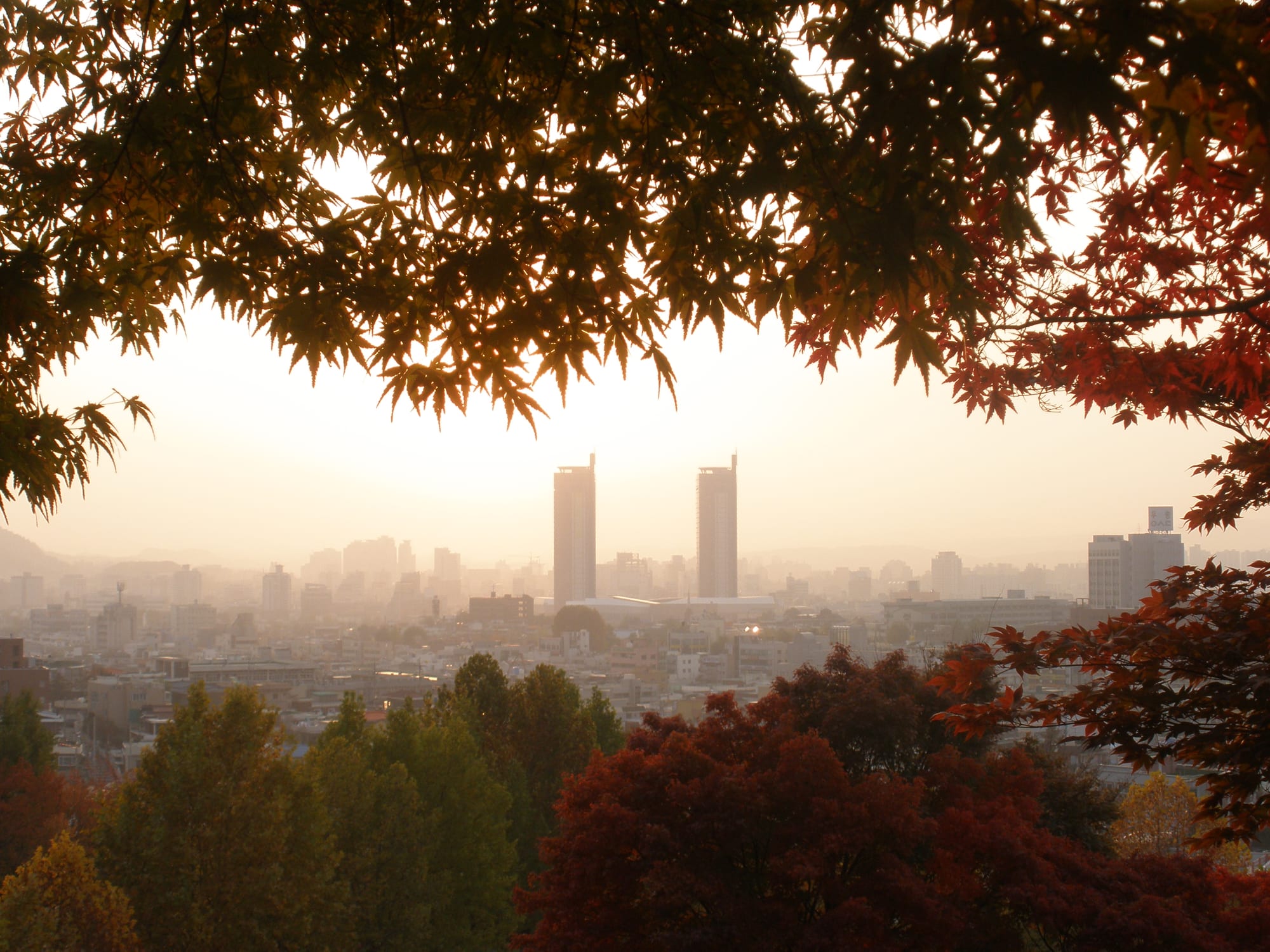
Hazy view over central Daejeon at sunset, twin high-rise towers above low city blocks, framed by red and orange maple leaves

Gangwon & the Chungcheong Centre, South Korea

Daejeon

Central Daejeon seen through autumn maples from a hillside on the edge of the city. (Paul Evans - User (WT-shared) Snave at wts wikivoyage / Wikimedia Commons · Public domain)

A metropolitan city of about 1.4 million people at the geographic centre of South Korea, where the main railways and motorways from Seoul divide for the south and the south-east. It grew from a village into a rail junction after 1905 and then into the country's research capital, with government institutes, KAIST and an old hot-spring quarter at Yuseong.

Neighbourhoods

  • Eunhaeng-dong and the old downtown
    • First-time visitors
    • Best for food
    • Close to public transport

    The original centre around Daejeon station, with a covered shopping street, a large traditional market, the city's best-known bakery and streets of cheap restaurants. It lost business to the newer districts but remains the place with the most street life.

    Open in Maps
  • Dunsan
    • Shopping
    • Business travellers
    • Nightlife

    The planned district built from the 1990s west of the centre, with the city hall, the government complex, department stores, an arts centre and wide boulevards. Most of the newer hotels and offices are here.

    Open in Maps
  • Yuseong
    • Hot springs
    • Spas
    • Quiet and residential

    The spa quarter in the north-west, where hot mineral water has been used for centuries. Bath houses, hotels and a foot-bath park sit among apartment blocks, with the university and research district just beyond.

    Open in Maps
  • Daedeok Innopolis
    • Science and research
    • Parks

    A spread-out zone of government laboratories, institutes and company research centres north of the river, laid out among woods and lakes, with the science museum and the Expo grounds at its southern edge.

    Open in Maps
  • Gungdong and the university quarter
    • Students and nightlife
    • Best for food

    The streets beside Chungnam National University, thick with cheap restaurants, bars, cafés and pubs, and the busiest night-time district for young residents.

    Open in Maps
  • Daecheong and the northern hills
    • Walks
    • Nature
    • Day trips

    The edge of the city towards the Daecheong reservoir and the wooded ridges, with trails, lakeside roads, temples and quiet villages within half an hour of the centre.

    Open in Maps

Things to do

Science and the Expo legacy

  • National Science Museummuseum

    The country's main science museum, in the Daedeok research district, with astronomy, natural history and technology galleries, an observatory and a planetarium.

    Open in Maps
  • Expo Science Parkattraction

    The riverside site of the 1993 world exposition; most of its pavilions were cleared from 2014, but the Hanbit Tower was kept and the grounds now hold a science complex, a film studio and research institutes.

    Open in Maps
  • KAISTattraction

    The Korea Advanced Institute of Science and Technology, the country's leading research university, whose wooded campus in Yuseong is open to walkers.

    Open in Maps
  • Daejeon Museum of Artmuseum

    The municipal art museum beside the Expo grounds, showing modern and contemporary Korean work, often with a science and media theme.

    Open in Maps

Parks, hills and water

  • Hanbat Arboretumpark

    The largest man-made urban arboretum in the country, laid out in Seo District in themed east and west gardens on either side of a central plaza.

    Open in Maps
  • Gyejoksantrail

    A 429-metre ridge on the northern edge of the city with a red clay path along the crest that walkers follow barefoot, beside the remains of an old mountain fortress.

    Open in Maps
  • Bomunsanviewpoint

    A forested hill of 458 metres just south of the old centre, made a park in 1965, with paths, temples, a carved Buddha figure and views over the city.

    Open in Maps
  • Daecheong Damlandmark

    The dam on the Geum River east of the city, holding a large reservoir that supplies water to much of the central provinces, with lakeside paths and viewpoints.

    Open in Maps
  • Daejeon O-Worldattraction

    A combined zoo, amusement park and flower garden on the southern slopes of the city, a standard outing for local families.

    Open in Maps

History in the city

  • Daejeon stationtransit hub

    The station that created the city, established in 1904 on the line from Seoul to Busan and now a stop for high-speed trains, with the old downtown at its gates.

    Open in Maps
  • Uam Historical Parklandmark

    The study and shrine complex associated with the 17th-century Confucian scholar Song Si-yeol, preserved in a garden in the east of the city.

    Open in Maps
  • Ppuri Parkpark

    A hillside park by the river devoted to Korean family clans and their origins, with sculpture, a genealogy museum and views of the valley.

    Open in Maps

Short trips from the city

  • Gyeryongsan National Parkpark

    A compact granite mountain park on the city's western boundary, with ridge walks and several long-established Buddhist temples in its valleys.

    Open in Maps
  • Donghaksalandmark

    A temple on the eastern side of Gyeryongsan, known as a centre of Buddhist study for nuns and for the cherry blossom along its approach.

    Open in Maps
  • Gongjuneighborhood

    The former Baekje capital north-west of Daejeon, with a hilltop fortress above the Geum River and royal tombs on the UNESCO World Heritage list.

    Open in Maps
  • Sejongneighborhood

    The purpose-built administrative city north of Daejeon, where many national ministries moved from Seoul, with a lake park and unusual government architecture.

    Open in Maps

Seasonal events

  • Daejeon Science Festivalautumn

    A week of exhibitions, experiments and public events across the research district and the Expo grounds, run in the city that houses the national institutes.

  • Yuseong hot spring festivalspring

    Street events, bathing promotions and performances in the spa quarter, held at the start of the warm season.

  • Baseball seasonApril to October

    The city's professional baseball club plays through the summer, and match evenings fill the restaurants and bars near the ground.

  • Cherry blossom on GyeryongsanApril

    The approach roads to the temples on the city's western mountain are lined with blossom, and the park is at its busiest.

Eat and drink

Long-standing places and food districts in Daejeon. Hours, ratings and directions come from your maps app, always current.

Daejeon classics

  • Sungsimdangcafe

    A bakery founded near the station in 1956 and now a symbol of the city, known for its soboro bun with a red-bean filling and for its chive bread; queues run along the pavement.

    Open in Maps
  • Kalguksurestaurant

    Hand-cut wheat noodles in broth, made in many local variations with anchovy, beef or seafood, and a dish the city is particularly associated with.

    Open in Maps
  • Dubu-durigirestaurant

    Blocks of tofu simmered in a red, spicy pork and chilli sauce at the table, a cheap local favourite in the older districts.

    Open in Maps

Food districts and markets

  • Jungang Marketmarket

    A sprawling traditional market near Daejeon station, with food alleys selling noodles, dumplings, rice cakes and fried snacks among the clothing and household stalls.

    Open in Maps
  • Gungdongneighborhood

    The student quarter by the national university, with inexpensive grills, noodle shops, chicken restaurants and bars busy late into the night.

    Open in Maps
  • Dunsan restaurant streetsneighborhood

    The newer centre's dining district, with grilled meat houses, Korean-Chinese restaurants and cafés serving the surrounding offices.

    Open in Maps

Experience Daejeon

History

Daejeon barely existed before the railway. The area was farmland at the meeting of small rivers in the Chungcheong plain, its name a Sino-Korean rendering of the older Korean Hanbat, meaning large field. When the Seoul–Busan railway opened a station here in 1904, a town grew around it almost immediately, and the Japanese colonial administration made the junction a centre for shipping rice and goods out of the interior. A second line west towards Mokpo, and later the road network, confirmed its position as the crossroads of the country.

The Korean War hit the young city hard. In the summer of 1950 it briefly became the seat of the South Korean government after Seoul fell, and heavy fighting in and around it left much of the centre destroyed, with large-scale killings of civilians and prisoners in the area during that summer. Reconstruction followed through the 1950s and 1960s, and the city grew quickly as people moved in from the surrounding countryside.

The decisive change came in the 1970s, when the government began moving research institutes out of Seoul to a new science town at Daedeok. KAIST relocated to the city, and dozens of national laboratories, the space and atomic energy agencies and corporate research centres followed, gathering much of the country's public research effort in one district. The 1993 world exposition on the riverbank put it on the international map and left the Expo grounds and their landmark tower behind. Daejeon became a metropolitan city in 1989, the Dunsan district was built as a second centre in the 1990s, and high-speed trains arrived in 2004, putting Seoul within about fifty minutes.

Culture & Customs

Daejeon's self-image is built on science and on being the country's crossroads. The research institutes and universities give it an unusually highly educated population, a steady flow of visiting scientists and students, and a calendar of science festivals, lectures and open days that few Korean cities can match. Residents are used to explaining that the city is not old, and they tend to point to what it does rather than what it has kept.

The Chungcheong manner shapes daily life. People from this region are known across Korea for speaking slowly, hedging rather than confronting and preferring understatement, and the local dialect and its drawn-out endings are the subject of affectionate national jokes. Hospitality is straightforward and unshowy, and the city is often described by Koreans as comfortable rather than exciting.

Popular culture here runs through food and baseball. The professional club draws devoted support, and its fixtures order the summer for many families. The bakery in the old downtown has become a genuine civic symbol, with queues that visitors join as a matter of course. Older traditions survive at the edges — the Confucian shrines associated with Song Si-yeol, the clan-lineage park above the river, and the Buddhist temples on Gyeryongsan, a mountain long regarded as a place of spiritual power and still home to several religious communities.

Daily Life

About 1.4 million people live in Daejeon, spread across five districts, and it is the fifth-largest metropolis in South Korea. Most residents live in apartment complexes, from the dense older blocks around the centre to the tall estates of Dunsan and Yuseong, and the population is comparatively young because of the universities and the research campuses.

The economy is unlike other Korean cities. Public research institutes, the defence and space agencies, universities and technology firms in the Daedeok district employ tens of thousands of people, alongside government offices, hospitals, the railway and a belt of manufacturing on the outskirts. That base makes the city stable but has not produced the wealth of the capital region, and many graduates still move to Seoul or to the industrial cities for work.

Daily rhythms are those of a commuter city of medium size: the metro and buses busy morning and evening, shopping and cinemas concentrated in Dunsan, students filling Gungdong at night, and families walking in the arboretum and on the hill paths at weekends. The recurring concerns are the drift of population and offices towards Sejong next door, the decline of the old downtown, summer heat in the basin, and the search for industries to sit alongside the laboratories.

Food

Daejeon's most famous food is bread. Sungsimdang, opened by a refugee family near the station in the 1950s, grew into an institution that Koreans travel to the city for, best known for twigim soboro, a fried bun with a crumbly top and a red-bean filling, and for its chive bread. Buying a box to take home has become a standard ritual of any visit.

The savoury speciality is kalguksu, wheat dough rolled and cut by hand into flat noodles and served in broth. The city has a long-standing reputation for it, with versions made on anchovy, beef, chicken or seafood stock, some with perilla seed or with a red chilli edge. Close behind is dubu-durigi, tofu cooked with pork and a fierce chilli sauce in a shallow pan on the table, a cheap dish tied to the older neighbourhoods.

Otherwise the city eats the food of the Chungcheong plain and of Korea at large. Markets sell ginseng from Geumsan, an hour to the south and the country's main ginseng town, along with mushrooms, chestnuts and mountain vegetables; ginseng chicken soup is common in midsummer. The student quarters run on grilled pork belly, fried chicken and cheap noodle dishes, the Korean-Chinese restaurants on jjajangmyeon, and the cafés on coffee and pastries — Daejeon has an unusually large bakery trade for its size, the bread city reputation being one the place has cultivated deliberately.

Planning tools

Budget

Daejeon is noticeably cheaper than Seoul for both rooms and meals, and a business-hotel bed in Dunsan or by the station costs less than a mid-range room in the capital. Food is inexpensive, museums charge little, and the city's parks, hills and the famous bakery queue cost nothing beyond the goods themselves. Spa hotels in Yuseong are the priciest option.

Daily Budget Midrange
USD 100–180 (business or spa hotel, restaurant meals, museum entry, KTX connections, taxis)
Daily Budget Shoestring
USD 35–65 (guesthouse or motel, market and student-district meals, buses and the metro)

Staying near Daejeon station keeps trains, the old downtown and the market within walking distance, while Dunsan suits those who want newer hotels and shopping.

Best Time to Visit

April and May, when the blossom is out on Gyeryongsan and the arboretum opens up, and late September to early November, when the hills around the city colour and the science festival is held. July and August are hot, humid and wet in a basin that traps heat, and January is cold and dry, when the hot springs come into their own.

Suggested Number of Days

A day or two covers the museums, the old downtown and a hill walk. Three or four days suit a visit that also takes in the mountains on the city's edge and the Baekje sites and administrative city nearby, which are easy to reach by bus or train.

First Visit
1–2 days
With Surroundings
3–4 days

Transportation

A single metro line runs from the east of the city through the centre and Dunsan to Yuseong, and a dense bus network covers the rest, including the research district and the hills. Taxis are cheap and plentiful. The city is spread out, so most journeys involve a bus or the metro, and a bike-share scheme works well on the flat riverside paths.

Buses and the metro use the same transport card as Seoul, and a transfer between them is free within the allowed time.

Airport & Station Connections

Daejeon is the main railway junction of South Korea. High-speed trains from Seoul reach the city in about 50 minutes, and services continue to Busan, Gwangju and the south, with two stations — Daejeon in the old centre and Seodaejeon — plus the high-speed stop at Osong nearby. Express buses run from every large city, and Cheongju airport, about an hour away, has domestic and some regional international flights.

Walkability

Each district is walkable in itself: the old downtown around the station, the market and the shopping street; Dunsan's grid between the arboretum and the government complex; and the spa streets of Yuseong. The distances between them are several kilometres, so the metro, buses or taxis are needed to move around. Riverside paths along the Gap and Yudeung streams make long, level walks and cycle routes.

Safety

Daejeon is a safe city with low levels of violent crime, and the centre is busy and well lit at night. The practical concerns are traffic, summer heat in a basin where temperatures sit high for days, heavy monsoon rain and flash flooding along the streams, icy pavements in winter and fine dust in spring.

Take care crossing roads, avoid the stream-side paths during heavy rain, and check air-quality alerts in spring. Check current official travel advice before travelling.

Climate

An inland climate with four clear seasons, made more extreme by the basin the city sits in, which holds summer heat and traps cold air in winter. Most rain falls between late June and August.

Summer
hot and humid, often 30–34°C by day, with monsoon rain in July and stifling nights in August
Winter
cold and dry, typically between −6°C and 3°C, with occasional snow that rarely lies long

Local Customs

Tipping is not practised anywhere. Shoes come off in guesthouses and traditional restaurants, and in the hot-spring bath houses bathers wash thoroughly before entering the pools and use them without swimwear, in single-sex areas; tattoos are still restricted at some establishments. Age shapes address and seating, and elders are served first.

Use both hands when offering or receiving something, separate rubbish for recycling, and ask before photographing inside shops, laboratories or temple halls.

Common Payment Methods

The currency is the South Korean won. Cards and mobile payment are taken almost everywhere, including buses, the metro and small restaurants, and ATMs accepting foreign cards are found at banks and convenience stores. Cash is worth carrying for market stalls and older bath houses.