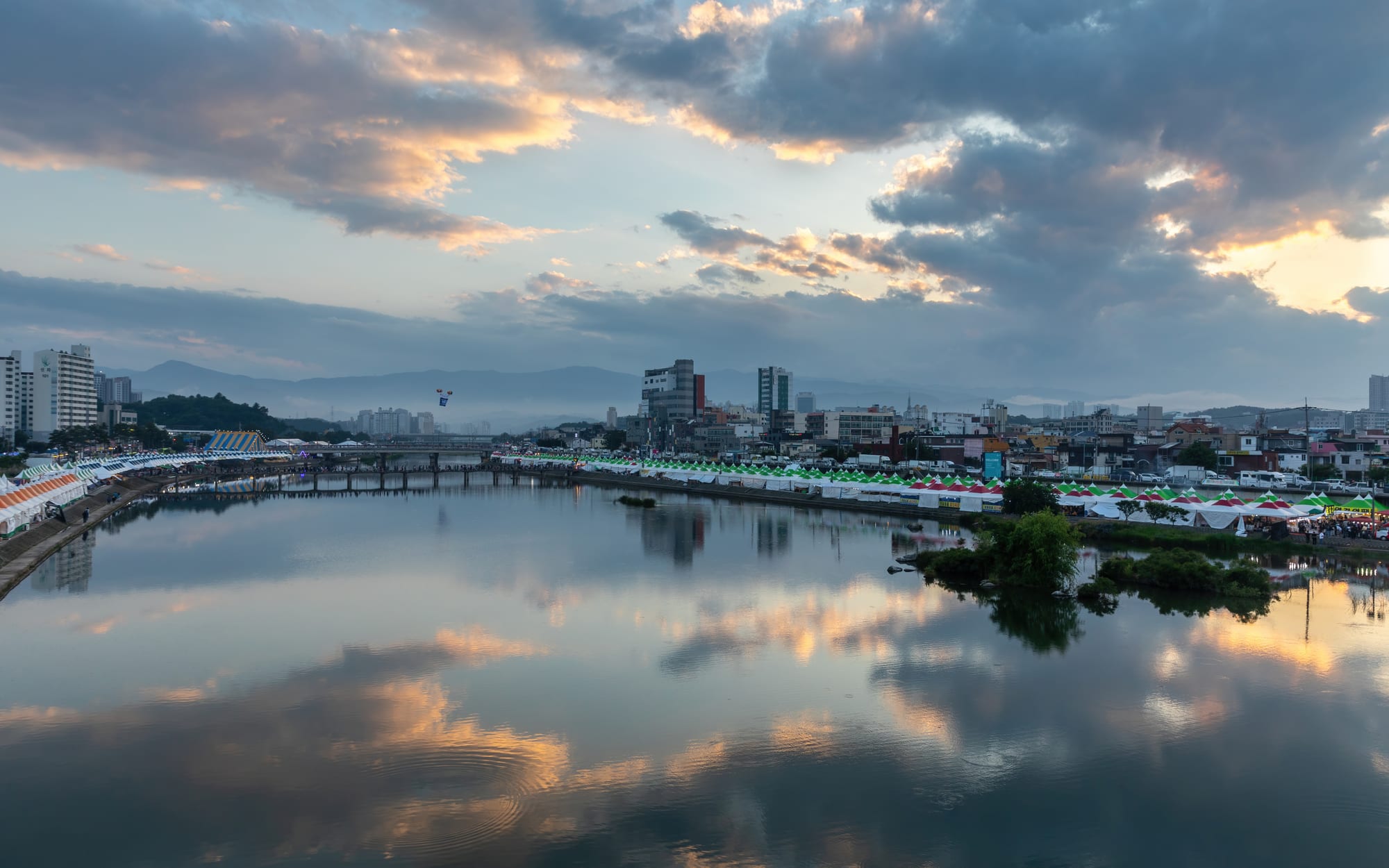
Still stream reflecting sunset clouds, with festival tents along both banks and the low city skyline and mountains behind

Gangwon & the Chungcheong Centre, South Korea

Gangneung

The Namdaecheon stream in central Gangneung, lined with festival stalls at dusk. (Basile Morin / Wikimedia Commons · CC BY-SA 4.0)

The largest city on Gangwon's east coast and the economic centre of the Yeongdong region, set on a coastal plain between the Taebaek mountains and the East Sea. A Joseon-era centre of Confucian scholarship, it keeps old wooden houses, a UNESCO-listed spring festival and the birthplace of the scholar Yi I, alongside a long beach, a lagoon, a street of coffee houses and the ice rinks built for the 2018 Winter Olympics.

Neighbourhoods

  • Downtown and the market quarter
    • First-time visitors
    • Best for food
    • Close to public transport

    The old centre between the railway station and the Namdaecheon stream, built around a large covered market and its side alleys. Most of the city's cheap restaurants, bakeries and shops are here, along with the bus terminals and the main hotels.

    Open in Maps
  • Gyeongpo
    • Beaches
    • Families
    • Walks

    The resort district about 6 kilometres north-east of the centre, where a long beach faces the sea and a lagoon lies just behind it. Hotels, pensions and seafood restaurants line the shore, and historic pavilions and houses stand on the low ground around the lake.

    Open in Maps
  • Anmok and Songjeong
    • Cafés
    • Sea views
    • Quiet and residential

    A stretch of coast south of Gyeongpo where a line of coffee houses faces the beach, the origin of the city's reputation for coffee. Quiet residential streets and small guesthouses run inland from the promenade.

    Open in Maps
  • Chodang
    • Best for food
    • Local life

    A village of low houses and pine woods between the lagoon and the sea, known throughout Korea for soft tofu curdled with seawater and for the restaurants that serve it.

    Open in Maps
  • Jumunjin
    • Harbour life
    • Best for food

    A working fishing port about 15 kilometres up the coast, with a busy fish market, breakwaters and a beach that became well known from Korean television.

    Open in Maps

Things to do

Historic houses and heritage

  • Ojukheonlandmark

    A 15th- or 16th-century wooden house, among the oldest surviving in Korea, where the Confucian scholar Yi I was born and where his mother, the painter Shin Saimdang, lived; black bamboo grows around it.

    Open in Maps
  • Seongyojanglandmark

    A large gentry residence of ninety-nine rooms beside Gyeongpo lake, one of the country's designated folk houses, with separate men's and women's quarters, storehouses and a lotus pond pavilion.

    Open in Maps
  • Gyeongpodaelandmark

    A tiled pavilion on a rise above the lagoon, counted among the Eight Views of Gwandong and long celebrated in Korean poetry for its moonlit views.

    Open in Maps
  • Gangneung Hyanggyolandmark

    The city's old Confucian school, a provincial heritage site, with lecture halls and a shrine still used for rites honouring Confucius.

    Open in Maps

The coast and the lagoon

  • Gyeongpo Beachbeach

    A wide arc of pale sand backed by pine trees, the city's main beach and one of the busiest on the east coast in summer.

    Open in Maps
  • Gyeongpo Lakepark

    A shallow brackish lagoon behind the beach, ringed by a path used for walking and cycling and lined with cherry trees in spring.

    Open in Maps
  • Anmok coffee streetneighborhood

    A seafront row of cafés and roasters that grew from beach vending machines into the district that gave Gangneung its coffee reputation.

    Open in Maps
  • Jumunjinmarket

    A fishing port north of the city whose market sells squid, crab and flatfish straight off the boats, with raw-fish restaurants above the stalls.

    Open in Maps

Olympic venues

  • Gangneung Ovalattraction

    The speed-skating arena built for the 2018 Winter Olympics, in the Olympic park on the edge of the city.

    Open in Maps
  • Gangneung Hockey Centreattraction

    The ice hockey arena from the 2018 Games, part of the cluster of rinks that made this coastal city the Olympic ice venue.

    Open in Maps
  • Gangneung Curling Centreattraction

    The curling venue of 2018, housed in the city gymnasium of 1998 and renovated for the Games; it held the curling again at the 2024 Winter Youth Olympics.

    Open in Maps

Short trips from the city

  • Jeongdongjinbeach

    A beach south of the city where a railway station stands almost on the sand, known across Korea as a place to watch the first sunrise of the year.

    Open in Maps
  • Odaesan National Parkpark

    A broad mountain park inland from the city, with fir forests, high ridges and long walking routes.

    Open in Maps
  • Woljeongsalandmark

    A Buddhist temple in the Odaesan valley, approached along an avenue of tall firs, with a nine-storey octagonal stone pagoda.

    Open in Maps
  • Daegwallyeongviewpoint

    The 832-metre pass on the old road over the Taebaek range above the city, carrying traffic and travellers between the coast and the interior for centuries, with views down towards the sea.

    Open in Maps

Seasonal events

  • Gangneung Danojethe fifth lunar month, in May or June

    The city's great festival, on the UNESCO intangible heritage list, combining shamanic and Confucian rites, a mask drama, a brewing of ritual liquor and a fairground along the stream.

  • Gangneung Coffee Festivalautumn

    A festival of roasters, baristas and coffee stalls held in the city that made coffee its speciality.

  • New Year sunrise at Jeongdongjin1 January

    Trains and buses fill with people coming to watch the year's first sunrise from the beach and the headland south of the city.

  • Summer beach seasonJuly and August

    Gyeongpo and the smaller beaches open with lifeguards, stalls and crowds from across the country, and rooms are scarce.

Eat and drink

Long-standing places and food districts in Gangneung. Hours, ratings and directions come from your maps app, always current.

Gangneung classics

  • Chodang sunduburestaurant

    Soft tofu set with clean seawater instead of a mineral coagulant, eaten plain with soy sauce or in a peppery stew; the village of Chodang is lined with restaurants that make it.

    Open in Maps
  • Gangneung coffeecafe

    Roasteries and cafés along Anmok beach and in the centre serve the hand-dripped coffee the city is known for, a reputation that began with beachfront vending machines and a row of cafés that formed from the 1990s.

    Open in Maps
  • Raw fish and grilled squid at the portsrestaurant

    Fish and squid bought at Jumunjin's market and eaten upstairs as hoe, or grilled and dried on the quay.

    Open in Maps
  • Makguksu and gamja-ongsimirestaurant

    Gangwon mountain staples found across the city — cold buckwheat noodles in a chilled broth, and chewy potato dumplings in a light soup.

    Open in Maps

Food districts and markets

  • Gangneung Jungang Marketmarket

    The central covered market and the alleys around it, with fish, dried seafood, mountain vegetables, rice cakes and rows of street-food stalls.

    Open in Maps
  • Chodang villageneighborhood

    A quiet district of pine woods and single-storey houses given over almost entirely to tofu restaurants, several of them long established.

    Open in Maps

Experience Gangneung

History

Gangneung has been the main settlement of this coast for a very long time. Under Silla it was a provincial centre known as Myeongju, and its position at the seaward end of the passes over the Taebaek range made it the administrative and cultural capital of the eastern coastal strip, the Yeongdong. Goryeo and then Joseon governed the region from here, and the county magistrate's compound, the Confucian school and the pavilions above the lagoon date from that long period of quiet importance.

In the Joseon centuries the city became known for scholarship and for the families that produced it. Yi I, called Yulgok, one of the two towering Confucian philosophers of the dynasty, was born in 1536 at Ojukheon, the house of his mother's family; his mother, Shin Saimdang, is remembered as a painter and calligrapher and is the most celebrated woman of the era. Both appear on South Korean banknotes today, and their presence anchors the way the city presents itself. Gentry houses such as Seongyojang, built by a branch of a landed family and enlarged through the 18th and 19th centuries, survive from the same world.

Modern Gangneung grew on fishing, farming, cement and coal traffic, and later on domestic tourism to its beaches. The city and county were merged in 1995. Two projects transformed access and image: the expressway over the Daegwallyeong pass, and the KTX line opened in 2017, which cut the journey from Seoul to about two hours. In February 2018 the city hosted all the ice events of the PyeongChang Winter Olympics, building the arenas that still stand on its northern edge; they served again for the 2024 Winter Youth Olympics.

Culture & Customs

Gangneung thinks of itself as a city of scholars and of ritual, and both survive in visible form. Rites for Confucius are still performed at the hyanggyo school, ancestral ceremonies continue in the old gentry houses, and the memory of Yulgok and Shin Saimdang runs through local museums, schools and festivals. The dialect of the Yeongdong coast, with its distinctive intonation, is a marker of local identity that people here keep up.

The Danoje is the city's great cultural event and one of the best-known folk festivals in Korea. Held in the fifth lunar month, it lasts for weeks in its full form: the brewing of a sacred liquor, a procession to collect a mountain spirit, shamanic ceremonies, a masked satirical drama, wrestling, swinging competitions and a market along the Namdaecheon. UNESCO inscribed it on its intangible heritage list in 2005, and it is run by local preservation associations rather than staged for outsiders.

Coffee is the modern layer of local culture. What began with vending machines on Anmok beach became a street of roasteries, then a citywide trade with its own autumn festival, and drinking coffee looking at the sea is now as much a Gangneung habit as a visitor's ritual. Sea and mountain also set the social calendar: sunrise watching at New Year, beach weekends in summer, temple visits and hiking inland in autumn.

Daily Life

About 210,000 people live in Gangneung, making it the largest city on Gangwon's east coast and the economic centre of the Yeongdong region. Most live in apartment districts inland from the beaches, around the centre and along the roads towards the mountains, while the coastal villages keep their older low-rise pattern. The city has held its population better than most of Gangwon, but it is ageing, and young people still leave for Seoul.

The economy rests on public administration, education and health services, fishing and food processing, farming on the coastal plain, and tourism. Catering, hotels and the beach trade employ a large seasonal workforce. Gangneung is also the transport hub of the coast: the KTX terminus, the bus terminals and the roads over the pass make it the gateway for the whole Yeongdong strip, and the Olympic arenas are used for training, skating events and concerts.

Life follows the seasons closely. Summer weekends bring heavy traffic to the coast and queues at the tofu restaurants; autumn is for the mountains; the deepest winter can bring snowfalls that close the pass and shut schools for a day. Longer-running issues include depopulation in the villages inland, the balance between beachfront development and the lagoon's ecology, and the wildfire risk that has grown with dry, windy springs.

Food

Chodang sundubu is the city's best-known dish, and it is genuinely local: soybean curd set with clean seawater rather than a mineral coagulant, giving a soft, faintly saline tofu eaten warm with soy sauce and sesame, or simmered into a red, peppery sundubu-jjigae. The village of Chodang, between the lagoon and the sea, is lined with restaurants that have made it for generations, and the same tofu is sold to take away in tubs.

The sea provides the rest of the standard table. Squid is everywhere — grilled, dried, stuffed with rice and vegetables as ojingeo sundae, or served raw in slivers — along with flatfish, crab, pollack and shellfish bought at the ports at Jumunjin and Gangneung itself. In summer, mulhoe, raw fish in a cold sour-hot broth, is eaten along the shore, and in colder weather the fish goes into clear soups and spicy stews.

Behind the coast, Gangwon mountain food appears on most menus: makguksu, cold buckwheat noodles with vegetables and sometimes a scoop of ice; gamja-ongsimi, hand-rolled potato dumplings in a light soup; potato pancakes; corn; and the wild mountain vegetables gathered in spring. Sweet things include chodang-style tofu ice cream and the rice cakes sold in the central market. Coffee, hand-roasted and hand-poured, is the drink the city is proudest of, and local makgeolli and the ritual liquor brewed for Danoje belong to the older tradition.

Planning tools

Budget

Gangneung is cheaper than Seoul for food and rooms, but the seafront in high summer and over holiday weekends is an exception, when Gyeongpo hotels charge resort prices. The centre, near the market and the station, keeps ordinary city rates all year. Entry fees for the historic houses are small, and the beaches and lake paths cost nothing.

Daily Budget Midrange
USD 110–200 (hotel or sea-view room, restaurant meals, KTX from Seoul, entry to the historic houses)
Daily Budget Shoestring
USD 40–70 (guesthouse or motel, market meals, city buses)

Staying downtown rather than on the beach cuts the bill sharply in July and August, and the two are about fifteen minutes apart by bus.

Best Time to Visit

May and June, when the weather is mild and the Danoje festival fills the centre, and late September to October, when the mountains inland colour and the coast is quiet. Midsummer is hot, humid and crowded; winter is cold and windy with heavy snow at times, though the city is clear and bright between storms and the ski areas inland are open.

Suggested Number of Days

Two days is enough for the historic houses, the lake and the coast. Three or four allow the mountains inland, the ports up the coast and the beaches to the south. Festival weekends and the summer peak need more time for travel.

First Visit
2 days
With Surroundings
3–4 days

Transportation

City buses run from the station and the bus terminals to Gyeongpo, Anmok, Chodang and Jumunjin, and are the usual way to move between the centre and the coast. Taxis are plentiful and cheap for short hops. Bicycles suit the flat lake and seafront paths, and a car is useful only for the mountains and the coast road.

Beach-bound buses are slow and full on summer weekends; allow extra time or use a taxi for the short run from the centre.

Airport & Station Connections

Gangneung is the end of the KTX high-speed line from Seoul, with trains from Cheongnyangni and Seoul stations taking roughly two hours through the mountains by way of PyeongChang. Express buses from Seoul take about three hours, and coastal buses link the city with Sokcho to the north and Donghae and Samcheok to the south. Incheon airport is served by direct buses.

Walkability

The centre is flat and walkable, with the market, the stream and the older streets within twenty minutes of each other, and a riverside promenade through the middle of town. The coast, the lagoon and Chodang are several kilometres out and need a bus or taxi, but each of those districts is easy on foot once reached, and paths run right around Gyeongpo lake.

Safety

Gangneung is a safe city with little crime that affects visitors. The main hazards are natural: rip currents and sudden deep water off the east-coast beaches, heavy snow and ice in winter, summer typhoons and monsoon flooding, and the wildfires that have burned close to the city in dry, windy springs.

Swim only where lifeguards are posted during the official beach season, take beach and trail warnings seriously, and follow local guidance during fire and typhoon alerts. Check current official travel advice before travelling.

Climate

A coastal climate softened by the East Sea, with the Taebaek range blocking the cold western winds. Winters are milder than inland Gangwon but bring the country's heaviest snow when the wind blows off the sea; summers are hot and humid, with the monsoon in July.

Summer
hot and humid, usually 27–31°C by day, slightly cooler on the shore than inland
Winter
cold but not extreme, generally 0–5°C by day, with occasional very heavy snowfalls

Local Customs

Tipping is not practised. Shoes come off in guesthouses and traditional restaurants, dishes are shared, and drinks are poured for others with both hands. At the historic houses and the Confucian school, visitors keep to marked paths and off the wooden floors unless invited. The Danoje rites are religious as well as festive, and are watched quietly.

Ask before photographing people at the fish markets or at festival rites, and separate rubbish for recycling, which is enforced.

Common Payment Methods

The currency is the South Korean won. Cards and mobile payment are accepted almost everywhere, including buses, cafés and most market stalls, and ATMs at banks and convenience stores take foreign cards. A little cash is useful at the fish market and roadside stalls.