A village of traditional tiled-roof and thatched houses among trees, seen from above, with a river and a forested hillside behind

South Korea

Busan, Gyeongju & the Southeast

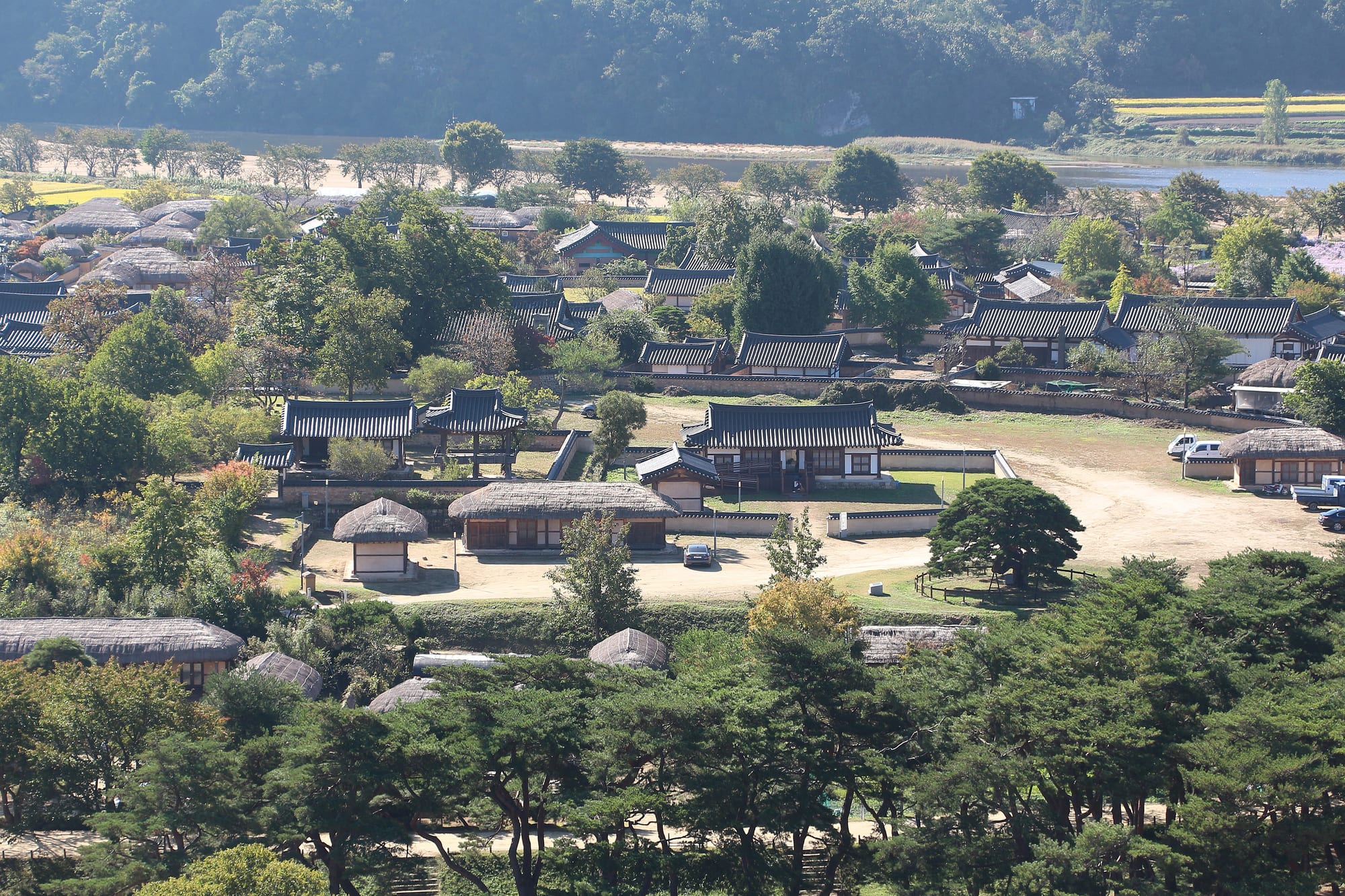
Tiled and thatched houses of Hahoe Folk Village near Andong, seen from above. (Bernard Gagnon / Wikimedia Commons · CC0)

The Gyeongsang provinces of southeastern South Korea — the Nakdong River basin and the coast from Pohang to Tongyeong — where the port of Busan, the inland city of Daegu and industrial Ulsan sit alongside Gyeongju, capital of the Silla kingdom for nearly a thousand years, and the Confucian villages around Andong.

Explore Busan, Gyeongju & the Southeast

History

The southeast was divided in its early centuries between the Gaya confederacy along the lower Nakdong, whose iron-rich burial mounds survive at Gimhae and Goryeong, and the kingdom of Silla, centred on Gyeongju. Silla absorbed Gaya in the 6th century and, allied with Tang China, defeated Baekje in 660 and Goguryeo in 668. As capital of Unified Silla, Gyeongju became a great Buddhist city: Bulguksa temple and the Seokguram grotto were built in the 8th century, and Silla lasted until 935, when its last king surrendered to Goryeo.

Under Joseon the inland Gyeongsang region became the heartland of Confucian scholarship. The philosopher Yi Hwang, known as Toegye, taught at the academy of Dosan near Andong, and powerful clans such as the Ryu of Hahoe built their villages there. The coast faced Japan: Japanese armies landed at Busan in 1592, and Admiral Yi Sun-sin defeated a Japanese fleet off Hansan Island near Tongyeong, where the naval headquarters of the southern provinces was later established.

Busan was opened to Japanese trade in 1876 and grew into Korea's main port. In 1950 it lay inside the Pusan Perimeter, the last pocket held by South Korean and UN forces, and served as the temporary capital, its hills filling with refugee shacks. Under Park Chung-hee, himself from the region, the southeast became the engine of industrialisation: steel at Pohang, cars and ships at Ulsan, electronics at Gumi and textiles in Daegu, where Samsung had started as a trading firm in 1938.

Culture & Customs

Gyeongsang speech is famously blunt, loud to outsiders and marked by a strong pitch accent, and Busan's version is instantly recognisable across the country. The region has long been a conservative political stronghold, especially Daegu and North Gyeongsang, and the old rivalry with the Jeolla provinces to the west still shapes national elections.

Andong calls itself the capital of Korean spirit and keeps Confucian traditions more visibly than anywhere: clan head houses, ancestral rites and seowon academies, several of which are part of a UNESCO World Heritage listing. Hahoe's masked dance drama, once performed to satirise the local nobility and the clergy, is the centrepiece of the Andong International Mask Dance Festival each autumn.

Busan has a looser, maritime character. The Busan International Film Festival, held each autumn since 1996, is one of the most significant in Asia, and fans of the Lotte Giants baseball team are among the most devoted in the country. Buddhism remains strong in the southeast, and the great temples — Haeinsa, home of the Tripitaka Koreana woodblocks, Tongdosa and Beomeosa — remain active monasteries. Tongyeong has a strong arts tradition and is known for lacquerware inlaid with mother-of-pearl.

Daily Life

Busan, with about 3.3 million people, is South Korea's second city and busiest port, followed by Daegu with around 2.4 million, Ulsan with about 1.1 million, Changwon and Pohang. Gyeongju has roughly 250,000 people and Andong about 150,000, while much of the rural interior is ageing and losing population.

The economy rests on heavy industry and trade: container shipping and fishing in Busan, Hyundai's car plant and shipyard in Ulsan, one of the richest cities per head in the country, the POSCO steelworks at Pohang, machinery around Changwon and shipbuilding on Geoje island. Daegu's textile industry has declined, and the city has turned to medicine, services and education.

Busan's daily rhythm runs around the sea — fish markets opening before dawn, evening crowds on the beaches and in the bars of Seomyeon and Gwangalli. A central concern across the region is decline: young people moving to Seoul, the shrinking of manufacturing towns and the long-debated question of how to balance growth between the capital and the south.

Food

Busan's signature dish is dwaeji gukbap, a pork-bone soup with rice, eaten with chives and salted shrimp, and the city created milmyeon, cold wheat noodles in an icy broth modelled on northern naengmyeon. Eomuk, fish cake, is sold on skewers in broth on every street, Jagalchi's stalls grill eels and serve raw fish, and ssiat hotteok, sweet pancakes filled with seeds and nuts, are a popular street snack.

Andong has three famous dishes: jjimdak, braised chicken with glass noodles and soy sauce, heotjesabap, a mock-ritual meal of rice and vegetables seasoned with soy sauce instead of red-pepper paste, and salted mackerel. Andong soju is a strong distilled spirit with a long local history.

Gyeongju's Hwangnam bread is a small round pastry filled with red-bean paste. Daegu is known for makchang, grilled beef or pork offal, and for its apples. Tongyeong gave its old name to chungmu gimbap, plain rice rolls served with spicy squid and radish kimchi on the side, and its sheltered bays make it the country's leading producer of farmed oysters.

Attractions & Natural Wonders

Gyeongju is an open-air museum. The Silla capital's centre is dotted with royal burial mounds, including Cheonmachong in the Daereungwon complex; nearby are the Cheomseongdae stone observatory, the reconstructed Donggung Palace and Wolji Pond, and the Gyeongju National Museum. Bulguksa and the Seokguram grotto on Tohamsan form a UNESCO World Heritage Site, and Namsan, the mountain south of town, is covered with Buddhist rock carvings. The clan village of Yangdong lies to the north.

Busan's beaches — Haeundae, Gwangalli below the lit-up Gwangan Bridge, Songdo — are its best-known sight, alongside its markets: Jagalchi fish market, Gukje and Bupyeong markets. Gamcheon Culture Village climbs a hillside in bright colours, Haedong Yonggungsa temple sits on seaside rocks, and Taejongdae's cliffs, Beomeosa temple and the UN Memorial Cemetery round out the city.

Daegu has the Yangnyeongsi herbal-medicine market, Seomun market and the temple of Donghwasa on Palgongsan. In the Andong area, Hahoe Village, a UNESCO World Heritage Site with Yangdong, sits in a bend of the Nakdong below the Buyongdae cliff, with Dosan Seowon and the Andong Dam lakes nearby. Ulsan offers the Bangudae petroglyphs, the Taehwa River garden, the Ganjeolgot headland and the whaling museum at Jangsaengpo.

Tongyeong has the Mireuksan cable car, the Dongpirang mural village, the harbour of Gangguan and boats to the islands of the Hallyeo Maritime National Park, including Hansan Island. Inland, Haeinsa on Gayasan holds the Tripitaka Koreana, and Jinju's fortress stands above the Nam River.

Cities in Busan, Gyeongju & the Southeast

Planning basics

Budget

The southeast is cheaper than Seoul overall. Busan's Haeundae district is the priciest place to stay, especially in July and August and during the film festival, while central Busan, Daegu and Andong have inexpensive motels. Gyeongju has hanok guesthouses in every price range, and seafood — the main temptation in Busan and Tongyeong — is where meal costs climb.

Daily Budget Midrange
USD 110–210 (sea-view or hanok hotel, seafood dinners, KTX trips, temple and heritage tickets)
Daily Budget Shoestring
USD 40–70 (guesthouse or motel, market food and gukbap, metro and buses)

Stay in Gyeongju for a night rather than visiting from Busan, and eat at Jagalchi or Busan's market stalls for good-value seafood.

Safety

The southeast is safe. The main risks are typhoons and heavy rain in late summer, heat in the Daegu basin, rip currents on open beaches and crowds on Busan's beaches and at festivals. The area around Gyeongju and Pohang has had moderate earthquakes in recent years, though serious damage is rare.

Watch typhoon warnings from August to October, swim within flagged zones, and carry water on hot days inland. Check current official travel advice before travelling.

Climate

The coast around Busan, Tongyeong and Ulsan is the mildest part of the mainland in winter, with little snow and many clear days. Inland, the Daegu basin is one of the hottest places in South Korea in summer, regularly above 35°C, and cold in winter. The whole southern coast is exposed to typhoons in late summer.

Summer
hot and humid, 28–33°C on the coast and often above 35°C in Daegu; typhoon risk in August and September
Winter
mild on the coast, usually around 0–10°C; colder inland around Andong, with frosty nights

Transportation

The KTX runs from Seoul to Busan in about two and a half hours, stopping at Daegu, Gyeongju and Ulsan. Busan has a metro, Gimhae international airport and ferries to Japan. Andong is reached by train from Seoul or by bus from Daegu, and Tongyeong by express bus from Busan. Gyeongju's scattered sights are easiest by city bus, bicycle or taxi.

Gyeongju's KTX station (formerly Singyeongju) is well outside the town centre; allow time for the bus or taxi into town.

Best Time to Visit

April, when cherry blossom fills Gyeongju and the naval port of Jinhae in Changwon, and October to early November, for the Busan International Film Festival, the Andong mask dance festival and autumn colour in the temple hills. July and August are beach season in Busan and very hot inland.