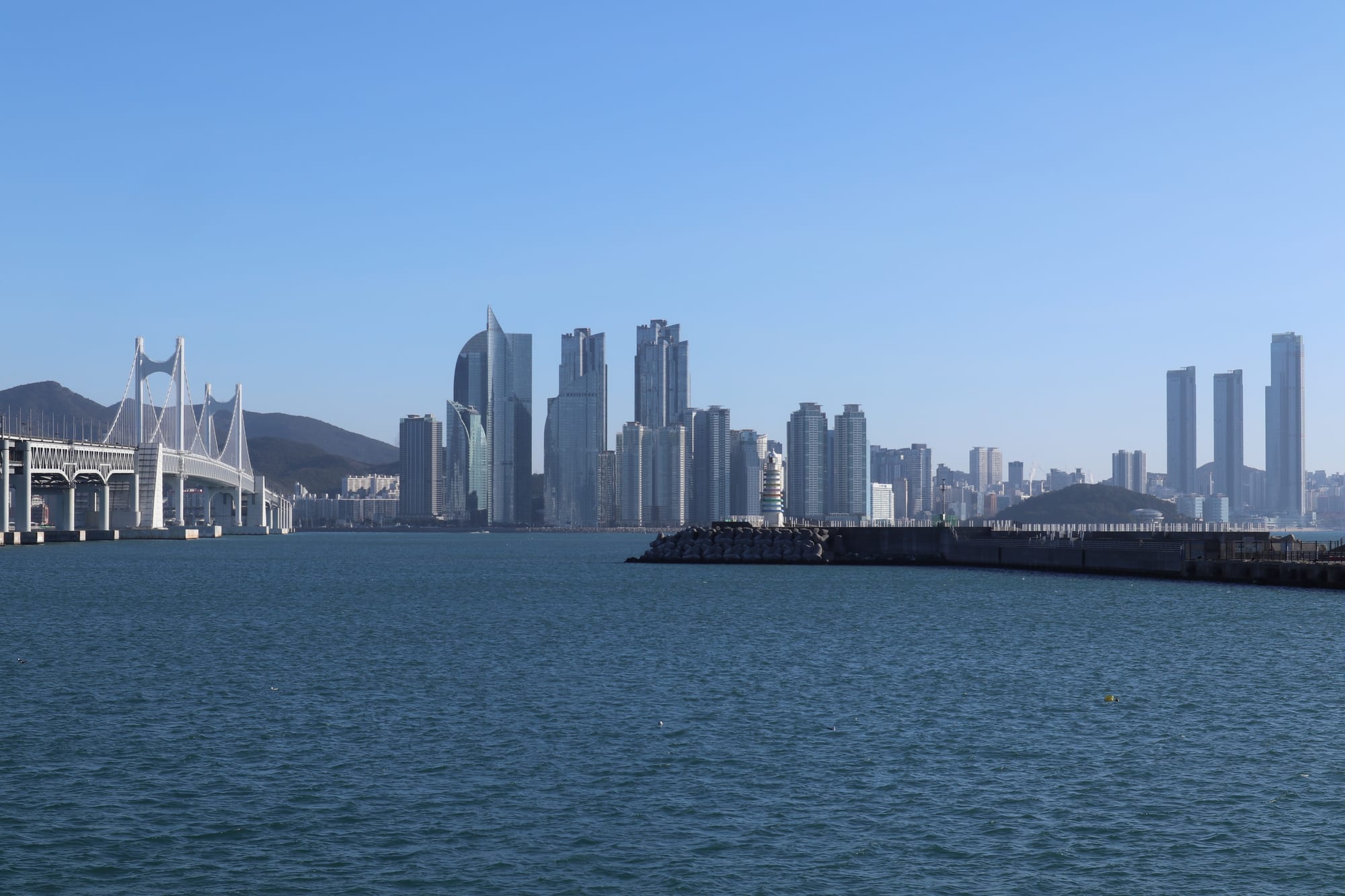
A line of tall towers along a blue bay, with the white suspension towers of a long bridge on the left and hills behind

Busan, Gyeongju & the Southeast, South Korea

Busan

Busan's bayside skyline, with the Gwangan Bridge on the left and the high-rises of Marine City and Haeundae beyond. (S h y numis / Wikimedia Commons · CC BY 4.0)

South Korea's second city and its largest port, wrapped around bays and mountains at the south-eastern tip of the peninsula. A fishing and trading settlement that became the country's gateway to Japan, it filled with refugees when it served as the wartime capital in 1950, and is now a city of beaches, fish markets, hillside villages and a major film festival.

Neighbourhoods

  • Haeundae
    • Beaches
    • First-time visitors
    • Hotels and resorts

    The resort district in the east of the city, built along a long sand beach backed by some of the tallest residential towers in the country. Hotels, seafood restaurants and beach bars line the front, and the coastal walk to Dongbaek Island begins at its western end.

    Open in Maps
  • Seomyeon
    • Nightlife
    • Shopping
    • Close to public transport

    The commercial heart of the modern city, where two metro lines cross beneath a dense grid of department stores, cosmetics shops, cinemas and underground arcades. Its side streets hold the city's busiest concentration of restaurants and bars, including a lane known for pork soup.

    Open in Maps
  • Nampo-dong and the old centre
    • Historic district
    • Best for food
    • Markets

    The original downtown beside the harbour, holding the Jagalchi fish market, the alleys of Gukje Market, BIFF Square and the hill of Yongdusan Park. Ferries to Japan and the older port quays are close by, and the streets are busiest in the evening.

    Open in Maps
  • Gwangalli
    • Beaches
    • Cafés and bars
    • Sea views

    A crescent of sand facing the illuminated Gwangan Bridge, with a promenade of cafés, bars, seafood restaurants and raw-fish houses. It is livelier at night than by day and is the vantage point for the city's fireworks festival.

    Open in Maps
  • Gamcheon
    • Views
    • Photography
    • Local life

    A hillside of small brightly painted houses stacked in terraces above the western harbour, laid out by refugees and religious settlers in the 1950s and reworked as an art village from 2009. Narrow stairways, murals, workshops and cafés thread between lived-in homes.

    Open in Maps
  • Centum City and Marine City
    • Shopping
    • Modern architecture
    • Families

    Reclaimed land between Haeundae and the Suyeong River, holding a very large department store, the Busan Museum of Art, the Cinema Center and convention halls, with a waterfront of tall apartment towers and marina restaurants at Marine City next door.

    Open in Maps

Things to do

Beaches and the coast

  • Haeundae Beachbeach

    The city's best-known beach, a kilometre and a half of sand below a wall of towers, packed in July and August and used for festivals and sea swims the rest of the year.

    Open in Maps
  • Gwangalli Beachbeach

    A curved beach facing the Gwangan Bridge, lined with cafés and bars and the main viewing point for drone shows and fireworks over the bay.

    Open in Maps
  • Taejongdaeviewpoint

    A wooded headland of sea cliffs at the southern tip of Yeongdo island, with a lighthouse, a coastal path and a road train circling the point.

    Open in Maps
  • Oryukdoviewpoint

    A line of uninhabited rocky islets off the eastern entrance to the harbour, counted as five or six depending on the tide, with a lighthouse on the outermost and a glass-floored skywalk, opened in 2013, on the cliff opposite.

    Open in Maps
  • Songdo Beachbeach

    A small man-made beach in the west, created in 1913 as the first public beach in Korea, with a cable car running across the bay and a coastal walkway on the rocks.

    Open in Maps

Markets and street life

  • Jagalchi Marketmarket

    The country's largest seafood market, run largely by women, with tanks of live fish and shellfish on the ground floor and restaurants above that cook or slice whatever is bought below.

    Open in Maps
  • Gukje Marketmarket

    A sprawling market of covered alleys that grew from the trade in surplus goods after 1945, selling clothes, household goods, tools and street food.

    Open in Maps
  • BIFF Squareattraction

    The old cinema street in Nampo-dong, named for the film festival, with handprints of directors set into the pavement and stalls selling seed-filled hotteok.

    Open in Maps
  • Bupyeong Kkangtong Marketmarket

    A market with roots in the American tinned goods once sold here, now best known for its evening food alleys.

    Open in Maps

Temples, landmarks and viewpoints

  • Beomeosalandmark

    A major Buddhist temple founded in the 7th century on the slopes of Geumjeongsan, with a gate of stone pillars and wisteria woods above the city's northern edge.

    Open in Maps
  • Haedong Yonggungsalandmark

    A temple built on sea rocks on the coast north-east of Haeundae, reached down a long flight of steps, unusual for standing at the water rather than in the mountains.

    Open in Maps
  • Busan Towerviewpoint

    The observation tower on the hill of Yongdusan Park above the old centre, giving a view over the harbour, the bridges and the surrounding ridges.

    Open in Maps
  • Gwangan Bridgelandmark

    A long suspension bridge across Suyeong Bay, lit in changing colours at night and the backdrop to Gwangalli's beachfront.

    Open in Maps
  • Geumjeong Fortresslandmark

    A long ring of Joseon-era walls and gates on the mountain above the city, the largest fortress in Korea, with ridge paths between the gates.

    Open in Maps
  • Yongdusan Parkpark

    A green hill in the middle of the old downtown, reached by escalators and stairs from the market streets.

    Open in Maps

Museums and culture

  • Busan Museum of Artmuseum

    The city's main public art museum in Centum City, showing modern and contemporary Korean work alongside international exhibitions.

    Open in Maps
  • Busan Cinema Centerattraction

    The film festival's permanent home, a complex of cinemas and outdoor seating under a vast cantilevered roof covered in LED lights.

    Open in Maps
  • United Nations Memorial Cemeteryattraction

    The only United Nations cemetery in the world, where about 2,300 United Nations Command casualties of the Korean War are buried in a quiet walled park.

    Open in Maps
  • Busan Museummuseum

    The city's history museum, covering the port's prehistory, the Joseon-era trade post with Japan and the colonial and wartime city.

    Open in Maps

Short trips from the city

  • Gyeongjuattraction

    The old Silla capital of burial mounds and temples, about 50 kilometres north and reached in roughly an hour by train or bus.

    Open in Maps
  • Tongyeongattraction

    A harbour town of oyster beds and island ferries west along the coast, with a cable car to a ridge above the bay.

    Open in Maps
  • Gimhaeattraction

    The neighbouring city on the Nakdong plain, seat of the Gaya confederacy, with royal tombs and a museum of Gaya ironwork beside the international airport.

    Open in Maps

Seasonal events

  • Busan International Film Festivallate September or October

    One of Asia's leading film festivals, held since 1996 and centred on the Cinema Center and the cinemas of Centum City and Nampo-dong.

  • Busan International Fireworks Festivalautumn

    A large fireworks display staged over Suyeong Bay and the Gwangan Bridge, watched from Gwangalli Beach and the surrounding hills.

  • Haeundae Sand Festivallate spring

    Sand sculptures and beach events on Haeundae, marking the start of the seaside season.

  • Jagalchi Festivalautumn

    A market festival on the quays at Jagalchi with fish-catching events, cooking stalls and street performances.

Eat and drink

Long-standing places and food districts in Busan. Hours, ratings and directions come from your maps app, always current.

Busan classics

  • Jagalchi Marketmarket

    Raw fish sliced to order, grilled eel and shellfish, and the smell of the sea; buyers choose from the tanks downstairs and eat upstairs.

    Open in Maps
  • Seomyeon's pork soup alleyneighborhood

    A short street of long-standing shops serving dwaeji gukbap, the pork-bone soup with rice that is the city's signature dish, eaten with chives, shrimp sauce and kimchi.

    Open in Maps
  • Millak Raw Fish Townneighborhood

    A block of raw-fish halls on the Gwangalli waterfront where fish bought downstairs is eaten at tables looking out at the bridge.

    Open in Maps

Food districts and markets

  • Gukje Market food alleysmarket

    Stalls of bibim dangmyeon, glass noodles in a spicy sauce, together with fish cake, dumplings and knife-cut noodles among the clothing and hardware alleys.

    Open in Maps
  • BIFF Square street foodneighborhood

    The cinema street's stalls are known for ssiat hotteok, a sweet pancake split and filled with seeds and nuts.

    Open in Maps
  • Bupyeong Kkangtong night marketmarket

    Evening stalls of skewers, fish cake, dumplings and fried snacks in a covered market a short walk from Jagalchi.

    Open in Maps

Experience Busan

History

The bays that became Busan were settled from prehistory — shell mounds survive at Dongsam-dong on Yeongdo — and by the Joseon period a walled town at Dongnae ruled the area while a Japanese trading post, the Waegwan, operated under close supervision on the shore. Japanese forces landed here in 1592 at the start of the Imjin War, storming Busanjin and Dongnae fortresses, and the port remained the peninsula's regulated point of contact with Japan for centuries afterwards.

The modern city dates from 1876, when the Japan–Korea Treaty opened Busan as Korea's first treaty port. Under Japanese rule from 1910 it was rebuilt as a colonial port and the terminus of the railway from Seoul, with a ferry to Shimonoseki carrying goods, migrants and conscripted labour. Hills above the harbour filled with Korean workers' housing as the Japanese town spread over the flat ground and reclaimed land.

Busan's defining decade was the 1950s. When the Korean War began in June 1950 the city lay inside the Pusan Perimeter, the last territory held in the south, and served as the provisional capital for most of the war. Its population more than doubled as refugees arrived, building shanty settlements on every slope — Gamcheon and the villages above Choryang began this way. Post-war reconstruction turned the port into the country's shipping and shipbuilding hub, and container trade made it one of the world's largest container ports. The film festival arrived in 1996, the Asian Games in 2002, and a long programme of waterfront redevelopment has since remade Haeundae and the reclaimed land around it.

Culture & Customs

Busan thinks of itself as the opposite of Seoul: maritime, informal and direct. The Gyeongsang dialect spoken here is recognised instantly across the country for its flat vowels and strong pitch, and it carries an unfussy reputation that locals enjoy. Older residents trace family histories to the refugee years, and the city keeps a memory of the war that is more immediate than elsewhere, marked by the United Nations cemetery and by memorial ceremonies each November.

Film is the city's cultural calling card. The Busan International Film Festival has run since 1996 and fills cinemas across Centum City and Nampo-dong each autumn, supported by an archive, a film commission and a permanent Cinema Center. Sport matters at least as much: the Lotte Giants baseball team has a reputation for the loudest crowds in Korean baseball, complete with orange plastic bags worn as rally caps, and a K League football club plays in the west of the city.

Buddhism has deep roots here, with Beomeosa on Geumjeongsan among the country's important monasteries and Haedong Yonggungsa drawing crowds at dawn on New Year's Day. Shamanic practice survives quietly in the hills, and fishing communities still hold rites for a safe catch. Contemporary art has spread through the hillside villages of Gamcheon and Huinnyeoul, while Busan's proximity to Japan shows in its food, its ferry traffic and long-standing exchanges between the two ports.

Daily Life

About 3.3 million people live in Busan, making it South Korea's second city, though its population has fallen for three decades as younger residents move to the capital region, and its residents are on average older than the national picture. Households are spread along narrow coastal plains and up steep slopes, so daily life involves buses, stairs and long metro journeys; the newest housing stands on reclaimed land at Centum City, Marine City and the Myeongji district in the west.

The port underpins the economy. Busan handles the great majority of the country's container traffic, most of it now through the New Port at Gangseo, and shipping, logistics, shipbuilding services and cold storage employ many thousands. Fishing and seafood processing remain visible in the old harbour, tourism and conventions grew with the beaches and the festival, and finance and film industries were deliberately encouraged as part of a policy of decentralising away from Seoul.

The rhythm of the day starts early at the fish quays and ends late in Seomyeon's bars. Summer evenings belong to the beaches, where families set out mats and the promenades stay busy past midnight. Persistent local issues include an ageing and shrinking population, the cost of maintaining hillside districts, redevelopment pressure on old neighbourhoods, and the balance between the port's expansion and the city's tourist waterfront.

Food

Busan's food is built on the sea and on the war years. Dwaeji gukbap, a milky pork-bone broth poured over rice and seasoned at the table with salted shrimp, chives and pepper paste, is the city's own dish and is sold in dedicated shops across Seomyeon and the old centre. Milmyeon, cold wheat noodles in a chilled broth, was created by refugees from the north who adapted their buckwheat naengmyeon to wheat flour that arrived as aid. Eomuk, fish cake, is a Busan speciality sold on skewers from broth pots and in smart bakery-style shops.

Raw fish, hoe, is eaten everywhere — at Jagalchi, in the raw-fish halls at Millak and Cheongsapo, and from tanks on any harbour front — usually with sesame oil, pepper paste and lettuce leaves rather than soy sauce alone. Grilled eel, steamed blue crab, shellfish barbecues and ghost-fish soup fill out the seafood repertoire, and blowfish soup is a hangover remedy. Sea urchin and gejang, raw crab marinated in soy sauce, appear in season.

Street food is its own tradition. Ssiat hotteok, the seed-stuffed sweet pancake fried at BIFF Square, is particular to the city, as is bibim dangmyeon, spicy cold glass noodles from the Gukje Market alleys. Dwaeji galbi and grilled offal serve the late-night drinking crowd, and the coastal cafés of Gwangalli and Dongbaek have made Busan one of the country's strongest coffee cities.

Planning tools

Budget

Busan costs less than Seoul for accommodation and food, though Haeundae and Gwangalli charge resort prices in July and August and during the film festival. Central districts such as Seomyeon and Nampo-dong have plentiful cheap motels and guesthouses, market meals are inexpensive, and the metro is very cheap. Seafood dinners and sea-view hotel rooms are where costs climb.

Daily Budget Midrange
USD 110–200 (mid-range or sea-view hotel, seafood dinners, taxis, museum and cable-car tickets)
Daily Budget Shoestring
USD 40–75 (guesthouse or motel bed, market food and gukbap, metro and buses)

Rooms in Seomyeon or near Busan Station cost far less than beachfront Haeundae and are better connected, and the city is at its fullest in autumn, when the film and fireworks festivals are held.

Best Time to Visit

Late April to early June and late September to early November are the most comfortable, with warm days, clear air and the autumn festivals. July and August bring beach crowds, high humidity, monsoon rain and the risk of typhoons. Winter is mild by Korean standards and often sunny, with quiet beaches and cheap rooms.

Suggested Number of Days

Two to three days suits a first visit, since the districts sit far apart and travel between them takes time. Longer stays allow day trips along the coast and inland. Beach weather and festival dates stretch the number.

First Visit
2–3 days
With Surroundings
4–6 days

Transportation

The metro has four lines and reaches most places visitors want, with an additional light railway to Gimhae and the Donghae line running up the coast past Haeundae. Buses fill the gaps, a scenic beach train and sky capsule run along the old coastal railway east of Haeundae, and taxis are cheap. The T-money or Cashbee card works on everything.

Distances are long and the city is strung out along bays, so allow up to an hour on the metro between the old centre and Haeundae.

Airport & Station Connections

Gimhae International Airport lies about 20 kilometres west of the centre, with flights across Asia and a light railway link to the metro. KTX trains reach Busan Station, near the old downtown, from Seoul in about two and a half hours. Express buses serve two large terminals, and ferries cross to Japan from the international terminal beside the port.

Walkability

Each district is walkable in itself — the market alleys of Nampo-dong, the beach promenades, the stairways of Gamcheon — but the city as a whole is not, being spread over hills and separated bays. Slopes and staircases are constant away from the waterfront, and coastal paths such as the walk around Dongbaek Island or the Igidae cliffs are among the best ways to see the city.

Safety

Busan is a safe city with low levels of violent crime, and walking after dark is normal in busy districts. The practical hazards are natural and seasonal: typhoons and heavy rain between August and October, rip currents and jellyfish on open beaches, and very hot, humid days in midsummer. Steep stairways and alleys in the hillside neighbourhoods are slippery in rain.

Swim between the flags on patrolled beaches, follow typhoon warnings in late summer, and treat the painted village lanes as people's homes rather than a set. Check current official travel advice before travelling.

Climate

A humid subtropical climate moderated by the sea, milder in winter than anywhere else on the mainland and cooler in summer than inland cities. Most rain falls in the summer monsoon, and typhoons can pass close to the coast in late summer and early autumn.

Summer
hot and humid, typically 28–33°C, with heavy monsoon rain in July and typhoon risk in August and September
Winter
mild and dry, usually 0–10°C, with sunshine and only occasional light snow

Local Customs

Tipping is not expected anywhere. Shoes come off at the door in guesthouses and traditional restaurants, and at temple halls. The Gyeongsang dialect spoken here is blunt and loud to outsiders and is not a sign of rudeness. Drinking is communal, with glasses poured for others rather than for oneself and two hands used when an elder pours.

In Gamcheon and other hillside villages, keep noise down and do not photograph through windows or doorways; residents live there year-round.

Common Payment Methods

The currency is the South Korean won. Cards and phone payments are taken almost everywhere, including taxis and most market stalls, and convenience store ATMs marked for global cards handle foreign withdrawals. Small cash amounts are still handy at fish market counters and street stalls.