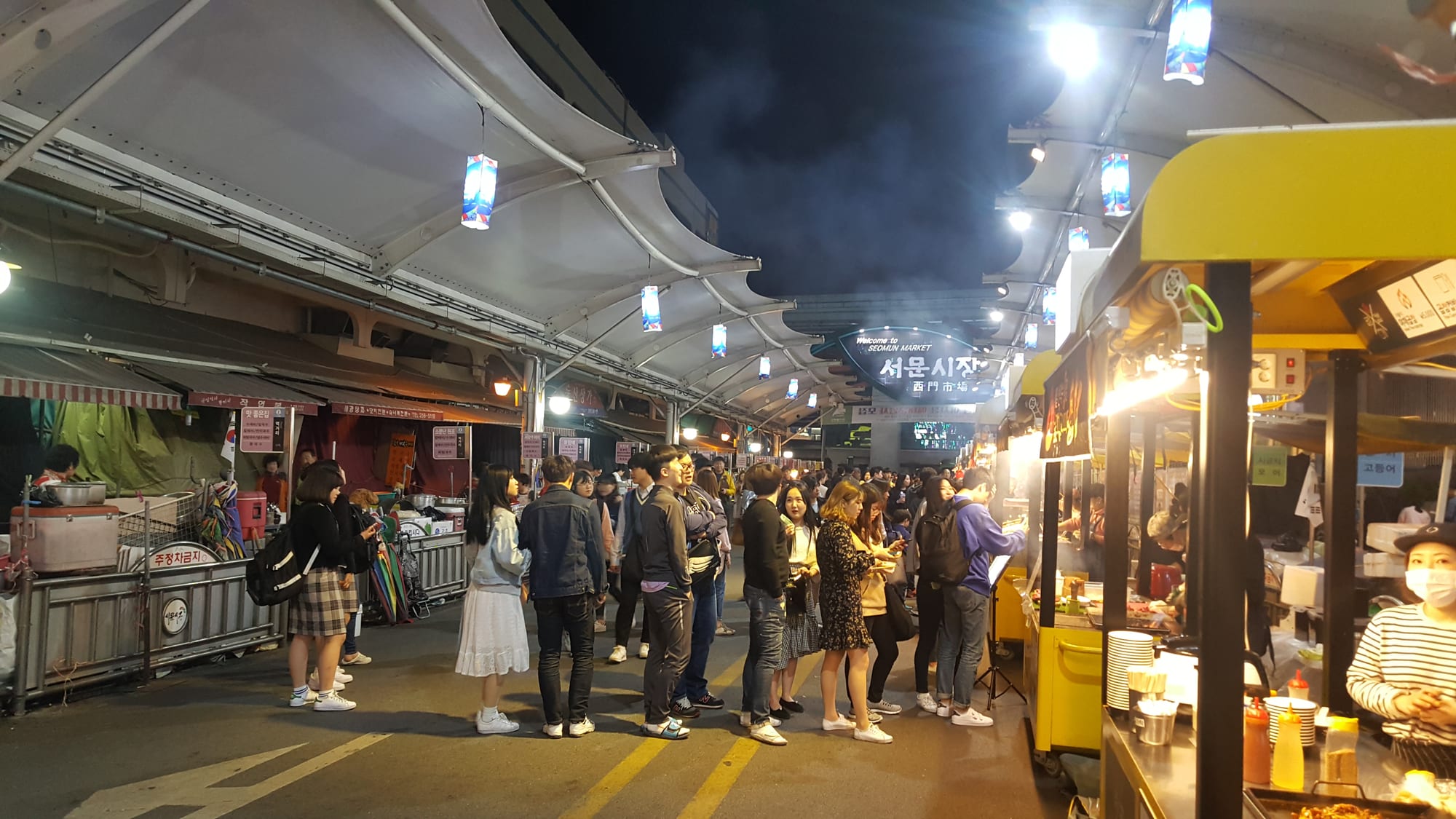
A covered market aisle at night lit by strip lights and lanterns, with yellow food carts and crowds moving between the stalls

Busan, Gyeongju & the Southeast, South Korea

Daegu

The night market at Seomun Market in central Daegu. (Choi2451 / Wikimedia Commons · CC BY-SA 3.0)

South Korea's fourth-largest metropolitan city, set in a mountain-ringed basin on the Geumho River and surrounded by North Gyeongsang Province. Long the trading centre of the south-east and the country's textile capital, it is known for a herbal-medicine market that dates from the 17th century, the sprawling Seomun market, the temples of Palgongsan above it, and some of the hottest summers in Korea.

Neighbourhoods

  • Jung-gu and Dongseongno
    • First-time visitors
    • Shopping
    • Nightlife

    The old walled centre, now the shopping and going-out core of the city, built around the long pedestrian street of Dongseongno. Department stores and cosmetics shops sit beside the herbal medicine market, a cathedral, missionary houses on Cheongna Hill and lanes of alley food.

    Open in Maps
  • Seomun Market and the western centre
    • Markets
    • Best for food
    • Local life

    The district around the city's largest traditional market, a dense grid of textile and household-goods stalls that turns over to food carts in the evening. The streets nearby are workaday, with wholesale shops and cheap eating houses.

    Open in Maps
  • Suseong
    • Quiet and residential
    • Cafés and bars
    • Families

    The prosperous south-eastern district, known nationally for its schools and cram schools, with wide streets of apartment blocks and a lake ringed by cafés, restaurants and an evening promenade.

    Open in Maps
  • Dalseo and Duryu
    • Parks
    • Families
    • Views

    The western side of the city, largely residential, containing the hill and woods of Duryu Park with its amusement park and observation tower, sports stadiums and the main concentration of manufacturing on the city's edge.

    Open in Maps
  • The Palgongsan foothills
    • Nature
    • Temples
    • Short trips

    The northern fringe below Palgongsan, where the built-up city gives way to valleys of orchards, cafés and pensions on the way up to Donghwasa temple and the cable car. It is where residents go walking at weekends and for autumn colour.

    Open in Maps

Things to do

Markets and the old centre

  • Seomun Marketmarket

    The largest traditional market in Daegu, with more than four thousand shops selling cloth, clothing and household goods by day and a night market of food carts after dark.

    Open in Maps
  • Yangnyeongsi herbal medicine marketmarket

    A street of herbal medicine shops and wholesalers trading since the 17th century, with a museum explaining Korean medicine and the smell of dried roots along the pavement.

    Open in Maps
  • Dongseongnoneighborhood

    The pedestrianised main street of the downtown, following the line of the old city wall, packed with shops, street performers and food stalls in the evening.

    Open in Maps
  • Gyesan Cathedrallandmark

    A brick Gothic church with twin spires, the third-oldest Gothic church building in the country and the cathedral of the Roman Catholic archdiocese of Daegu.

    Open in Maps
  • Chilseong Marketmarket

    A traditional market near Daegu Station selling produce, flowers, tools and street food, less visited by outsiders than Seomun.

    Open in Maps

Parks, mountains and views

  • Palgongsantrail

    The mountain range that closes off the city to the north, parts of it designated a national park in 2023, with ridge paths, a cable car and temples on its slopes, and heavy autumn colour.

    Open in Maps
  • Donghwasalandmark

    A temple on Palgongsan founded in the 5th century and rebuilt many times, with a very large standing stone Buddha and a long-running temple stay programme.

    Open in Maps
  • Gatbawilandmark

    A seated stone Buddha on a Palgongsan ridge wearing a flat stone slab like a hat, reached by a long stair climb and visited by people praying for exam success.

    Open in Maps
  • Apsan Parkpark

    The wooded mountain on the southern edge of the city, with walking trails, a Korean War memorial hall and a cable car to a viewpoint over the whole basin.

    Open in Maps
  • Duryu Parkpark

    A large park on a wooded hill in the west, containing an amusement park, gardens, a lake and the observation tower that stands over the city's western skyline.

    Open in Maps
  • Suseongmotpark

    A reservoir in the south-east, made in 1927 under Japanese rule, now circled by a promenade of cafés and restaurants with musical fountains in the evening.

    Open in Maps

Museums and history

  • Daegu National Museummuseum

    The regional collection of Gyeongsang archaeology, Buddhist art and traditional costume, on the eastern edge of the city.

    Open in Maps
  • Daegu Art Museummuseum

    The city's public gallery of modern and contemporary art, in the south-east of the city.

    Open in Maps
  • Bullo-dong Ancient Tombslandmark

    Hundreds of grassy burial mounds of local chiefs from the Three Kingdoms period, spread over low hills near the airport.

    Open in Maps
  • The modern history alleysattraction

    A signed walking route through the old centre linking the missionary houses on Cheongna Hill, Gyesan Cathedral and the lanes behind the medicine market.

    Open in Maps

Short trips from the city

  • Haeinsalandmark

    The mountain temple west of the city that holds the Tripitaka Koreana, more than eighty thousand 13th-century woodblocks of the Buddhist canon, in purpose-built halls.

    Open in Maps
  • Gyeongjuattraction

    The Silla capital of burial mounds, temples and rock carvings, about an hour away to the east.

    Open in Maps

Seasonal events

  • Colorful Daegu FestivalMay

    The city's street festival, with parades and performances along Dongseongno and in the central parks.

  • Daegu International Musical FestivalJune and July

    A festival of musical theatre with Korean and invited foreign productions in theatres across the city, held since 2006.

  • Daegu Chimac FestivalJuly

    A festival built around fried chicken and beer, the combination known as chimaek, staged in Duryu Park during the hottest weeks of the year.

Eat and drink

Long-standing places and food districts in Daegu. Hours, ratings and directions come from your maps app, always current.

Daegu classics

  • Anjirang Gopchang Alleyneighborhood

    A street of grill houses in the south of the city devoted to makchang and gopchang, the grilled offal that is Daegu's best-known dish, eaten with a soybean dipping sauce.

    Open in Maps
  • Dongin-dong jjimgalbi streetneighborhood

    A lane of restaurants serving jjimgalbi, beef short ribs braised with garlic and red pepper in a shallow metal dish, a dish the city claims as its own.

    Open in Maps
  • Seomun Market night marketmarket

    Evening food carts through the market aisles selling grilled skewers, fried snacks, dumplings and noodles.

    Open in Maps

Alley food in the old centre

  • Napjak mandu alleysneighborhood

    Small shops around the downtown selling flat fried dumplings filled mostly with noodles and spring onion, served with sauce and often mixed with spicy rice cakes.

    Open in Maps
  • Yangnyeongsi and the medicine alleysmarket

    Around the herbal market, restaurants serve chicken soup and stews made with medicinal roots, and shops sell ginseng, jujube and dried herbs.

    Open in Maps

Experience Daegu

History

Daegu grew where the Geumho River meets the Nakdong, in a basin that made it a natural meeting point for roads across the south-east. Burial mounds at Bullo-dong show that local chiefdoms were established here well before Silla absorbed the area. Its importance became administrative under Joseon, when the governor of Gyeongsang province moved his seat here in 1601 after the Japanese invasions, and a walled town grew up around the offices; the market that became Seomun and the herbal medicine market, trading from 1658, drew merchants from across the country.

The city wall was pulled down in the 1900s and replaced by the ring of streets that still forms the downtown. In 1907 Daegu launched the National Debt Repayment Movement, a public subscription to pay off Korea's debt to Japan, which spread nationally and is commemorated in a central park. Under Japanese rule the city became a rail junction and a centre of textiles, and after 1945 the mills multiplied; Samsung began here in 1938 as a trading company. In the Korean War Daegu stayed inside the Pusan Perimeter and remained in South Korean hands throughout the war.

In February 1960 a student protest in Daegu against the ruling party became one of the first acts of the movement that brought down the government that April. Textiles carried the city through the industrial decades and then declined from the 1990s under foreign competition. A fire on the metro in February 2003 killed almost two hundred people and led to major changes in Korean transport safety rules. The city has since rebuilt its economy around medicine, machinery and education, and hosted the World Championships in Athletics in 2011.

Culture & Customs

Daegu is the most politically conservative of Korea's large cities and has supplied a striking number of the country's presidents and senior officials; the regional label TK, for Daegu and North Gyeongsang, is national shorthand for that establishment. Residents are conscious of the reputation and of the region's long rivalry with the Jeolla provinces to the west.

The Gyeongsang dialect is spoken here with a strong pitch accent and a clipped delivery that other Koreans find brusque and funny in equal measure. Daegu is also a city of markets and traders, and the habits of bargaining, alley eating and late opening run through daily life. It has an unusual density of theatre: musical theatre in particular has been promoted heavily since the international festival began in 2006, and small theatres cluster in a lane near the downtown.

Religion is visible. Protestant and Catholic missions arrived early — the missionary houses on Cheongna Hill and the brick cathedral in the old centre remain — and Daegu has one of the strongest Christian presences of any Korean city alongside the Buddhist temples on Palgongsan, where students and their parents climb to Gatbawi to pray before the university entrance exam. The city is proud of its apples, its textiles, its baseball team and its heat, which residents discuss with something close to affection.

Daily Life

About 2.3 million people live in Daegu, making it the fourth-largest of the country's metropolitan cities, though the number has fallen steadily for two decades as younger residents move to Seoul and to the newer industrial cities. Most people live in apartment blocks spread across the basin floor; Suseong in the south-east is the sought-after district, known nationwide for the concentration of cram schools around its lake.

Textiles remain part of the economy but no longer define it. Machinery, car parts and metal fabrication occupy the industrial estates on the western and southern edges, medical services and research have been deliberately built up around a cluster of hospitals and universities, and a large inland free-trade zone handles distribution for the region. The herbal medicine trade continues on its old street, supplying pharmacies across the country.

Summer shapes the year here more than anywhere else in Korea. Between late July and mid-August the basin holds heat well into the night, streets empty at midday and fill again after dark, when the night market and the riverside parks are at their busiest. The persistent local concerns are the shrinking population, the future of the textile districts, the airport and the military land inside the city, and the cost of cooling a city built in a bowl.

Food

Daegu's cooking is strongly flavoured and cheap, and the city promotes a list of local dishes that appear across its markets and alleys. Makchang, the grilled fourth stomach of beef or pork intestine, is the best-known: eaten with a thick soybean-and-chilli dipping sauce in grill houses that have made one southern street famous for them. Jjimgalbi, beef short ribs braised until soft with garlic and red pepper in a shallow dish, comes from a lane in Dongin-dong and is now served across the country.

Alley food is the other tradition. Napjak mandu are thin, flat dumplings filled mostly with glass noodles and spring onion, fried and eaten with sauce or tossed with spicy rice cakes. Ttaro gukbap keeps the soup and the rice in separate bowls rather than combining them. Muchim-hoe is raw fish dressed with a sharp red-pepper sauce and vegetables, unusual for an inland city. Yukgaejang, the spicy beef and vegetable soup, has a local version thickened with plenty of leek.

Sweet and cold things matter in the heat: shaved ice, iced barley tea, and the apples grown in the orchards around the basin, long a symbol of the city. Chimaek — fried chicken with beer — is celebrated with a midsummer festival in Duryu Park, and the herbal market supplies the ginseng and jujube that flavour the chicken soups eaten on the hottest days of the year.

Planning tools

Budget

Daegu is one of the cheaper large Korean cities. Motels and business hotels near Dongseongno and Dongdaegu Station cost far less than similar rooms in Seoul or Busan, market meals are inexpensive, and the metro fare is low. The main variables are summer, when air-conditioned rooms fill up, and the autumn festival season.

Daily Budget Midrange
USD 100–180 (business or mid-range hotel, grilled meat dinners, taxis, museum and cable-car tickets)
Daily Budget Shoestring
USD 35–70 (guesthouse or motel, market food and alley snacks, metro and buses)

Staying near Dongdaegu Station or Banwoldang keeps most of the city within a short metro ride and costs less than the hotel districts of Suseong.

Best Time to Visit

April and May, when blossom covers Palgongsan and the city parks, and October, the clearest and mildest month, with autumn colour on the mountains. Midsummer is genuinely hot — this is one of the hottest cities in the country — and best avoided by anyone sensitive to heat. Winter is cold, dry and quiet.

Suggested Number of Days

One to two days suits the markets, the old centre and one of the city mountains. Longer stays take in the temples and the countryside beyond the basin. Summer heat slows walking considerably and is worth allowing for.

First Visit
1–2 days
With Surroundings
3 days

Transportation

Three metro lines cross the city, the third of them an elevated monorail with long views over the rooftops, and they connect the main stations, markets and parks. Buses fill in the rest and taxis are cheap. The Palgongsan temples are reached by city bus from the centre.

The monorail line is the easiest way to get a sense of the city's layout, running above the streets across the basin.

Airport & Station Connections

Dongdaegu Station, east of the centre, is a main stop on the high-speed line, with trains from Seoul in under two hours and from Busan in well under an hour; it adjoins the express bus terminal. Daegu International Airport handles domestic flights and a limited number of regional international routes, and lies only a few kilometres north-east of the centre.

Walkability

The downtown around Dongseongno is flat, dense and pleasant on foot, with pedestrianised streets, market alleys and a signed heritage walking route linking most of the historic buildings. Beyond it the city is built on a large grid of wide roads and is better covered by metro or bus. Summer heat and humidity make long daytime walks hard work from June to September.

Safety

Daegu is a safe city with low violent crime, and the central streets stay busy late. The main risks are environmental: severe summer heat in the basin, which regularly produces official heat warnings, monsoon downpours, and poor air quality on spring days when fine dust blows in. Mountain trails on Palgongsan and Apsan are steep in places.

Plan around the midday heat in July and August, drink more water than feels necessary, and check air-quality forecasts in spring. Check current official travel advice before travelling.

Climate

A continental climate exaggerated by the surrounding mountains, which trap heat in summer and cold air in winter and leave the basin drier than the coast. Spring and autumn are short, mild and the most comfortable seasons.

Summer
very hot and humid, often above 35°C in late July and August, with monsoon rain in July
Winter
cold and dry, generally around 0–8°C by day, with hard frosts and little snow

Local Customs

Tipping is not practised. Shoes come off in floor-seated restaurants and guesthouses. The Gyeongsang manner is direct and loud to outsiders and is not rudeness. Grilled offal and braised rib restaurants are communal places where the table shares one dish; the youngest person usually pours drinks for the elders, with two hands.

At Palgongsan's temples, keep quiet in halls during services and remove hats inside; photography of worshippers is best avoided.

Common Payment Methods

The currency is the South Korean won. Cards and phone payments work almost everywhere, including taxis and most market shops, and ATMs in convenience stores take foreign cards. Cash remains useful at Seomun's night stalls and among the older market traders.