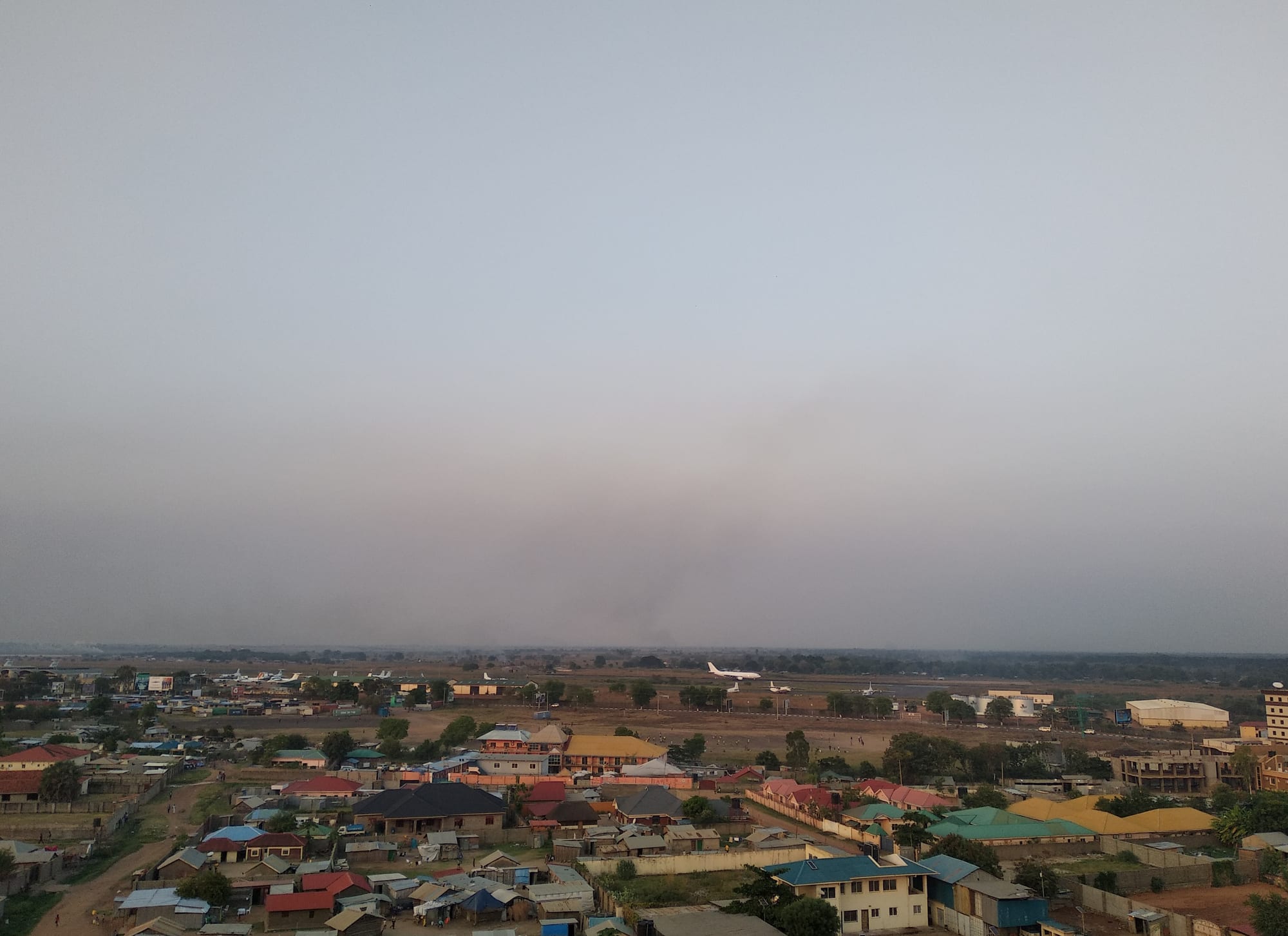
A wide view over low tin-roofed houses and walled compounds in Juba, spreading across flat open ground

Juba & Equatoria, South Sudan

Juba

Juba from above, with houses and compounds spreading across the flat ground of the city. (Umar sheriff habibullah / Wikimedia Commons · CC BY-SA 4.0)

South Sudan's capital, on the west bank of the White Nile in Bari country, grown from a small river and mission station into the political and commercial centre of the world's youngest country. It is a low, spread-out place of markets, ministries, aid compounds and largely unpaved streets. This page is written to explain the city, not to encourage travel.

Neighbourhoods

  • Juba Town
    • First-time visitors
    • Offices and banks
    • Close to the river

    The old administrative core between the main market and the riverbank, holding ministries, banks, airline offices and most of the city's larger buildings. Streets here are among the few that are paved, and the White Nile is a short walk away.

    Open in Maps
  • Konyo Konyo and Malakia
    • Markets
    • Street food
    • Local life

    The busiest commercial quarter, built around the city's main market near the river. Traders, lorries, stalls of vegetables, fish and imported goods and small eating places fill the streets, and the noise and crowds continue from early morning until dusk.

    Open in Maps
  • Hai Cinema and Tongping
    • Quiet and residential
    • Embassies and aid compounds

    Walled districts north-west of the centre where embassies, United Nations offices and aid organisations keep their compounds and guesthouses. Wide, dusty roads, high fences and gates give the area a quieter and more institutional feel than the rest of the city.

    Open in Maps
  • Munuki
    • Local life
    • Markets

    A large residential district on the western side of Juba, with its own market, small churches, workshops and bars along the main road. It is one of the areas that grew fastest as people moved into the capital after 2005.

    Open in Maps
  • Gudele
    • Local life
    • Quiet and residential

    A sprawling area of self-built housing on the north-western edge of the city, beyond Munuki, where much of Juba's population growth has gone. Services and tarmac thin out quickly towards its outer streets.

    Open in Maps
  • Kator
    • Historic district
    • Churches

    The southern part of the city, named after the Catholic mission that took root here, with the Catholic cathedral and older church institutions nearby. Housing spreads from it south along the road towards Gumbo and the river crossing.

    Open in Maps

Things to do

Landmarks and the river

  • John Garang Mausoleumlandmark

    The tomb of the SPLM/A leader John Garang, who died in 2005, set in a large open square in the centre of the city that is used for national ceremonies.

    Open in Maps
  • Juba Nile Bridgelandmark

    The road bridge over the White Nile on the eastern edge of the city, built in 1972 and for many years the only road crossing of the Nile in the country; a second bridge, the Freedom Bridge, opened a short way upstream in 2022.

    Open in Maps

Churches and institutions

  • All Saints Cathedrallandmark

    The Anglican cathedral of the Episcopal Church of South Sudan, a centre of church life in a country where Christianity is the majority faith.

    Open in Maps
  • St Theresa Cathedrallandmark

    The Catholic cathedral of the Archdiocese of Juba in Kator, the mother church of a large and influential Catholic community.

    Open in Maps
  • University of Jubaattraction

    The country's main university, founded in 1975, which spent the years of the second civil war relocated to Khartoum before returning to its campus here.

    Open in Maps

Markets

  • Konyo Konyo Marketmarket

    The market of the Konyo Konyo area near the river, selling vegetables, dried and fresh fish, cloth, hardware and goods trucked in from Uganda and Kenya.

    Open in Maps

Short trips from the city

  • Rejafattraction

    A settlement on the west bank of the Nile a short way upstream of Juba, once the terminus for boats on the river and a colonial administrative post before Juba took its place.

    Open in Maps
  • Terekekaattraction

    A riverside town on the west bank of the Nile north of Juba, and the main town of the Mundari, a cattle-herding people for whom cattle are wealth and status.

    Open in Maps

Seasonal events

  • Independence Day9 July

    The anniversary of the 2011 separation from Sudan, marked with parades and official ceremonies in the capital.

  • Christmas and EasterDecember and March or April

    The principal festivals of the year for most of the city, with long church services, choirs and family gatherings.

  • Eid al-Fitrvaries with the lunar calendar

    Marked by Juba's Muslim minority, mainly traders and northern-origin families, with prayers and shared meals.

Eat and drink

Long-standing places and food districts in Juba. Hours, ratings and directions come from your maps app, always current.

Juba classics

  • Grilled Nile fishrestaurant

    Tilapia and Nile perch, grilled whole over charcoal and served with salad and flatbread, cooked at simple riverside eating places.

    Open in Maps
  • Ful and kisra stallsrestaurant

    Stewed brown beans with oil and bread, or sorghum kisra with okra and groundnut stew, sold at small eating houses through the centre.

    Open in Maps

Markets and food districts

  • Konyo Konyo Marketmarket

    A large market near the river for fresh produce, dried fish, sorghum and goods brought up by lorry from Uganda and Kenya.

    Open in Maps
  • Malakia eating placesneighborhood

    A dense quarter of stalls and small kitchens near the market, where Sudanese, Ugandan and Ethiopian cooking sit side by side.

    Open in Maps
  • Ethiopian and Eritrean kitchensneighborhood

    Injera with spiced stews, cooked by the long-established Ethiopian and Eritrean community that runs many of Juba's small restaurants and coffee places.

    Open in Maps

Tea and coffee

  • Roadside tea sellerscafe

    Women selling sweet black tea, milky tea and spiced coffee from charcoal stoves under trees, an institution of the working day across the city.

    Open in Maps

Experience Juba

History

The Bari people have farmed and fished this stretch of the White Nile for centuries, and the area around present-day Juba lay on the route that Egyptian, Sudanese and European traders and explorers followed upriver in the nineteenth century. Their base was Gondokoro, a station a little downstream that was the furthest point boats could reach on the Nile and where Samuel Baker met the returning explorer John Hanning Speke in the 1860s; Rejaf, upstream, was the seat of the Belgian commander of the Lado Enclave before the area passed to British administration.

The present town began with a Church Missionary Society mission and school set up in a Bari village in 1920-21, and in the late 1920s Anglo-Egyptian officials laid out a new town on the site as the capital of Mongalla Province; traders moved up from Rejaf in 1929 and the provincial governor's office followed in 1930. The Juba Conference of June 1947 agreed that the northern and southern provinces would form a single Sudan, a decision that shaped the politics of the next sixty years, and Juba was a focus of much fighting during the second civil war.

The 2005 peace agreement made Juba the capital of the autonomous south, and independence on 9 July 2011 made it the capital of a new state. Ministries, embassies and aid agencies arrived and the population grew rapidly. Fighting broke out in the city in December 2013 at the start of the civil war and again in July 2016, and although the 2018 peace agreement reduced the violence, the political crisis that deepened in 2025 and the fighting reported in parts of the country during 2025 and 2026 have kept the capital tense.

Culture & Customs

Juba is the one place where all of South Sudan's peoples meet. Bari is the language of the original inhabitants of the area, but the street language is Juba Arabic, a simplified Arabic creole that grew up in the nineteenth-century garrisons and trading posts and now serves as the common tongue of the markets, buses and bars. English is the official language, used in government, schools and newspapers, and Dinka, Nuer, Zande, Madi and dozens of others are spoken at home.

Church life is central. Catholic and Anglican cathedrals stand within the city, church choirs are a serious musical training ground, and Sunday services are long, sung and well attended. Music is the city's strongest cultural export: a generation of South Sudanese singers and rappers, many of them raised in Khartoum, Nairobi or Kampala and returning after 2005, record and perform here, mixing Juba Arabic and English lyrics with East African styles.

Social life runs through extended family and community associations, which support new arrivals from the states and organise weddings and funerals. Wrestling matches between communities, football and church events draw the largest crowds. Visitors are treated with courtesy, but the city is also watchful: politics is discussed carefully, uniforms are given a wide berth, and cameras are regarded with suspicion.

Daily Life

Juba's population was put at 525,953 people in 2017; no recent census figure is agreed, and the number rises and falls with conflict and displacement in the rest of the country. Growth since 2005 has been fast and largely unplanned, spreading the city west and north over several kilometres of low, self-built housing.

Government, aid organisations, trade and transport provide most formal work. Nearly everything consumed in the city arrives by lorry from Uganda and Kenya through Nimule, so a closed road or a fall in the value of the pound is felt immediately in the market. Many households also rely on remittances from relatives abroad, on small trade, or on farming plots at the city's edge.

The day begins early, before the heat, with tea sold at the roadside; offices and markets work through the morning, slow in the afternoon and revive in the evening. Electricity comes mainly from private generators and solar panels, water is delivered by tanker from the river, and fuel shortages and price rises are constant subjects of conversation. Unpaved streets flood in the rains, public services are thin, and displacement from elsewhere in the country continues to add to the city's population.

Food

Juba eats the food of the whole country and of its neighbours. The staple is sorghum, ground and cooked into a stiff porridge (asida) or made into kisra, a thin fermented flatbread, and eaten with stews of okra, dried fish, beans, leafy greens or groundnut paste. Cassava and maize from Equatoria's farms are common too, and rice and wheat bread arrive by road.

Fish from the Nile is the local speciality: tilapia and Nile perch grilled whole over charcoal, or split and sun-dried and then stewed. Grilled goat and beef are eaten at gatherings and at roadside grills, and ful, slow-stewed brown beans dressed with oil, is the standard cheap breakfast, a habit inherited from Sudan.

Because so many residents have lived in neighbouring countries, the city's small restaurants are unusually varied for its size. Ethiopian and Eritrean kitchens serve injera with spiced stews, Ugandan and Kenyan places do chapati, beans and grilled meat, and there are Indian and Middle Eastern restaurants catering to traders and aid workers. Sweet black tea and spiced coffee are drunk all day, bottled beer is easy to find in the capital, and sorghum and maize beers are brewed at home for gatherings.

Planning tools

Budget

Juba is expensive for what it offers. Demand from aid agencies, diplomats, traders and officials has pushed hotel rooms and restaurant meals far above regional prices, almost everything is imported by road from Uganda or Kenya, and vehicles with drivers are hired by the day. There is no visitor economy and no budget accommodation of the kind found elsewhere in East Africa.

Daily Budget Midrange
USD 150–300 (a modest hotel room, meals, a driver and vehicle, before any security costs or flights)
Daily Budget Shoestring
USD 100–150 (a basic guesthouse room, market food, shared transport) — the lowest that is realistically workable

Costs are settled in US dollar cash, rooms and vehicles are normally arranged in advance through a host organisation, and prices move with the exchange rate.

Best Time to Visit

The dry season from December to March is when roads in and out of the city are passable and the air is clearest, though afternoons are very hot and dusty. The rains from April to November bring cooler storms but flood unpaved streets and cut road links. In practice security conditions and permissions, not the season, decide whether any visit happens.

Suggested Number of Days

Two or three days covers the centre, the markets and the riverbank at a slow pace in the heat. Four or five allows for the river upstream and downstream of the city. Movement here depends on security clearance and transport, which lengthens everything.

First Visit
2–3 days
With Surroundings
4–5 days

Transportation

There is no public transport system beyond shared minibuses and small motorcycle taxis, known locally as boda bodas, which carry most people around the city. Aid organisations and businesses run their own four-wheel drive vehicles, and hiring a car with a driver is the normal arrangement for anyone working here. Away from a short paved core, roads are dirt, rutted and badly flooded in the rains.

Journeys are planned around daylight, and vehicles rather than walking are used between districts after dark.

Airport & Station Connections

Juba International Airport, a few kilometres north-east of the centre, is the country's main gateway, with daily flights to Nairobi, Entebbe and Addis Ababa, flights on to Wau, and small aircraft serving airstrips inside the country. By road the paved route south to the Ugandan border at Nimule, about 190 kilometres away, is the main overland link and the way most imported goods arrive. Barges and boats still use the river, slowly and irregularly.

Walkability

The old centre between the main market and the riverbank can be crossed on foot in twenty minutes or so, and is where walking makes sense. Beyond it the city spreads for many kilometres with few pavements, open drains, heavy traffic and long dusty stretches between districts, and the midday heat discourages walking in any case.

Safety

Juba has armed crime, carjacking and frequent checkpoints, and the city itself saw fighting in 2013 and again in July 2016. Political tension rose again in 2025 and has continued into 2026. Movement is restricted, photography of bridges, airports, soldiers and government buildings can lead to arrest, and medical care in the city is minimal.

Most governments advise against all travel. Anyone present for work should move only with a security plan, hold evacuation cover, carry permissions in writing and take no photographs without permission. Check current official travel advice before travelling.

Climate

Tropical savanna, hot all year, with a rainy season from roughly April to November and a hot, dusty dry season from December to March. Rain usually falls as afternoon or evening storms rather than all-day drizzle.

Summer
rainy season, roughly April to November: warm and humid, about 25–33°C, with heavy storms and deep mud on unpaved roads
Winter
dry season, December to March: hot and dusty, often 35–38°C by mid-afternoon, with cooler nights

Local Customs

Juba Arabic is the everyday language of the streets and the market, while English is the official language of government, and Bari is spoken by the area's original inhabitants. Greetings are unhurried and handshakes matter. Dress is modest, and shorts are unusual on adults. Photography is the most common cause of trouble for outsiders: officials, soldiers, bridges and government buildings must not be photographed, and people should be asked first.

Tipping is not expected, though small amounts are appreciated; dress modestly and cover shoulders and knees in churches; ask before taking any photograph; and expect Sunday to be a quiet day given over to church.

Common Payment Methods

The currency is the South Sudanese pound, which has lost much of its value, so prices are commonly quoted and settled in US dollar cash. Card payment is rare outside a handful of hotels, ATMs are unreliable, and money is changed through trusted contacts rather than on the street. Clean, recent US dollar notes are strongly preferred.