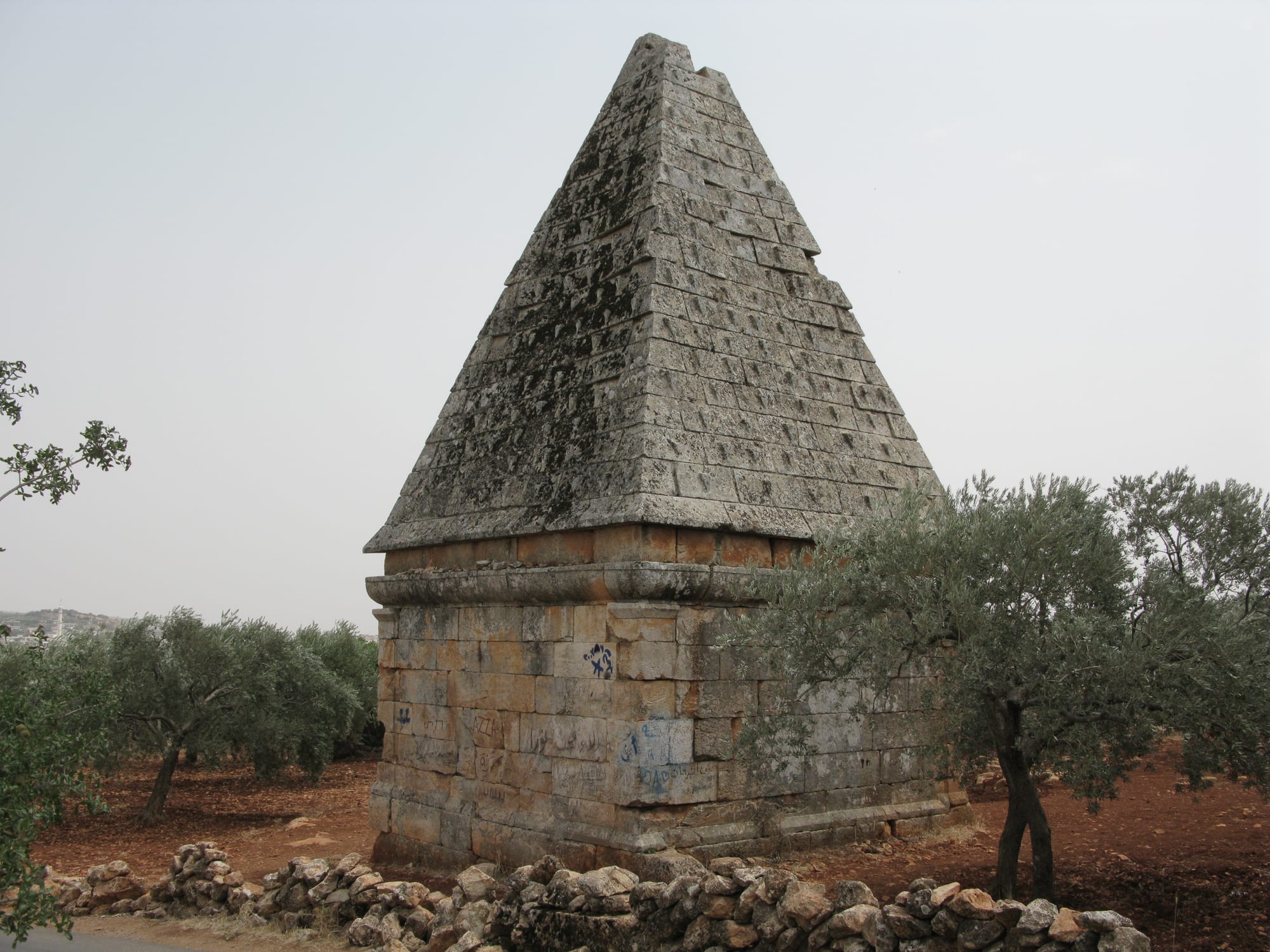
A stone tomb with a steep pyramid roof standing among olive trees on red soil behind a low dry-stone wall

Aleppo & the North, Syria

Idlib

A pyramid-roofed tomb at al-Bara, one of the Dead Cities in the hills south of Idlib. (Vyacheslav Argenberg / Wikimedia Commons · CC BY 4.0)

The provincial capital of north-western Syria, a market town among olive groves and orchards on red soil near the Turkish border. It is the centre of a farming region scattered with the abandoned Byzantine villages known as the Dead Cities and the Bronze Age mound of Ebla, and it stood at the heart of the war's final years. This page is written to explain the city, not to encourage travel to it.

Neighbourhoods

  • The town centre
    • First-time visitors
    • Markets
    • Close to transport

    The compact core of low concrete buildings around the main roundabouts and squares, where the shops, bakeries, banks, government offices and bus and taxi stands are gathered. Everything in the town is a short walk or a cheap taxi ride from here.

    Open in Maps
  • The souk quarter
    • Markets
    • Local life

    The streets of covered and open stalls just off the centre, selling vegetables and fruit from the surrounding farms, olives and oil, cloth, hardware and household goods. It is busiest in the early morning and again before sunset.

    Open in Maps
  • The northern and western edges
    • Quiet and residential

    Newer residential streets and apartment blocks spreading out towards the olive groves and the expressway, built up quickly during the war years as displaced families arrived from other parts of Syria. Services here are stretched and the edges of town blur into farmland.

    Open in Maps

Things to do

In the town

  • Idlib Museummuseum

    The provincial archaeological museum, founded in 1989 and best known for the clay tablets of the royal archive of Ebla, along with mosaics, steles and pottery. It was looted and shelled during the war, and two galleries were reopened in 2018.

    Open in Maps
  • Idlib soukmarket

    The town's produce and general market, the trading point for the olives, figs, cherries and vegetables grown on the surrounding red-soil farmland.

    Open in Maps

Ancient sites nearby

  • Eblalandmark

    The mound of Tell Mardikh south-east of the town, where a third-millennium BC palace yielded thousands of cuneiform tablets recording a wealthy trading kingdom.

    Open in Maps
  • Al-Baralandmark

    One of the largest of the Dead Cities, with churches, houses and two pyramid-roofed tombs standing among olive groves in the Jabal Zawiya hills.

    Open in Maps
  • Serjillalandmark

    One of the best-preserved of the Dead Cities, a Byzantine village built in a natural basin, with a bath complex, a men's meeting hall and stone houses.

    Open in Maps
  • Qalb Lozehlandmark

    A 5th-century basilica in the hills north-west of the town, whose design influenced later church building in Syria and beyond.

    Open in Maps
  • Jabal Zawiyaviewpoint

    The limestone massif south of Idlib, terraced with olive trees and dotted with ruined villages, churches and tombs of late antiquity.

    Open in Maps

Short trips from the town

  • Maarat al-Numanattraction

    A town on the Damascus–Aleppo road, birthplace of the poet al-Maarri, with a museum of mosaics from the Dead Cities.

    Open in Maps
  • Jisr al-Shughurattraction

    A town on the Orontes west of Idlib, named for its bridge, where the plain gives way to the wooded hills towards the coast.

    Open in Maps
  • Arihaattraction

    A small town under the slopes of Jabal al-Arbaeen a short way south, long noted for its orchards.

    Open in Maps
  • Bab al-Hawa Border Crossingtransit hub

    The main crossing to Turkey north of the town, for years the principal route for aid into north-western Syria.

    Open in Maps

Eat and drink

Long-standing places and food districts in Idlib. Hours, ratings and directions come from your maps app, always current.

Idlib classics

  • Olive oil and olivesmarket

    The province is one of Syria's main olive-growing areas, and pressed oil, green and cured olives and olive soap are sold everywhere in the town, most cheaply just after the autumn harvest.

    Open in Maps
  • Freekeh and village breadmarket

    Green wheat roasted and cracked into freekeh is a staple of the local table, cooked with meat or in soup, and thin bread is baked on the domed saj griddle.

    Open in Maps

Food streets and markets

  • The town-centre food streetsneighborhood

    Grills, shawarma stands, falafel counters and sweet shops line the main streets near the market, serving the plain, meat-and-bread cooking of the north-west rather than the elaborate mezze of Aleppo.

    Open in Maps
  • Idlib produce marketmarket

    Figs, cherries, tomatoes, pistachios and sacks of olives come in from the surrounding villages, and the seasons of the market follow the harvests closely.

    Open in Maps

Experience Idlib

History

Idlib is an old settlement on the route between Aleppo and the Orontes, and the town's district has been farmed continuously since antiquity, though the great cities of the area lay outside it. Ebla, at Tell Mardikh a short way to the south-east, ruled a wealthy trading kingdom in the third millennium BC and kept its records on clay tablets, unearthed in excavations that began in 1964, which remain one of the main sources for the Bronze Age in Syria. In late antiquity the limestone hills around the town filled with prosperous villages that grew olives for export and built churches, baths and tombs of dressed stone. Trade routes shifted after the Arab conquest, the villages were gradually abandoned, and they survive as the Dead Cities, listed by UNESCO as the Ancient Villages of Northern Syria.

Under Ottoman rule Idlib was a modest market town in the province of Aleppo, and it kept that role through the French mandate, when the surrounding countryside was reorganised for commercial farming. It became a provincial capital when Idlib Governorate was separated from Aleppo in 1957, growing slowly around trade in olives, olive oil, soap, fruit and grain, with light industry and government offices added in the later 20th century.

From 2011 the province was heavily involved in the uprising and the war that followed. Idlib changed hands, absorbed very large numbers of displaced people from other parts of Syria, and became the last major opposition-held area, which brought years of bombardment and the destruction of much of the province's housing and infrastructure. The earthquake of February 2023 struck an already weakened region. Since the change of government in Damascus in December 2024 the province has been reconnected with the rest of the country.

Culture & Customs

Idlib's culture is that of the north-western countryside rather than of a metropolis. Extended families and village origins shape social life, and most townspeople can name the village their family came from and the olive terraces that go with it. The population is overwhelmingly Sunni Arab, and the province is more conservative than Aleppo or the coast: mosques set the rhythm of the week, and modest dress is the norm in the street and the market.

Hospitality follows the old pattern of the region. Guests are received in a formal sitting room, tea is poured very sweet in small glasses, and a meal is pressed on visitors long past the point of politeness. Weddings are large and public, with drumming, dabke dancing in lines and processions of cars through the streets, and condolence gatherings after a death are attended by the whole neighbourhood.

The olive harvest in the autumn is the closest thing the province has to a shared seasonal festival, gathering whole families into the groves for weeks of picking and pressing. Craft traditions are practical ones: olive-oil soap-making, wood and stone work, and the weaving of baskets and mats. The war also gave the province an unusually dense civil society of local councils, relief organisations and media outlets, many run by young people, and that experience marks the way public life is discussed here.

Daily Life

The town had about 100,000 people at the last full census, and the population of both the town and the province rose sharply during the war as displaced families arrived from across Syria and settled in rented rooms, unfinished buildings and camps along the Turkish border. Numbers have shifted again since 2024 as people return to their home areas, so any current figure is provisional.

The economy rests on farming and the trade that goes with it: olives and olive oil above all, along with figs, cherries, pistachios, wheat and vegetables from the red soil, with small workshops, soap-making, transport and shops in the town, and a large presence of aid organisations. Work is often informal, and remittances from relatives abroad matter to many households. Electricity and water supply are unreliable, and rooftop solar panels, generators and tankers are ordinary fixtures.

Days begin early, with the produce market at its busiest in the first hours and again at dusk, and slow in the heat of the afternoon. Evenings are spent visiting, in cafés or on balconies. The pressing concerns are the clearance of rubble and unexploded ordnance, rebuilding damaged homes, disputes over property left by people who fled, school places for a young population, and the return of families still living in camps.

Food

Idlib eats the food of the northern Syrian countryside: plainer than Aleppo's and built around what the province grows. Olive oil is on every table, poured over labneh, hummus and foul for breakfast and used in cooking rather than butter. Bread comes thin and blistered from the domed saj griddle or in flat loaves from the neighbourhood oven, and the manaqish baked in the mornings are spread with zaatar and oil or with minced meat.

Freekeh, green wheat roasted while still soft and then cracked, is the local grain speciality, cooked as a pilaf with lamb or chicken or added to soup, and burghul does the same work in kibbeh and in salads. Kibbeh here is homelier than the Aleppine versions, often baked in a tray. Mezze leans on the produce of the hills: makdous, small aubergines stuffed with walnuts, garlic and pepper and kept in oil; muhammara made with pepper paste and walnuts; and pickles of every kind. Lamb and chicken are grilled over charcoal, and stews of meat with vegetables are served on rice.

The fruit of the province is famous within Syria — cherries, figs, grapes and pistachios — and much of it is dried or made into syrups and jams for the winter. Sweets are simple: semolina cakes, pastries with pistachio, and dates. Very sweet tea is drunk all day, and Arabic coffee with cardamom marks every formal visit.

Planning tools

Budget

Idlib was never a visitor town, and its accommodation has served traders, aid workers and returning families rather than travellers. Costs are low in absolute terms but everything is paid in cash, and the real expense of any visit is a driver who knows the roads and the checkpoints. Figures are indicative only.

Daily Budget Midrange
USD 90–180 (better hotel, restaurants, car and driver) — indicative only
Daily Budget Shoestring
USD 30–50 (simple hotel, street food, shared taxis) — indicative only

Carry clean US dollar notes and change them through trusted channels; Syria issued a redenominated pound in January 2026 with two zeros removed, and the old notes were withdrawn by the end of July 2026.

Best Time to Visit

Historically April to early June, when the hills are green and the Dead Cities stand among wildflowers, and September to October for the olive harvest and cooler days. Summer is hot and dry, and winter cold and wet with mud on the farm tracks. Security conditions, not the season, decide whether any visit is possible.

Suggested Number of Days

The town itself is small and can be seen in a day. Two or three days make sense only because of the archaeological sites spread through the surrounding hills, which are slow to reach on minor roads.

First Visit
1 day
With Surroundings
2–3 days

Transportation

Minibuses and shared taxis connect Idlib with Aleppo, Ariha, Jisr al-Shughur and the villages, using the expressway north towards Bab al-Hawa and the roads east to Saraqib and the M5. Within the town, everything is walkable or a short taxi ride. The Dead Cities, Ebla and Qalb Lozeh lie on minor roads and need a hired car.

Use a local driver who knows current checkpoints, travel in daylight, and never leave the road near former front lines.

Airport & Station Connections

There is no airport at Idlib; the nearest is Aleppo, roughly 60 km north-east, which has taken commercial flights again since 2025. Almost everyone arrives by road, either from Aleppo along the expressway and the M5, from Latakia and the coast over the hills, or from Turkey through the Bab al-Hawa crossing, which is used mainly by aid convoys, trade and returning Syrians.

Walkability

The town is flat, small and easily crossed on foot, and the market streets are best seen that way. Pavements are broken or absent in places, traffic mixes with pedestrians on the main roads, and some blocks remain damaged. Nothing outside the town is walkable: the sites in the hills need a vehicle.

Safety

Most governments advise against all or all-but-essential travel to Syria. Idlib province was the last major opposition stronghold and among the most heavily bombed parts of the country, and its former front lines, ruined villages and farmland are contaminated with mines and unexploded ordnance. Buildings weakened by war and by the 2023 earthquake can collapse, armed groups, crime and kidnapping remain risks, and consular help is minimal or absent.

Do not travel for leisure; anyone who must go should use an experienced local fixer, stay off unmarked ground and out of damaged buildings, and never touch debris. Check current official travel advice before travelling.

Climate

The hills around Idlib are a little cooler and wetter than Aleppo, which is why olives and fruit trees grow here without irrigation. Summers are hot and dry, winters cold and damp with most of the year's rain between November and March, and spring and autumn are mild.

Summer
hot and dry, typically 31–36°C by day and cool after dark
Winter
cold and wet, roughly 2–12°C, with frost and occasional snow on the hills

Local Customs

This is a rural, conservative province where village and family loyalties matter and hospitality is taken seriously: tea or coffee is offered at once and refusing outright is awkward. Modest dress is expected of both men and women, covering shoulders and knees, and most local women wear a headscarf. Greetings are long, and business follows conversation rather than the other way round.

Ask before photographing people, and do not photograph soldiers, checkpoints, government buildings or damaged areas. Alcohol is not generally available or acceptable in public here; small tips are appreciated.

Common Payment Methods

The currency is the Syrian pound, redenominated in 2026 with two zeros removed, though Turkish lira circulated widely in the north-west during the war years. Payment is in cash; card acceptance is effectively non-existent and ATMs cannot be relied on. Visitors bring clean US dollar notes and change them locally.