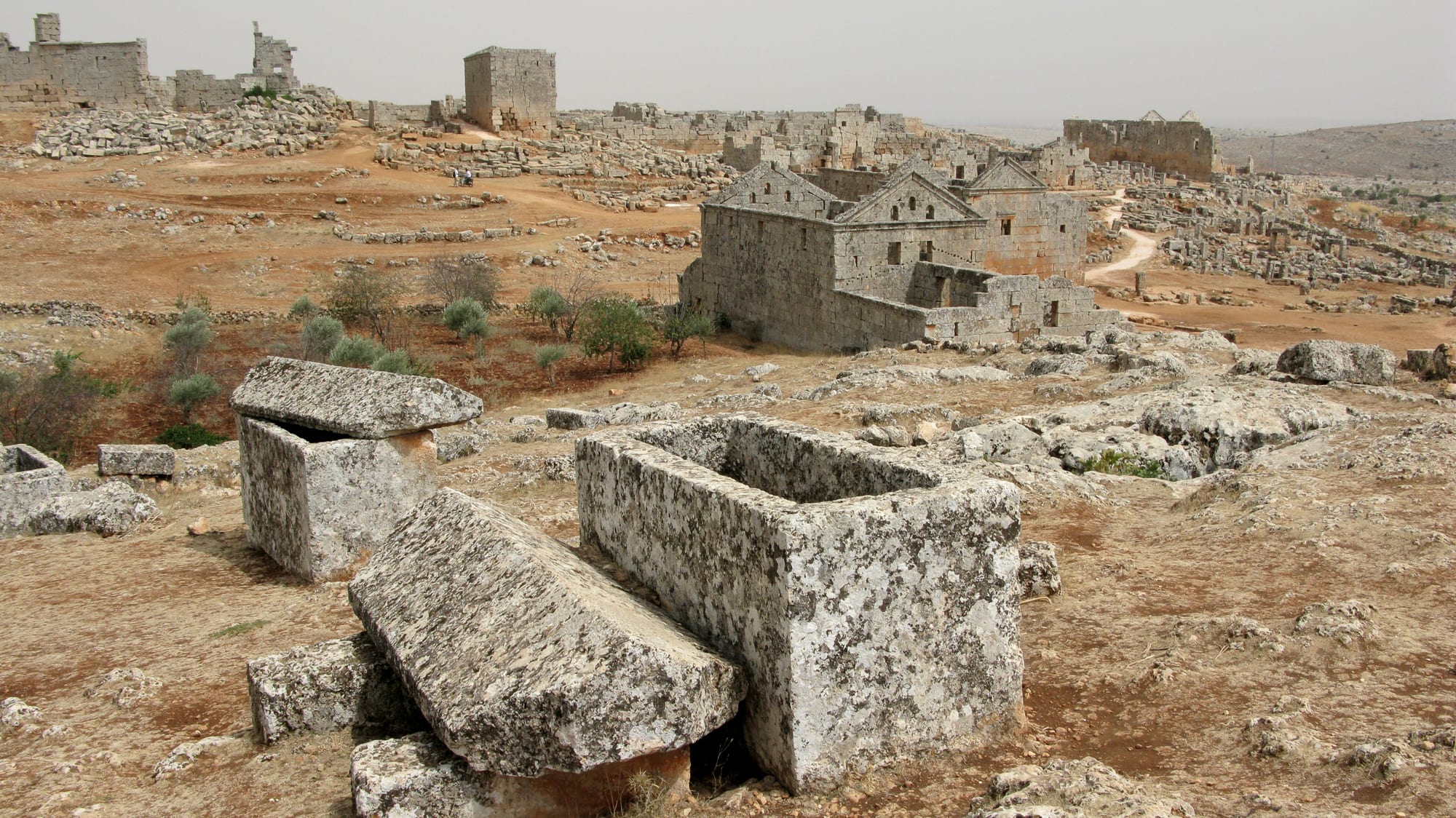
Stone sarcophagi in the foreground and the roofless stone houses and towers of an abandoned village on a dry hillside

Syria

Aleppo & the North

Serjilla, one of the best-preserved of the Dead Cities in the limestone hills of Idlib province. (Vyacheslav Argenberg / Wikimedia Commons · CC BY 4.0)

Northern Syria between the Turkish border and the Orontes, centred on Aleppo — for centuries the great trading city of the Levant — and the olive-covered limestone hills of Idlib, scattered with the abandoned Byzantine villages known as the Dead Cities. This page is written to explain the region, not to encourage travel to it.

Explore Aleppo & the North

History

The north was a centre of power early. Ebla, south of Aleppo, ruled a trading kingdom in the third millennium BC and kept its records on clay tablets discovered in the 1970s. Aleppo, known in ancient texts as Halab, was the capital of the Amorite kingdom of Yamhad in the Middle Bronze Age, and the mound under its citadel held a temple of the storm god. The city passed to Hittites, Assyrians, Persians and the Seleucids, who called it Beroea.

In late antiquity the limestone hills west of Aleppo filled with prosperous farming villages that grew olives for export, built stone houses and churches, and made the region a heartland of Syrian Christianity; Simeon Stylites drew pilgrims to his pillar until his death in 459. After the Arab conquest trade shifted, and the villages were slowly abandoned, becoming the Dead Cities.

Aleppo flourished as a frontier capital under the Hamdanid emir Sayf al-Dawla in the 10th century, withstood the Crusaders, and was fortified by Saladin's son al-Zahir Ghazi, who rebuilt the citadel. Under the Ottomans from 1516 it became one of the empire's great commercial cities, with European consuls and merchants in its khans. Armenian survivors of the 1915 deportations settled there in large numbers. From 2012 to 2016 Aleppo was divided by the front line and its eastern half destroyed; Idlib became the last major opposition stronghold, and the 2023 earthquake struck both. The offensive that ended Assad's rule took Aleppo in late 2024.

Culture & Customs

Aleppines consider their city Syria's cultural capital and Damascus its political one, and the rivalry is old and good-humoured. The city was home to Sunni Arabs, Kurds, Turkmen, and one of the Middle East's most varied Christian populations — Armenian, Syriac, Greek Orthodox and Catholic — in quarters such as Jdeydeh, many of whose families left during the war. Aleppo's dialect, distinct from the Damascene, is quickly recognised across Syria.

Music is the city's pride. Aleppo is famous for tarab, the rapture of classical Arabic song, for its qudud halabiya songs and for the muwashshah tradition, and the singer Sabah Fakhri, an Aleppine, carried them to the whole Arab world. Sufi lodges kept up chanting and dhikr ceremonies.

Crafts include Aleppo soap, made from olive and laurel-berry oil and aged in stacks for months, silk and cotton weaving, and gold in the souks. Idlib province is more rural and conservative, a land of farming families where village and clan loyalties matter and the olive harvest in the autumn gathers whole families.

Daily Life

Aleppo was Syria's largest city before 2011, with about two million people and much of the country's industry in textiles, food processing and pharmaceuticals. Much of the east and the old city was destroyed, and reconstruction is slow and uneven, though markets, workshops and factories are reopening. Idlib province, rural before the war, swelled with displaced people from across Syria, and large camps grew up along the Turkish border; the towns of Idlib, Maarat al-Numan and Jisr al-Shughur are its main centres.

The economy rests on trade with Turkey, farming — olives, wheat, pistachios, figs and cherries — and aid, remittances and small workshops. Electricity has long been scarce, and private generators, solar panels on the roofs, and water tankers are part of every neighbourhood.

In Aleppo the day turns on the workshops and markets, the bakeries and the evening walk in the public garden; in Idlib it follows the farming seasons and the rhythm of families trying to rebuild. Returns to damaged homes, property disputes and the reconnection of the north with the rest of the country are the issues of the moment.

Food

Aleppo is widely held to be Syria's greatest food city. Its kibbeh runs to dozens of varieties, among them kibbeh safarjaliyeh, cooked with quince, and kibbeh labaniyeh, simmered in yoghurt; its kebabs include kebab halabi and the famous kebab with sour cherries. Muhammara here is made with Aleppo pepper and pomegranate molasses, and shish barak, small meat dumplings in hot yoghurt, is a household favourite.

Traditional sweets include mamuniyeh. Aleppo's pistachios, the fustuq halabi, go into baklava, mabrumeh and ice cream, and the sweet shops are as proud of their wares as those of Damascus.

The Idlib hills produce olive oil, olives, figs, cherries and the local green wheat, freekeh, and village bread is baked on the curved saj. Aleppo pepper, semi-dried, crushed and often salted, flavours much of the region's cooking, and coffee and sweet tea close every visit.

Attractions & Natural Wonders

Old Aleppo is a UNESCO World Heritage Site, and its citadel rises on a steep glacis-covered mound in the centre, reached by a bridge and a fortified gateway, with a throne hall, mosques and a theatre built for concerts in recent decades. Below it run the souks, kilometres of stone-vaulted lanes lined with khans such as Khan al-Wazir and Khan al-Saboun, many burned and damaged in the fighting and some restored. The Great Mosque lost its 11th-century minaret in 2013; the Jdeydeh quarter keeps Ottoman merchants' houses and churches, and the Baron Hotel was a famous stopping place for travellers.

West of the city, on Jebel Sem'an, the church of Saint Simeon Stylites stands on a hilltop in ruins that still show its arches, carved stone and the stump of the pillar. The Dead Cities, listed by UNESCO as the Ancient Villages of Northern Syria, continue into Idlib province: Serjilla with its baths and men's meeting hall, al-Bara with pyramid-roofed tombs among olive trees, and the church of Qalb Lozeh.

In Idlib province itself, Ebla lies at Tell Mardikh, Maarat al-Numan keeps a museum of mosaics from the Dead Cities, and Idlib city is the provincial centre, surrounded by olive groves on red soil.

Cities in Aleppo & the North

Planning basics

Budget

Aleppo once had a busy trade in cheap hotels around Bab al-Faraj and boutique courtyard hotels in the old city, and much of that is gone or closed. What remains is priced in a volatile pound and paid in cash, and a private car with a driver is the only practical way to reach the Dead Cities or Saint Simeon. Figures are indicative only.

Daily Budget Midrange
SYP equivalent of roughly USD 90–180 (better hotel, restaurants, car and driver) — indicative only
Daily Budget Shoestring
SYP equivalent of roughly USD 30–50 (simple hotel, street food, shared taxis) — indicative only

Carry clean US dollar notes, change them through trusted channels, and expect prices to shift from week to week.

Safety

Most governments advise against all or all-but-essential travel to Syria. Aleppo and Idlib were among the most heavily fought-over areas of the war, and the former front lines, ruined districts and farmland are contaminated with mines and unexploded ordnance. Armed groups, crime, kidnapping and air strikes remain risks, buildings weakened by war and by the 2023 earthquake can collapse, and consular help is minimal or absent.

Do not travel for leisure; anyone who must go should use an experienced local fixer, stay off unmarked ground and out of damaged buildings, and never touch debris. Check current official travel advice before travelling.

Climate

More continental than the coast: Aleppo has hot, dry summers and cold winters with frost and occasional snow. The Idlib hills are slightly cooler and wetter, which is why olives and fruit trees grow there without irrigation, while the east of Aleppo province shades into dry steppe.

Summer
hot and dry, typically 33–38°C in Aleppo, cool at night
Winter
cold and damp, 1–11°C, with frost and occasional snow

Transportation

The M5 highway links Aleppo with Hama and Damascus, and Aleppo's airport has reopened to commercial flights. Minibuses and shared taxis run between Aleppo, Idlib and the towns, but the Dead Cities, Ebla and Saint Simeon lie on minor roads and need a hired car. The crossings to Turkey are used mainly by aid, trade and returning Syrians, and conditions change often.

Use a local driver who knows current checkpoints, travel in daylight, and never leave the road near former front lines.

Best Time to Visit

Historically April to early June, when the Dead Cities stand among wildflowers, and September to October for the olive harvest and cooler days in the souks. Security conditions, not the season, now decide whether any visit is possible.