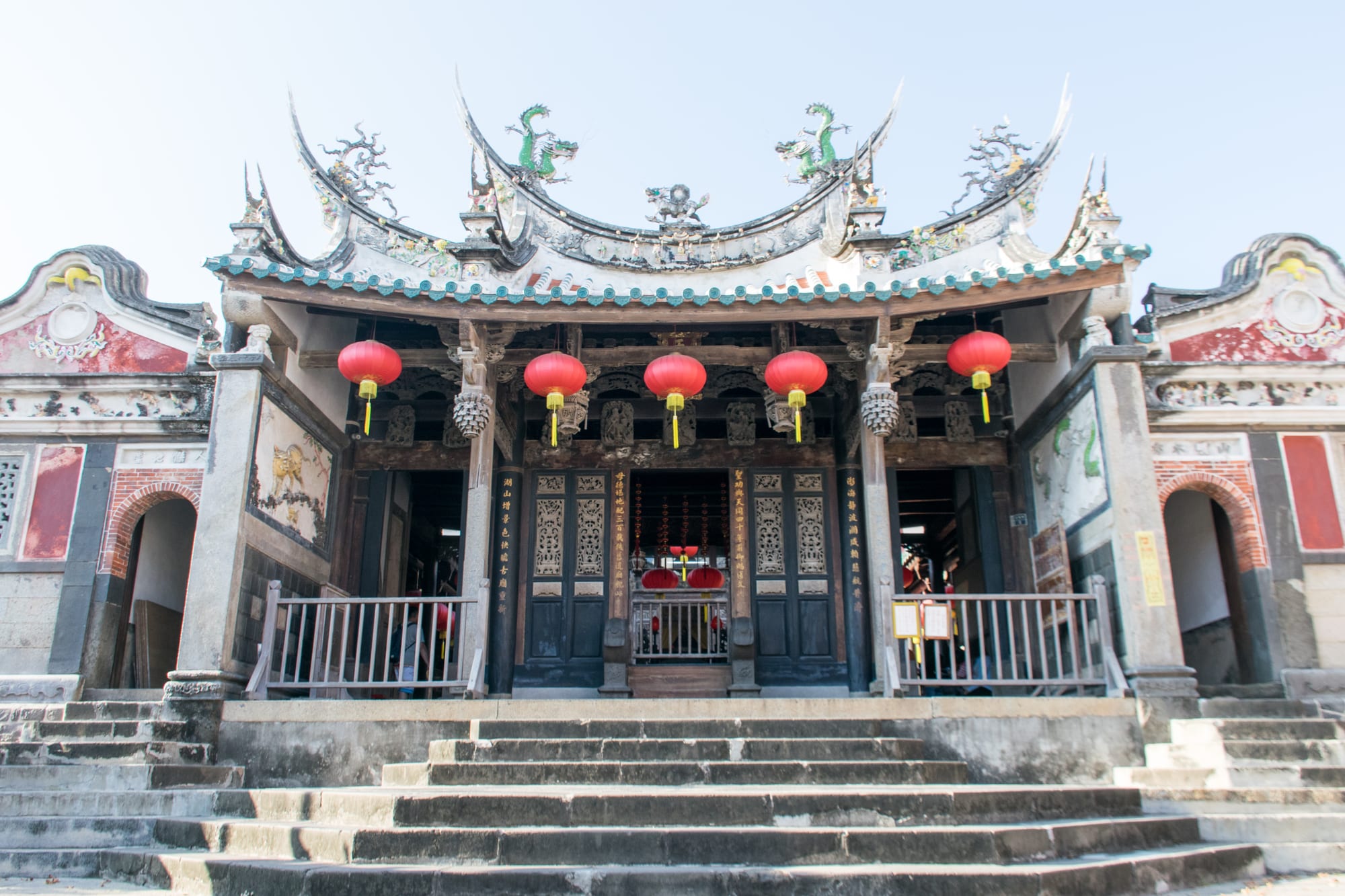
A stone-stepped temple front with swallowtail roof ridges, carved dragons and red lanterns hanging under the eaves

Penghu, Kinmen & Matsu, Taiwan

Magong

The Mazu temple in the old quarter of Magong, Penghu. (Jgfhhgf942zo / Wikimedia Commons · CC BY-SA 4.0)

The main town of the Penghu archipelago in the Taiwan Strait, built around a deep natural harbour on a low, treeless island of basalt and coral sand. Its name comes from the Mazu temple at its heart, generally held to be the oldest Mazu temple in Taiwan, and the old quarter keeps Qing walls, a well and a lane of merchant shophouses. Ferries and flights make it the gateway to the outer islets.

Neighbourhoods

  • The old quarter and Zhongyang Street
    • First-time visitors
    • Historic district
    • Best for food

    The lanes behind the harbour around the Mazu temple, including a narrow paved street of restored shophouses and an old communal well. Souvenir shops, cafés and small guesthouses fill it, and the surviving stretch of Qing wall and its gate stand at one end.

    Open in Maps
  • The harbour and ferry terminal
    • Boats and ferries
    • Close to public transport
    • Seafood

    The working waterfront, with the ferry building for the outer islets and for Taiwan, fishing boats, dive and tour operators and a line of seafood restaurants. Most island-hopping trips start here.

    Open in Maps
  • Wenkang and the new town
    • Local life
    • Shopping
    • Quiet and residential

    The residential districts spreading east and north of the old centre, with schools, the hospital, supermarkets and apartment blocks. Everyday shops and cheaper eating places are here rather than in the tourist lanes.

    Open in Maps
  • Guanyinting and the west shore
    • Waterfront walks
    • Sunsets

    A seafront park and temple on the western edge of town, with a promenade, a rainbow-lit bridge over a small bay and a view west across the strait that draws people at sunset.

    Open in Maps
  • Huxi and the airport side
    • Beaches
    • Close to the airport

    The eastern township on the same island, where the airport, the aquarium and several sheltered beaches lie within a short drive of town. It is flatter, emptier and more agricultural.

    Open in Maps

Things to do

The old town

  • Penghu Tianhou Templelandmark

    The Mazu temple that gave the town its name, generally regarded as the oldest Mazu temple in Taiwan, with carved stone, swallowtail roofs and a Ming-era inscribed tablet.

    Open in Maps
  • Magong Old City Walllandmark

    What survives of the walls built between 1887 and 1889, after the French occupation, including the one gate left standing beside the harbour.

    Open in Maps
  • Jinguitou Fortresslandmark

    A Qing coastal battery on the point west of the old town, rebuilt in 1887 as part of Penghu's defences and later used by the garrison.

    Open in Maps
  • Penghu Reclamation Hallmuseum

    The former Japanese-era official residence of the county head, kept as a museum of Penghu's settlement and administration.

    Open in Maps

Museums and parks

  • Penghu Living Museummuseum

    A county museum covering the islands' fishing, stone weirs, houses and daily life, with reconstructed interiors and boats.

    Open in Maps
  • Guanyinting Recreation Areapark

    A seafront park and temple on the town's western shore, with a promenade, swimming water and a bridge lit at night.

    Open in Maps
  • Penghu Great Bridgelandmark

    The long causeway bridge linking Baisha to Xiyu across a fast tidal channel, the main road out to the western islands.

    Open in Maps

Coast and beaches

  • Shanshui Beachbeach

    A broad sand beach on the south coast a few kilometres from town, one of the closest swimming beaches to Magong.

    Open in Maps
  • Aimen Beachbeach

    A long shallow beach on the eastern side of the island, part of a sand strand of more than three kilometres running past Lintou Park.

    Open in Maps
  • Fenggui Caveattraction

    A basalt sea cave at the end of the Fenggui peninsula south-west of the town, where listening to the waves in the rock is a long-standing local pastime.

    Open in Maps

Short trips by boat

  • Jibei Islandbeach

    A small island north of Baisha with a long sand spit curving into clear water, reached by fast boat in summer.

    Open in Maps
  • Qimei Islandattraction

    The southernmost island of the group, known for the Double-Heart of Stacked Stones, a stone fish weir built on the reef.

    Open in Maps
  • Wangan Islandattraction

    An island of old coral-stone houses at Zhongshe village and of nesting green turtles on its beaches.

    Open in Maps
  • Xiyu Western Fortlandmark

    A large Qing artillery fort of the 1880s on the western island, with tunnels, barracks and gun emplacements above the strait.

    Open in Maps

Seasonal events

  • Penghu International Fireworks FestivalMay to July

    Firework displays over the bay at Guanyinting, and on some of the outer islands, on set evenings from about early May to late July.

  • Mazu's birthdaythird lunar month, usually April

    Processions, opera and offerings at the Tianhou temple and at village temples across the islands.

  • Summer beach seasonJuly and August

    The calmest, hottest weeks, when island-hopping boats, water sports and flights run at full capacity and rooms are scarce.

  • Winter windsurfingNovember to February

    The north-east monsoon brings steady strong wind to Penghu's bays, which is what draws windsurfers to the islands out of season.

Eat and drink

Long-standing places and food districts in Magong. Hours, ratings and directions come from your maps app, always current.

Penghu classics

  • Squid and cuttlefishrestaurant

    Small squid grilled or in broth, cuttlefish balls and dried squid are the islands' signature, sold in restaurants near the harbour and in every souvenir shop.

    Open in Maps
  • Cactus icecafe

    Bright magenta sorbet and drinks made from the fruit of the prickly pear that grows wild on Penghu's basalt, a local speciality found across the town.

    Open in Maps
  • Brown sugar cakemarket

    A soft steamed sponge of dark sugar, sold warm in boxes and taken home as the standard Penghu gift.

    Open in Maps

Markets and food streets

  • Zhongyang Streetneighborhood

    The restored lane in the old quarter, lined with snack shops, dried-seafood stalls, tea and ice stands and souvenir shops.

    Open in Maps
  • Beichen Marketmarket

    The town's main market, busiest early in the morning, selling fish landed that day, vegetables grown behind coral walls and cooked-food stalls at the edges.

    Open in Maps
  • Magong night marketmarket

    Evening stalls in the town centre with grilled squid, fried snacks, shaved ice and drinks, at their liveliest in the summer season.

    Open in Maps

Experience Magong

History

Penghu was settled long before Taiwan itself. Fishermen from Fujian were working these islands by the Song period, and a government office was established here in 1281, making them the first part of the region under Chinese administration. The Mazu temple at the heart of Magong is generally held to be the oldest Mazu temple in Taiwan; a stone tablet found there, recording a Ming official's dealings with the Dutch in 1604, is among the island's most important relics. The town's name derives from Mazu's palace, the temple itself.

The harbour's depth and position made it strategic. The Dutch East India Company occupied Penghu in the 1620s before being pushed on to Taiwan. In 1683 the Qing admiral Shi Lang destroyed the Zheng family's fleet off these islands, opening the way to the annexation of Taiwan. France seized Penghu during the Sino-French War of 1884–85, and the Qing responded by building a walled city at Magong between 1887 and 1889, together with new batteries at Xiyu and Jinguitou. Japan took the islands in March 1895, months before the rest of Taiwan.

Under Japanese rule Magong became a naval port and the administrative centre of the archipelago, and its name was written Mako. After 1945 it remained a garrison town, close to the front line of the strait, with a large military presence and a population that declined steadily as families left for Kaohsiung and Taipei in search of work. Since the 1990s tourism has reshaped it: the old street was restored, the fireworks festival was created, and the summer months now bring more visitors than the islands have residents.

Culture & Customs

Penghu's culture is Fujianese and maritime. Hokkien is spoken widely, often with distinctive island vocabulary, and the calendar turns on temple festivals: Magong alone has a dense collection of shrines, and almost every village on the islands has its own, many dedicated to Mazu or to Wangye plague-quelling deities. Boat-burning rites, processions and spirit-medium performances remain part of village life rather than displays for visitors.

Wind and stone shape everything visible. Houses are built low from coral stone and basalt, fields are protected by thick walls of the same material against the salt gales, and the shallows hold heart-shaped stone weirs that trap fish on the falling tide, some of them centuries old. Emigration is a second defining fact: Penghu families are scattered across Kaohsiung and Taipei, and return for Lunar New Year and temple festivals in numbers that fill the flights.

Islanders have a reputation for directness and for a dry sense of the archipelago's hardships — the summer typhoons, the winter monsoon, the difficulty of growing anything in the wind. Manners are Taiwanese: shoes off where indicated, quiet in temples, food shared at the table. Residents are conscious that their economy now turns on a short summer, and debate about tourism's scale, water supply and the possibility of casino development has run for years.

Daily Life

About 63,000 people live in Magong, out of roughly 105,000 in Penghu County — more than half the archipelago's population in one town. The town holds the county government, the hospital, the main schools, the airport road and the ferry terminal, so islanders from the outer settlements come in for anything official or medical.

Work is in fishing and aquaculture, in government and public services, in the military and coastguard, and increasingly in tourism, which now dominates from April to September. Farming is limited by wind and thin soil to hardy crops grown behind stone walls — sweet potato, peanuts, melons, garlic and the mild-tasting Penghu pumpkin. Many households depend on summer earnings to carry them through a quiet winter, and younger residents leave for Kaohsiung in large numbers.

The rhythm is seasonal to an unusual degree. In summer the harbour is busy from dawn with boats loading day-trippers, the night market runs late and rooms are full; in winter the wind keeps boats in port, shops shorten their hours and the streets empty early. Water supply has long been a concern on islands with no rivers, and desalination and pipelines are part of everyday policy. Electricity, fuel and most food arrive by sea, which keeps prices above those on the mainland.

Food

Seafood defines Penghu's table. Small squid, caught at night under lights, are grilled, simmered in clear broth or dried; cuttlefish is minced into springy balls; and the islands are known for oysters, shellfish, sea urchin in season and the seaweed called haicai, which goes into soups and omelettes. Restaurants along the harbour and in the old quarter cook plainly, letting the freshness carry the dish, and dried seafood fills the souvenir shops.

Two sweet things are inseparable from a visit. Cactus ice, a sharp magenta sorbet or drink made from the fruit of the prickly pear that grows wild across the basalt, is sold all over the town. Brown sugar cake, a soft dark steamed sponge, is boxed by the thousand and carried home on the afternoon flights. Penghu also makes a herbal infusion from a local groundcover, drunk cold as a cooling tea in summer.

Everyday food is Taiwanese with island variations: noodle soups with squid, sweet-potato porridge, fried rice with dried shrimp, and Penghu's own pumpkin cooked with rice noodles. The morning market sells fish landed a few hours earlier along with vegetables grown behind coral windbreaks, and the night market adds grilled skewers, fried chicken and shaved ice. Peanuts, garlic and dried fish are the other things people buy to take away.

Planning tools

Budget

Getting to Penghu is the main expense, since flights and ferries add up before anything else is spent. On the islands, homestays and seafood are reasonably priced, but rooms in Magong become scarce and costly in the summer season and on holiday weekends. Boat tours to the outer islets are the other significant cost.

Daily Budget Midrange
USD 110–200 (hotel, seafood dinners, island-hopping boat trips, flights split across the stay)
Daily Budget Shoestring
USD 45–70 (homestay bed, market and night-market food, a hired scooter)

Book summer flights, boats and rooms months ahead; the temples, the old street, the beaches and the coastal parks are free.

Best Time to Visit

April to September, when the sea is calm, the beaches are usable and the fireworks festival runs from May into July. July and August are hot and crowded. From October to March the north-east monsoon blows hard, many boats and water sports stop, and the islands are cold and bleak — though that wind is exactly what brings windsurfers.

Suggested Number of Days

Two or three days cover Magong and the islands linked by road. Four or five allow boat trips to the southern and northern islets as well. Wind and sea conditions decide more than anything else, so spare time is worth having.

First Visit
2–3 days
With Surroundings
4–5 days

Transportation

Magong itself is small enough to walk, and a hired scooter or car is the normal way to reach the rest of the main island and the islands joined to it by bridges and causeways. County buses run a few times a day. Boats from the harbour serve the outer islets, mostly in the summer half of the year, and tour operators sell combined island-hopping trips.

Hire a scooter for the bridged islands and book a combined boat tour from Magong for the outer islets; check schedules against the wind.

Airport & Station Connections

Penghu Airport, in Huxi east of the town, has frequent short flights from Taipei, Taichung, Chiayi, Tainan and Kaohsiung, taking under an hour. Ferries cross from Budai in Chiayi, the shortest route, and from Tainan and Kaohsiung. Fog in spring and strong winds in winter disrupt both.

Walkability

The old quarter, the harbour and the main shopping streets are flat and close together, and walking is the best way to see them. Beyond the town the island is open, treeless and exposed to wind and sun, with long distances between villages and beaches, so a scooter or car is needed for anything further out.

Safety

The islands are very safe, with low crime. Hazards come from the sea and the weather: strong winds, currents and sudden changes on boat trips, sunburn on an island with almost no shade, and cancelled transport. Tidal flats and stone fish weirs can cut off the unwary as the water returns.

Swim only at recommended beaches, wear a lifejacket on small boats, check tide times before walking out on the flats, and allow spare days for cancelled flights. Check current official travel advice before travelling.

Climate

Warm, dry and very exposed. Penghu gets far less rain than Taiwan proper, has almost no natural woodland, and is dominated in the winter half of the year by the north-east monsoon, which blows for months on end. Typhoons are possible in summer, when the weather is otherwise hot and settled.

Summer
hot and sunny, about 26–32°C, with calm seas; typhoons possible
Winter
cool and very windy, about 15–20°C, with salt-laden gales

Local Customs

Tipping is not expected. Temples are central to island life and open to quiet visitors who keep out of the way of worshippers and do not point at or touch ritual objects. Coral-stone walls, fish weirs and old houses are private property or protected heritage, not climbing frames, and several beaches lie within protected areas with their own rules.

Ask before photographing people or ceremonies, take nothing from the reefs or beaches, and keep off the stone fish weirs.

Common Payment Methods

The currency is the New Taiwan dollar. Cards work in hotels, the airport and larger restaurants in Magong, but homestays, boat tickets, scooter hire, markets and small eateries often want cash, and card acceptance thins out on the smaller islands. Draw money in Magong before heading to the islets.