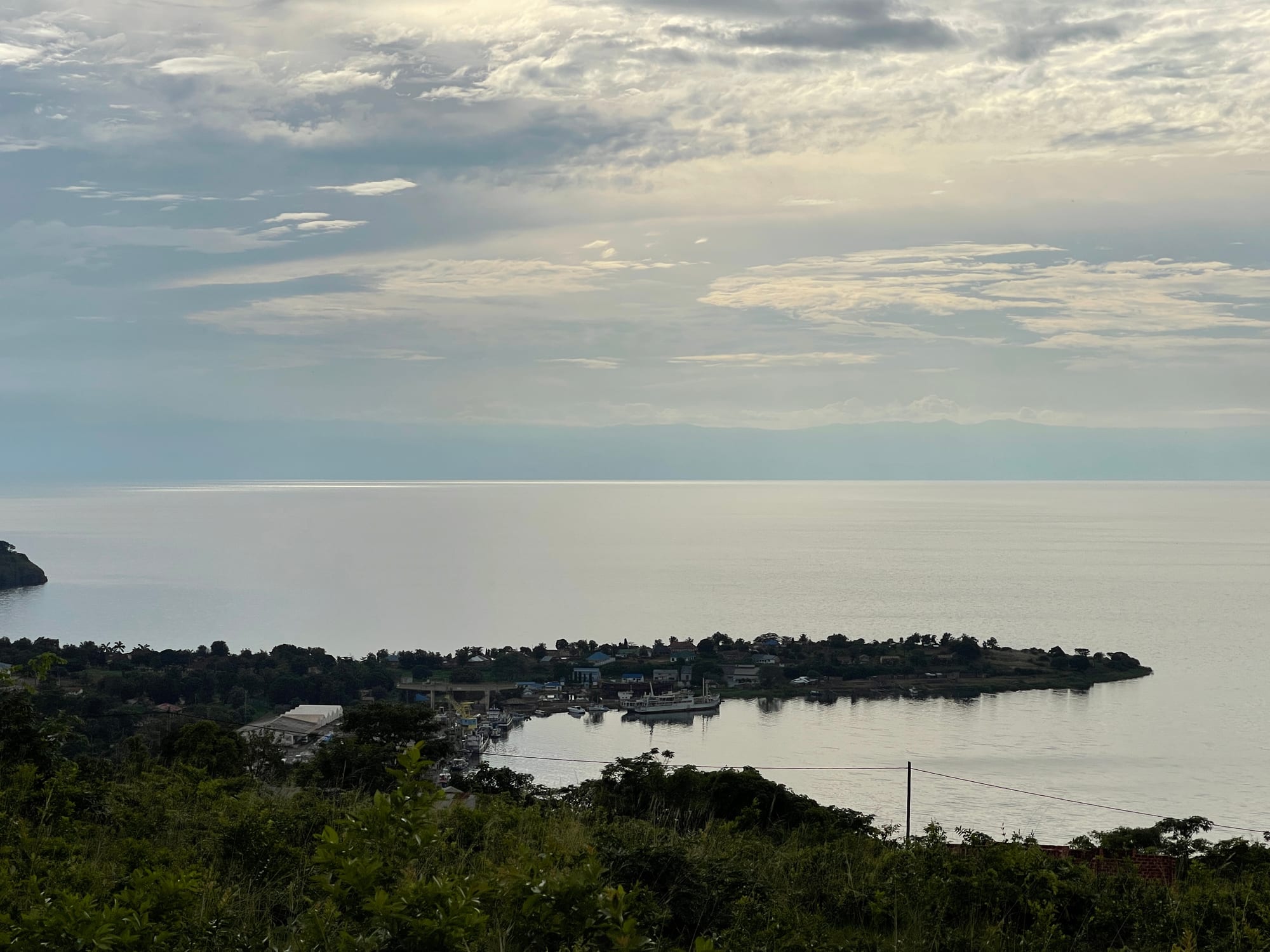
A wooded headland and small harbour below green hills, with the wide pale surface of Lake Tanganyika stretching to distant mountains

Dodoma, Tabora & the West, Tanzania

Kigoma

Kigoma's bay and harbour on Lake Tanganyika, with the Congolese shore on the far horizon. (Halidtz / Wikimedia Commons · CC BY-SA 4.0)

Tanzania's main port on Lake Tanganyika, in the far west near the Burundian and Congolese borders. Built by the Germans as the terminus of the central railway from the coast, it sits above a deep bay beside the older Swahili town of Ujiji, and serves as the jumping-off point for the chimpanzee forests of Gombe and Mahale.

Neighbourhoods

  • The town centre and station area
    • First-time visitors
    • Close to transport
    • Historic district

    The colonial-era core, laid out on a slope above the bay around the railway station and the broad avenue that runs down to the water. Banks, offices, the market and most hotels are within a short walk, and the port lies at the bottom of the hill.

    Open in Maps
  • The port and lakeshore
    • Boats and ferries
    • Views

    The working waterfront where ferries, cargo boats and lake taxis load for Burundi, Zambia and the Congolese shore. Fishing boats and their crews share the bay, and the view west across open water reaches the mountains of the Democratic Republic of the Congo.

    Open in Maps
  • Ujiji
    • Historic district
    • Local life

    The old Swahili lake town about six kilometres south-east, older than Kigoma and once the great slave and ivory port of the interior. Its mud-and-lime houses, mosques and markets have a distinctly coastal feel, and the Livingstone story is marked here.

    Open in Maps
  • The hill wards
    • Quiet and residential
    • Views

    Residential neighbourhoods spreading over the ridges behind the bay, with schools, churches, small shops and mango trees. The roads along the tops give long views down over the harbour and the lake.

    Open in Maps

Things to do

In the town

  • MV Liembaattraction

    The lake steamer built in Germany in 1913 as the Graf von Goetzen, shipped out in 5,000 crates and reassembled here, scuttled by her crew in 1916, raised in the 1920s and back in service as the Liemba from 1927, long a fixture of the run south to Mpulungu.

    Open in Maps
  • Kigoma Airporttransit hub

    The town's small airport, with domestic flights that spare travellers the very long road and rail journeys from the rest of Tanzania.

    Open in Maps

Along the lake

  • Ujijineighborhood

    The oldest town in western Tanzania, about six kilometres south-east and a registered national historic site, the inland end of the caravan route from the coast, where Henry Morton Stanley found David Livingstone on 10 November 1871; a memorial and small museum mark the spot.

    Open in Maps
  • Gombe Stream National Parkpark

    One of Tanzania's smallest national parks, 35 square kilometres of steep forested valleys along the lake shore north of Kigoma, reachable only by boat, where Jane Goodall began her study of wild chimpanzees in 1960 and habituated groups are followed on foot.

    Open in Maps

Eat and drink

Long-standing places and food districts in Kigoma. Hours, ratings and directions come from your maps app, always current.

Markets

  • Kigoma central marketmarket

    Cassava, beans, palm oil, bananas and mounds of dried dagaa from the lake, along with the day's fresh catch and produce from the hills.

    Open in Maps
  • Ujiji marketmarket

    The older town's market, with a Swahili and coastal character, selling fish, cassava flour, fruit and the red palm oil pressed in villages nearby.

    Open in Maps

Food districts

  • Lakeside fish grillsneighborhood

    Basic bars and grills near the water cook lake fish over charcoal and serve it with ugali, rice or chips, usually with kachumbari salad.

    Open in Maps
  • Town-centre eating housesneighborhood

    Small restaurants near the station and the main road serve beans, greens, goat stew, pilau and chapati, and a few cook Congolese-style dishes in palm oil.

    Open in Maps

Experience Kigoma

History

Ujiji, just south of today's town, is the older place: a Swahili-speaking port where Arab and coastal traders settled in the 19th century at the western end of the central caravan route, dealing in ivory and enslaved people carried between the lake and the Indian Ocean. Richard Burton and John Hanning Speke reached it in 1858, and in November 1871 Henry Morton Stanley found David Livingstone there, the meeting that made the town's name known far beyond Africa.

Kigoma itself was a German creation. The colonial administration chose the deep, sheltered bay a few kilometres north as its lake harbour, and drove the central railway west from Dar es Salaam to reach it in 1914, building a substantial station and port at the terminus. The Graf von Goetzen, later the MV Liemba, was assembled here in the same period. In the First World War Belgian forces from the Congo and British troops contested the lake, and the ship was scuttled in 1916.

Under British rule Kigoma remained the end of the line and the gateway west, its trade tied to the lake and the railway rather than to the rest of Tanganyika. In 1960 a young researcher, Jane Goodall, arrived by boat to begin work in the forests north of the town, and Gombe became one of the best-known field sites in science. From the 1970s onwards Kigoma has repeatedly received refugees from conflicts in Burundi and the Democratic Republic of the Congo, and cross-border trade, aid operations and the camps have shaped the town's modern character.

Culture & Customs

The countryside around Kigoma is Ha country, and the Ha language belongs with those of Burundi across the border rather than with the languages of central Tanzania; cattle, drumming and elaborate greetings all have their place in Ha custom. Swahili, however, is the language of the town, and Kigoma is one of the more cosmopolitan small towns in Tanzania, mixing Ha, coastal, Congolese and Burundian ways of doing things.

Ujiji's character is Swahili and Muslim, with mosques, coastal-style houses, kanga and kanzu worn in the street and the rhythm of Ramadan observed publicly. Christianity, Catholic and Protestant, predominates in the surrounding hills and in much of Kigoma itself, and mission schools and health centres are long established. The two communities live side by side without much friction.

Music comes across the water: Congolese rumba and soukous have been popular here for decades and are played in bars and on buses alongside Tanzanian Bongo Flava. Decades of refugee arrivals and of aid agencies working in the region have left the town used to outsiders and to several languages at once, and Kiswahili is the common ground. Greetings precede everything, elders are addressed with shikamoo, and business is done slowly and politely.

Daily Life

About 232,000 people lived in Kigoma at the 2022 census, and the town has a working rather than a touristic feel. The port, the railway, government offices, the regional hospital, trade with the borders and the presence of international agencies are the main sources of paid employment.

Most households, though, live from the lake and the land. Fishing crews go out at night with lamps for dagaa, the small sardine-like fish that are dried in the sun on racks and mats along the shore, and boats also bring in larger lake fish. Inland, families grow cassava, beans, maize, bananas and oil palms, and the red palm oil pressed in the villages is sold across the region. Cross-border trade moves goods between Tanzania, Burundi, the DR Congo and Zambia.

The day begins before dawn at the landings and the market, slows in the heat, and revives in the evening when the lake breeze comes up and people walk along the shore. Current issues include the long-term hosting of refugees in the region's camps, deforestation in the hills behind the town, pressure on the lake's fish stocks, and the isolation that comes from being the better part of two days' travel from Dar es Salaam by road or rail.

Food

Kigoma's kitchen is the lake's. Dagaa, tiny silver fish caught at night and dried on the shore, are fried with tomato and onion and eaten with ugali, which here is often made from cassava flour rather than maize. Larger lake fish are grilled over charcoal or simmered in tomato sauce, and the catch changes with the season and the depth the boats work.

Red palm oil is the distinctive local ingredient, pressed from oil palms in the villages around the town and giving stews of beans, greens and fish a deep colour and a strong flavour that is unusual in Tanzania. Cassava is eaten as flour, as boiled root and as leaves cooked into a relish — a habit shared with the Congo across the water — and bananas, groundnuts and beans fill out the everyday plate.

Street food follows the national pattern: chapati, mandazi, samosas, roasted maize and skewers of grilled meat, with chai brewed strong and sweet in the morning. Congolese-style dishes appear in small restaurants near the port, and Kigoma's name is attached across Tanzania to its dagaa and to the oil-palm products sent east by train and road.

Planning tools

Budget

The town is cheap — guesthouses, market food and shared transport cost little, and even the better hotels above the bay are moderate. The expense is everything on the water: park fees at Gombe are high, the boat there is hired rather than scheduled, and Mahale is a costly trip of its own.

Daily Budget Midrange
USD 70–150 (good hotel above the bay, restaurant meals, taxis; Gombe and Mahale cost far more)
Daily Budget Shoestring
USD 25–45 (guesthouse, local food, dalla dallas and the market)

Sharing a hired boat to Gombe with other travellers is the single biggest saving; budget for park fees separately and carry cash, since few places take cards.

Best Time to Visit

June to October is the dry season, when roads and forest trails are easier and lake travel is more settled, though chimpanzees may range higher up the slopes late in the dry months. The rains from about November to April bring heat, mud and slower journeys, and greener hills.

Suggested Number of Days

The town and the old lake port beside it fill a day or two. Allow four or five days to add Gombe, and longer again for the Mahale Mountains far to the south, where the boat journey alone takes most of a day each way.

First Visit
1–2 days
With Surroundings
4–5 days

Transportation

Kigoma is small enough to cross on foot, with dalla dalla minibuses, motorcycle taxis and ordinary taxis for longer hops and for Ujiji. The water is the region's other road: lake taxis and hired boats run north along the shore, a ferry works the long route south to Mpulungu in Zambia, and ships from Burundian and Congolese ports call at Kigoma.

Agree taxi and boat fares in advance, allow generous margins around lake departures, which are weather-dependent, and avoid travelling rural roads after dark.

Airport & Station Connections

Kigoma is the western terminus of the old metre-gauge central railway from Dar es Salaam by way of Dodoma and Tabora, a journey of about forty hours by the timetable. Buses take the long road east, and Kigoma Airport has domestic flights that cut a two-day trip to a couple of hours. Ferries connect the port with other lake towns and countries.

Walkability

The centre is compact and walkable, though it is built on a slope: the walk down to the port is easy and the climb back is not, especially in the middle of the day. Pavements are limited and street lighting is patchy, so most people take a motorcycle taxi after dark or to reach Ujiji.

Safety

Kigoma is generally quiet, with the usual petty theft around the market, the station and the port. Road accidents on long rural highways and the lake itself are the greater risks, as small boats can be caught by sudden storms. Kigoma hosts large camps of refugees from Burundi and the DR Congo, and the border areas see a strong security presence. Malaria is present year-round.

Choose well-maintained boats with life jackets on Lake Tanganyika, travel by day on rural roads, and keep a respectful distance from the chimpanzees. Carry identification near the borders and take malaria precautions. Check current official travel advice before travelling.

Climate

Warmer and more humid than the central plateau, sitting at about 775 metres beside a very large body of water, with green hills behind the town. There is one long wet season from about November to April and a pronounced dry season in the middle of the year.

Summer
November to April is hot and humid, with days around 29–31°C and heavy rain, especially from December to April
Winter
June to August is dry and a little cooler, with days around 27–29°C and comfortable nights

Local Customs

Kigoma is mixed: the Ha of the surrounding countryside, Swahili-speaking lake traders, long-settled Muslim families in Ujiji and people from across the borders. Islam is strong in Ujiji and Christianity in much of the rest of the region, so modest dress is expected, particularly near mosques. Greetings are formal and unhurried, and Congolese music is part of the local soundtrack.

Ask before photographing people, and avoid photographing the port, the railway, border posts, military sites or refugee facilities; tipping is not expected outside tourist lodges.

Common Payment Methods

The currency is the Tanzanian shilling. Banks and ATMs are in the town centre, but they can run out of notes, and cards are accepted only at the larger hotels and tour operators. Boats, guesthouses, markets and park transport are cash businesses, and some park fees may be quoted in US dollars.