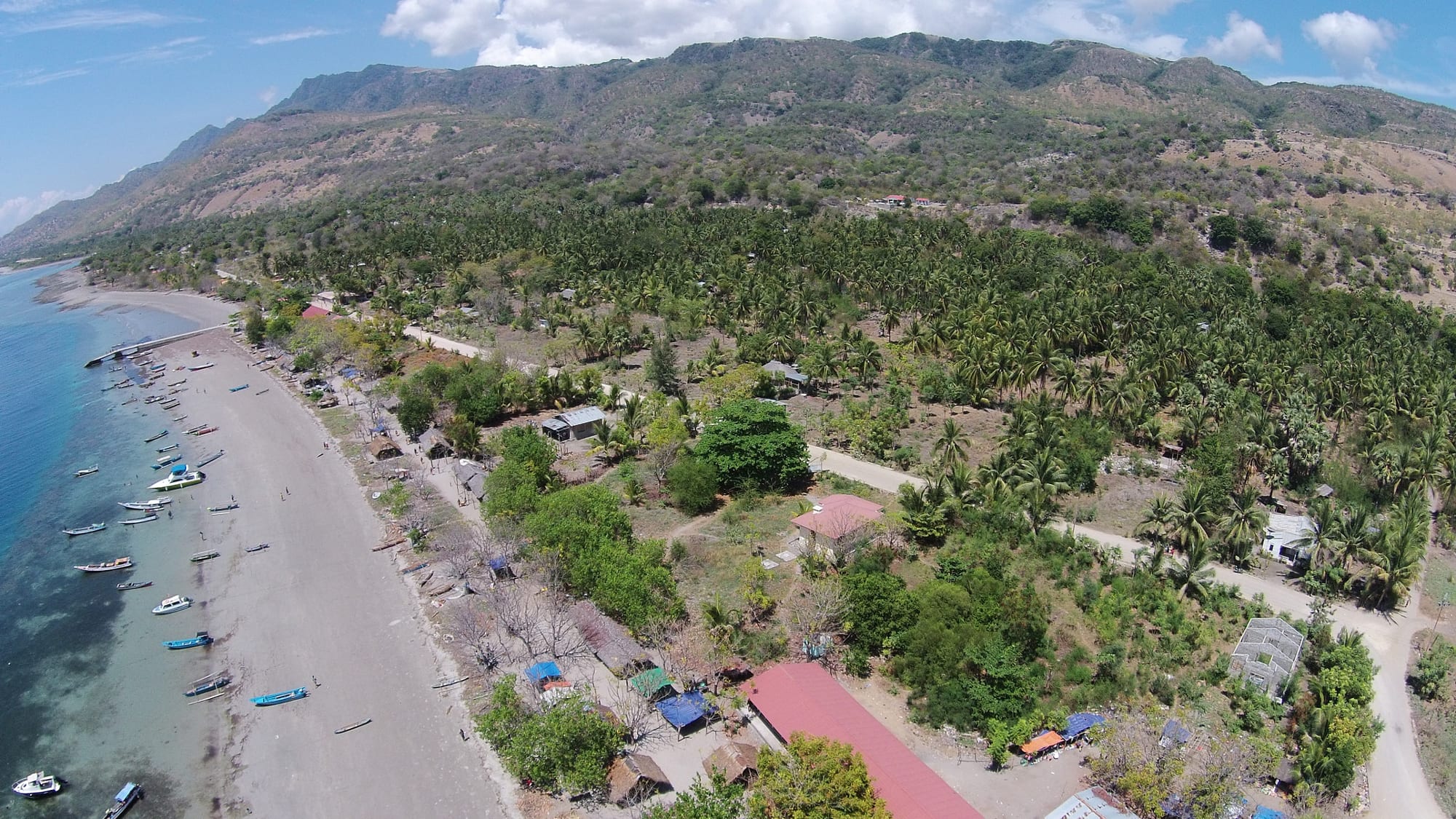
Aerial view of a grey-sand beach lined with small fishing boats, a village under palms and a long forested ridge behind

Timor-Leste

Atauro Island

The shore south of Beloi on Atauro, with outrigger boats drawn up on the beach below the island's central ridge. (Joshvdbroek / Wikimedia Commons · CC BY 3.0)

A steep, dry island about 25 kilometres north of Dili, rising to a forested ridge above villages strung along a narrow coastal shelf. Used by the Portuguese as a place of exile and long isolated from the mainland, it now lives from fishing, goats and a small number of village-run guesthouses, and its reefs, which drop away a short swim from the beach, are among the richest surveyed for reef fish anywhere.

Neighbourhoods

  • Vila Maumeta
    • First-time visitors
    • Services
    • Close to the boat

    The island's administrative centre on the east coast, with the municipal offices, a school, a clinic, a few shops and a church. Boats from Dili tie up here or just to the north, and the main road runs through it.

    Open in Maps
  • Beloi
    • Beaches
    • Diving and snorkelling
    • Markets

    The landing and beach village a short way north of Vila Maumeta, where the ferry from Dili unloads and most visitors stay. Fishing boats line a long grey beach, a market sets up on ferry days, and the reef starts a few metres offshore.

    Open in Maps
  • The west coast
    • Quiet and remote
    • Snorkelling
    • Sunsets

    A scatter of small fishing settlements below the ridge on the far side of the island, reached by a rough track or by boat. There is very little here beyond the sea, the houses and a view west towards the Indonesian island of Alor.

    Open in Maps
  • The highland villages
    • Walks and viewpoints
    • Local life

    Makadade and the other settlements on the plateau inland, an hour or more of climbing, where the air is cooler, goats graze the stony slopes and the whole strait is in view from the paths.

    Open in Maps

Things to do

The water

  • Beloi's house reefsbeach

    Coral reef within swimming distance of the beach at Beloi, where surveys have recorded exceptionally high numbers of reef fish species, snorkelled straight from the sand or dived from small boats.

    Open in Maps
  • Whale and dolphin watching in the straitattraction

    The deep water between Atauro and Timor forms part of the Ombai–Wetar corridor, a migration route for whales and dolphins, and boat trips run from the island to look for them; dolphins and the smaller whale species are seen through the year.

    Open in Maps
  • Adara and the western beachesbeach

    Quiet stony and sand beaches on the far coast, backed by fishing hamlets and reached by boat or a long walk over the ridge.

    Open in Maps

Walks and viewpoints

  • Manucocoviewpoint

    The island's highest point, just under 1,000 metres, climbed on foot from the east coast villages through dry forest to views over the strait and back to the Timor mainland.

    Open in Maps
  • Makadadeneighborhood

    A plateau village high above the coast, the usual destination of a morning's walk, with terraced gardens, goats and a wide outlook over the sea.

    Open in Maps

Villages and crafts

  • Beloi marketmarket

    An informal market on the beach at Beloi, at its busiest when the boat from Dili arrives, selling fish, vegetables, woven goods and the island's carved wooden figures.

    Open in Maps
  • Island wood carving and weavingattraction

    Carved wooden figures and woven goods are made in several villages on the island and sold on the beach and in Dili.

    Open in Maps

Across the water

  • Diliattraction

    The capital, about 25 kilometres south across the strait, with the Cristo Rei statue, the resistance museums and the country's markets and restaurants.

    Open in Maps

Eat and drink

Long-standing places and food districts in Atauro Island. Hours, ratings and directions come from your maps app, always current.

On the island

  • Village guesthouse kitchensrestaurant

    Almost all meals on Atauro are eaten where visitors sleep — fish landed that morning, rice, cassava and its leaves, pumpkin and beans, cooked by the family running the place.

    Open in Maps
  • Grilled fish at Beloirestaurant

    Tuna, mackerel and reef fish grilled over coconut husks near the landing, usually with rice, lime and a fresh chilli sauce.

    Open in Maps
  • Beloi marketmarket

    The place to buy fruit, vegetables brought down from the plateau, dried and fresh fish, and bread carried over from the mainland.

    Open in Maps

Experience Atauro Island

History

Atauro's people are linked as much to the islands to the north as to Timor: the languages spoken here belong to the same group as those of Wetar and Alor across the strait, and fishing and trade ran that way for centuries. The island had no single ruler, but several small chiefdoms on the coast and the plateau, and its dryness kept the population small.

Portuguese authority arrived late and lightly. From early in the Portuguese period the island was used as a place of banishment, taking political prisoners and others out of Dili, and the practice continued into the twentieth century; in the 1980s the Indonesian military held captured Timorese guerrillas here in the same way. That shared experience is part of how Atauro is remembered in Timor-Leste. Protestant missionaries working here in the later colonial decades also gave the island a religious character unlike the rest of the overwhelmingly Catholic country.

Atauro voted with the rest of Timor-Leste in 1999. It was governed as part of the Dili district after independence, and in 2022 it was made a municipality in its own right, giving the island its own administration for the first time. Marine surveys in the mid-2010s found extraordinary numbers of reef fish species in its waters, and the small, community-run tourism that followed — along with proposals to designate the island and its waters as a marine protected area — has become its main new source of income.

Culture & Customs

The island's own speech, Atauran, spoken in varieties around Beloi, Makadade, Biqueli and Makili, is closely related to Wetarese of the islands to the north and is not intelligible to Tetum speakers from the mainland; Tetum is the shared language and Indonesian and some English are heard where visitors come. People often describe themselves as Atauro islanders first.

Religion is the clearest difference from the rest of the country. Protestant congregations, established here in the decades before independence, are strong enough that church bells and hymn singing, rather than a Catholic mass, mark Sunday in many villages, though Catholic parishes exist too and older beliefs about ancestors, sacred places and the sea persist alongside both.

Carving is one of the island's crafts: wooden figures of standing men and women, cut from local timber, are sold in Dili's markets, and weaving and basketry are made in the same villages. Life is organised around fishing crews, extended families and the church, and decisions about reefs and fishing grounds are taken collectively rather than by the state. Visitors are welcomed calmly rather than eagerly; a greeting and a little patience go a long way, and hurrying anyone is poor manners.

Daily Life

About 10,000 people live on Atauro, spread between the coastal villages and the plateau settlements. Fishing is the mainstay — hand lines and small outriggers, with tuna and reef fish sold fresh, dried or salted and some carried to Dili by boat — alongside goats, maize, cassava and vegetables grown on stony terraces, and salt made along the shore. Guesthouses, dive operations and boat work now support a growing number of families, and money sent home from relatives working in Dili or abroad matters here as everywhere in the country.

Water is the daily constraint. The island is dry, springs are few, and carrying or piping water to houses takes up part of every morning; electricity reaches the larger villages but is not constant. There is a clinic rather than a hospital, a secondary school on the east coast, and a mobile signal that fades on the far side of the ridge.

Days start early and finish early. Boats go out before dawn, the market at Beloi is busiest when a boat from Dili is due, and by mid-afternoon the heat empties the tracks. Younger people leave for the capital to study or work and return for festivals and family ceremonies, and the new municipal status has brought building work, more officials and hopes of better roads and water supply.

Food

Food on Atauro is fish, and what will grow on a dry hillside. The catch — tuna, mackerel, parrotfish and other reef fish — is grilled whole over coconut husks or stewed with tomato, garlic and chilli, and what is not eaten fresh is split and dried in the sun. Rice is mostly imported from the mainland, so meals lean on boiled cassava and its leaves cooked as a green, maize, sweet potato, pumpkin, green papaya and mung beans. Batar daan, the maize, mung bean and pumpkin dish eaten across Timor-Leste, is standard home cooking here.

Meat is for occasions: goat above all, roasted or stewed for a feast or a church celebration, and chicken for a guest. Coconut appears in everything, grated into vegetables or squeezed for milk, and sea salt produced on the island seasons it. Fruit depends on the season and the rain — mango, banana, papaya, and the sour tamarind used to sharpen a fish stew.

Drinking is simple: strong Timorese coffee from the mainland highlands, black and sweet; coconut water; palm wine tapped from the island's palms, fresh or distilled into a spirit for ceremonies; and imported beer where lodges stock it. Guesthouse kitchens cook whatever the boats and gardens produced that day, so meals are decided for the visitor rather than chosen.

Planning tools

Budget

Costs on Atauro are lower than in Dili for food and higher for everything that has to be shipped or arranged. Village guesthouses and eco-lodges usually quote a nightly price that includes meals, which is how most visitors pay; diving packages, boat trips and guided walks are the main extras. There is very little else to spend money on.

Daily Budget Midrange
USD 90–200 (eco-lodge with meals, fast boat transfers, dive packages and guided walks)
Daily Budget Shoestring
USD 35–60 (village guesthouse with meals included, the public ferry, walking)

Bring all the cash needed for the stay in small US dollar notes — there are no reliable ATMs on the island and cards are not accepted.

Best Time to Visit

June to November, the dry season, when the sea is calm, underwater visibility is at its best and the boats run most reliably. Whales and dolphins migrate through the strait, and dolphins and the smaller whales are present all year. The wet months, December to May, bring heavy rain, rougher crossings and days when the small boats do not sail at all.

Suggested Number of Days

Two or three days suit the island, since boat schedules mean arriving one day and leaving another. Divers and walkers take four or five. Crossings are limited and weather-dependent, so it is worth allowing a spare day before any onward flight.

First Visit
2–3 days
With Surroundings
4–5 days

Transportation

There are no taxis and almost no public transport. One rough road runs along the east coast and a track climbs to the plateau; guesthouses move guests by pick-up or motorbike, and small boats are often the easier way to reach the west coast. Otherwise people walk, and distances between villages are longer and steeper than they look on a map.

Transfers, boat trips and guides are best arranged through the guesthouse in advance, as there is little to hire on the spot.

Airport & Station Connections

Boats leave from the port in Dili, about 25 kilometres south: the Berlin Nakroma, a passenger and vehicle ferry that takes about two hours and sails on certain days only, and faster fibreglass boats that make the crossing more quickly. Both land at or near Beloi on the east coast. The island's old airstrip is no longer usable by fixed-wing aircraft. Crossings can be cancelled in rough weather.

Walkability

Everything within a village is walked, and the flat coastal strip between Vila Maumeta and Beloi is an easy stroll. Beyond that the island rises steeply, paths are stony and unshaded and the heat is serious, so walks to the plateau or across to the west coast are half-day efforts best started early with a guide and plenty of water.

Safety

Atauro is peaceful and theft is rare, but it is remote: there is a small clinic and no hospital, phone signal is patchy, and serious cases have to be moved to Dili or flown to Darwin. The real risks are sea conditions and currents, sunburn and dehydration on the ridge paths, and injuries far from help. Malaria and dengue precautions apply as on the mainland.

Drive cautiously and only in daylight outside towns, take mosquito precautions, avoid isolated areas of Dili at night, and carry insurance with evacuation cover to Australia. Check current official travel advice before travelling.

Climate

Hot, tropical and notably dry — the island sits in a rain shadow, its hillsides brown for much of the year, and fresh water is scarce. Coastal days run to about 31–33°C with nights near 23°C, and the plateau is several degrees cooler.

Summer
the wet season, December to May, brings short heavy downpours, humid days near 31°C and the roughest sea crossings
Winter
the dry season, June to November, is sunny with days around 30–32°C, cooler nights and the calmest water

Local Customs

Village life is close and visitors are noticed. Tetum works everywhere, though the island's own languages, related to those of the islands to the north, are what people speak at home. Unusually for Timor-Leste, a large share of the population is Protestant, and Sunday services are long and well attended. Dress modestly away from the beach, and swim in a t-shirt if villagers are about.

Ask before photographing people, houses or ceremonies, ask before walking through gardens or taking a path past a house, and take rubbish back to the mainland, since the island has almost no way of dealing with it.

Common Payment Methods

The currency is the US dollar, with Timorese centavo coins for change. Atauro runs on cash: there are no dependable ATMs and no card payments outside a lodge or two, so bring small notes from Dili for meals, boats, guides and anything bought in a village.