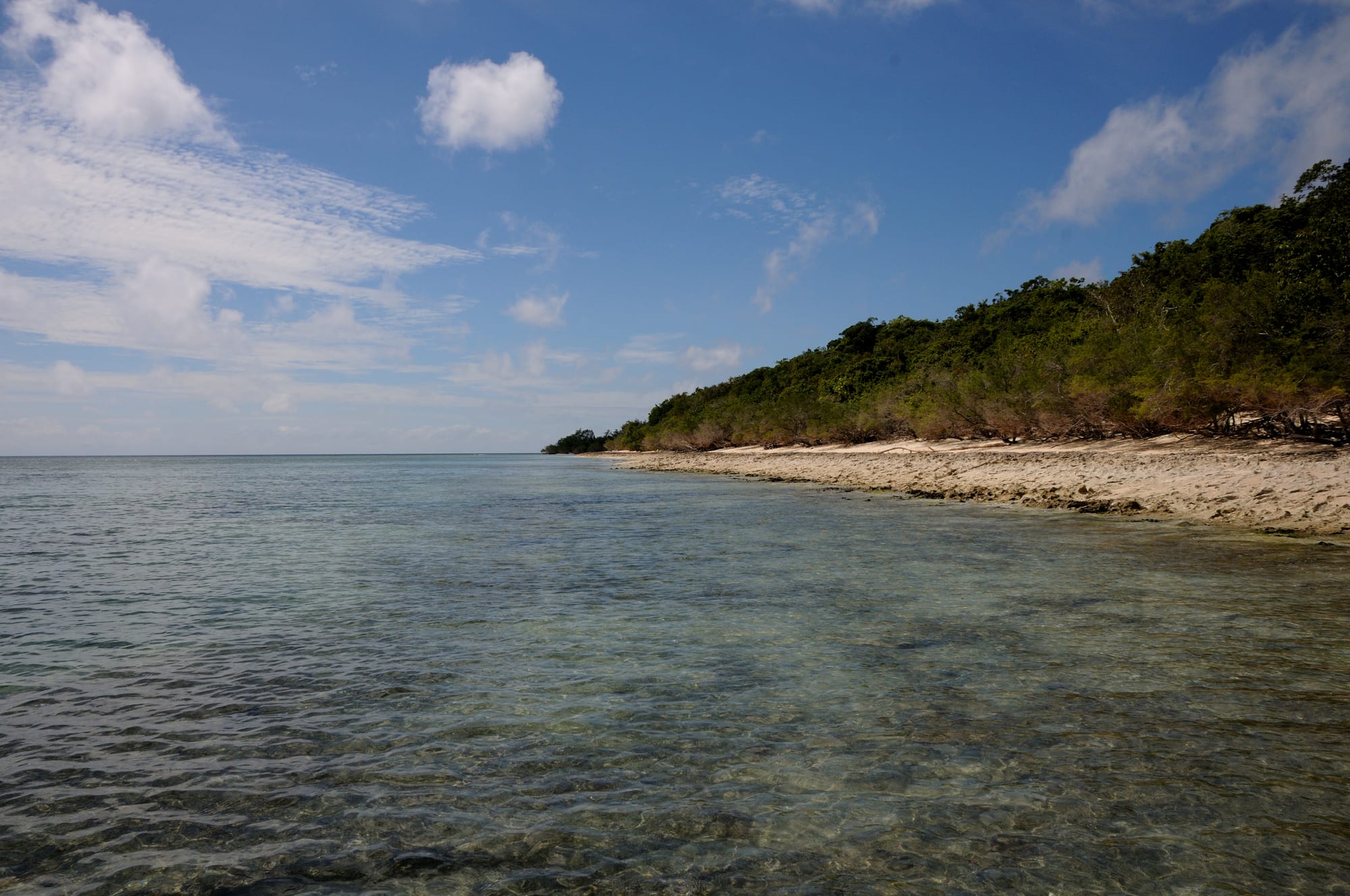
A curve of white-sand beach meeting clear turquoise water, backed by dry scrub and low hills under a bright sky

Timor-Leste

The coast of Jaco Island, an uninhabited islet at the eastern tip of Timor, considered sacred by local communities. (Josep M. Gracia / Wikimedia Commons · CC BY-SA 4.0)

The eastern half of the island of Timor — a former Portuguese colony invaded by Indonesia in 1975, which endured a brutal 24-year occupation before voting for independence in 1999 and becoming fully sovereign in 2002, the first new nation of the 21st century.

Explore Timor-Leste

History

Timor was drawn into Indian Ocean trade for its sandalwood, and Portuguese traders arrived in the sixteenth century, followed by Dominican missionaries. The island was eventually divided between Portugal (the east, plus the Oecusse enclave) and the Dutch (the west, later part of Indonesia). Portuguese Timor remained a neglected colony into the 1970s.

When Portugal's dictatorship fell in 1974, Timorese parties moved toward independence, and Fretilin declared it on 28 November 1975. Nine days later Indonesia invaded. The occupation that followed lasted 24 years and was exceptionally violent: through fighting, forced relocation, and induced famine, an estimated 100,000 to 180,000 Timorese — a large share of the population — died. The 1991 Santa Cruz massacre in Dili, filmed by a foreign journalist, brought international attention, and resistance leaders Xanana Gusmão and José Ramos-Horta became global figures, Ramos-Horta and Bishop Belo sharing the 1996 Nobel Peace Prize.

After Indonesia's President Suharto fell, a UN-run referendum on 30 August 1999 saw voters overwhelmingly reject autonomy within Indonesia. Pro-Indonesian militias, backed by the military, responded with a scorched-earth campaign that destroyed most of the country's infrastructure and displaced hundreds of thousands, until an Australian-led international force restored order. After a UN transitional administration, Timor-Leste became fully independent on 20 May 2002. An internal crisis in 2006 brought renewed violence and another international deployment, but the country has been stable since, holding a series of peaceful elections. It was admitted to full membership of ASEAN in 2025.

  • Timor-Leste: The Nation That Outlasted an Occupation — The eastern half of a small island, colonised by Portugal for four centuries — independent for nine days in 1975 before Indonesia invaded, then held for 24 years at the cost of more than 100,000 lives, and finally free in 2002

Culture & Customs

Timorese society blends Malayo-Polynesian and Melanesian roots, Catholicism, and strong customary law known as lisan or adat. The Catholic Church, which stood with the population during the occupation, commands deep loyalty; Timor-Leste is one of the most Catholic countries in the world, and church holidays and processions are major events.

Alongside this, traditional belief in ancestral spirits and sacred sites remains powerful. The uma lulik, or sacred house, is the ritual centre of a clan, and ceremonies around marriage, death, and house-building involve the exchange of buffalo, pigs, textiles, and heirlooms, and can be very costly. Tais, the handwoven cloth of each region, carries identity and is given at every important occasion.

The struggle for independence is central to national identity, commemorated in monuments, place names, and public holidays, and many leaders of today are veterans of the resistance.

  • Timor-Leste: The Sacred and the Woven — A devoutly Catholic nation that still honours its ancestors and sacred houses, where customary law is hung from a wooden post and a handwoven cloth marks every turning point of life

Daily Life

About 1.4 million people live in Timor-Leste, a very young population, mostly rural and dependent on subsistence farming — maize, rice, cassava, and vegetables — and on coffee, the main non-oil export, grown in the highlands. A large share of the population lives in or around Dili, the capital and by far the largest city.

The state is heavily dependent on oil and gas revenue from the Timor Sea, saved in a sovereign Petroleum Fund that finances most of the budget; the fields in production are declining, and the future of the large Greater Sunrise field — long disputed with Australia, with the maritime boundary settled in 2018 — remains unresolved. Poverty, child malnutrition, and unemployment are high, and many young Timorese seek work abroad, especially in Australia and the UK.

Life is slow-paced and community-oriented, organised around the church, the extended family, the market, and customary obligations.

  • Timor-Leste: The Clan House and the Sunday Market — Subsistence farming that still feeds most households, a sacred clan house at the centre of family obligation, and one of the most devoutly Catholic populations on Earth living alongside older beliefs in ancestral spirits

Food

Timorese cooking is simple and rooted in what the land provides. Batar da'an, a stew of corn, mung beans, and pumpkin, is a national comfort food. Rice, boiled cassava and its leaves, sweet potato, and grilled or stewed fish, chicken, and pork are everyday fare, often with budu, a fresh sauce of tomato, mint and lime.

Portuguese influence lingers in feijoada (pork, beans and chorizo), egg tarts and strong coffee, while Malay and Indonesian influence shows in the warungs of Dili. Ikan sabuko (Spanish mackerel in a tamarind marinade) and caril, a mild chicken curry, are other well-known dishes.

Timor-Leste's high-grown Arabica coffee, largely organic by default, is prized by specialty roasters abroad. Tapai, a sweet-sour fermented rice dish, is slightly alcoholic, and imported beer is widely available.

Attractions & Natural Wonders

Dili has the towering Cristo Rei statue on a headland at the end of a scenic walk, the resistance museum (Arquivo & Museu da Resistência Timorense), the Santa Cruz cemetery, the Portuguese-era Government Palace and waterfront, and the tais market. It also has many good dive sites close to the city, and the beach at Areia Branca.

Atauro Island, a ferry ride north of Dili, has some of the most biodiverse reefs ever surveyed, community-run eco-lodges, and hiking to its peak. At the eastern end of the country, Tutuala village looks down on Valu Beach and Jaco Island, an uninhabited islet held sacred locally, where visitors can be ferried across for the day but not stay overnight, within Nino Konis Santana National Park.

Inland, Mount Ramelau (Tatamailau), the highest peak at 2,963 metres, is climbed before dawn from the village of Hato Builico to a summit statue of the Virgin Mary. The former Portuguese hill town of Maubisse, the coffee country around Letefoho, and the south-coast wetlands and the Oecusse enclave round out a country that rewards patience and a tolerance for rough roads.

Planning basics

Budget

Timor-Leste is more expensive than its development level suggests, because imports, fuel, and the small hospitality sector (built around Dili and the dive scene) carry high prices. Outside Dili and Atauro, options are basic guesthouses and homestays, and getting around eats into the budget.

Daily Budget Midrange
USD 90–200 (hotel, restaurants, a hired vehicle with driver, dive packages)
Daily Budget Shoestring
USD 35–60 (Dili guesthouse, local warung food, microlets and shared transport)

Base in Dili and take day or overnight trips; hire a sturdy 4x4 with a driver for the mountains, as roads are rough and slow.

Visa Requirements

Most nationalities can obtain a visa on arrival at Dili airport, the Dili sea port, and the Batugade land border for a fee of USD 30, valid for 30 days and extendable to a total stay of 90 days. Arrivals at other points generally need a visa in advance. A passport valid for six months is required.

Typical Stay
30 days on a visa on arrival, extendable in Dili

Carry US dollars in cash for the visa fee on arrival, and an onward ticket.

Safety

Timor-Leste is largely peaceful and friendly to visitors, a marked change from the instability of the mid-2000s. The main risks are road accidents on poor mountain roads, petty theft in Dili (including after dark and on quiet beaches), occasional gang or martial-arts-group scuffles, and natural hazards — flooding, landslides, and strong ocean currents. Medical care is very limited.

Health
Timor-Leste was certified malaria-free by the WHO in 2025, but dengue is present — take mosquito precautions; tap water is not safe; the nearest good hospital is in Darwin, Australia

Drive cautiously and only in daylight outside towns, take mosquito precautions, avoid isolated areas of Dili at night, and carry insurance with evacuation cover to Australia.

Climate

Tropical and monsoonal. The wet season runs roughly December to May, with heavy rain that damages roads and can cut off districts; the dry season, June to November, is sunny and warmer, and the standard time to travel. The mountains are noticeably cooler, and the south coast is wetter than the north.

Dry Season
June–November
Wet Season
December–May (roads often impassable)

Transportation

Dili's Presidente Nicolau Lobato airport has flights to Bali, Darwin, and Singapore. There is no railway. Travel within the country is by shared minibus (microlet in Dili, mikrolet/angguna between towns), hired 4x4, or ferry to Atauro and the Oecusse enclave. Mountain roads are narrow, winding, and frequently damaged.

Allow far more time than distances suggest, hire a 4x4 with a local driver for the districts, and check road conditions after rain.

Best Time to Visit

June to October, the heart of the dry season, offers the best road conditions, hiking, and diving visibility. Whales and dolphins are found offshore, and whale watching is possible from Dili. Avoid the wet season for any travel outside Dili.

Events
Restoration of Independence Day (20 May); Popular Consultation Day (30 August); All Souls' Day; Christmas and Easter, widely observed

Currency

Timor-Leste uses the US dollar as its currency, with its own centavo coins for small change. It is largely a cash economy; ATMs exist in Dili and a few district towns but are unreliable, and cards are rarely accepted outside larger hotels.

Symbol
$
Currency Code
USD — United States dollar (with local centavo coins)

Language

Tetum and Portuguese are the official languages; Tetum is the everyday lingua franca and Portuguese is used in law, government, and part of education. Indonesian and English are "working languages" and widely understood, and around 30 indigenous languages are spoken.

Working Languages
Indonesian and English
Official Languages
Tetum and Portuguese