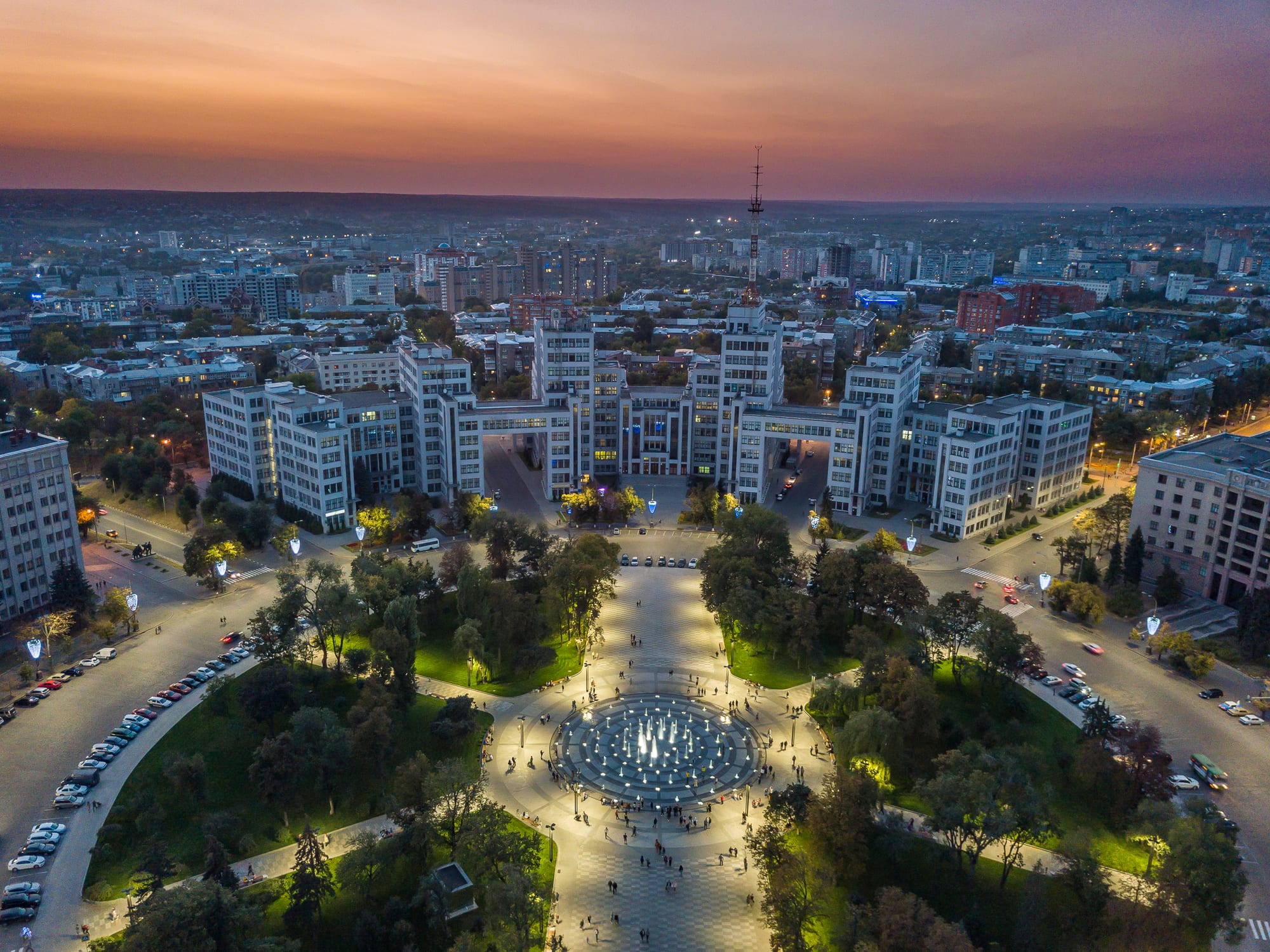
Aerial view of a large constructivist building complex beside a broad city square

Eastern Ukraine, Ukraine

Kharkiv

Derzhprom, the constructivist State Industry building of the 1920s, on Freedom Square in Kharkiv. (Konstantin Brizhnichenko / Wikimedia Commons · CC BY-SA 4.0)

Ukraine's second city and the largest of historic Sloboda Ukraine, founded as a Cossack fortress in 1654, capital of Soviet Ukraine from 1919 to 1934 and a centre of universities, constructivist architecture and heavy industry. Close to the Russian border, it has been under attack since 2022, and in February 2026 its mayor reported that a quarter of the city had been destroyed. This page is written to explain the city, not to encourage travel.

Neighbourhoods

  • The historic centre
    • Historic district
    • Churches

    The area inside the walls of the 17th-century fortress, around Constitution Square, Pavlivskyi Square and the Sobornyi descent, with the Dormition Cathedral on University Hill above the Lopan and the Annunciation Cathedral nearby.

    Open in Maps
  • Sumska Street and Freedom Square
    • First-time visitors
    • Architecture
    • Close to public transport

    The main street runs north from Constitution Square past theatres, the Mirror Stream fountain and the Shevchenko Garden to Freedom Square, one of the largest squares in Europe, ringed by Derzhprom and other Soviet-era landmarks.

    Open in Maps
  • University and the parks
    • Students
    • Parks

    North of the centre, the Karazin university, the Shevchenko Garden with the zoo, and the Central Park, laid out in the 1890s, give this part of the city its green, academic character.

    Open in Maps
  • Saltivka
    • Residential
    • Local life

    The residential area that gives its name to the Saltivskyi raion, renamed from Moskovskyi in 2016. Human Rights Watch reported that cluster munitions were used in the district on 28 February 2022, in the first days of the invasion.

    Open in Maps
  • Industrialnyi district
    • Industrial heritage
    • Residential

    One of the city's nine raions, where the first of Kharkiv's underground schools opened in May 2024 so that children could keep studying through the missile strikes.

    Open in Maps

Things to do

Famous landmarks

  • Freedom Squarelandmark

    The largest square in the city and one of the largest in Europe, in two parts, round and rectangular, scene of protests, parades and public events.

    Open in Maps
  • Derzhpromlandmark

    The State Industry Building, completed in 1928, the first modern skyscraper of the Soviet Union and a constructivist landmark placed on UNESCO's tentative list in 2017; a guided bomb caused significant damage in October 2024.

    Open in Maps
  • Sumska Streetneighborhood

    The city's main street, from Constitution Square north past theatres and gardens, which began as the road from the fortress to Sumy.

    Open in Maps
  • Mirror Streamlandmark

    A fountain of 1947 near the Philharmonic, one of the city's best-known architectural monuments.

    Open in Maps
  • Kharkiv railway stationtransit hub

    The grand station opened in 1952 to replace one destroyed in the Second World War; parts of it were destroyed again in 2022.

    Open in Maps

Churches and synagogue

  • Annunciation Cathedrallandmark

    A five-domed Neo-Byzantine cathedral completed in 1888, with an 80-metre bell tower, once one of the largest and tallest churches of the Russian Empire.

    Open in Maps
  • Dormition Cathedrallandmark

    The old main church of the city on University Hill above the Lopan, with a 90-metre Neoclassical bell tower; the church shares the building with a philharmonic society, which installed an organ in 1986.

    Open in Maps
  • Kharkiv Choral Synagoguelandmark

    An Orthodox synagogue on Pushkinska Street that mixes Romanesque, Gothic Revival and Moorish Revival styles, fully renovated between 1991 and 2016.

    Open in Maps

Museums, universities and theatres

  • Kharkiv Art Museummuseum

    One of the largest collections of fine and applied art in the city, in a 1912 industrialist's mansion; the building was damaged in March 2022 and its most valuable works were evacuated.

    Open in Maps
  • Sumtsov Kharkiv Historical Museummuseum

    The city's history museum, devoted to the history and cultures of Ukraine and the peoples who live here.

    Open in Maps
  • Karazin Kharkiv National Universitylandmark

    Founded in 1804 through the efforts of Vasyl Karazin, the oldest continuously operating university in Ukraine; it reported in March 2022 that none of its buildings was left intact.

    Open in Maps
  • Opera and Ballet Theatreattraction

    The opera and ballet theatre, in a postmodern building of 1991 faced with tufa.

    Open in Maps

Parks

  • Central Parkpark

    A public park laid out in 1893–1895 off Sumska Street, named after Maxim Gorky until it was renamed in June 2023.

    Open in Maps
  • Kharkiv Zoopark

    A zoo of about 1,170 animals from 193 species inside the Shevchenko Garden, which took in animals from private zoos around Ukraine in 2022.

    Open in Maps

Memorials and getting around

  • Drobytsky Yarlandmark

    The ravine where Nazi Einsatzgruppen murdered an estimated 16,000 to 30,000 local residents, mainly Jews, in 1941–1942, now a Holocaust memorial.

    Open in Maps
  • Kharkiv Metrotransit hub

    Three lines and 30 stations running since 1975; services were suspended from February to May 2022 while the stations served as bomb shelters.

    Open in Maps

Eat and drink

Long-standing places and food districts in Kharkiv. Hours, ratings and directions come from your maps app, always current.

Markets

  • Blahovishchenskyi (Central) Marketmarket

    The city's central market, officially the Central Market, named after the old Annunciation church beside it and later the Annunciation Cathedral.

    Open in Maps
  • Sumskyi Marketmarket

    One of the city's markets, in the Nahirnyi area.

    Open in Maps
  • Barabashovo Marketmarket

    The largest market in Ukraine and one of the largest in Europe, where much of the trade is run by the city's Vietnamese community.

    Open in Maps

Cafés and restaurants

  • Sumska and Pushkinska streetsneighborhood

    The central streets where most of the city's cafés and restaurants are found.

    Open in Maps

Experience Kharkiv

History

Settlers fleeing the wars of right-bank Ukraine fortified an abandoned site on the Lopan and Kharkiv rivers in 1654, and the new fortress, with just over 1,000 people, half of them Cossacks, became the centre of Sloboda Ukraine. Its walls enclosed what are now Constitution Square and the streets around the cathedrals. The university, founded through the efforts of Vasyl Karazin in 1804, made the city a centre of scholarship, and by the late 19th century Kharkiv had become a major commercial and industrial city of the Russian Empire.

From December 1919 to January 1934 Kharkiv was the capital of Soviet Ukraine. The era produced Derzhprom, the first Soviet skyscraper, and a flowering of Ukrainian culture, before the writers of what became known as the Executed Renaissance were purged and Stalin moved the capital to Kyiv. German forces captured the city in October 1941; it was retaken in February 1943 and lost again in March, and by its liberation in August 1943 the population had fallen below 200,000. Between December 1941 and January 1942 an estimated 15,000 Jews were murdered at Drobytsky Yar.

After 1991 the city's heavy industries kept their ties to the former Soviet market and their dependence on Russian oil and gas, and pro-Russian unrest broke out in 2014. In February 2022 Russian forces reached the outskirts but were pushed back towards the border after weeks of fighting, and Kharkiv was named a Hero City of Ukraine. A renewed advance was halted in May 2024, and attacks have continued since; in February 2026 the mayor reported that a quarter of the city had been destroyed.

Culture & Customs

Kharkiv is an intellectual city. The Karazin university, the polytechnic, the aviation institute and dozens of other institutions made it a student city, and its literary tradition runs from the writers of the 1920s to living writers such as the poet and novelist Serhiy Zhadan, Iryna Yevsa and the fantasy authors who write as Henry Lion Oldie. A literary museum commemorates the writers of the Executed Renaissance. Painters including Ilya Repin, Zinaida Serebryakova and Vasyl Yermilov worked here, and the city has about 20 museums and more than ten theatres.

Architecture is a source of pride: Art Nouveau mansions on the central streets, the constructivist Derzhprom, the railway post office and the railway workers' palace of culture, and the bell towers of the Annunciation and Dormition cathedrals. Football was the most popular sport, with Metalist clubs at the Metalist Stadium, which hosted matches at Euro 2012, and Shakhtar Donetsk playing there from 2017 after leaving the Donbas.

The war has reshaped culture. At least one theatre has performed underground, schools have moved below ground, and the park named after Maxim Gorky was renamed the Central Park in 2023. The city's Jewish community, 62,800 strong in 1970, is served by the old Choral Synagogue.

Daily Life

About 1.43 million people lived in Kharkiv in 2023, making it the second-largest city in Ukraine after Kyiv; before the full-scale invasion its estimated population was about 1.42 million. It is the administrative centre of Kharkiv Oblast and Kharkiv Raion, and is divided into nine city districts.

The economy grew on heavy industry — turbines from Turboatom, electrical machinery, tractors and defence plants — and later on an export-oriented IT sector selling mainly to North America and Europe. The Barabashovo market, one of the largest in Europe, is run in large part by the city's Vietnamese community. Since 2022 the Kharkiv Tractor Plant and many other workplaces have been damaged, and energy infrastructure is in a constant state of repair.

Life has adapted to constant danger. The metro, which sheltered residents in the first months of the invasion, again carries commuters; the first underground school opened in 2024, and much of public life has moved underground. Residents live with frequent alerts and an energy system in constant repair.

Food

Kharkiv eats the food of eastern and central Ukraine. Red borscht, made with beets, cabbage, potatoes, tomatoes, carrots, onions, garlic and dill, is the everyday soup, served with sour cream and often with pampushky, small buns seasoned with garlic sauce. Varenyky, dumplings of thin dough most often filled with potato, holubtsi, cabbage rolls, and deruny, potato pancakes with sour cream, are on the tables of canteens and homes alike.

Salo, cured pork fat, kovbasa sausage and kholodets, a meat aspic, are festive standbys, and syrnyky, fried quark fritters served with sour cream, jam or honey, are a favourite. In summer, kholodnyk, a cold beet soup blended with soured milk or kefir and served with a hard-boiled egg, replaces hot borscht for many.

The city's markets supply much of what is cooked at home: the Blahovishchenskyi or Central market, the Sumskyi and Kinnyi markets, and the vast Barabashovo market. Kvass, the fermented drink known since Kyivan Rus, compotes and horilka, the Ukrainian spirit, are the traditional drinks.

Planning tools

Budget

Before 2022 Kharkiv, with its large student population, was inexpensive. Today costs are irrelevant: the city is under constant attack. The figures below are a pre-war guide only.

Daily Budget Midrange
USD 55–110 (pre-war guide: mid-range hotel, restaurant dinners, taxis)
Daily Budget Shoestring
USD 20–40 (pre-war guide: hostel, canteen meals, metro)

Do not travel to the city while the attacks continue.

Best Time to Visit

There is no time to visit at present. In peacetime late spring and early autumn were the most comfortable seasons for walking the parks and the centre. Since 2022 the city has been within range of Russian artillery, missiles and glide bombs, and no season changes that.

Suggested Number of Days

Before the war most first visits took two to three days, and three to four allowed a slower pace. The city is large, so time on the metro adds to the total. Today the question does not arise: travel is advised against.

First Visit
2–3 days
With Surroundings
3–4 days

Transportation

The metro, running since 1975 on three lines with 30 stations and about 38 km of track, is the backbone of public transport, alongside trams, trolleybuses and buses. After a pause from February to May 2022, when its stations sheltered residents, it has run normally. Much of the city's public life has moved underground.

Do not travel to the city; anyone there should know the nearest metro station or shelter at all times.

Airport & Station Connections

Kharkiv International Airport has been closed since Ukraine's airspace was shut to civilian flights in 2022. The city remains connected to Kyiv by train, a journey of several hours, and to other Ukrainian cities by rail and bus, but services can be disrupted by attacks, and parts of the main station were destroyed in 2022.

Walkability

The centre is walkable along Sumska Street from Constitution Square to Freedom Square and the parks beyond, but the city is very large and the residential districts are a metro ride away.

Safety

Most governments advise against all travel to most or all of Ukraine. Kharkiv lies close to the Russian border and has been under shelling, drone, missile and glide-bomb attack since 2022; in February 2026 the mayor reported that a quarter of the city, including 4,700 apartment buildings and 3,500 houses, had been destroyed. A renewed Russian advance towards the city was halted in May 2024.

Do not travel to eastern Ukraine; anyone already there should follow local evacuation instructions, shelter during alerts and never touch debris or leave hard surfaces in formerly occupied areas. Check current official travel advice before travelling.

Climate

Humid continental, with long, cold, snowy winters and warm to hot summers. Rainfall is moderate, about 520 mm a year, with the most in June and July; the mean annual temperature is about 9°C.

Summer
warm to hot — July averages about 22°C
Winter
long, cold and snowy — January averages about −4.5°C

Local Customs

Kharkiv was long a largely Russian-speaking city. Many city districts were renamed in 2016 to drop Soviet names, and the Central Park lost Gorky's name in 2023, so older maps may not match. The city is proud of its universities, its writers and its title of Hero City of Ukraine, awarded in March 2022.

Do not photograph military sites, damage or infrastructure, follow the instructions of officials, and treat memorial sites with respect.

Common Payment Methods

The currency is the hryvnia. Cards and contactless payment are widely used, but carry some cash because power cuts caused by strikes on the grid can take card terminals offline.