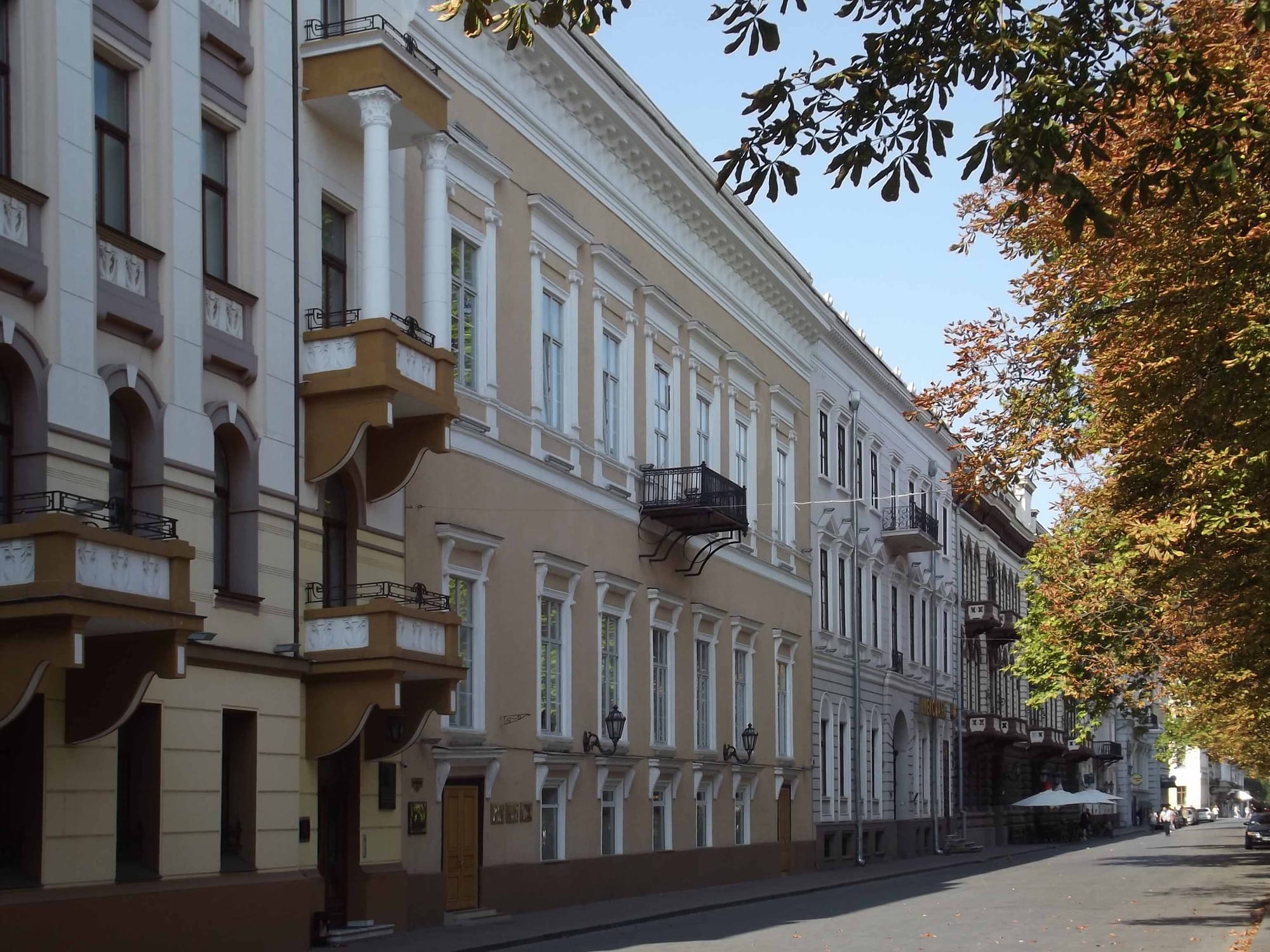
A row of pale classical buildings with balconies and tall windows along a quiet street lined with autumn-tinted trees

Southern Ukraine & Crimea, Ukraine

Odesa

Buildings along Prymorskyi Boulevard in the historic centre of Odesa. (Борис Мавлютов / Wikimedia Commons · CC BY-SA 3.0)

Ukraine's great Black Sea port, founded in 1794 on the site of an Ottoman fortress and built into a cosmopolitan grain-trading city of Greeks, Jews, Italians, Russians and Ukrainians. Its neoclassical centre, Potemkin Stairs and opera house became a World Heritage Site in danger in 2023, as Russian strikes hit the city and port. This page is written to explain the city, not to encourage travel.

Neighbourhoods

  • Historic centre
    • First-time visitors
    • Historic district
    • Architecture

    The grid of streets laid out for the new port in the 1790s, now on the World Heritage List. Derybasivska Street, the opera house, the Transfiguration Cathedral and Prymorskyi Boulevard above the Potemkin Stairs are all within a short walk, among the 19th-century houses of the merchant city.

    Open in Maps
  • Moldavanka
    • Local life
    • Literary history

    A Moldavian settlement just outside early Odesa where colonists of many origins settled, which the city later absorbed; before 1917 it was the centre of the city's Jewish quarter. It is the setting of Isaac Babel's Odessa Tales.

    Open in Maps
  • Arcadia and the beach suburbs
    • Beaches
    • Nightlife

    The historic resort quarter on the coast south of the centre, with a large sandy beach, a park and a strip of restaurants, bars and clubs. Otrada and other beaches lie between it and the centre.

    Open in Maps
  • Shevchenko Park and Lanzheron
    • Parks
    • Close to the sea

    The city's largest park, founded in 1875, stretches along the cliffs east of the centre. Lanzheron, the beach nearest the centre, lies just below it.

    Open in Maps

Things to do

Famous landmarks

  • Potemkin Stairslandmark

    The giant staircase from Prymorskyi Boulevard down towards the port, which gives the illusion of greater length; Eisenstein made it world-famous in Battleship Potemkin, and a funicular has run beside it since 1902.

    Open in Maps
  • Odesa Opera and Ballet Theatrelandmark

    A neo-baroque opera house by the Viennese firm Fellner & Helmer, opened in 1887 to replace the first theatre of 1810, which burned down in 1873.

    Open in Maps
  • Prymorskyi Boulevardlandmark

    The boulevard of the historic centre running from the City Hall to the Vorontsov Palace, with the statue of the Duc de Richelieu at the head of the stairs.

    Open in Maps
  • Vorontsov Palacelandmark

    A 19th-century palace and colonnade built in 1827–30 for Prince Mikhail Vorontsov, at the end of Prymorskyi Boulevard.

    Open in Maps
  • Derybasivska Streetneighborhood

    The pedestrian main street named after José de Ribas, the builder of Odesa, beside the City Garden, Odesa's first park.

    Open in Maps
  • Transfiguration Cathedrallandmark

    The city's first and principal church, founded in 1794, demolished by the Soviets in 1936 and later rebuilt; it was severely damaged by a Russian missile attack on 23 July 2023.

    Open in Maps
  • Odesa Philharmonic Theatrelandmark

    A concert hall whose design recalls the Doge's Palace in Venice.

    Open in Maps

Museums and the underground city

  • Odesa Fine Arts Museummuseum

    One of the principal art galleries of the city.

    Open in Maps
  • Odesa Archaeological Museummuseum

    Founded in 1825 and one of the oldest archaeological museums in Ukraine, on Lanzheronivska Street.

    Open in Maps
  • Odesa Museum of Western and Eastern Artmuseum

    A museum of European and Asian fine art on Italiiska Street.

    Open in Maps
  • Odesa catacombsattraction

    A labyrinth of tunnels, mostly left by limestone quarrying for the city's houses, running for up to 2,500 km under Odesa and its outskirts, used by partisans in the Second World War.

    Open in Maps

Parks and beaches

  • Shevchenko Parkpark

    Odesa's largest park, founded in 1875 and named after Taras Shevchenko since 1954.

    Open in Maps
  • Arcadia Beachbeach

    A large sandy beach south of the centre that has long been the city's favourite place to relax.

    Open in Maps
  • Lanzheron Beachbeach

    The beach closest to the centre, just below Shevchenko Park.

    Open in Maps
  • Odesa Botanical Gardenpark

    The university's botanical garden, spread across an old and a new site.

    Open in Maps

Markets

  • Pryvoz Marketmarket

    The largest food market in Odesa, trading since 1827, when goods were sold from the backs of horse carts.

    Open in Maps

Short trips from the city

  • Bilhorod-Dnistrovskyi fortresslandmark

    The Akkerman fortress, a stronghold of the 13th–14th centuries built on the remains of the ancient Greek city of Tyras.

    Open in Maps

Seasonal events

  • April Fools' Day1 April

    One of the most celebrated days in a city proud of its humour, marked with street festivities.

  • Odesa International Film Festivalmid-July

    An annual film festival founded in 2010, with open-air screenings on the Potemkin Stairs; since the full-scale invasion parts have been held abroad and in Chernivtsi.

  • Christmas on Derybasivskawinter holidays

    Christmas festivals on the main street during the winter holidays.

Eat and drink

Long-standing places and food districts in Odesa. Hours, ratings and directions come from your maps app, always current.

Food districts and markets

  • Pryvoz Marketmarket

    The city's biggest food market, with separate meat and fish halls, selling Black Sea fish, produce from the steppe and everything else the city cooks with.

    Open in Maps
  • Derybasivska Streetneighborhood

    The pedestrian main street and the lanes around the City Garden, where cafés and restaurants cluster in the historic centre.

    Open in Maps
  • Arcadianeighborhood

    The beach quarter's long strip of restaurants and bars, busiest on summer evenings.

    Open in Maps

Experience Odesa

History

The site was a fortress called Khadjibey, first mentioned in 1415, when a grain ship sailed from it to Constantinople, and under Ottoman control from the 16th century. Russian forces under Suvorov and Gudovich took it in 1789, and in 1794 Catherine II ordered a naval harbour and trading place built there. The town was renamed Odessa in 1795 after an ancient Greek colony believed to have stood nearby. The Spaniard José de Ribas, head of its military and civil administration, directed the building of the town; the Duc de Richelieu, governor from 1803 to 1814, planned much of the city, and his successor Count Langeron made it a free port.

The new port drew Greeks, Italians, Jews, Albanians, Armenians, Bulgarians, Germans and many others, and by 1897 Jews made up about 37 per cent of the population. Italian architects such as Francesco Boffo and Giovanni Torricelli designed buildings of the central district, and the Greek patriotic society Filiki Eteria was founded here in 1814. In 1905 the city rose in a workers' uprising supported by the crew of the battleship Potemkin, later immortalised by Eisenstein. In 1941 Romanian and German troops besieged Odesa for 73 days; under the Romanian occupation that followed, about 25,000 Odesans were murdered in the 1941 Odessa massacre and over 35,000 deported, while partisans fought on in the catacombs until the Red Army retook the city on 10 April 1944.

In independent Ukraine Odesa remained the country's main port. Since 2022 it has been under repeated Russian missile and drone attack aimed at its port, energy system and residential districts. In January 2023 UNESCO added the historic centre to the World Heritage List and to its list of sites in danger, and in October 2025 President Zelensky placed the city under a military administration after the mayor's Ukrainian citizenship was revoked.

Culture & Customs

Odesa sees itself as a city apart: cosmopolitan, irreverent and fond of jokes. Its Russian has a distinctive accent, and by the 1970s it had become known as the "capital of Soviet humour". Isaac Babel's Odessa Tales made the gangsters and traders of Moldavanka famous, and the city produced many other writers and musicians; between the 1970s and the 1990s most of Odesa's Jews emigrated, many ending up in Brighton Beach in New York, nicknamed "Little Odesa".

The opera house of 1887 is the city's pride, and Odesa also has a philharmonic hall modelled on the Doge's Palace and a cluster of museums of fine art, archaeology and Western and Eastern art. April Fools' Day, on 1 April, is one of the most celebrated days of the year, and since 2010 the Odesa International Film Festival has been held each July, with open-air screenings on the Potemkin Stairs in peacetime; during the war parts have moved abroad and to Chernivtsi.

The city has many religious traditions — Orthodox, Catholic, Lutheran, Jewish and others — reflected in its churches and synagogues. Language is changing fast: in a 2023 survey most residents still spoke Russian at home, while across Odesa Oblast the share speaking Ukrainian at home rose from about a quarter in 2021 to 42 per cent in 2023.

Daily Life

About 1,010,000 people lived in Odesa at the start of 2022, making it the third-largest city in Ukraine. Since 2000 much of the city has been a free economic zone, and its life is bound up with the sea: the port and the nearby terminals handle grain and other cargo, the Seventh-Kilometer Market on the outskirts is one of the largest market complexes in Eastern Europe, and Derybasivska Street is the main shopping street.

Most people live in apartment blocks spread out from the old centre, in districts such as Moldavanka and along the coast towards Arcadia. In summer the beaches, which line most of the waterfront outside the port, have long been the centre of local life.

The war has reshaped the routine. Air-raid alerts, nights of drone and missile attacks, and outages of power, water and heating after strikes on the grid are part of life, and attacks on ships carrying grain and other cargo have killed seamen and port workers. The city is governed by a military administration created in October 2025.

Food

Odesa has a culinary tradition of its own, shaped by the sea and by the many peoples who settled the port. Gobies, small Black Sea fish, are the city's typical dish, eaten dried or fried in a batter. Forshmak, chopped herring served with boiled potatoes, onions and eggs, comes from the Jewish kitchen and is popular in Odesa and Dnipro, and nearby Kherson is known for aubergines fried in oil with paprika and apple vinegar and for aubergine "caviar", or ikra.

The common Ukrainian table is here too: red borscht of beets, cabbage, potatoes, tomatoes, carrots, onions, garlic and dill; varenyky dumplings filled with potato and fried onion, quark or cherries; and holubtsi, cabbage rolls stuffed with rice or millet and often meat. Rice became an everyday food in the south in the Soviet era, when it was first grown on a large scale in the Odesa, Kherson and Crimean regions.

The Pryvoz market, trading since 1827, is where the city shops for fish, meat and produce. Ukrainian wine, horilka spirit and kvass are the traditional drinks.

Planning tools

Budget

Before 2022 Odesa was an inexpensive summer city, filled each year by Ukrainian holidaymakers on its beaches. Since the full-scale invasion the city and its port have been frequent targets and the price of a stay matters far less than the risk. The figures below are a pre-war guide only.

Daily Budget Midrange
USD 65–130 (pre-war guide: mid-range hotel, seafood dinners, taxis)
Daily Budget Shoestring
USD 25–45 (pre-war guide: hostel, canteen meals, trams and minibuses)

Do not travel to Odesa while the war continues; ordinary travel insurance does not cover it.

Best Time to Visit

In peacetime June to September was the beach season, when the sea in the Gulf of Odesa is above 20°C, and late spring and early autumn suited sightseeing. Since 2022 there is no advisable season: strikes on the city, the port and energy infrastructure continue all year.

Suggested Number of Days

No stay can be recommended while the war continues. In peacetime the historic centre filled two or three days, and the beaches and trips along the coast and the Dniester estuary added more.

First Visit
Not advisable at present
With Surroundings
Not advisable at present

Transportation

Public transport is made up of trams, trolleybuses and marshrutka minibuses, which link the centre, the railway station, the Pryvoz market and the beaches. A funicular beside the Potemkin Stairs has run between Prymorskyi Boulevard and the sea terminal since 1902, and a cable car goes down to Vidrada Beach. Air-raid alerts and power cuts can stop services.

Anyone in the city should know the nearest shelter, carry a power bank and keep to official alert apps and instructions.

Airport & Station Connections

Odesa International Airport lies 7 km south-west of the centre but has been closed to civilian flights since 24 February 2022; on 1 May 2022 President Zelensky said Russian forces had destroyed its newly built runway. The city is reached overland: long-distance trains arrive at the main station, Odesa-Holovna, next to the Pryvoz market, and in peacetime the fastest trains from Kyiv took about seven hours.

Walkability

The historic centre is compact and laid out on a regular grid, so the opera house, Derybasivska Street, the cathedral and the top of the Potemkin Stairs are all close together. The beaches, the airport and the bus and railway stations are too far to walk to comfortably from the centre; trams cover them.

Safety

Most governments advise against all travel to most or all of Ukraine. Odesa has been hit by Russian missiles and drones since 2022: strikes have killed civilians, struck the port, its grain terminals and cargo ships, damaged the Transfiguration Cathedral in July 2023 and historic buildings of the World Heritage centre as recently as August 2026, and cut power, water and heating. In August 2025 three swimmers were killed by sea mines off the coast of Odesa Oblast.

Do not travel to southern Ukraine or Crimea; if present, shelter during alerts, keep off beaches and fields that may be mined, and never touch debris. Check current official travel advice before travelling.

Climate

A hot-summer continental climate tempered by the Black Sea, with dry, cold winters that are mild for Ukraine and warm summers with more rain.

Summer
warm — temperatures often reach the high 20s and low 30s °C, and the sea is about 23°C in August
Winter
dry and cold but mild for Ukraine — temperatures rarely fall below −10°C

Local Customs

Odesa has long been a largely Russian-speaking city with its own accent and a reputation as the 'capital of Soviet humour'. In a 2023 survey 80 per cent of residents spoke Russian at home and 16 per cent Ukrainian, though the use of Ukrainian across the region has grown quickly since 2022. Odesans take pride in their mixed origins and their city's distinctness.

Martial law is in force; follow instructions from officials and at checkpoints, and avoid photographing strike sites or military positions.

Common Payment Methods

The currency is the Ukrainian hryvnia. Cards and contactless payment are widely accepted and the banking system has kept working through the war; some cash is useful for markets and for power cuts that take card terminals offline.