Aerial view of a small wooded island with a pavilion and paths, joined to the shore by a footbridge across a green lake

Central Ukraine, Ukraine

Uman

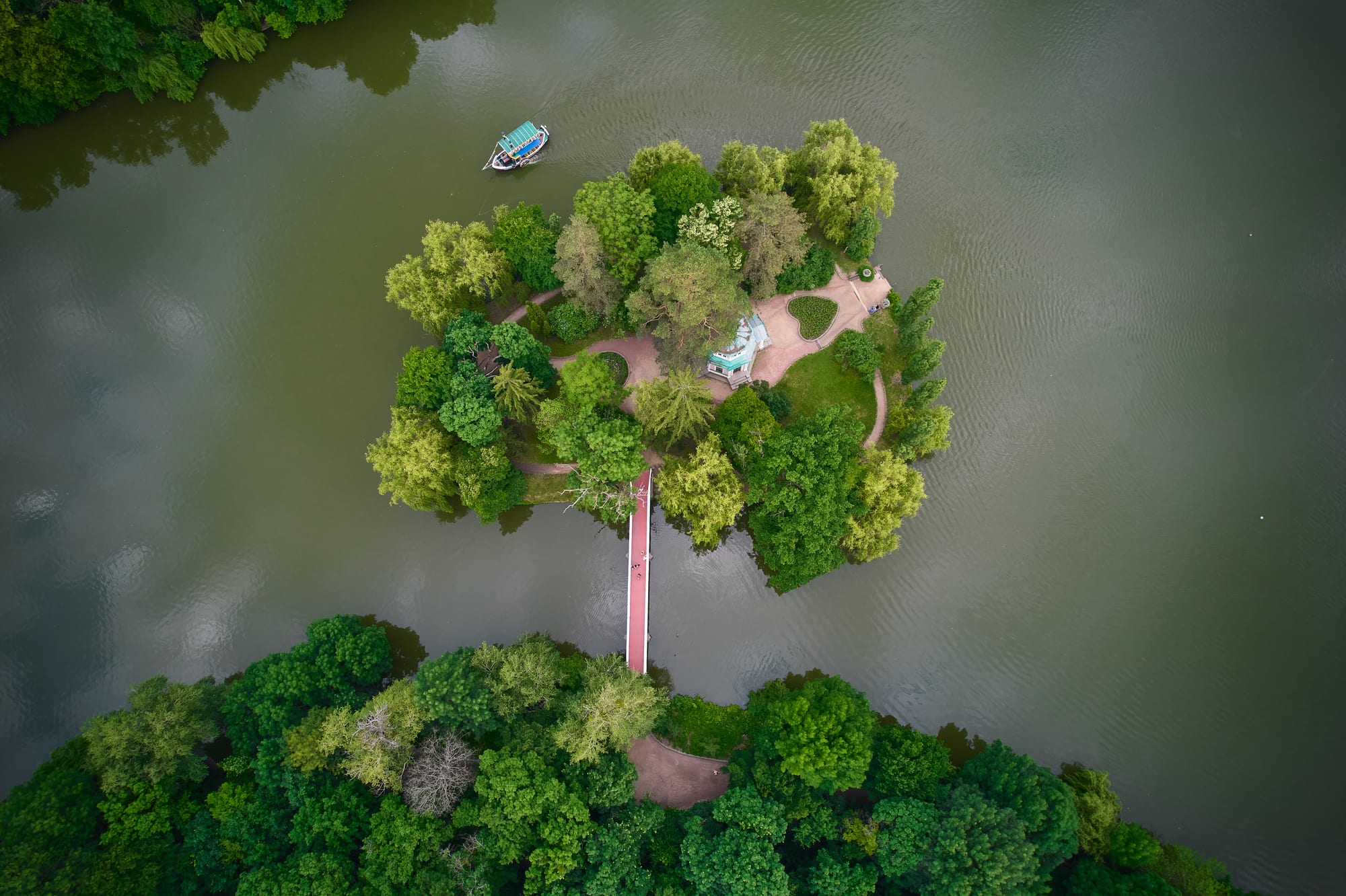
An island in one of the ponds of Sofiyivka Park in Uman, seen from above in June. (Ryzhkov Oleksandr / Wikimedia Commons · CC BY-SA 4.0)

A city of about 80,000 on the Umanka River in Cherkasy Oblast, in the east of historic Podolia. A Polish frontier fort turned Potocki family seat, it is known for Sofiyivka, the landscape park laid out from 1796, and as the burial place of Rebbe Nachman of Breslov, whose grave draws tens of thousands of Hasidic pilgrims each Jewish New Year. This page is written to explain the city, not to encourage travel.

Neighbourhoods

  • City centre
    • First-time visitors
    • Close to public transport

    The old core on the Umanka, with low 19th-century buildings, the Catholic church of the Assumption, the museums, the markets and the bus station within reach of each other.

    Open in Maps
  • Sofiyivka and the north
    • Parks
    • Quiet and residential

    The northern part of the city, where Sofiyivka Park follows the ravine of the Kamianka river, with the University of Gardening nearby. Green and quiet outside the main pilgrimage season.

    Open in Maps
  • Pushkina Street and the pilgrim quarter
    • Jewish heritage
    • Religious sites

    The streets around Rebbe Nachman's grave on Pushkina Street, on the site of the old Jewish cemetery. A small permanent Jewish community has grown here since the 1990s, and the quarter fills with pilgrims at Rosh Hashanah.

    Open in Maps

Things to do

Parks and landmarks

  • Sofiyivka Parkpark

    An English landscape garden founded in 1796 by Count Stanisław Szczęsny Potocki and named after his wife, with ponds, waterfalls up to 14 metres, a 224-metre underground river, grottoes and antique sculptures; about 300,000 people visit it each year.

    Open in Maps
  • Rebbe Nachman's gravelandmark

    The burial place of the Hasidic leader Rebbe Nachman of Breslov, in a rebuilt synagogue on the site of the former Jewish cemetery, the goal of the annual Rosh Hashanah pilgrimage.

    Open in Maps
  • Church of the Assumptionlandmark

    A Roman Catholic church built in 1826, on Kolomenska Street in the centre.

    Open in Maps

Museums

  • Local history museummuseum

    The city's museum of local history.

    Open in Maps
  • Museum of the culture and life of the Uman regionmuseum

    A museum of the culture and way of life of Uman and its district.

    Open in Maps

Markets

  • Meshchanka Marketmarket

    One of the city's food markets, on Zalizniaka Street.

    Open in Maps

Seasonal events

  • Rosh Hashanah pilgrimageRosh Hashanah, September or early October

    Tens of thousands of Breslov Hasidim and other Jewish pilgrims, nearly all men, gather at Rebbe Nachman's grave for the Jewish New Year; numbers fell to about 10,000 in 2022 after the invasion.

Eat and drink

Long-standing places and food districts in Uman. Hours, ratings and directions come from your maps app, always current.

Food markets

  • Meshchanka Marketmarket

    One of the city's food markets, on Zalizniaka Street.

    Open in Maps
  • Tyshchyka Street food marketmarket

    The food market on Tyshchyka Street.

    Open in Maps

Cafés and restaurants

  • City-centre cafésneighborhood

    Cafés and restaurants in the centre serve Ukrainian staples such as borscht, varenyky and halushky.

    Open in Maps

Experience Uman

History

Uman first appears in documents in 1616, a privately owned town of the Polish–Lithuanian Commonwealth that served as a fort against Tatar raids and housed a Cossack regiment. In 1648 the Cossacks of Bohdan Khmelnytsky took it, and it became the seat of their regiment; Poland retook it in 1667, many residents fled east, and between 1670 and 1674 it was the residence of the hetman of right-bank Ukraine. Under the Potocki family, owners from 1726 to 1832, it grew in wealth and importance, with a Basilian monastery and school.

The region saw haidamak uprisings in 1734, 1750 and 1768. In the last, the Koliivshchyna, the rebels Maksym Zalizniak and Ivan Gonta took Uman and massacred Jews, Poles and Ukrainian Uniates; Polish sources put the dead at about 20,000. Count Stanisław Szczęsny Potocki rebuilt the town and in 1796 began the Sofiyivka park. After the Second Partition of Poland in 1793 Uman passed to Russia, and in 1810 Rebbe Nachman of Breslov spent the last months of his life here and asked to be buried in the town. Railways to Kyiv and Odesa brought industry, and the population passed 50,000 by 1914.

In 1941 the Germans encircled Soviet armies near the town in the Battle of Uman and occupied it until March 1944; around 17,000 Jews were murdered and the Jewish cemetery destroyed. Since independence the pilgrimage has grown into the city's main industry. On 24 February 2022 Russian artillery hit the city, and on 28 April 2023 a missile strike on a residential building killed at least 23 people.

Culture & Customs

For Ukrainians, Uman is bound up with Taras Shevchenko's longest poem, Haidamaky of 1841, which retells the uprising of 1768. For gardeners and scientists it is the home of Sofiyivka, a research institute of the National Academy of Sciences as well as a park, and of the University of Gardening; for many Jews around the world it is simply the place of Rebbe Nachman's grave.

The Rosh Hashanah pilgrimage dates from 1811, when Nathan of Breslov, the rebbe's foremost disciple, organised the first. Hundreds came each year until the Soviet border closed; a few continued in secret, some at the cost of exile to Siberia. It resumed on a small scale in 1948, and after the Cold War grew to tens of thousands, with more than 30,000 pilgrims in 2018, drawn from many parts of the ultra-Orthodox world. The grave area was protected by presidential decree in 1994, though in 2024 the city council reduced the protected zone.

Away from the pilgrim quarter, the city's life is that of a provincial Ukrainian town, with a Catholic church that recalls the Polish past.

Daily Life

About 81,500 people lived in Uman in 2022. It is the administrative centre of Uman Raion in Cherkasy Oblast and the hub of a farming district, and its institutions — the Pavlo Tychyna pedagogical university, the University of Gardening, a campus of the European University and the Sofiyivka research institute — bring students and staff.

The annual pilgrimage is regarded as the city's main economic industry. A small but growing Jewish population has lived around the grave on Pushkina Street since the 1990s. For much of the year Sofiyivka is the city's other draw, with about 300,000 visitors a year.

Daily life follows a provincial rhythm of markets such as Meshchanka, city buses and walks in the park. Since 2022 it has been shaped by air-raid alerts and martial law, and by the missile strike of April 2023 on a residential building, which killed at least 23 people, including six children.

Food

Uman eats the food of central Ukraine. Red borscht, a soup of beets, cabbage, potatoes, tomatoes, carrots, onions, garlic and dill, is often served with pampushky, soft bread rolls topped with garlic butter. Varenyky, dumplings of thin, soft dough most often filled with potato, and holubtsi, cabbage rolls, are everyday dishes, and halushky, pieces of steam-boiled leavened dough served in soups or on their own, are another traditional Ukrainian dish.

Deruny, potato pancakes with sour cream, and syrnyky, fried quark fritters served with sour cream, jam or honey, are favourites at breakfast and in canteens, while salo, cured pork fat, kovbasa sausage and kholodets, a meat aspic, appear on holiday tables. The city's food markets sell the produce of the surrounding farmland.

Kapusniak, a soup of cabbage, pork, salo and beans served with sour cream, is a winter standby, and in summer kholodnyk, a cold beet soup blended with soured milk or kefir and served with a hard-boiled egg, is a lighter alternative. Kvass, a fermented drink known since the days of Kyivan Rus, and horilka, the Ukrainian spirit, are the traditional drinks.

Planning tools

Budget

Uman is inexpensive for most of the year. Around Rosh Hashanah the arrival of tens of thousands of pilgrims fills every room and pushes prices up sharply. Price is not the obstacle to travel; the war is.

Daily Budget Midrange
USD 55–110 (mid-range hotel, restaurant dinners, taxis and a park guide)
Daily Budget Shoestring
USD 20–40 (guesthouse, canteen and market food, minibuses)

Do not plan leisure travel while the war continues; anyone in the city around Rosh Hashanah should expect crowds and heavy security.

Best Time to Visit

In peacetime Sofiyivka was at its best in spring and autumn, and the Jewish New Year brought the pilgrimage and its crowds. Air-raid alerts and strikes can affect any part of Ukraine at any time of year, so current advice matters more than the season.

Suggested Number of Days

Most visits take one or two days, as the park alone needs three or four hours. Allow up to three for a slower pace; the pilgrimage season changes the experience entirely.

First Visit
1–2 days
With Surroundings
2–3 days

Transportation

City buses cover Uman, and taxis are inexpensive. The centre, the pilgrim quarter and Sofiyivka are close enough to walk between in good weather.

Keep small hryvnia notes for bus fares and a power bank charged for outages.

Airport & Station Connections

Uman lies about 210 km from Kyiv and 273 km from Odesa. Regular minibuses run to the bus station from Kyiv, Cherkasy and Odesa, and trains have linked the city with Kharkiv and Poltava. Civilian flights in Ukraine are suspended.

Walkability

The centre is compact and easy on foot, and Sofiyivka itself is a long walk of paths, steps and bridges through a ravine. Pavements can be uneven, and the pilgrimage season brings very crowded streets around Pushkina Street.

Safety

Most governments advise against all travel to most or all of Ukraine. Uman is away from the front line but not safe: a Russian missile struck a residential building in the city on 28 April 2023, killing at least 23 people, including six children. Air-raid alerts are frequent, and martial law is in force.

Shelter when sirens sound, avoid military and industrial sites, carry identification and follow local instructions. Check current official travel advice before travelling.

Climate

Moderately continental, with mild winters and warm summers; the mean annual temperature is about 8°C.

Summer
warm — July averages about 20.5°C
Winter
mild for the region — January averages about −4°C

Local Customs

Uman is a Ukrainian city with a long Polish and Jewish past, and the pilgrimage brings Hasidic customs into its streets each autumn. Among Ukrainians the city is known from Taras Shevchenko's poem Haidamaky.

Dress modestly at churches and at the pilgrimage site, and ask before photographing worshippers.

Common Payment Methods

The currency is the hryvnia. Cards and contactless payment are widely used, but market stalls prefer cash, and power cuts can take card terminals offline.