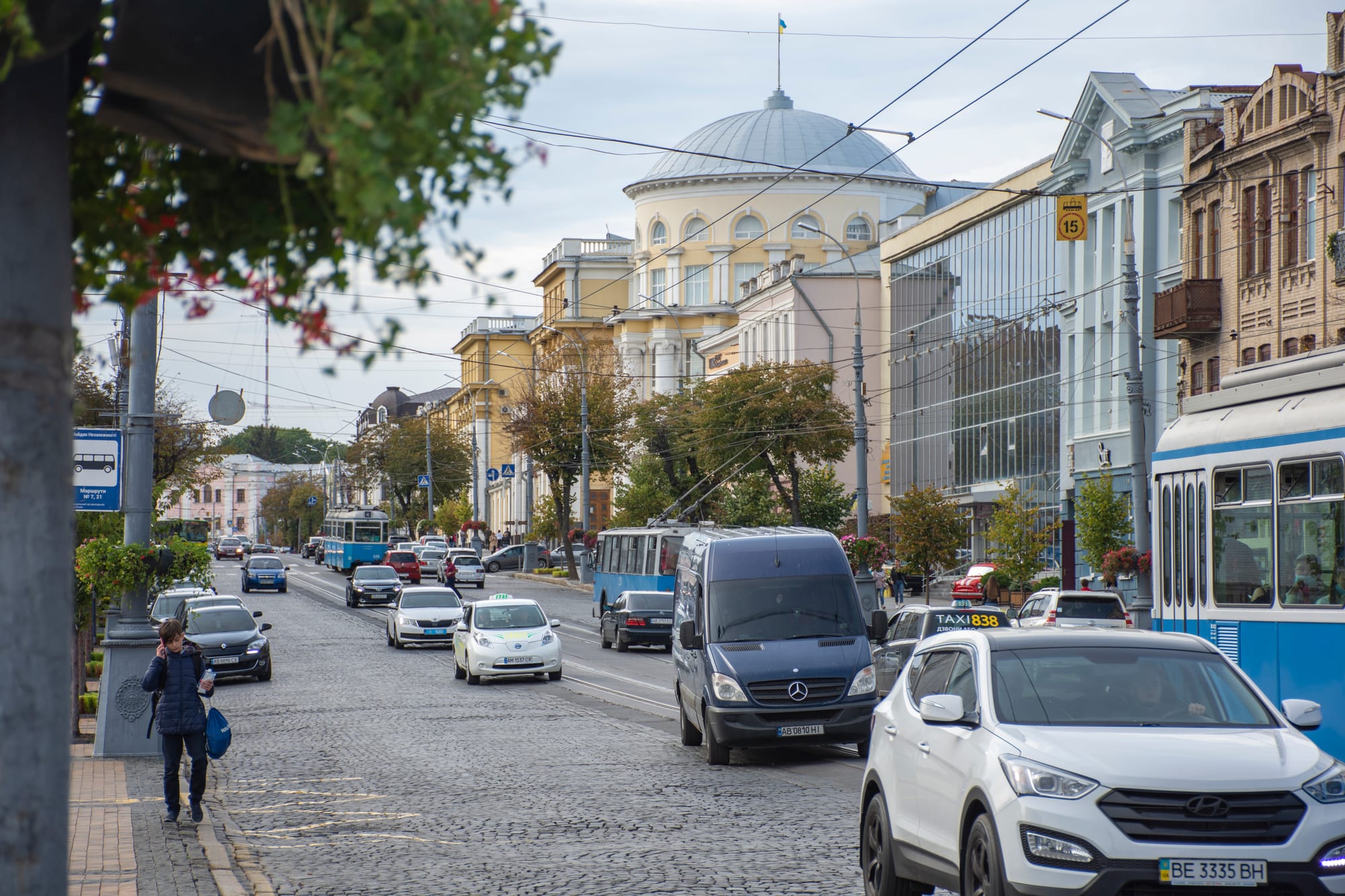
A cobbled main street with blue trams, cars and overhead wires, lined with trees and a domed yellow building

Central Ukraine, Ukraine

Vinnytsia

Soborna Street, the main street of central Vinnytsia, with its trams in 2020. (Shyam peelery / Wikimedia Commons · CC BY-SA 4.0)

The largest city of historic Podillia, on the Southern Bug in west-central Ukraine, grown from a 14th-century Lithuanian fortress into a regional capital of about 370,000. Its old Jesuit and Dominican quarter, Swiss-built trams, floating Roshen fountain and the Pirogov estate sit beside memories of Soviet and Nazi massacres and a deadly 2022 missile strike. This page is written to explain the city, not to encourage travel.

Neighbourhoods

  • Soborna Street and the centre
    • First-time visitors
    • Close to public transport

    The main street runs through the centre past early 20th-century buildings, the regional administration, cafés and bars, with trams along much of its length.

    Open in Maps
  • Mury and the old quarter
    • Historic district
    • Museums

    At the river end of Soborna Street, the defensive complex known as Mury, 'the Walls', and the former Jesuit monastery hold the regional museum, the art museum and the archive, with the Transfiguration Cathedral, a former Dominican monastery, beside the central bridge.

    Open in Maps
  • The Roshen embankment and Kempa island
    • Evening walks
    • Riverside

    A 700-metre stretch of the Southern Bug, embanked with a pedestrian zone and amphitheatre facing the floating fountain, opposite Kempa island.

    Open in Maps
  • Railway station district
    • Close to public transport
    • Markets

    About 4 km north-east of the centre, around the main station and the Pryvokzalnyi market, the arrival point for most travellers.

    Open in Maps

Things to do

Landmarks

  • Multimedia Fountain Roshenattraction

    A floating fountain on the Southern Bug, built in 2011 and considered the largest of its kind in Europe, with evening shows of water, music, lasers and projections from early April to late October.

    Open in Maps
  • Vinnytsia water towerlandmark

    Hryhorii Artynov's water tower of 1912 on European Square, a landmark of the city and a museum since 1985.

    Open in Maps
  • Murylandmark

    The 'Walls', a complex of defensive buildings on Soborna Street around the former Jesuit monastery, now the city's museum quarter.

    Open in Maps
  • Vinnytsia TV Mastlandmark

    A 354-metre guyed steel tube mast of 1961, described as the tallest structure of its kind in the world.

    Open in Maps

Churches

  • Transfiguration Cathedrallandmark

    A Baroque church built in 1758 by the Italian architect Paolo Fontana as part of a Dominican monastery, converted to Orthodox use under Russian rule and now a cathedral of the Orthodox Church of Ukraine.

    Open in Maps
  • Church of the Holy Virgin Mary of the Angelslandmark

    A Baroque church built in 1748–1761 as part of a Capuchin monastery, on Soborna Street.

    Open in Maps
  • Saint Nicholas Churchlandmark

    A church built in 1746 on the site of an older one, considered the oldest building in the city.

    Open in Maps

Museums

  • Pirogov's Estate Museummuseum

    The estate of the surgeon Nikolay Pirogov, opened as a museum in 1947, with the church-necropolis built in 1885 over the crypt where his embalmed body still lies.

    Open in Maps
  • Kotsiubynsky Literary Memorial Museummuseum

    The literary and memorial museum of the writer Mykhailo Kotsiubynsky, in a house built in the late 19th century and open as a museum since 1927.

    Open in Maps
  • Regional Museum of Local Lore and Art Museummuseum

    Two regional museums in the Mury complex, covering the history and art of Podillia.

    Open in Maps
  • Museum of the Vinnytsia Trammuseum

    A museum inside a working tram and trolleybus depot; an excursion tram can also be booked for a trip around the city.

    Open in Maps

Parks and getting around

  • Central Parkpark

    The 40-hectare Mykola Leontovych Park of Culture and Recreation off Soborna Street, with a summer theatre, planetarium, the Mini-Vinnytsia open-air museum and the city's festivals.

    Open in Maps
  • Vinnytsia tramwaytransit hub

    A tram network running since 1913, whose fleet has been built up since 2007 with cars transferred from Zurich.

    Open in Maps

Short trips from the city

  • Werwolflandmark

    The ruins of Hitler's Eastern Front headquarters in a pine forest about 12 km north of the city, built in 1941–1942 by prisoners of war.

    Open in Maps

Seasonal events

  • Roshen fountain seasonearly April to late October

    Evening multimedia shows on the river, watched from the amphitheatre on the embankment.

  • Europe DayMay

    One of the holidays celebrated with folk festivals and events in Central Park.

  • Independence Day24 August

    The national holiday, marked with celebrations in Central Park.

Eat and drink

Long-standing places and food districts in Vinnytsia. Hours, ratings and directions come from your maps app, always current.

Markets

  • Central Marketmarket

    The central market on Kotsiubynskoho Avenue, one of several food markets in the city.

    Open in Maps
  • Kyivskyi Marketmarket

    A food market on Kyivska Street.

    Open in Maps

Cafés and bars

  • Soborna Street cafésneighborhood

    Cafés, restaurants and cocktail bars line the main street through the centre.

    Open in Maps
  • The Roshen embankmentneighborhood

    Riverside cafés and restaurants along the embankment by the fountain.

    Open in Maps

Experience Vinnytsia

History

Vinnytsia has been a trading and political centre since 1363, when Fyodor Koriatovych, a nephew of the Lithuanian grand duke Algirdas, built a fortress against Tatar raiders on the Southern Bug. It received Magdeburg rights in the 15th century and belonged to Poland from 1569 to 1793 as a royal city, with Jesuit, Dominican and Capuchin monasteries. In 1648 it was at the centre of Bohdan Khmelnytsky's uprising, and in February 1651 Ivan Bohun's Cossacks defeated a Polish army of 20,000 there; it was a regimental city of the Hetmanate until 1667 and Ottoman from 1672 to 1699.

Russia annexed the city in 1793 and turned Catholic churches into Orthodox ones. The railway, completed in 1871, brought rapid growth, and the city architect Hryhorii Artynov built the water tower, theatre, churches and mansions that still shape the centre. In 1897 Vinnytsia had about 30,500 people, third in Podolia after Kamianets-Podilskyi and Uman.

The 20th century brought massacres. In 1937–1938 the NKVD executed between 9,000 and 11,000 people in the city. German troops arrived on 19 July 1941, and almost all of the roughly 17,000 Jews who had not been evacuated were murdered; Hitler's Werwolf headquarters was built nearby. Since 2022 the city has been struck repeatedly: the airfield was destroyed in March 2022, and on 14 July 2022 cruise missiles hit the centre, killing 27 people. In 2023 the city opened a representative office to the European Union.

Culture & Customs

Vinnytsia is described as developing into one of the most comfortable cities to live in Ukraine. Its culture is literary and scientific as much as artistic: the writer Mykhailo Kotsiubynsky, a classic of Ukrainian literature, is remembered in a literary museum open since 1927, while the surgeon Nikolay Pirogov spent his last years on his estate outside the city, where his embalmed body still lies in a church crypt. The medical university bears Pirogov's name and the pedagogical university Kotsiubynsky's.

The trams are part of the city's identity. They have run since 1913, and since 2007 the fleet has been renewed with cars passed on by Zurich, so that Swiss trams are a familiar sight on Soborna Street; there is even a tram museum inside a working depot. The Roshen fountain on the river, with its shows of water, music and lasers, became the city's best-known modern attraction after 2011.

Religious life is varied: Orthodox cathedrals, Catholic churches in former monasteries, a Greek Catholic church by the river built in the 1990s and one of the largest Evangelical church buildings in Europe. City Day, Europe Day and Independence Day are celebrated with folk festivals in Central Park. The city is also known as the long-time political base of former president Petro Poroshenko, though he never lived there.

Daily Life

About 371,000 people lived in the Vinnytsia urban hromada in mid-2026, making it one of the ten largest cities in Ukrainian-controlled territory. It is the administrative centre of Vinnytsia Oblast and of Vinnytsia Raion. In 2001 Ukrainians made up 87 per cent of the population and Russians 10 per cent, and in a 2023 survey 85 per cent of residents said they spoke Ukrainian at home.

The economy combines food processing and industry. Roshen's confectionery, diamond polishing, the Fort firearms company, an oil and fat plant and engineering firms are among the employers, and industrial output grew every year from 2021 to 2025. The city is also a growing centre of IT outsourcing, and the medical and pedagogical universities bring many students.

Days run to the timetable of the trams and trolleybuses, which start at about half past five in the morning, and evenings centre on Soborna Street and the river. Since 2022 life has included frequent air-raid alerts, martial law and displaced families from other regions, and the missile strike of July 2022 on the city centre remains a defining memory.

Food

Vinnytsia eats the food of Podillia and of central Ukraine. Red borscht, made with beets, cabbage, potatoes, tomatoes, carrots, onions, garlic and dill, is the everyday soup, but southern Podolia also has its own white borscht, cooked with fresh sugar beets, beans and vegetables. Varenyky, dumplings of thin, soft dough most often filled with potato, holubtsi, cabbage rolls, and halushky, pieces of steam-boiled dough, are staples of home cooking and canteens.

Deruny, potato pancakes served with sour cream, and syrnyky, fried quark fritters served with sour cream, jam or honey, are favourites; salo, cured pork fat, kovbasa sausage and kholodets, a meat aspic, are common. The city's markets — the Central Market on Kotsiubynskoho Avenue, the Kyivskyi Market and others by the station and across the river — sell the produce of the surrounding farmland.

Sweets have a special place: the Roshen confectionery company, whose name the riverside fountain carries, has a factory in the city. To drink there is kvass, the fermented drink known since Kyivan Rus, compotes and horilka, the Ukrainian spirit, and Soborna Street has cafés and cocktail bars for evenings out.

Planning tools

Budget

Vinnytsia has always been cheaper than Kyiv, with inexpensive public transport and food. None of this is a reason to travel while the war continues.

Daily Budget Midrange
USD 55–110 (mid-range hotel, restaurant dinners, taxis and museum tickets)
Daily Budget Shoestring
USD 20–40 (hostel or guesthouse, market food and canteens, trams)

Do not plan leisure travel while the war continues; trams and trolleybuses are the cheap way around.

Best Time to Visit

In peacetime, late spring to early autumn brought the fountain shows on the river, open-air events in Central Park and comfortable weather for walking. Air-raid alerts and missile and drone strikes affect the whole country at any time of year, so current advice matters more than the season.

Suggested Number of Days

Most first visits take about two days. Allow three to include the surroundings of the city at a slower pace; the sights are spread out, so time on trams and taxis adds to the total.

First Visit
2 days
With Surroundings
3 days

Transportation

Vinnytsia has an extensive network of trams, trolleybuses, buses and marshrutky (minibuses). Trams and trolleybuses run from about 5.30 in the morning until late evening, and six tram routes cross the city. Five bridges cross the Southern Bug. Taxis are inexpensive.

Most tram and trolleybus routes stop by about 10 or 11 pm, so plan late journeys by taxi.

Airport & Station Connections

The city lies about 260 km south-west of Kyiv. The main railway station, about 4 km north-east of the centre, has regional and long-distance trains, including international routes to Przemyśl in Poland and Chișinău in Moldova. Buses run from the central bus station to Kyiv, Uman, Kamianets-Podilskyi, Odesa and many other towns. The airport's airfield was destroyed by Russian missiles in March 2022, and civilian flights in Ukraine are suspended.

Walkability

The centre along Soborna Street, the Mury quarter and the river embankment are easy to walk, with wide pavements and many trees. The railway station, the Pirogov estate and outer districts are a tram, bus or taxi ride away.

Safety

Most governments advise against all travel to most or all of Ukraine. Vinnytsia is away from the front line but has been struck repeatedly: on 14 July 2022 three Russian cruise missiles hit the city centre, killing 27 people, including three children. Air-raid alerts are frequent, and martial law is in force.

Shelter when sirens sound, avoid military and industrial sites, carry identification and follow local instructions. Check current official travel advice before travelling.

Climate

Moderately continental, with warm summers and cold winters.

Summer
warm — July averages about 18°C
Winter
cold — January averages about −6°C

Local Customs

Ukrainians are the overwhelming majority, and in 2023 most residents said they spoke Ukrainian at home. The city mixes Orthodox, Catholic, Greek Catholic and Baptist congregations. Holidays are celebrated in Central Park, and the city is described as one of the most comfortable places to live in Ukraine.

Dress modestly in churches, including at the Pirogov church-necropolis, and do not photograph military sites or infrastructure.

Common Payment Methods

The currency is the hryvnia. Cards and contactless payment are widely used, but markets prefer cash and power cuts can take card terminals offline.