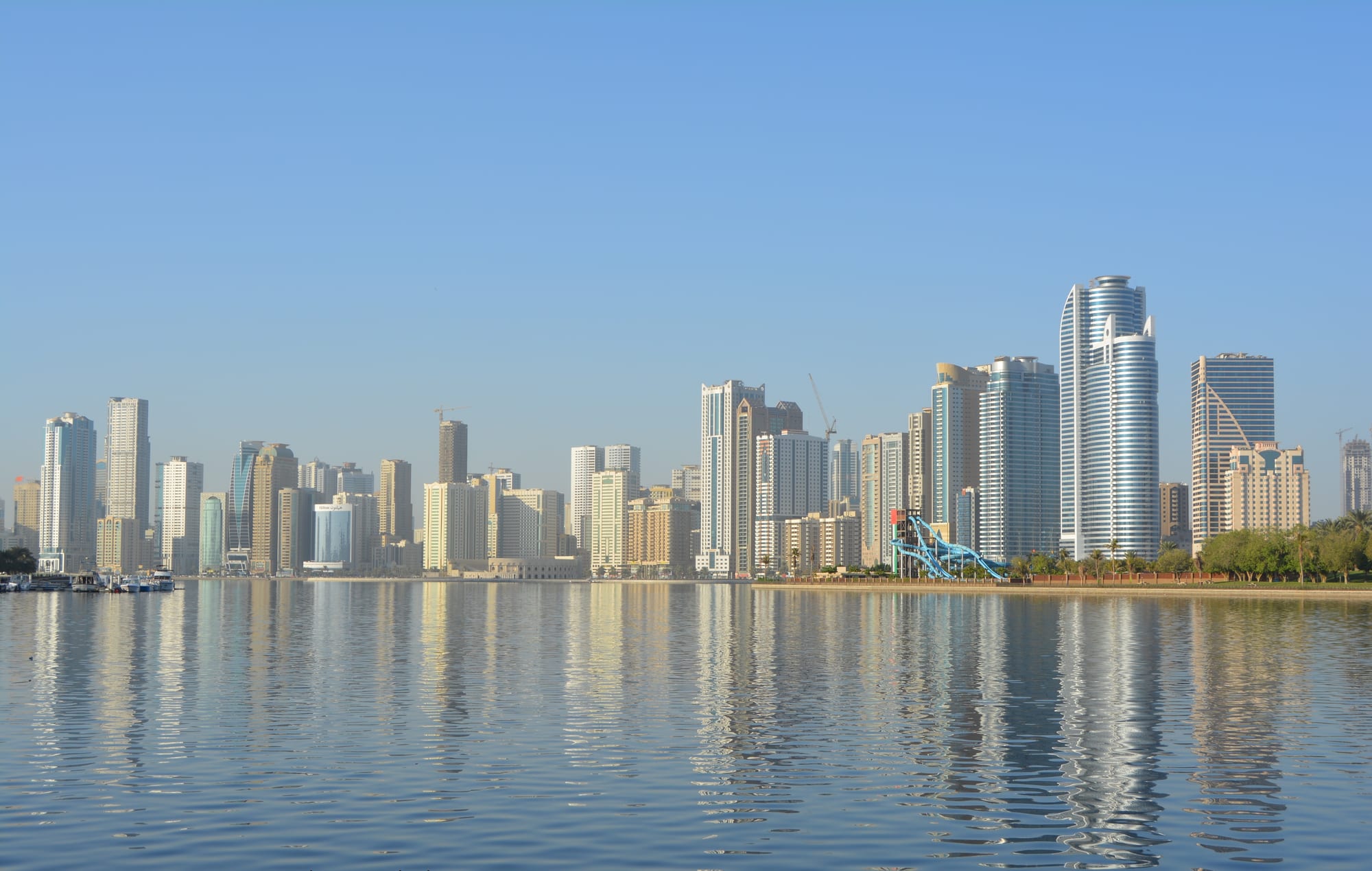
A line of white and blue high-rise towers along a shore, mirrored in the calm water of a lagoon under a clear sky

United Arab Emirates

Sharjah

The skyline of Sharjah rising above the water at the centre of the city. (Mueed Ahmed / Wikimedia Commons · CC BY-SA 4.0)

The third largest city of the United Arab Emirates, on a creek and lagoon immediately north-east of Dubai, into which it now merges. Once the leading port of the Trucial Coast and the site of the first British air staging post in the Gulf, it has built its modern identity on museums, restored heritage quarters and Arabic culture, and it is the only emirate where the sale of alcohol is prohibited.

Neighbourhoods

  • The Heart of Sharjah and Al Shuwaiheen
    • First-time visitors
    • Historic district
    • Museums

    The restored old town beside the creek, a grid of coral-stone houses, wind towers, narrow lanes and courtyards holding the fort, the arts square, several museums and the old covered souq. It is the most walkable part of the city and the quietest by day.

    Open in Maps
  • Al Majaz and Buhairah
    • Waterfront
    • Family trips
    • Restaurants

    The districts around Khalid Lagoon, with a landscaped waterfront park, a fountain on the water, an amphitheatre and rows of cafés and restaurants in the towers behind. The evening crowd here is largely families.

    Open in Maps
  • Al Khan and Al Qasba
    • Waterfront
    • Museums
    • Close to Dubai

    A canal district between the lagoon and the sea with a promenade, small theatres and cafés along the water, on the side of the city closest to Dubai.

    Open in Maps
  • Al Nahda and Al Qasimia
    • Budget stays
    • Close to public transport
    • Local life

    Dense residential districts of apartment blocks running to the Dubai border, home to much of the city's South Asian and Arab population, with cheap restaurants, supermarkets and heavy commuter traffic.

    Open in Maps
  • The Corniche and Al Layyah
    • Local life
    • Markets

    The working waterfront along the creek and the port, with the fish and vegetable markets, dhow wharves and the older commercial streets behind them.

    Open in Maps

Things to do

Museums

  • Sharjah Museum of Islamic Civilizationmuseum

    A converted covered souq on the creek holding Qur'ans, manuscripts, scientific instruments, ceramics and coins from across the Islamic world, under a gold-decorated dome.

    Open in Maps
  • Sharjah Art Museummuseum

    A large museum in a building of 1997, holding an Orientalist collection, modern and contemporary art from the Emirates and the wider Middle East, and changing exhibitions, in the arts square of the old town.

    Open in Maps
  • Sharjah Archaeology Museummuseum

    Finds from sites across the emirate, from stone tools and Bronze Age tombs to pre-Islamic coins and pottery, explaining how people lived here before the coastal towns.

    Open in Maps
  • Sharjah Calligraphy Museummuseum

    A small museum in a restored house in the old town devoted to Arabic calligraphy, with works by contemporary and historic calligraphers.

    Open in Maps

The old town and the souqs

  • Al Hisn Fortlandmark

    The rulers' fort, built in 1820 by Sheikh Sultan bin Saqr Al Qasimi, largely pulled down in 1970 and rebuilt in the 1990s with doors, windows and foundations saved from the demolition, now a museum of the emirate's rule.

    Open in Maps
  • Souq Al Arsahmarket

    A low covered arcade of small shops selling antiques, coffee pots, silver and textiles in the Heart of Sharjah, restored in the first phase of the old-town project.

    Open in Maps
  • Central Souqmarket

    The blue-tiled twin halls beside the lagoon, built in 1978 with wind-tower detailing, holding some six hundred shops for gold, carpets and curiosities, and known as the Blue Souq.

    Open in Maps
  • Sharjah Art Foundation spacesattraction

    Galleries and courtyards woven into the old town, which stage year-round exhibitions and the Sharjah Biennial, a long-running contemporary art event.

    Open in Maps

The waterfronts

  • Al Majaz Waterfrontpark

    A park and promenade along Khalid Lagoon with gardens, playgrounds, restaurants and a fountain that plays to music in the evenings.

    Open in Maps
  • Al Noor Mosquelandmark

    A mosque on the lagoon shore in Turkish Ottoman style, modelled on the Sultan Ahmed Mosque in Istanbul, and one of the mosques in Sharjah open to visitors of other faiths.

    Open in Maps
  • Al Qasbaattraction

    A canal about a kilometre long between the lagoon and the sea, lined with cafés and small theatres, with boats running along the water.

    Open in Maps
  • Sharjah Aquariumattraction

    An aquarium run by the emirate's museums authority at Al Layyah, beside the maritime museum, with tanks of Gulf species, an underwater tunnel and displays on fishing and pearl diving.

    Open in Maps

Short trips from the city

  • Mleihaattraction

    An archaeological area in the desert inland, with Bronze Age tombs and a pre-Islamic fort, a visitor centre built into the landscape and dunes around it.

    Open in Maps
  • Khor Fakkanattraction

    A Sharjah exclave on the east coast, about 100 kilometres away over the Hajar Mountains, with white-sand beaches, coral reefs offshore and an amphitheatre above the bay.

    Open in Maps
  • Dubaiattraction

    The neighbouring city, whose suburbs now run into Sharjah's, reached in twenty minutes or an hour and a half depending on the traffic.

    Open in Maps

Seasonal events

  • Sharjah Biennialspring, in odd-numbered years

    A large contemporary art exhibition spread through the old town's courtyards, warehouses and galleries, held since 1993.

  • Sharjah International Book FairNovember

    One of the world's largest book fairs, running for about twelve days with two thousand or so exhibitors from more than a hundred countries.

  • Sharjah Light Festivalthe cool season

    Projections and light shows on the facades of mosques, museums and public buildings over several evenings, held annually since 2010.

  • Ramadanvaries with the lunar calendar

    A month of daytime fasting, observed strictly here, when eating, drinking and smoking in public in daylight are restricted and the evenings fill with iftar gatherings.

Eat and drink

Long-standing places and food districts in Sharjah. Hours, ratings and directions come from your maps app, always current.

Sharjah classics

  • Emirati and Gulf kitchens in the old townrestaurant

    A few restaurants in and around the restored quarter serve machboos, harees, thareed and luqaimat, with gahwa coffee and dates.

    Open in Maps
  • Karak cafeteriascafe

    Tea boiled with milk, sugar and cardamom, served with paratha and egg sandwiches at cafeterias on almost every street, often to drivers at the kerb.

    Open in Maps

Food districts and markets

  • Al Nahda and Al Qasimia restaurantsneighborhood

    Kerala canteens, Pakistani grills, Egyptian and Syrian bakeries and Filipino kitchens fill the residential blocks towards the Dubai border.

    Open in Maps
  • Sharjah fish marketmarket

    The morning market by the port where Gulf fish and prawns are sold, with counters that will grill or fry a purchase on the spot.

    Open in Maps
  • Al Majaz waterfront cafésneighborhood

    Shisha cafés, Lebanese and Turkish restaurants and dessert counters along the lagoon, busy every evening in the cooler months.

    Open in Maps

Experience Sharjah

History

Sharjah sits on a creek that gave shelter to boats, and the coast around it has been settled for thousands of years — the tombs and settlements at Mleiha and elsewhere in the emirate span the Bronze Age to the centuries just before Islam. The Al Qasimi family, a seafaring dynasty whose ships dominated the lower Gulf, made the town their seat in the eighteenth century, and Sharjah became the region's leading port, trading pearls, dates and goods between Persia, India and East Africa.

British naval campaigns against Qasimi shipping in the early nineteenth century ended with the treaties that created the Trucial States, and Sharjah stayed the most important town of the coast for another century. In 1932 the British opened an airfield here as a staging post on the Imperial Airways route to India, with a fort-like rest house beside the runway — the first airport in the region. The collapse of the pearl trade in the 1930s and the silting of the creek hurt badly, and by mid-century Dubai had overtaken it.

Sharjah joined the federation on 2 December 1971. Modest oil and gas revenues from the 1970s funded expansion, but the emirate's distinctive turn came under Sheikh Sultan bin Muhammad Al Qasimi, ruler since 1972 and a historian by training, who put money into museums, publishing, a university city and the restoration of the old quarters rather than into towers and tourism. UNESCO named Sharjah the cultural capital of the Arab world in 1998. Meanwhile its population grew as workers priced out of Dubai moved here, turning the city into a commuter-heavy extension of its neighbour.

Culture & Customs

Sharjah's self-description as the country's cultural capital is backed by institutions: more than a dozen museums, a publishing industry and book fair, a university city, an art foundation with an international reputation, and a long programme of restoration that rebuilt the coral-stone quarter beside the creek rather than clearing it. The biennial brings contemporary artists from around the world into those same courtyards, an unusual combination of conservative civic life and experimental art.

The emirate is also the most socially conservative of the seven. Alcohol is not sold or served — there are no bars, no licensed restaurants and no shops — and a decency code sets expectations for dress and public behaviour. Visitors generally find this straightforward once understood: cover shoulders and knees, keep affection private, and accept that the evening centres on cafés, shisha, family outings and the lagoon rather than nightlife.

Everyday culture is heavily South Asian and Arab. Malayalam, Urdu, Hindi, Arabic and English are all heard in the same street; Kerala canteens, Egyptian bakeries and Syrian sweet shops sit side by side; and cricket is played on any spare ground. Emirati traditions — falconry, poetry, the ayyala dance, gahwa poured for guests — are presented in the museums and practised in family life. Manners are formal, greetings unhurried, and questions about the emirate's museums are usually met with genuine pride.

Daily Life

About 1.8 million people live in the emirate, most of them in the city and the districts that run into Dubai, and the great majority are foreign nationals, with South Asians the largest group by far. Rents are lower than across the border, which is why so many people live here and work there: tens of thousands commute each morning down roads that jam for hours, and the government has experimented with staggered hours and new bridges to relieve it.

The economy rests on the port and free zones, light manufacturing and warehousing, education — a university city holds several institutions — and the public sector, along with the trade that fills the souqs. Incomes are generally lower than in Dubai or Abu Dhabi, and households are often larger and more crowded.

Days follow the Gulf pattern: early starts, a long midday pause in summer, evenings outdoors once the heat drops. Families gather at Al Majaz and along the corniche after sunset, the malls take the place of parks in the hot months, and Friday is quiet until afternoon prayers. Since 2022 the emirate's public sector has worked a four-day week with a three-day weekend, the first in the Gulf to do so. Without bars or clubs, social life runs through cafés, restaurants, shisha terraces and home visits. The war since February 2026 and its effect on flights and shipping is felt here through the port and the low-cost airline based at the airport.

Food

Sharjah eats much as Dubai does but with fewer imported restaurant brands and no alcohol at all. Emirati dishes are on offer in the old town and at family restaurants: machboos, rice cooked down with meat or fish, dried lime and warm spices; harees, wheat and meat beaten smooth; thareed, stew over thin bread; and madrooba, salted fish pounded with flour. Fish is the local strength, with hammour, kingfish and prawns landed at the port and grilled or baked into sayadiah rice.

The everyday food is South Asian and Levantine. Kerala canteens serve thali, parotta and fish curry; Pakistani grills do karahi and seekh kebabs; Syrian and Egyptian bakeries turn out manakish, fatayer and pastries; Iranian places bake bread in clay ovens. Shawarma stands and shisha cafés stay open late, and karak tea — boiled hard with milk, cardamom and sugar — is the city's real national drink, often bought from a hatch without leaving the car.

Sweets and coffee close the day: luqaimat in date syrup, kunafa and baklava from Arab pastry shops, fresh juice counters, and gahwa with dates offered to guests. The fish market by the port and the fruit and vegetable markets beside it are where the city shops, and stalls there will cook what has just been bought.

Planning tools

Budget

Sharjah is the cheapest of the big Emirati cities. Hotel rooms, meals and taxis cost noticeably less than in Dubai, museum entry is low, and the absence of alcohol removes what is often the largest line in a UAE budget. Many visitors stay here and travel into Dubai by road.

Daily Budget Midrange
USD 120–250 (mid-range or beach hotel, restaurants, museum entries, taxis)
Daily Budget Shoestring
USD 45–85 (budget hotel or shared flat, cafeteria meals, buses and walking)

Museum entry is inexpensive and a combined ticket covers several of them, which suits a city where the museums are the main attraction.

Best Time to Visit

November to March, when the corniche, the old town and the waterfront parks are comfortable during the day and the cultural calendar — the book fair, the light festival and, in alternate years, the biennial — is at its fullest. Summer from May to September is extreme and best spent indoors. The war that began in February 2026 has disrupted flights, shipping and events across the region, so it is worth confirming that anything being travelled for is going ahead.

Suggested Number of Days

A day or two covers the museums and the old town, which sit close together. Three or four allow the desert sites inland and the emirate's east coast enclaves. Many visitors come for a single day from the neighbouring city instead.

First Visit
1–2 days
With Surroundings
3–4 days

Transportation

There is no metro. City buses run on a rechargeable card, taxis are metered and cheaper than in Dubai, and ride-hailing apps work throughout. Intercity buses connect to Dubai, Ajman and the northern emirates, and a hire car is needed for the desert sites and the east coast. Traffic on the roads to Dubai is very heavy at commuting times.

Crossing to or from Dubai in the morning and late afternoon peaks can take well over an hour, so travel between the cities outside those windows where possible.

Airport & Station Connections

Sharjah International Airport is about 13 kilometres east of the centre and is the base of a large low-cost airline, with flights across the Middle East and South Asia; Dubai's airport is a similar distance away on the other side. Buses and taxis run in from both, and intercity coaches connect with Dubai and the northern emirates. Aviation across the region has been disrupted since the war began in February 2026, so schedules can change at short notice.

Walkability

The Heart of Sharjah, the museums around it and the lagoon promenades are genuinely walkable, and the old town is best seen on foot. Between districts the roads are wide and fast and pavements are patchy, so a taxi or bus is needed. From May to September the heat limits walking to early mornings and evenings.

Safety

Crime is very low and the streets are safe at any hour. The cautions are legal and cultural, and stricter here than elsewhere in the country: a decency code governs dress and behaviour in public, alcohol is banned outright in the emirate, drug laws are severe, photographing people or government and military sites without consent is risky, and online posts deemed offensive have led to prosecution. Same-sex relationships are criminalised. Since 28 February 2026 the United States and Israel have been at war with Iran and its allies; Abu Dhabi was among the places hit by Iranian drones and missiles in the first days, further attacks on US military assets and Emirati infrastructure have followed, the UAE has struck Iran in return, and shipping in and around the Strait of Hormuz has been attacked. Gulf governments have prosecuted residents and foreigners for sharing unverified accounts of the attacks online.

Carry a doctor's note for prescription medicines, drink only in licensed venues, dress modestly in public and conservative areas, do not photograph people or officials without permission, and take care with what is posted online. Check current official travel advice before travelling.

Climate

Hot desert climate on a humid coast, with rain on only a handful of days between December and March and occasional dust haze. The creek and lagoon hold the heat, so nights in summer are warm and close.

Summer
May to September is extreme — roughly 38–42°C by day, sometimes above 45°C in July and August, with high humidity and warm nights
Winter
November to March is warm and dry, about 24–27°C by day and 13–17°C at night, and this is the season for everything outdoors

Local Customs

Sharjah applies the most conservative public rules in the country. Alcohol is not sold and is not served in hotels, restaurants or any other outlet in the emirate, and selling or consuming it without a licence is an offence. A published decency code asks for clothing that covers the shoulders and reaches below the knee in public places, and swimwear belongs only on the beach or at a pool. Public displays of affection are not accepted, and during Ramadan daytime eating, drinking and smoking in public are restricted. Tipping is customary but small.

Dress conservatively in the souqs and museums, ask before photographing people, and expect no alcohol to be sold or served anywhere, including in hotels.

Common Payment Methods

The currency is the UAE dirham, pegged to the US dollar. Cards and mobile payment are widely accepted and ATMs are everywhere, but cash is still used in the souqs, the fish market and small cafeterias, and prices in the markets are negotiated.