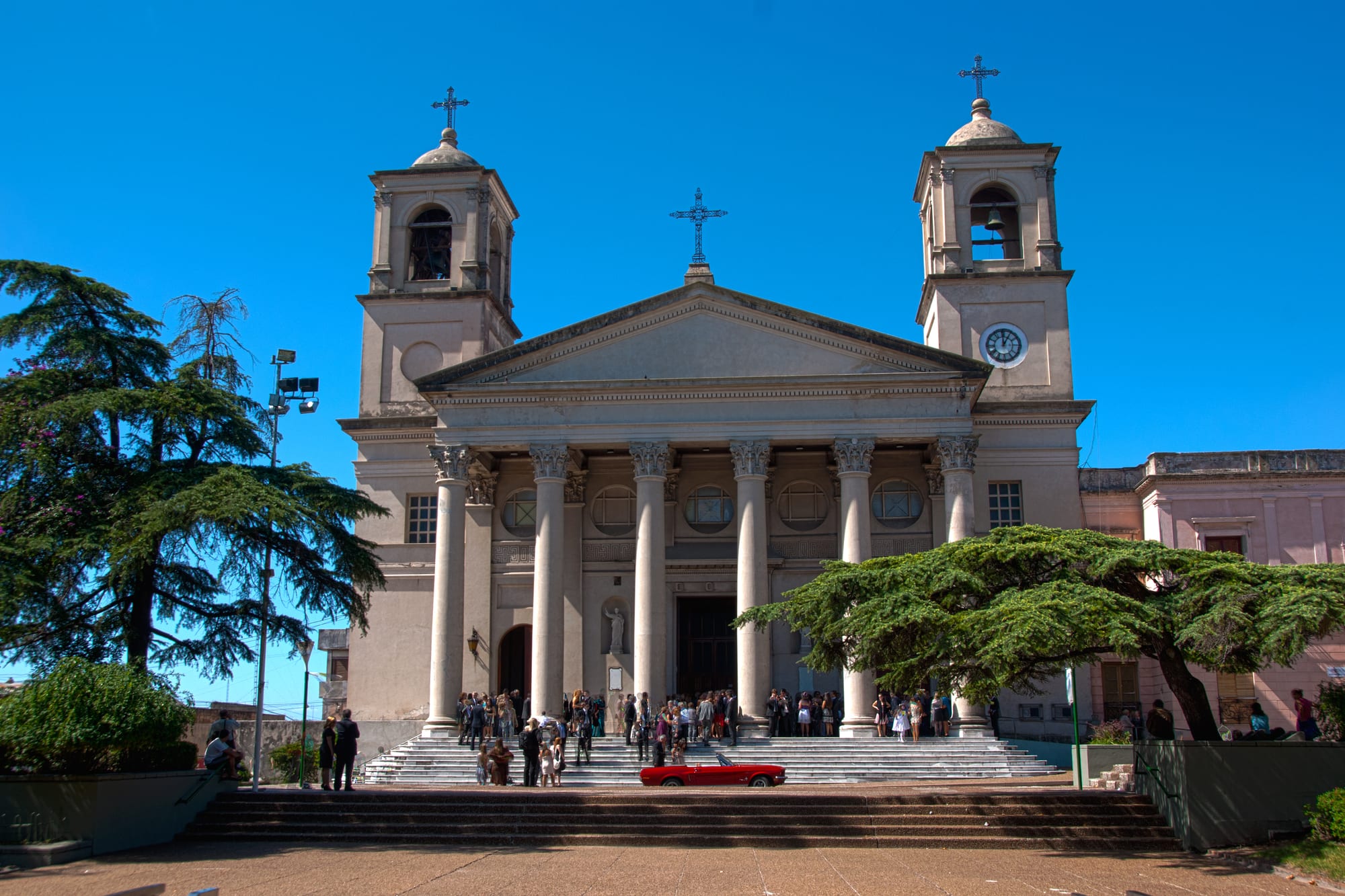
The columned facade and twin bell towers of Paysandú's basilica above wide steps, framed by cedar trees under a deep blue sky

The Interior & the Thermal North, Uruguay

Paysandú

The Basilica of Our Lady of the Rosary and St Benedict of Palermo on Plaza Constitución, Paysandú. (Fedaro / Wikimedia Commons · CC BY-SA 3.0)

Uruguay's fourth-largest city, on the east bank of the Uruguay River opposite Colón in Argentina. Founded in 1756 and called La Heroica for its defence in the siege of 1864–65, it grew on Italian immigration, wool, leather, sugar and beer; today it is a calm river city known for Norteña beer, the chajá cake and its Holy Week beer festival.

Neighbourhoods

  • Centre and Plaza Constitución
    • First-time visitors
    • Historic district

    The old core around Plaza Constitución, where the basilica and the mausoleum of General Leandro Gómez, defender of the city in the 1864–65 siege, both stand. The surrounding streets hold the shops, banks, cafés and restaurants of a provincial capital.

    Open in Maps
  • The riverfront
    • Beaches
    • Walks
    • Festivals

    The bank of the Uruguay River, with Argentina in view across the water. Its river beaches have lifeguards in summer, the city has rowing and yacht clubs, and the open-air Anfiteatro del Río Uruguay is the stage of the Holy Week beer festival.

    Open in Maps
  • Residential barrios
    • Quiet and residential
    • Local life

    Beyond the centre the city spreads into low-rise districts such as Barrio Norte, Barrio Obrero, Chaplin and Santa Elena, linked to the centre by COPAY's local buses.

    Open in Maps

Things to do

Famous landmarks

  • Basilica of Paysandúlandmark

    The parish church built in 1860, severely damaged during the siege of 1864–65 and rebuilt, declared a minor basilica in 1949; its Walcker organ was inaugurated in 1906.

    Open in Maps
  • Monumento General Leandro Gómezlandmark

    The mausoleum and statue on Plaza Constitución honouring General Leandro Gómez, the defender of the city in the siege, designed by Walter Castelli; his remains were placed there in 1984.

    Open in Maps
  • Monumento a Perpetuidadlandmark

    The Old Cemetery on Calle Montecaseros in the south of the city, used from 1835, where many victims of the defence of Paysandú are buried among 19th-century pantheons and mausoleums in marble, granite and bronze.

    Open in Maps

The river and parks

  • River beachesbeach

    Recreational beaches on the Uruguay River, with lifeguards during the summer.

    Open in Maps
  • Anfiteatro del Río Uruguayattraction

    An open-air amphitheatre by the river, opened in 1997, which hosts the concerts of the beer festival.

    Open in Maps
  • Hipódromo San Félixattraction

    The city's horse-racing track.

    Open in Maps

Short trips across the river and beyond

  • General Artigas Bridgelandmark

    A cantilever road bridge 2,350 metres long over the Uruguay River, opened in 1975, linking the city with Colón in Argentina.

    Open in Maps
  • Colónattraction

    The Argentine river city across the bridge, founded in 1863 by Justo José de Urquiza.

    Open in Maps
  • Termas de Guaviyúattraction

    Hot springs north of the city on Route 3, with thermal pools and cabins, reached easily by car or bus.

    Open in Maps

Seasonal events

  • Semana de la CervezaHoly Week (Semana de Turismo), March or April

    Paysandú's beer week, first held in 1966 by the local Norteña brand on Plaza Constitución and now centred on the riverside amphitheatre, with food, music and culture.

Eat and drink

Long-standing places and food districts in Paysandú. Hours, ratings and directions come from your maps app, always current.

Paysandú classics

  • Chajá at the city's confectionerscafe

    The chajá, a cake of sponge, meringue, cream and peaches or strawberries, was created in Paysandú in 1927 and is sold across the city.

    Open in Maps
  • Parrillas in central Paysandúrestaurant

    Grill restaurants serving beef, sausages and offal cooked over embers, alongside chivito and burger places.

    Open in Maps

Cafés and bars

  • Bars and cafés around Plaza Constituciónneighborhood

    The centre's cafés and bars, where Norteña, the beer first brewed in the city in 1947, is the local choice.

    Open in Maps

Experience Paysandú

History

Paysandú was founded in October 1756. The origin of its name is uncertain; some sources trace it to Guaraní, and one early interpretation reads it as an island set in the river, and a Jesuit map of 1749 already places the name where the city stands. It had become a town before Uruguayan independence and was made a city in 1863.

The defining event came soon after. During the Uruguayan War, Brazilian forces under the Marquis of Tamandaré and Colorado forces under Venancio Flores besieged the town from 3 December 1864, and its defenders under General Leandro Gómez held out until 2 January 1865, when the town fell. The church, built in 1860, was badly damaged and later rebuilt, the remains of many victims of the defence rest in the old cemetery on Calle Montecaseros, and the resistance gave the city its name, La Heroica, the Heroic City.

From the late 19th century Italian immigrants arrived in large numbers, first working on the river trade, commerce and farming, and by the early 20th century Paysandú was one of the main centres of Italian settlement in Uruguay after Montevideo. Industry followed: wool fabrics, leather, sugar and, from 1947, Norteña beer. The chajá cake was created in a local confectioner's in 1927, the beer festival began in 1966, and in 1975 the General Artigas Bridge joined the city to Colón in Argentina.

Culture & Customs

Paysandú's identity rests on its history and its immigrants. The memory of the siege is kept on Plaza Constitución, where the mausoleum of Leandro Gómez stands on the same square as the basilica, and in the Old Cemetery. Italian roots run deep: in 1992 about 65 per cent of the department's people were estimated to be of Italian descent, and the city also drew settlers from Switzerland, Poland, Germany, Russia, Ukraine, Belgium and several African nations, which makes it more cosmopolitan than most Uruguayan towns.

The year's high point is the Semana de la Cerveza in Holy Week, which began in 1966 as a festival run by the Norteña brewery on Plaza Constitución and since 1997 has filled the riverside Anfiteatro del Río Uruguay with concerts. Music has local heroes, among them the band Los Iracundos and the tango musician Alfredo Eusebio Gobbi.

Sport is a large part of life, with rowing and yacht clubs on the river and clubs for football, rugby, hockey, tennis and polo. The city has produced many footballers, among them Walter Gargano and Nicolás Lodeiro, and the boxer Cecilia Comunales. Clotilde Luisi, the first woman to study law at the University of the Republic, was born here.

Daily Life

About 81,500 people lived in Paysandú at the 2023 census, making it the fourth-largest city in Uruguay after Montevideo, Salto and Ciudad de la Costa. It is an industrial and agricultural centre: the Norteña brewery, the Azucarlito sugar works, the Paylana woollen mill and Paycuero leather are the main industries, and the city is also the centre of the country's plantation forestry, with eucalyptus planted and harvested across the department. The University of the Republic has a centre here.

The centre around Plaza Constitución holds the shops and offices; the residential barrios, among them Barrio Norte, Barrio Obrero, Chaplin and Santa Elena, spread out around it, linked by COPAY buses. The rhythm is that of the interior: long lunches, a siesta in the summer heat, evening walks and Sunday football, with the river beaches busy in summer.

The bridge keeps close ties with Colón across the river. Like other towns on the Uruguay, the city must watch for floods after heavy rain, and, as across the interior, young people leaving for Montevideo or abroad is a long-running concern.

Food

Paysandú has two claims on the national table. The chajá, a cake of sponge, meringue, cream and fruit — peaches and strawberries in the usual versions — was created on 27 April 1927 by Orlando Castellano, owner of the Confitería Las Familias, and named after the southern screamer bird, known locally as the chajá. It has since become a typical Uruguayan dessert and is exported to neighbouring countries. Norteña beer, first brewed in the city in 1947, is the drink that goes with it all and the reason for the Holy Week festival.

Everyday eating follows the interior's ranch cooking. The parrilla grills beef, chorizo and morcilla sausages over embers, and chivitos, the steak sandwich piled with ham, cheese and egg, are everywhere. Guiso carrero, a rice or noodle stew, and puchero are winter dishes, and tortas fritas, fried dough, go with mate on rainy afternoons. Freshwater fish come from the Uruguay River.

Mate, the bitter herbal infusion drunk from a shared gourd, is the constant companion.

Planning tools

Budget

Paysandú is cheaper than Montevideo or the coast. City hotels are the main cost, and prices rise for Holy Week, when the beer festival fills the city, and in the winter holidays, when families head for the hot springs. Set lunches and parrillas are good value.

Daily Budget Midrange
USD 100–180 (city hotel, sit-down dinners, a hire car or bus to the hot springs)
Daily Budget Shoestring
USD 40–65 (budget hotel or thermal campsite, set lunches, intercity and local buses)

Book well ahead for Holy Week; outside the festival and the July holidays rooms are easy to find.

Best Time to Visit

Spring (October–November) and autumn (March–April) are the most comfortable. Holy Week brings the beer festival and the largest crowds, summer is the season for the river beaches, and winter, from June to August, is the time for the nearby hot springs.

Suggested Number of Days

One or two days are enough for the city itself. Allow about three to add the hot springs to the north and a crossing to Argentina; the beer festival is the main reason to stay longer.

First Visit
1–2 days
With Surroundings
3 days

Transportation

The centre is walkable. COPAY runs the local buses, linking the barrios with the centre and the nearest towns, and taxis cover the rest. Buses north along Route 3 serve the Guaviyú hot springs, and a car is useful for the countryside.

The intercity bus terminal is on Bulevar Artigas, within reach of the centre.

Airport & Station Connections

The city is 378 km north-west of Montevideo by Routes 1 and 3, with long-distance buses from the capital; buses also run from Salto, Rivera and Tacuarembó, and from Colón and Concepción del Uruguay in Argentina. The General Artigas Bridge crosses the river to Colón. The local airport, south of the city, handles air taxis and crop-spraying planes, so the nearest major airport is Carrasco in Montevideo.

Walkability

The centre, Plaza Constitución, the basilica and the riverfront are within walking distance of each other. The cemetery and the residential barrios are a longer walk or a short bus ride, and the bridge and hot springs need transport.

Safety

Uruguay is among the safest countries in Latin America, though property crime and, in some Montevideo neighbourhoods, violent crime have risen with drug-trafficking activity. Crime is low in the interior's country towns. The real risks are the roads, summer heat and floods along the Uruguay River after heavy rain.

Swim only where lifeguards are on duty, carry water in summer, and check flood warnings after heavy rain. Check current official travel advice before travelling.

Climate

A humid subtropical climate, with warm to hot summers and cool winters with frost and fog. Summer is December–February. Rain is spread through the year, slightly less in winter, and the annual average temperature is about 19 °C. On 20 January 1943 the city recorded 44.0 °C, the joint highest temperature ever measured in Uruguay.

Summer
warm to hot, with days of 30–36 °C in the north-west
Winter
cool days of 12–18 °C, with frost and fog

Local Customs

Mate is carried everywhere and passed around a group, and life follows the interior's unhurried rhythm, with long lunches, a summer siesta, evening walks around the main square and football on Sundays. The local Spanish is the Rioplatense variety, and English is not widely spoken.

Mate is often passed to visitors as a gesture of hospitality. Religion is a low-key private matter for most people, though the basilica remains a working church.

Common Payment Methods

The currency is the Uruguayan peso. Cards are widely accepted and ATMs are common in the centre; US dollars are taken for larger purchases in tourist areas. Some cash helps for buses, small cafés and festival stalls.