💰 Budget
Tacuarembó is one of the cheaper places to stay in Uruguay. Town hotels and set lunches are good value. Everything changes during the Fiesta de la Patria Gaucha, when the few hotels fill and most visitors rent houses or camp in grounds set up beside the festival.
- Daily Budget Midrange
- USD 100–180 (town hotel or nearby estancia with meals, sit-down dinners, a hire car)
- Daily Budget Shoestring
- USD 40–65 (budget hotel or camping, set lunches, intercity buses)
For the March festival, arrange a room or a camping place well in advance.
📅 Best Time to Visit
Early March, for the Fiesta de la Patria Gaucha, is the town's busiest and liveliest time. Spring (October–November) and autumn (March–April) are the best seasons for riding, walking and estancia stays; summers are hot, and winter nights bring frost.
⏳ Suggested Number of Days
One or two days cover the town. Allow two or three to reach the countryside around it by car, and longer to see the March festival, which runs over several days and draws visitors from across the region.
- First Visit
- 1–2 days
- With Surroundings
- 2–3 days
🚆 Transportation
The town is small and easy to walk. Several of the attractions lie outside it, in the hills and valleys of the department, and need a car, a taxi or a tour.
Drive rural roads slowly and avoid them at night, watching for cattle and log lorries.
🛬 Airport & Station Connections
Long-distance buses from the Tres Cruces terminal in Montevideo take four to five hours along Route 5. Rivera, on the Brazilian border, is 113 km north-north-east, about two hours by bus, and Salto lies about 225 km to the west by road.
🚶 Walkability
The centre is compact and flat enough to cover on foot, and the Laguna de las Lavanderas is within walking distance north of it. The outlying lagoon at Iporá, Valle Edén and Cerro Batoví need transport.
🛡️ Safety
Uruguay is among the safest countries in Latin America, though property crime and, in some Montevideo neighbourhoods, violent crime have risen with drug-trafficking activity. Crime is low in the interior's country towns. The real risks are the roads — long straight routes, heavy timber lorries and animals on the verge at night — and summer heat.
Avoid driving rural roads at night and carry water in summer. Check current official travel advice before travelling.
🌦️ Climate
A humid subtropical climate, with warm to hot summers and cool winters with frequent frosts and fog. Summer is December–February. Rain is spread evenly through the year, at about 1,165 mm, and the annual average temperature is 18 °C. In March, the festival month, days are usually hot and sunny but evenings turn cold quickly.
- Summer
- warm to hot by day; even in early autumn, nights can drop to around 10 °C
- Winter
- cool days of 12–18 °C, with frequent frost and fog
🤝 Local Customs
Gaucho traditions of riding and cattle work shape life in the countryside around the town. Mate is passed around groups and offered to visitors, and the asado is cooked slowly over embers. Life is unhurried, with long lunches and a summer siesta.
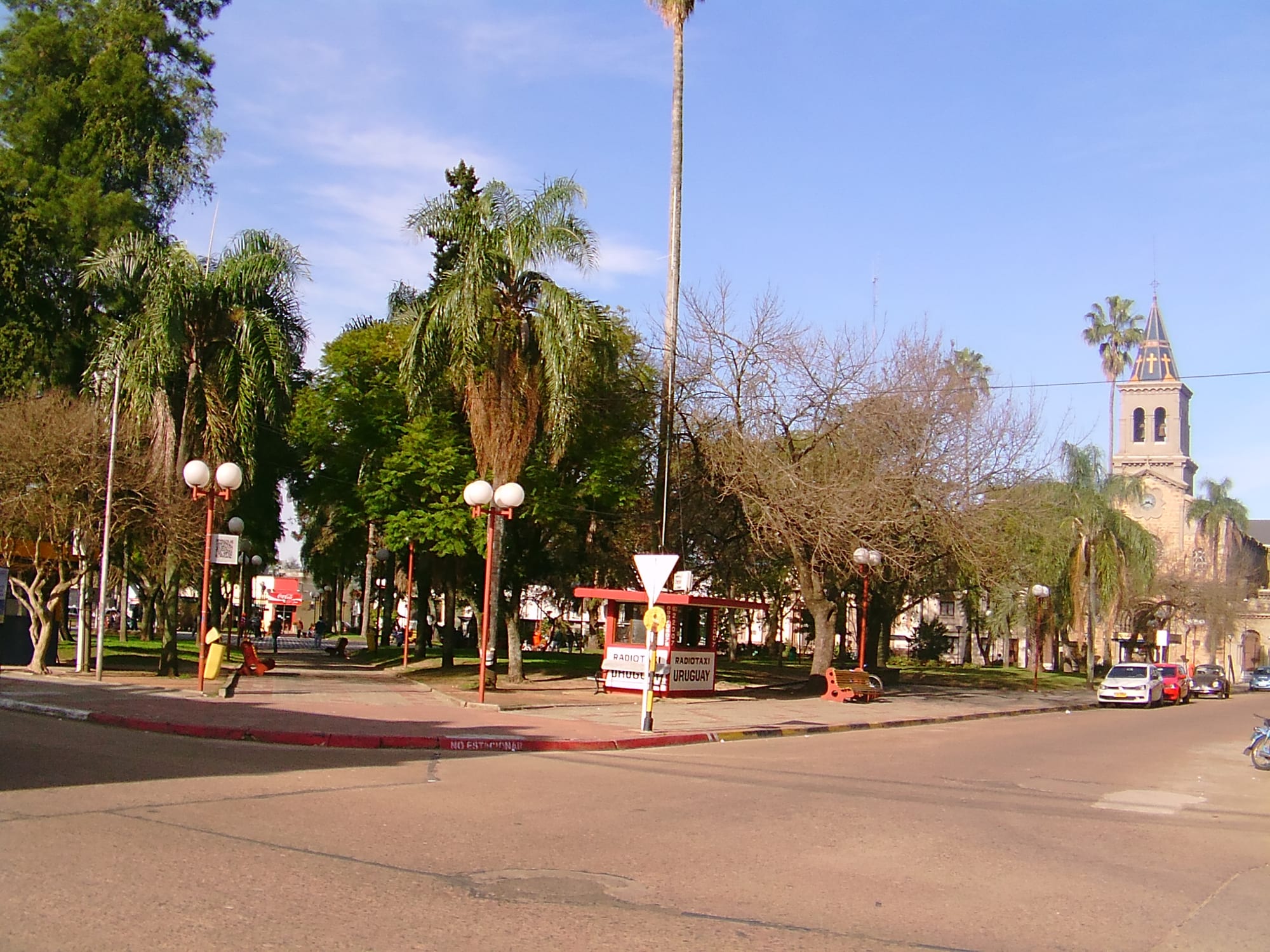
After the festival parade, riders gather at the Artigas statue on the main square, the usual moment for photographs. Religion is a low-key private matter for most people, though the festival includes a misa criolla.
💳 Common Payment Methods
The currency is the Uruguayan peso. Cards are widely accepted and ATMs are found in the centre; carry some cash for the festival, rural museums and small shops.